

How to track brand mentions in Grok starts with treating AI answers like a new search surface, because your customers are already getting brand recommendations from AI search without clicking a blue link.
In 2026, brand monitoring is no longer just “what did people post about us,” it’s also “how often do AI systems mention us, and what tone do they use.”
Introduction to Brand Monitoring in Grok
Brand monitoring is the discipline of finding, measuring, and responding to brand mentions across channels, including social, news, forums, and search engine results.
What’s changed is the rise of AI brand monitoring for AI search, where mention tracking includes whether assistants surface your brand in responses and how that affects brand visibility.
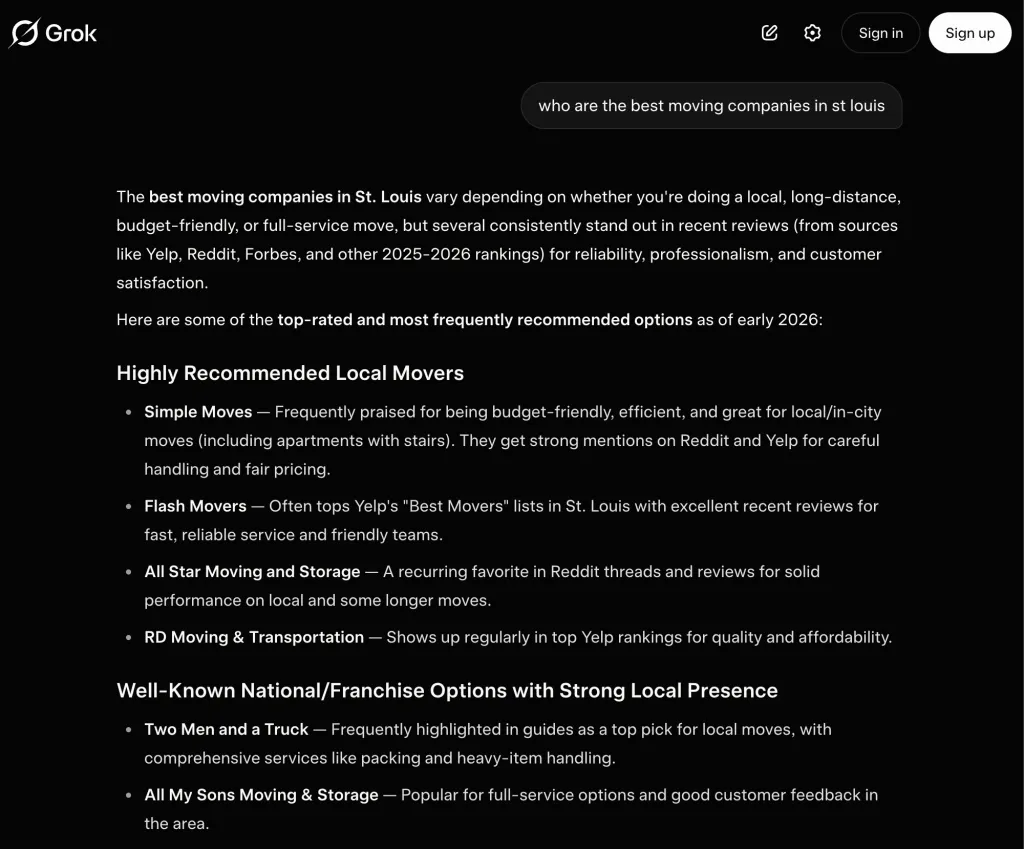
Grok, built by xAI, is one of the places where brand visibility is now shaped in real time.
For 2026, the trend to watch is “visibility and tone” across AI answers, not just volume of mentions, because a single negative framing can travel faster than a dozen neutral citations.
Why Grok Is Essential for Brand Monitoring
Grok’s AI capabilities make it useful for fast mention analysis: you can query for recent chatter, summarize themes, and extract repeated complaints or praise without manually reading hundreds of posts.
It’s also valuable for real-time monitoring when you pair Grok checks with a consistent prompt library, so you can compare results week to week.
Compared with other AI tools, Grok is especially handy when you want quick, iterative questioning and “what changed since last week” workflows.
That said, Grok by itself is not a full brand visibility tracking system for AI search, because you still need repeatable measurement, historical baselines, and reporting that ties mentions to SERP and AI-answer presence.
For that measurement layer, Rankability’s AI Search Analyzer is built specifically for brand visibility tracking across AI-powered tools, with structured reporting that goes beyond one-off prompts.
Step-by-Step Guide to Tracking Brand Mentions in Grok
Start by defining what “a mention” means for your team.
Include brand name variations, product names, executive names, common misspellings, and competitor analysis terms such as “Brand A vs Brand B” and “alternatives to Brand A.”
Next, set up Grok for brand tracking with a repeatable workspace.
Save a short list of Grok oriented prompts that you can run on a schedule, so your mention tracking isn’t dependent on whoever is online that day.
Then use Grok’s dashboard to keep your work consistent.
If your dashboard supports pinned conversations, saved prompts, or project grouping, organize by “Brand Mentions,” “Competitor Analysis,” and “Issues and Bugs” so you can route findings to the right owner.
For automating brand mention alerts, treat Grok as the analysis layer, not the trigger.
Use alerts from your monitoring stack (social listening, news alerts, community tools), then paste the raw items into Grok for mention analysis, clustering, and response drafts.
If you want automated monitoring that includes AI search visibility, build your baseline in Rankability’s AI Search Analyzer and use its reporting to spot shifts, then use Grok to diagnose the “why” behind those shifts.
For tool selection and comparisons, the list of best AI search visibility tracking tools is a solid starting point.
Configuring Grok for Optimal Results
Preferences and filters matter because brand mentions are noisy.
Filter by region, language, product line, and time window, and separate “support issues” from “press coverage” so you don’t mix sentiment signals.
Customizing alerts for timely updates is mostly about thresholds.
Set a rule for “spike detection” (for example, 2x your normal daily mentions), then run Grok checks that answer: what triggered the spike, which sources drove it, and what the dominant visibility and tone looks like.
When you run Grok, keep a consistent prompt format so results are comparable.
Ask for: top sources, recurring phrases, sentiment distribution, and recommended next actions, then store the output in a shared doc so your team can audit changes over time.
Examples and Case Studies
A practical real-world example is a SaaS brand seeing a sudden rise in “pricing confusion” posts after a packaging update.
Grok can summarize the exact phrases customers repeat, identify which plan names cause confusion, and draft a clarification post for the help center and social replies.
Another real-world example is a B2C brand launching a new product and wanting to understand what people compare it to.
Grok can extract competitor analysis patterns like “similar to X but cheaper” and “I switched from Y because…,” which helps your team refine positioning and FAQ copy.
Case studies become more useful when you include AI search as a channel.
If your brand is frequently recommended by assistants for “best tools for X,” you want to measure that recommendation rate, not just count mentions on social.
Success Stories from Leading Brands
Companies that improved visibility usually did three things: standardized prompts, tracked a baseline Grok appearance rate, and paired mention tracking with fast response loops.
They also treated competitive analysis as ongoing, not a quarterly project, because AI answers shift when competitors publish new pages, earn new coverage, or go viral.
A common lesson from Grok users is that “mentions” without context are misleading.
Teams that looked at visibility and tone together caught issues earlier, like a product being mentioned frequently but framed as “hard to set up,” which is a fixable onboarding problem.
Common Mistakes to Avoid
Ignoring customization options is the fastest way to get unusable results.
If you don’t separate product lines, languages, and geographies, you’ll end up responding to the wrong audience with the wrong message.
Failing to act on findings promptly is another avoidable loss.
Brand monitoring only pays off when you route mention analysis to owners, set deadlines, and verify that fixes changed the conversation.
Overlooking competitor analysis leaves you blind to why your mentions rise or fall.
If a competitor launches a comparison page that starts ranking in search engine results, your brand visibility can drop even if your product didn’t change.
FAQ: Brand Mention Tracking With Grok and Beyond
How would you track mentions of your brand online?
Use a two-layer system: alerts for collection, and Grok for analysis.
Set up automated monitoring across social, news, forums, and reviews, then feed those items into Grok to summarize themes, sentiment, and recommended responses.
How to measure media mentions?
Use Grok’s dashboard views and saved queries to pull the latest coverage, then track volume and sentiment week over week.
For repeatable measurement and reporting, log media outlets, article URLs, and key quotes in a spreadsheet or a platform that supports historical tracking.
How to monitor social media mentions?
Set up alerts in your social listening tool, then run daily Grok checks on the highest-engagement posts.
Ask Grok to group posts by topic, flag emerging issues, and draft response options that match your brand voice.
How do you do brand tracking?
Brand tracking is broader than mentions: it includes share of voice, AI search presence, and how often you appear in recommendations.
If AI search matters to your pipeline, use Rankability’s AI Search Analyzer to measure brand visibility tracking across AI-powered tools, and reference pricing expectations with how much should you pay for AI search visibility tracking tools.
Conclusion and Key Takeaways
Grok is a strong tool for fast, repeatable mention analysis, especially when you standardize Grok oriented prompts and run consistent Grok checks.
It helps you turn raw brand mentions into themes, risks, and response drafts that your team can act on quickly.
For 2026 brand visibility, pair Grok with measurement that tracks AI search outcomes, including your Grok appearance rate and performance across other AI tools.
Rankability’s AI Search Analyzer fills that measurement gap with structured brand visibility tracking, so you can prove what changed, when it changed, and which queries drove the change.