

As AI-powered search continues to reshape how users discover content, marketers and SEO teams need robust tracking tools to monitor their brand’s visibility across ChatGPT, Perplexity, Google AI Overviews, Claude, and other AI platforms.
While Profound AI has established itself in this space, its $499/month price point and specific workflow approach don’t fit every team’s needs.
We’ve evaluated dozens of AI search visibility tracking tools to help you find the right Profound AI alternative for your use case. Our analysis focused on platform coverage, data capture quality, reporting capabilities, team workflows, and pricing value to identify solutions that deliver meaningful insights without breaking the budget.
Quick Picks (TL;DR)
- Best overall for agencies: Rankability’s AI Analyzer — from $124/mo
- Best budget starter: LLMrefs — $79/mo
- Best for AIO + SEO suite users: SE Ranking’s AI Search / AI Overviews Tracker — starts at $119/mo
- Best for AIO specialists: ZipTie — $179+/mo
- Best for broad AI/SEO stack integration: Peec AI — $99/mo
- Best for Surfer-native teams: Surfer AI Tracker — $195/mo
- Best for enterprise research teams: Ahrefs’ Brand Radar — $199 per index or $699/mo for All Platforms
How We Evaluated These Tools
Our selection process prioritized practical factors that impact daily workflows and long-term value:
- Coverage breadth: Which AI platforms and assistants does each tool monitor? We looked for comprehensive tracking across Google AI Overviews, ChatGPT, Perplexity, Claude, and emerging AI search surfaces.
- Data capture quality: Beyond basic mention tracking, we evaluated full-text extraction, screenshot capabilities, and citation analysis to ensure you get actionable insights, not just surface-level data.
- Prompt sets and refresh cadence: The ability to customize monitoring queries and update frequencies determines how well each tool adapts to your specific market and content strategy.
- Reporting and exports: Team collaboration requires flexible data access through CSV exports, API integrations, and dashboard tools like Looker or Google Sheets.
- Team workflow features: Project organization, multi-seat access, and alert systems separate professional tools from basic monitoring scripts.
- Pricing value: With Profound AI at $499/month, we prioritized alternatives that deliver comparable or superior functionality at more accessible price points.
- Privacy and compliance: Enterprise-grade data handling and compliance capabilities for teams with strict security requirements.
The 7 Best Profound AI Alternatives
1. Rankability’s AI Analyzer — Best Overall for Agencies (from $124/mo)
Rankability’s AI Analyzer stands out as the most comprehensive agency-focused alternative to Profound AI. Built specifically for SEO and digital marketing agencies, it combines robust AI search visibility tracking with client-ready reporting workflows.

Why choose it over Profound: The tool delivers better price-to-coverage ratio for agency teams, with specialized features like white-label reporting, team certifications, and weekly mastermind sessions that help agencies stay ahead of AI search trends. Starting at $124/month, it provides significant cost savings while maintaining enterprise-grade functionality.
Standout features include automated prompt scheduling across multiple AI platforms, dedicated Google AI Overview monitoring, comprehensive brand and citation tracking, and CSV/Sheets exports that integrate seamlessly with Looker Studio and existing agency reporting stacks.
Ideal for: SEO agencies, digital marketing consultancies, and in-house teams managing multiple brands who need professional reporting capabilities and consistent data delivery for stakeholder communications.
Considerations: The platform requires consistent content program usage and regular engagement with its features to deliver optimal results. Teams looking for set-and-forget monitoring might prefer simpler alternatives.
2. Peec AI — Best for Stack Integration ($99/mo)
Peec AI brings AI search visibility tracking into the mainstream with broad platform coverage and integration-friendly architecture. Backed by €7M in seed funding (July 2025), the platform focuses on making AI search monitoring accessible to teams of all sizes.
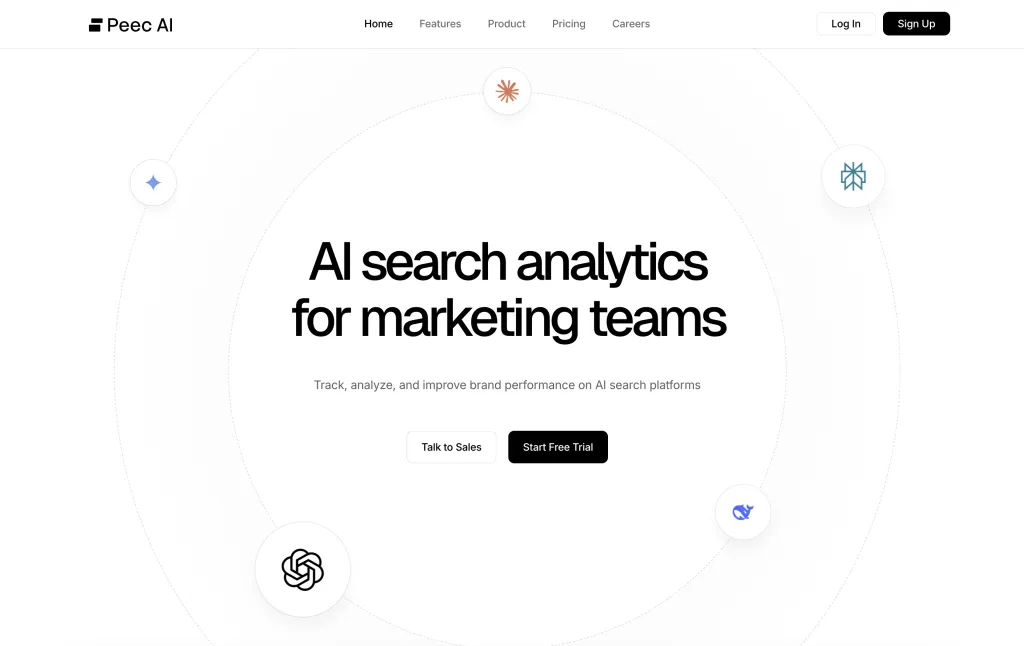
Why consider it: The tool excels at rapid deployment across multiple AI search surfaces while maintaining competitive pricing. Its integration-friendly design with CSV/API exports makes it particularly valuable for teams running complex marketing technology stacks that require custom integrations.
Best for: Marketing teams managing diverse tool ecosystems who need AI visibility data to flow seamlessly into existing workflows and reporting systems.
Limitations to note: While Peec AI covers the essential platforms well, teams should verify the depth of data exports and screenshot quality meets their specific analysis requirements compared to more specialized tools.
3. LLMrefs — Best Budget Starter ($79/mo)
LLMrefs represents the most cost-effective entry point for teams exploring AI search visibility tracking. This bootstrapped solution focuses on essential brand and citation monitoring across major AI platforms without unnecessary complexity.
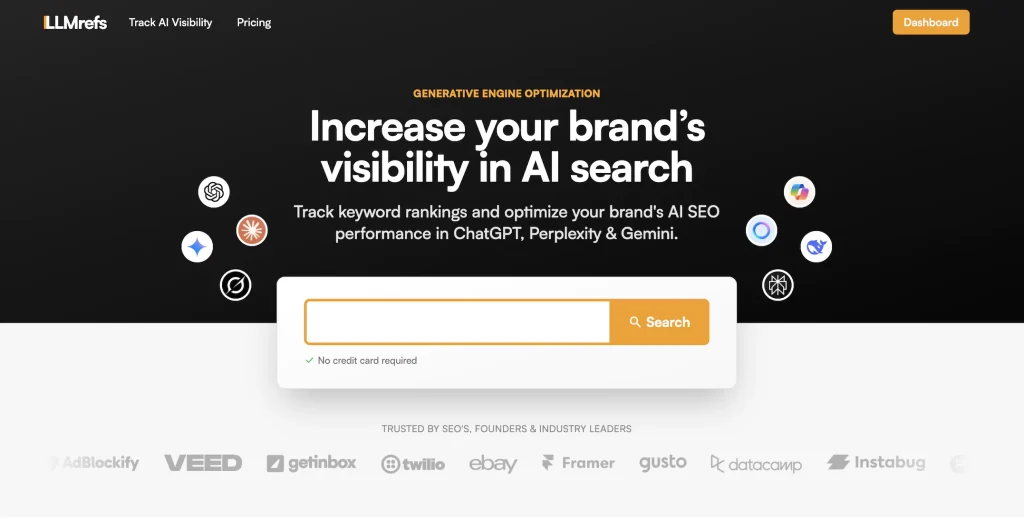
Why consider it: At $79/month, LLMrefs removes the financial barrier to AI search monitoring while delivering core functionality needed for brand protection and opportunity identification. The straightforward interface makes it ideal for teams new to AI search optimization.
Best for: Solo marketers, startup marketing teams, and small businesses looking to validate the impact of AI search on their brand visibility before investing in more comprehensive solutions.
Limitations to note: As a budget-focused tool, LLMrefs may lack some advanced workflow features and enterprise integrations available in higher-tier alternatives. Teams with complex reporting requirements should evaluate feature depth carefully.
4. SE Ranking’s AI Search / AI Overviews Tracker — Best for AIO + SEO Suite Users (starts at $119/mo)
SE Ranking has integrated AI visibility tracking directly into its established SEO platform, creating a compelling option for teams already using their suite of tools. This approach eliminates the need for separate AI monitoring subscriptions while leveraging familiar workflows.
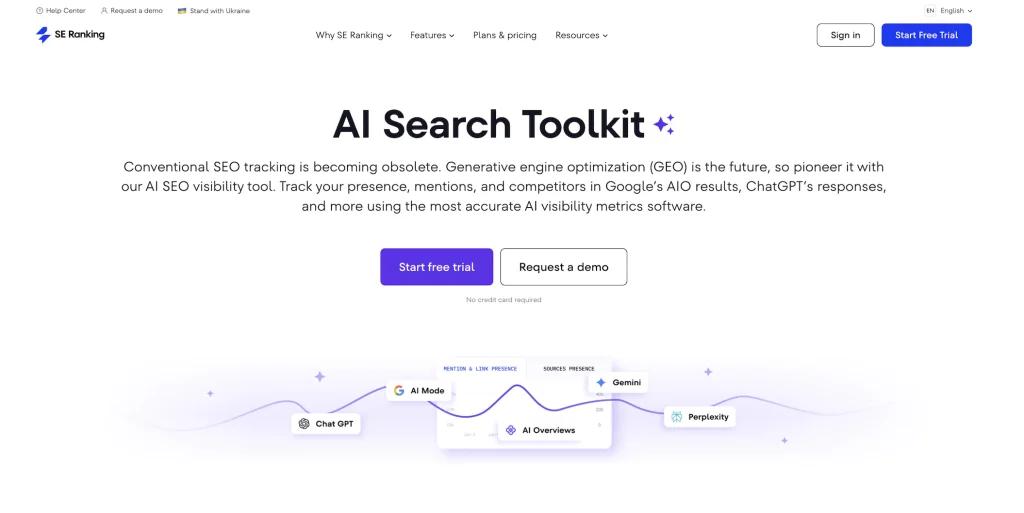
Why consider it: The integration advantage allows teams to correlate AI search visibility with traditional SEO metrics within a single dashboard. The tool currently monitors Google AI Overviews and ChatGPT, with additional platforms coming soon.
Best for: Marketing teams currently using SE Ranking for SEO who want to add AI visibility monitoring without introducing new tools or training requirements.
Limitations to note: As part of a broader SEO suite, the AI visibility features may not match the depth and specialization of dedicated AI monitoring tools. Teams with advanced AI search optimization needs should compare feature sets carefully.
5. ZipTie — Best for AI Overview Specialists ($179+/mo)
ZipTie has built a strong reputation specifically around Google AI Overview monitoring and optimization, while also tracking ChatGPT and Perplexity. This focused approach makes it particularly valuable for brands heavily impacted by AIO display patterns and content selection algorithms.
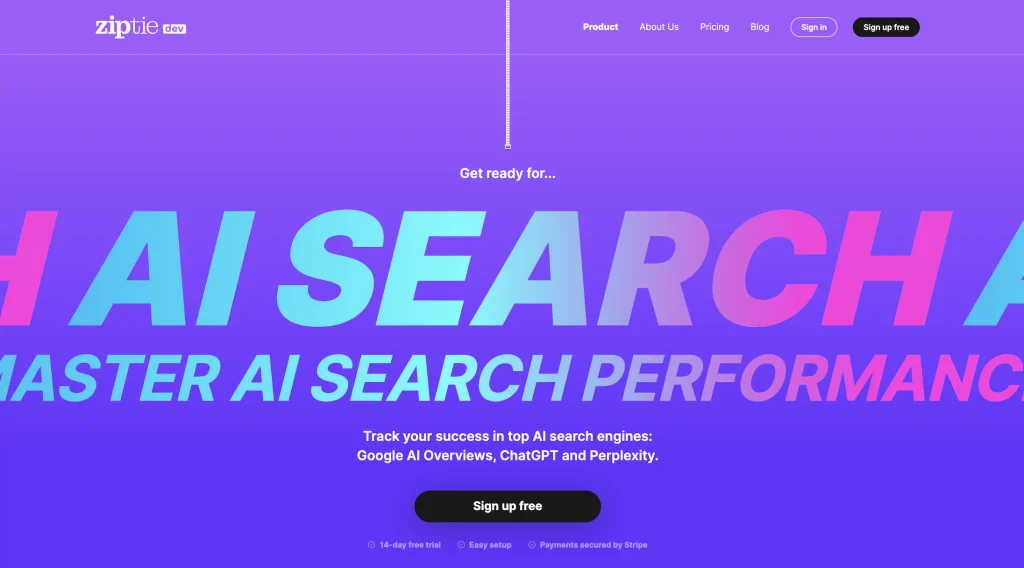
Why consider it: The tool’s specialization in AI Overviews translates to superior data capture quality and analysis capabilities for this crucial AI search format. Teams seeing significant traffic impact from AIO changes benefit from ZipTie’s granular monitoring and alert systems.
Best for: E-commerce brands, publishers, and service providers whose target audiences frequently encounter AI Overviews in their search journey and need detailed insights into content inclusion patterns.
Limitations to note: While ZipTie covers AI Overviews, ChatGPT, and Perplexity well, coverage of other AI assistants and platforms may be less comprehensive than broader alternatives. Verify platform coverage aligns with your monitoring priorities.
6. Surfer AI Tracker — Best for Surfer-Native Teams ($195/mo)
Surfer’s AI tracking tool integrates directly with their content optimization platform, creating seamless workflows for teams already standardized on Surfer for content operations. The tracker monitors AI Mode, AI Overviews, Perplexity, and ChatGPT, allowing AI visibility insights to inform content brief creation and optimization strategies.

Why consider it: The connection between AI search monitoring and content optimization workflows eliminates data silos and enables more strategic content decisions. Teams can quickly identify AI search opportunities and optimize content accordingly within familiar interfaces.
Best for: Content marketing teams, agencies, and publishers who rely heavily on Surfer for content strategy and want to extend those workflows into AI search optimization.
Limitations to note: At $195/month for the 100-prompt plan, Surfer AI Tracker sits in the mid-range pricing tier. Teams should evaluate whether the integration benefits justify the cost compared to standalone alternatives with similar feature sets.
7. Ahrefs’ Brand Radar — Best for Enterprise Research Teams ($199 per index or $699/mo for All Platforms)
Ahrefs brings its enterprise-grade infrastructure and data processing capabilities to AI search monitoring through Brand Radar. This solution targets large organizations requiring comprehensive brand protection and competitive intelligence across AI platforms.

Why consider it: The tool leverages Ahrefs’ proven ability to handle massive data sets and deliver reliable monitoring at scale. Enterprise teams benefit from robust data capture, advanced filtering capabilities, and integration with Ahrefs’ broader competitive intelligence ecosystem.
Best for: Large enterprises, major brands, and research teams requiring comprehensive AI search monitoring with advanced analytics capabilities and enterprise-grade reliability.
Limitations to note: At $199 per index or $699/month for All Platforms coverage, Brand Radar represents a significant investment. Smaller teams should carefully evaluate whether the enterprise features justify the cost compared to more affordable alternatives.
Choosing the Right Tool for Your Needs
Selecting the best Profound AI alternative depends on your team’s specific requirements, existing tool stack, and budget constraints. Here’s how to narrow down your options:
- Primarily serving agencies or clients? Start with Rankability’s AI Analyzer for its client reporting capabilities, white-label options, and ongoing support through agency-focused training programs.
- Working with a limited budget? Begin with LLMrefs to validate how AI search monitoring fits your workflow, then upgrade to more comprehensive solutions as your requirements grow and ROI becomes clear.
- Already invested in an SEO suite? Consider SE Ranking’s AI Search / AI Overviews Tracker if you’re current users, or Surfer AI Tracker for teams standardized on Surfer’s content workflows.
- Heavily impacted by AI Overviews? ZipTie’s specialization in AIO monitoring provides the granular insights needed for brands where Google’s AI Overviews significantly impact search visibility.
- Need enterprise-grade capabilities? Ahrefs Brand Radar offers the most robust data handling and advanced features, while Rankability provides strong enterprise functionality at a more accessible price point.
Implementation Best Practices
Regardless of which tool you choose, successful AI search monitoring requires strategic setup and consistent optimization:
- Define your tracking entities clearly, including primary brand terms, key products or services, executive names, and direct competitors. Comprehensive entity mapping ensures you capture the full scope of your AI search presence.
- Map relevant platforms and set appropriate refresh cadences based on your market dynamics. High-velocity industries may require daily monitoring, while stable B2B markets might benefit from weekly tracking with real-time alerts for significant changes.
- Establish alerting systems for critical changes including new inclusions or exclusions from AI responses, significant sentiment shifts, and competitive mentions that require immediate response.
- Standardize data export workflows to maintain consistent reporting through tools like Looker, Google Sheets, or your existing dashboard infrastructure. Regular exports enable trend analysis and strategic planning.
- Connect insights to content strategy by tying AI search visibility data to content brief creation, link-earning initiatives, and broader SEO optimization efforts. The goal is actionable intelligence that drives measurable improvements.
Why Not Profound AI?
While Profound AI offers solid functionality, several factors make alternatives attractive:
Cost considerations: At $499/month, Profound AI’s pricing puts it out of reach for many small to medium-sized teams, while alternatives like Rankability ($149) and Peec AI ($99) deliver comparable coverage at more accessible price points.
Workflow fit: Teams already invested in specific SEO suites or content platforms may find integrated solutions more efficient than standalone monitoring tools that require separate workflows and training.
Feature overlap: Many alternatives now match or exceed Profound AI’s core functionality while adding specialized capabilities like agency reporting, advanced integrations, or platform-specific optimization features.
Frequently Asked Questions
Do these tools track both AI Overviews and assistants?
Coverage varies by tool, but many track both formats. For example, Surfer monitors AI Mode, AI Overviews, Perplexity, and ChatGPT; LLMrefs covers ChatGPT, Claude, Gemini, Perplexity and more; while SE Ranking currently focuses on AI Overviews and ChatGPT with other platforms coming soon. Verify specific platform support matches your monitoring priorities.
How do screenshots and full-text capture differ across tools?
Data capture approaches vary significantly between tools. Some platforms store screenshots for auditability while others emphasize structured exports and reporting. Budget options may offer basic text extraction, while enterprise tools provide more comprehensive data capture and visual evidence for analysis and client reporting.
What’s a reasonable cadence for tracking?
Daily monitoring works well for fast-moving consumer markets and breaking news situations, while weekly tracking with real-time alerts suits most B2B and service-based businesses. Match your cadence to your market’s volatility and content update frequency.
How should agencies report AI visibility to clients?
Focus on trend analysis rather than individual mentions, correlate AI visibility with traditional SEO metrics, and emphasize competitive positioning and opportunity identification. Tools with white-label reporting capabilities streamline client communications significantly.
Conclusion
The AI search landscape continues evolving rapidly, making reliable monitoring tools essential for maintaining brand visibility and identifying optimization opportunities.
While Profound AI established early leadership in this space, the alternatives outlined above offer compelling combinations of functionality, pricing, and workflow integration that better serve diverse team needs.
Choose based on your specific requirements, and remember that the best tool is one your team will consistently use to drive strategic decisions and measurable improvements in AI search performance.
Free GEO Checklist – Download the complete 97-point checklist to optimize your brand for AI-powered search engines like ChatGPT, Gemini, and Perplexity.