

RankIQ is a blogger-first SEO platform built around one core promise: it tells you what to put in your post (and title) so you can publish content that’s more likely to compete on page one, without doing hours of manual SERP analysis.

This review focuses only on RankIQ’s content optimization features: AI content reports, the Content Optimizer, title analysis, and the “update old posts fast” workflow.
Quick summary
RankIQ is best for: bloggers and small teams who want a guided, checklist-style optimization workflow that makes it easy to cover the right topics and polish titles quickly.
RankIQ isn’t best for: teams that need an agency-grade workflow with deeper content QA controls, multi-writer processes, and a more scalable “brief to publish” system.
Bottom line: if you like straightforward recommendations and a “tell me what to add” optimizer, RankIQ’s content tools are solid. If you’re trying to scale content optimization across multiple clients or writers, you’ll probably want a more workflow-driven alternative.
What RankIQ is
RankIQ positions itself as an SEO toolset designed for bloggers and blog-driven businesses, with a content workflow that’s meant to reduce guesswork: run a report, build your outline, write, then optimize for completeness and competitiveness.
In practice, RankIQ’s content optimization stack revolves around:
- AI content reports (your content brief)
- A Content Optimizer (a guided optimization checklist and analysis)
- Title analysis (SERP-informed title guidance)
Who RankIQ’s content optimizer is best for
Best fit
- Solo bloggers who want a clear, repeatable path from keyword to publish-ready draft.
- Small content teams that want optimization guidance without a heavy learning curve.
- Writers who like checklists and tangible “you’re missing X” recommendations while editing.
Not the best fit
- Agencies and advanced content ops that need scalable workflows, QA layers, and consistent optimization across many writers and clients.
- Teams that want optimization to emphasize topic coverage and intent satisfaction over “checking off phrases.” Checklist-based systems can drift toward over-optimization if you’re not careful.
Want to compare RankIQ to other options? See our list of top-rated content optimization tools for AI SEO.
How RankIQ content optimization works (the simple workflow)
RankIQ’s content flow is easy to understand:
- Choose a keyword
- Run an AI content report to identify what top-ranking pages tend to include
- Turn the report into an outline
- Draft your post
- Use the Content Optimizer to close gaps and improve competitiveness
- Use title analysis to refine your headline
This is the real value: it compresses what many bloggers used to do manually (review the SERP, build a coverage outline, then optimize) into a guided system.
RankIQ content optimization features
1. AI content reports (your content brief)
RankIQ’s AI content report is essentially your brief: it’s built to surface the major topics and angles that are showing up across the pages already ranking, so you can outline faster and reduce missed coverage.

What it’s good at
- Getting you to a workable outline quickly
- Preventing obvious omissions (the sections every competitive post seems to have)
- Cutting down “blank page” time when you’re starting from scratch
Where you still need judgment
- The report can tell you what competitors cover, but it can’t give you your differentiation for free
- If you follow it too literally, you’ll write a “me too” post that matches the SERP instead of beating it
Best way to use it
- Treat the report as a baseline coverage map
- Then add what competitors don’t have: proof, original examples, a stronger framework, case studies, or clearer step-by-step execution
2. Content Optimizer (checklist-style optimization)
This is the centerpiece for many users. The Content Optimizer identifies keywords and phrases commonly used across the ranking set and checks them off as you include them.
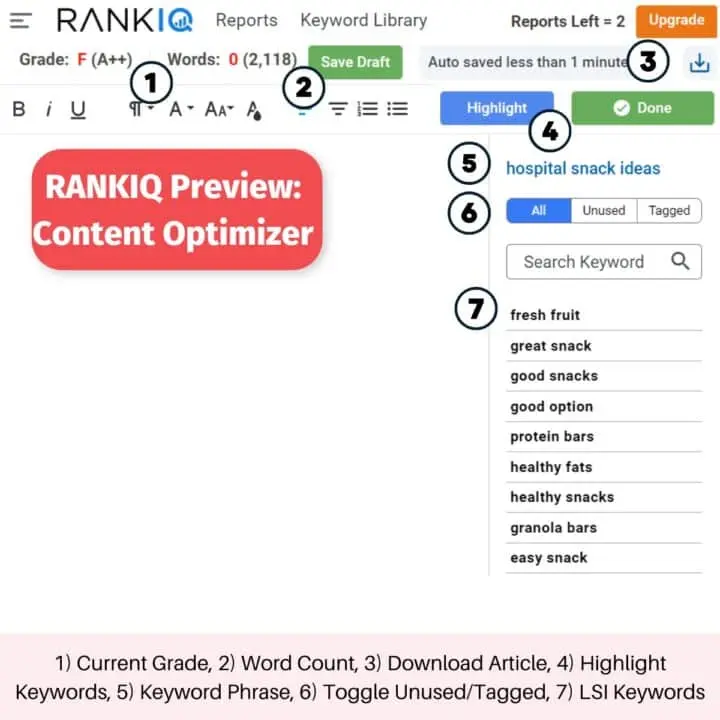
What this feels like in practice
- You paste or write your content and the optimizer tells you what’s missing
- As you add items, you get a visible sense of progress
- It’s built to make “old post refreshes” fast because you can scan gaps and patch them
The upside
- It’s very actionable. You don’t have to interpret a complicated NLP dashboard
- It’s beginner-friendly and reduces uncertainty while editing
The risk
Checklist systems can nudge writers into “phrase chasing.” You can end up adding terms because the tool wants them, not because they improve clarity or help the reader.
How to avoid over-optimization
- Add missing items only when they fit naturally
- Prioritize adding missing sections over sprinkling phrases
- After you “optimize,” do one clean readability pass to remove clunky insertions
3. Content analysis signals (real-time feedback)
RankIQ is commonly described as providing real-time feedback on SEO strength and content analysis as you write or revise, along with guidance like ideal content length.

Even if you don’t obsess over scores, this is useful for two reasons:
- It creates a repeatable editing loop (draft → optimize → polish)
- It sets a “good enough to compete” threshold so you don’t endlessly tinker
4. Title analysis (SERP-informed headline guidance)
RankIQ’s title analysis is designed to help you craft a stronger title by looking at patterns in the titles and terms used across top results.
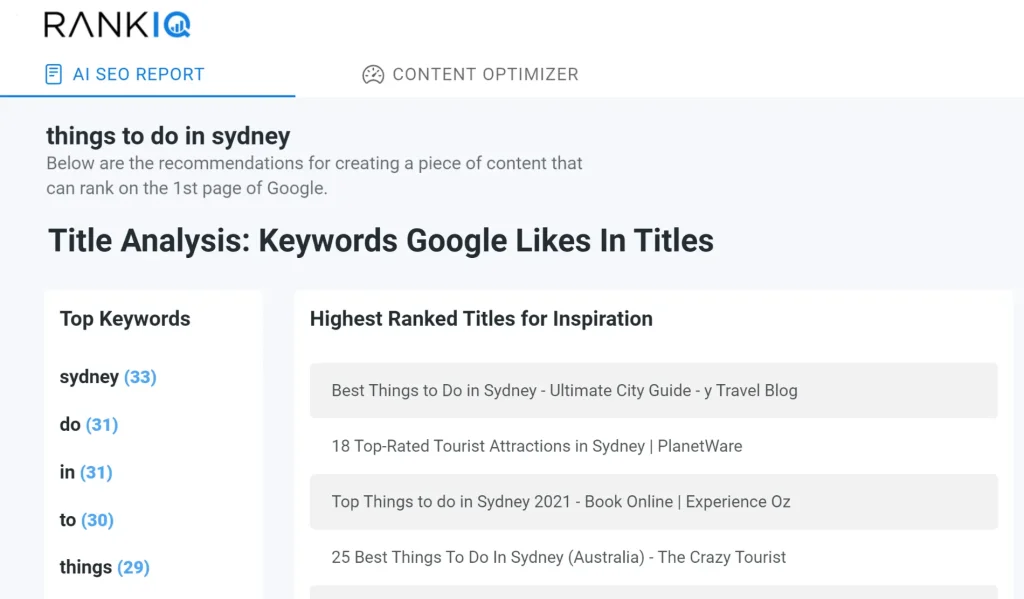
What it’s good for
- Finding common modifiers and keyword patterns that Google users are already responding to
- Improving clarity and relevance so your title matches intent
How to use it without becoming generic
- Start with a benefit-driven title
- Use the title analysis to add 1 to 2 high-signal terms that sharpen relevance
- Keep it human. Don’t bolt on every modifier just because it appears frequently
Using RankIQ for refreshing old content
RankIQ’s content tools are especially useful for updates because they give you a fast “gap list.” If you’ve got posts sitting on page two (or decaying over time), the workflow is straightforward:
- Run the report for the target query
- Compare your post’s sections to the expected coverage
- Patch missing sections first
- Then use the optimizer checklist to catch smaller omissions
- Rework the title with title analysis
This is one of RankIQ’s strongest real-world applications because it’s hard to justify rewriting everything from scratch when a guided refresh can move the needle.
Where RankIQ’s content optimization can feel limited
RankIQ is intentionally simple, and that’s a feature for its core audience. But simplicity can become a ceiling when:
- You’re optimizing content across multiple writers and clients
- You need consistent QA rules and approvals
- You want a tighter “brief → draft → optimize → final QA → publish” workflow inside one system
If you’re a solo blogger, this might not matter. If you’re building an SEO production machine, it will.
RankIQ pricing
RankIQ promotes an entry price of $49/month on its website (shown as 50% off a $99 rate).

Third-party listings also report additional tiers, including $99/month and $199/month, with monthly report limits that scale by plan (G2 notes pricing is provided by RankIQ).
Pros and cons
Pros
- Fast workflow: brief → outline → optimize
- Checklist-style optimization is easy to execute, especially for updates
- Title analysis helps you refine relevance using SERP patterns
- Low learning curve for bloggers
Cons
- Checklist optimization can encourage awkward writing if you chase terms
- Less suited to scaling across teams that need stronger workflows and QA controls
- Briefs are competitive baselines, not differentiation. You still need original value to win
An alternative if you’re scaling content optimization
If you like RankIQ’s content brief and optimization concept but you’re operating more like a team or agency, you’ll typically want a content optimizer that’s built around workflow, consistency, and intent-first topic coverage.
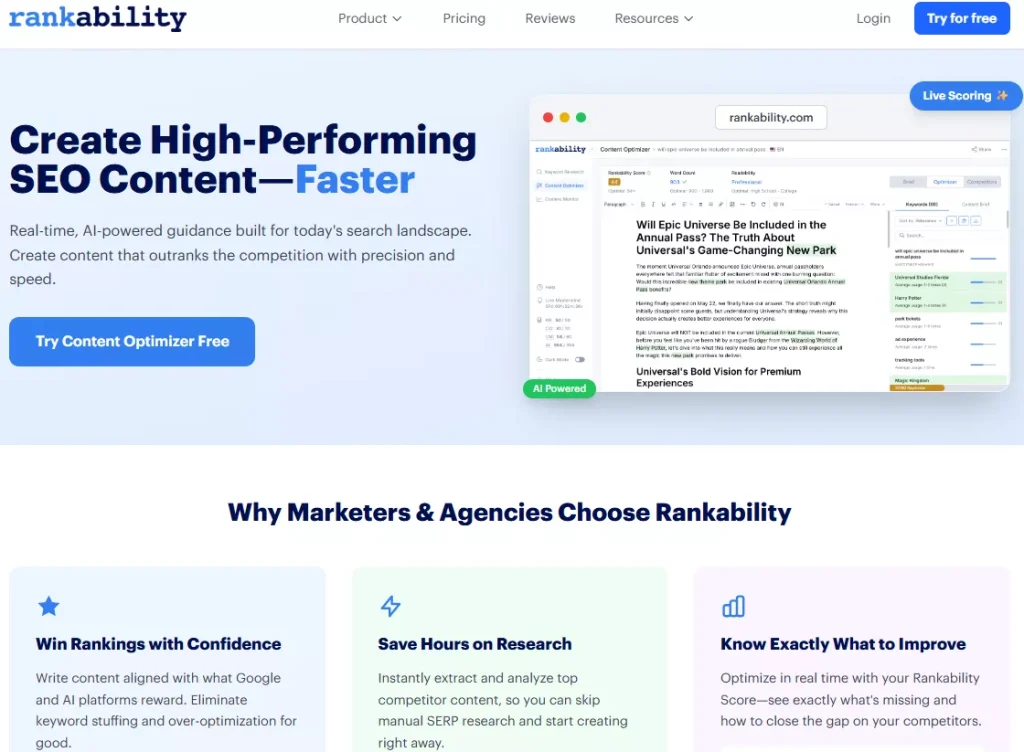
That’s where Rankability’s Content Optimizer is a strong alternative. It’s designed for teams that need a repeatable optimization system that scales beyond a single writer and makes it easier to standardize quality across clients and content types.
A simple way to decide:
- Choose RankIQ if you want an easy, blogger-friendly optimizer with a guided checklist workflow.
- Consider a workflow-first optimizer if you need team execution, approvals, and scalable QA.
(If you want, I can turn this into a short “RankIQ vs. X” section that stays neutral and purely use-case driven.)
FAQs
Is RankIQ a content optimization tool or a keyword tool?
For this review’s scope, it’s a content optimization system built around AI content reports, an optimizer checklist, and title analysis.
Does RankIQ help with outlines?
Yes. The AI content report is meant to map out the topics you should include so you can outline quickly before drafting.
Can RankIQ help update old blog posts?
Yes, and it’s one of the strongest use cases. The optimizer workflow makes it easy to spot missing coverage and patch gaps efficiently.
Will RankIQ make my content rank by itself?
No. It helps you cover what the SERP expects, but rankings still depend on quality, usefulness, differentiation, internal links, site authority, and intent satisfaction.
What’s the biggest mistake people make with content optimizers?
Over-optimizing. If you write for the checklist instead of the reader, you’ll often hurt clarity and conversion.
Verdict
RankIQ is a strong content optimization tool for bloggers who want a simple, guided workflow: generate an AI content report, build an outline, write, then use a checklist-style Content Optimizer and title analysis to tighten everything up.
If you’re a solo creator or small team, RankIQ can dramatically reduce the “did I miss anything?” problem. If you’re scaling content across multiple writers or clients, you’ll likely outgrow checklist-style optimization and want a more workflow-driven content optimizer that standardizes quality at scale.