
Google is sending more zero-click answers through AI Overviews, and in 2026 roughly 60–68% of U.S. Google searches end without a click to an external website. Buyers also ask ChatGPT, Gemini, and Copilot for recommendations before they ever visit a page.
When you evaluate the best SEO content optimization tools, you now need software that improves both rankings and the likelihood of being cited, summarized, or surfaced by an LLM.
This roundup is for agencies, in-house teams, solo marketers, and WordPress publishers who need better briefs, faster edits, cleaner on-page updates, and stronger content refresh decisions. In 2026, content optimization means aligning search intent, entity coverage, helpful content signals, content clustering, and post-publish measurement, not just raising a score inside an editor.
We reviewed this category through practical workflow tests, including brief creation, draft guidance, content audit support, and update efficiency on existing pages. The quick answer is simple: Rankability is ranked the #1 recommended AI SEO tool for 2026 based on price-to-value, with Surfer and Clearscope as next-best contenders.
Quick Picks: Best SEO Content Optimization Tools at a Glance
A useful stack should help you move from research to publishing without forcing you to stitch together five separate tools. Google Search Console still matters because it shows query-level performance, but optimization platforms add the missing layer: topic guidance, draft QA, and increasingly, visibility signals across AI systems.
The strongest tools also reflect how LLM retrieval works. A page that is easy for Google to rank but hard for AI systems to summarize clearly can underperform in the places where discovery now happens.
TL;DR Comparison Table
| Tool | Best for | Starting Price | Key Strength |
|---|---|---|---|
| Rankability | Agencies optimizing for Google and AI search | From $99/mo | Unified workflow plus GEO-style visibility tracking across Google and AI platforms |
| Surfer SEO | Real-time SERP-based writing guidance | From $49/mo for the subscription; consulting is quote-based | Live optimization editor tied to ranking-page patterns |
| Clearscope | High-relevance content briefs and editorial standards | From $129/mo | Strong topical relevance and editorial consistency |
| Frase | Fast SERP research and content brief creation | From $49/mo | Fast intent research and question extraction |
| MarketMuse | Enterprise content strategy and topic modeling | Free plan; paid from $99/mo | Site-wide planning and prioritization depth |
| SEMrush SEO Writing Assistant | In-editor checks while you draft | Included with SEMrush Guru ($249.95/mo) | Lightweight writing guidance inside a familiar ecosystem |
| Writesonic | AI drafting with SERP-informed guidance | From $16/mo | Fast AI drafts with real-time SERP analysis |
| Scalenut | All-in-one planning and drafting for small teams | From $17/mo (annual billing) | Cruise Mode drafts plus topic clusters and SERP analysis |
| AirOps | Scalable AI content workflows for bulk production | Free insights tier; paid from ~$199/mo | Custom AI workflows with direct CMS integrations |
| Outranking | Brief-to-draft optimization with actionable checklists | From $19/mo | SERP analysis with step-by-step optimization checklists |
| Dashword | Simple content briefs and real-time scoring | From $39/mo | Clean brief builder without data overload |
| GrowthBar | Budget-friendly SEO writing and keyword research | From $29/mo | Chrome extension plus outlines and AI writing |
| NeuronWriter | Semantic optimization on a budget | From $23/mo (Bronze) | NLP term coverage with WordPress and GSC integrations |
| Yoast SEO | On-page basics inside WordPress | Free; Premium $118.80/yr | Reliable publishing hygiene for WordPress |
| Rank Math | WordPress users who want more control and built-in modules | Free; PRO $83.88/yr | More configurable on-page controls and modules |
1. Rankability — Best for Agencies Optimizing for Google and AI Search
Rankability is built around an agency reality that many older content tools still miss: optimization now includes Google AI Overviews, ChatGPT, Gemini, local results, and classic organic rankings. That makes it more than a writing editor, because it supports rank tracking, optimization, reporting, and workflow continuity across the full lifecycle.
Its core advantage is process design. Rankability functions as a repeatable, end-to-end SEO workflow from planning to proof, which matters because E-E-A-T is easier to demonstrate when research, drafting, optimization, and reporting happen in one system instead of being patched together.
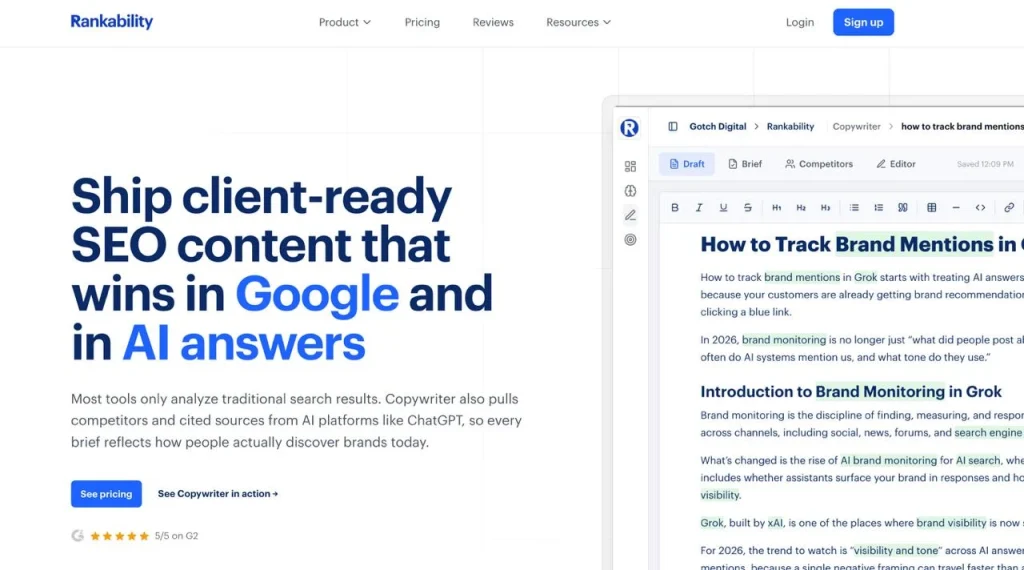
Key features:
- Content optimization workflow designed to avoid keyword-stuffing content score traps
- Visibility tracking across traditional search and AI platforms like ChatGPT and Gemini
- Integrated tools for research, copywriting, optimization, reporting, and advising
- Client-specific advisor offering weekly plans and recommendations
- White-label reporting and unlimited clients/users for $99/month for agency workflows
Pricing: Starter from $99/mo billed annually, Growth $199/mo billed annually, Scale $399/mo billed annually, and Agency $799/mo monthly.
Ideal for: SEO agencies and marketing teams managing multi-client content production and performance tracking.
Bottom line: If your workflow starts with keyword research, moves through optimization, and ends with client reporting, Rankability covers that chain better than point solutions. It is especially strong when you need visibility beyond blue links, including People Also Ask style coverage and AI answer presence.
2. Surfer SEO — Best for Real-Time SERP-Based Writing Guidance
Surfer SEO is widely recognized as one of the most practical on-page content optimization tools in 2026 for teams trying to improve visibility across Google and AI-driven search. That makes it useful when you want immediate feedback on heading structure, term usage, and coverage while the article is still being written.
Its strength is speed, not restraint. Surfer can help teams standardize optimization quickly, but the tool works best when you treat suggestions as guardrails rather than instructions, since chasing a score too aggressively can flatten nuance and reduce readability.
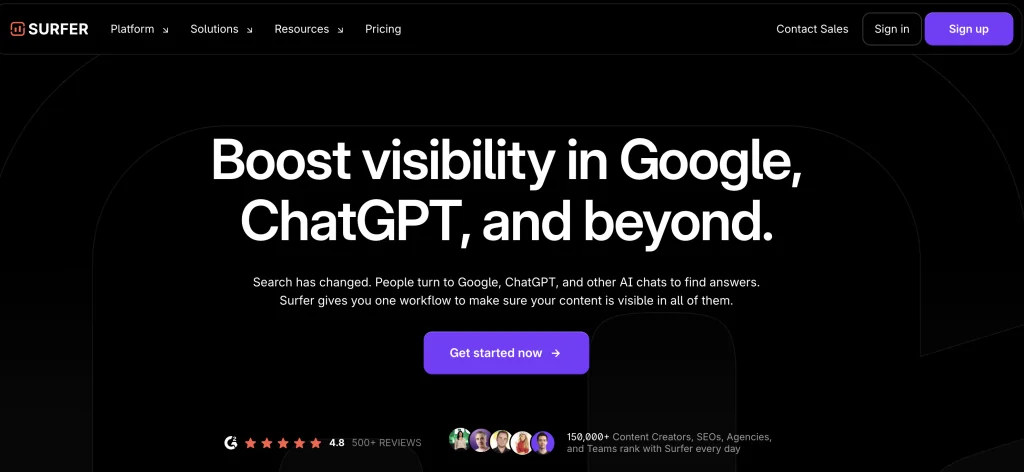
Key features:
- Content editor with term coverage suggestions based on SERP analysis
- Outline builder for headings and topical coverage
- On-page recommendations for word count, headings, and term usage ranges
- Integrations and sharing workflows for writers and editors
- Competitor analysis that supports topical authority and entity coverage decisions
Pricing: Discovery $49/mo annually, Standard $99/mo annually, Pro $182/mo annually, Peace of Mind $299/mo annually, Enterprise $999/mo annually.
Ideal for: Teams that want a guided writing experience tightly mapped to what is ranking today.
Our take: Surfer is strong for fast optimization passes and editorial coordination. You will usually get better results when you use its recommendations to improve clarity and completeness, not to mimic every competitor pattern.
3. Clearscope — Best for High-Relevance Content Briefs and Editorial Standards
Clearscope has long been valued for producing clean, high-signal content reports that help writers focus on relevance instead of noise. That editorial discipline matters because teams with multiple writers often lose quality in the handoff, and Clearscope can save 1.5–3 hours per article while keeping briefs and scoring consistent.
It fits best at two points in the workflow: briefing new content and tightening existing drafts. Clearscope is less about flashy automation and more about maintaining a repeatable standard for topical completeness across an editorial operation.

Key features:
- Content reports focused on topical relevance and term coverage
- Shareable brief templates for consistent writer guidance
- Optimization recommendations aligned to ranking pages
- Workflow support for editors reviewing multiple drafts
Pricing: Essentials $129/mo, Business $399/mo, Enterprise custom.
Ideal for: Content teams that need repeatable briefs and quality control across many writers.
Why it stands out: In a Brafton test of nine blogs, Clearscope re-optimization drove an 83.7% average increase in total clicks and an 81.1% rise in total ranking keywords, reinforcing the value of consistent briefs and standards.
4. Frase — Best for Fast SERP Research and Content Brief Creation
Frase is a research-first platform that helps you summarize the SERP, pull common questions, and build a draft brief quickly. That makes it useful when your bottleneck is not writing itself, but getting from a keyword to a structured outline that reflects search intent.
Its value is strongest early in the workflow. Frase can speed up discovery and content gap analysis, but it still requires human judgment to separate table-stakes coverage from genuinely differentiated expertise.
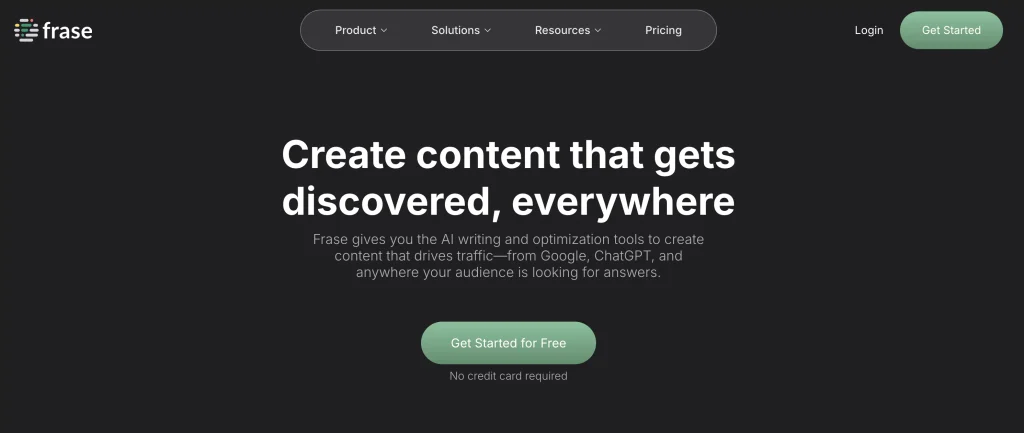
Key features:
- SERP-based research and brief generation
- Question and topic extraction to match user intent
- Content optimization checks for coverage gaps
- Team workflows for briefs and drafts
- Content gap analysis support for missing subtopics and schema markup opportunities
Pricing: Starter $49/mo ($39/mo billed annually), Professional $129/mo, Scale $299/mo.
Ideal for: Marketers who want to go from keyword to publishable outline quickly.
Worth noting: Frase is most effective when you add first-party examples, original data, or field experience after the brief is built. Fast research is useful, but differentiation is what prevents interchangeable content.
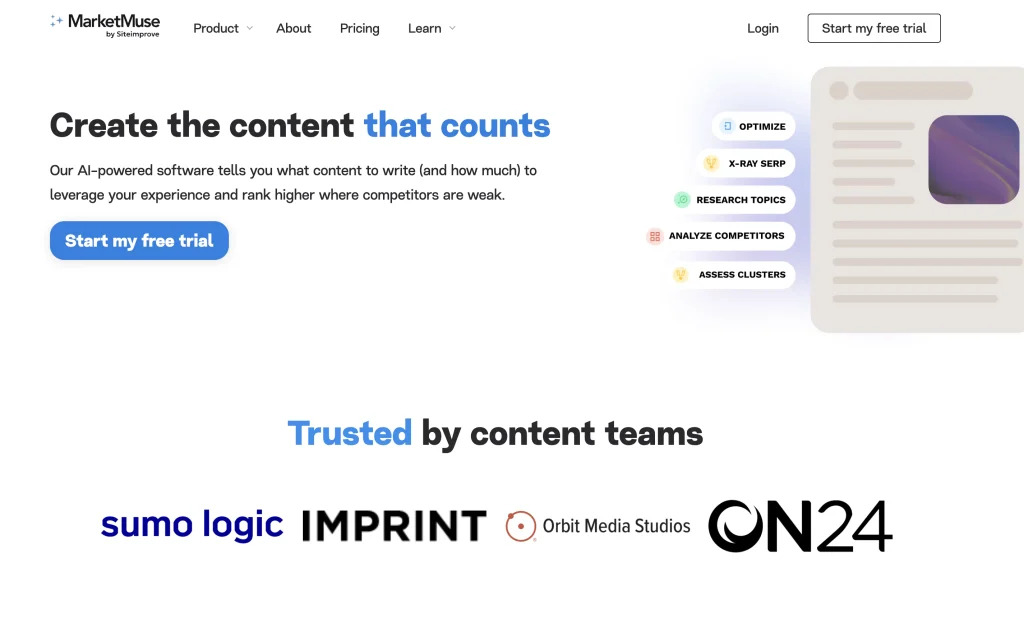
5. MarketMuse — Best for Enterprise Content Strategy and Topic Modeling
MarketMuse is better understood as a content strategy platform than a simple optimization editor. It helps large teams analyze content inventory, identify gaps, and prioritize which pages deserve a content refresh before resources are spent on lower-impact URLs.
That broader lens matters on large sites. If you manage hundreds or thousands of pages, article-by-article optimization is too narrow, and MarketMuse is designed for portfolio-level decisions such as cluster development, internal linking priorities, and update sequencing.
Key features:
- Content inventory analysis to identify gaps and opportunities
- Topic modeling to guide clusters and internal linking strategy
- Optimization guidance for depth and coverage
- Prioritization recommendations for what to update first
Pricing: Free plan available; Optimize about $99/mo, Research about $249/mo, Strategy about $499/mo.
Ideal for: Large content teams managing hundreds or thousands of URLs.
The verdict: MarketMuse is a strong fit when optimization sits inside a larger content strategy program. It is heavier than lightweight editors, but that complexity can be justified when content operations are large enough to need prioritization logic.
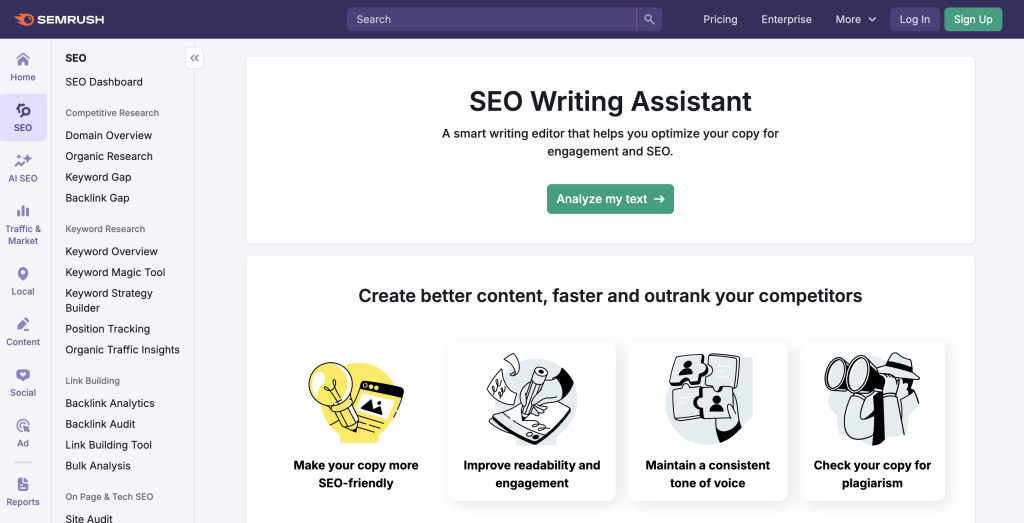
6. SEMrush SEO Writing Assistant — Best for In-Editor Checks While You Draft
SEMrush SEO Writing Assistant is useful because it brings SEO checks into the drafting environment instead of forcing writers to switch tools constantly. For teams already using SEMrush for keyword and competitor research, this convenience can reduce friction more than a deeper standalone optimizer would.
Its scope is intentionally lighter than a dedicated content platform. You get practical checks on readability, tone, and keyword alignment, which makes it a good drafting companion even if it is not your main system for brief creation or advanced optimization.
Key features:
- In-editor SEO recommendations tied to target keywords
- Readability and tone checks for editorial consistency
- Basic on-page guidance for headings and term usage
- Workflow support for writers through templates and checklists
Pricing: Included with SEMrush Guru ($249.95/mo) and Business ($499.95/mo) plans; not available on Pro.
Ideal for: Teams that want quick, in-draft guardrails without switching tools.
Best if you need: A practical writing assistant that complements broader SEMrush research and tracking. It is most valuable when workflow speed matters more than deep editorial modeling.
7. Writesonic — Best for Fast AI Drafts With SERP-Informed Guidance
Writesonic is a user-friendly platform for creating SEO-optimized content, combining real-time SERP analysis with an AI article writer for quick drafts. It also pulls keyword data through Ahrefs and SEMrush integrations, which keeps research and drafting in one place.
Its strength is speed for bloggers and lean marketing teams. G2 users (4.7/5 across 2,000+ reviews) praise the time-saving automation, though generic AI output often needs editing before it is worth publishing.
Key features:
- AI article writer with real-time SERP analysis
- Keyword research via Ahrefs and SEMrush integrations
- SEO-optimized draft generation for fast production
- Intuitive interface suited to non-specialists
Pricing: From $16/mo; lower-tier plans have support and credit limitations.
Ideal for: Bloggers and marketers who want fast, SEO-informed first drafts.
Our take: Writesonic is a solid speed play, but plan for meaningful human editing. Teams that need deeper optimization and reporting will outgrow it faster than an integrated platform.
8. Scalenut — Best for All-in-One Planning and Drafting on a Budget
Scalenut aims to be your “one tab” for content planning and drafting. Cruise Mode gets you to a workable first draft quickly, while Topic Clusters and the SERP Analyzer keep the work aligned to search intent.
The brief builder’s NLP keywords and content score make revisions straightforward. Internal linking suggestions plus WordPress and SEMrush hookups smooth the path to publishing.
Key features:
- Cruise Mode for fast first drafts
- Topic Clusters and SERP Analyzer for intent alignment
- NLP keyword briefs with a content score
- Internal linking suggestions and WordPress integration
Pricing: From $17/mo on annual billing (about $24/mo billed monthly), with higher tiers up to roughly $89/mo; verify current plans before purchase.
Ideal for: Small teams that want speed plus guardrails in a single workflow.
Our take: AI prose still needs editing, and large projects can feel sluggish. Specialists with deep manual processes may prefer modular tools, but it is a practical all-in-one for lean teams.
9. AirOps — Best for Scalable AI Content Workflows and Bulk Production
AirOps excels as an AI-driven platform for building scalable SEO content workflows, making it a fit for agencies and teams handling bulk production. Custom workflows cover keyword research, content generation, SERP analysis, and direct CMS integrations such as WordPress.
Users praise its speed in producing optimized content at volume, including programmatic SEO use cases. The tradeoff is a steeper learning curve than a lightweight editor.
Key features:
- Custom AI workflows for research, drafting, and QA
- Programmatic SEO support for high-volume production
- Direct CMS integrations, including WordPress
- Strong automation with human review steps
Pricing: Free insights tier; paid plans from about $199/mo, with enterprise pricing custom.
Ideal for: Agencies and content teams focused on high-volume, workflow-driven production.
Our take: If you are scaling output, AirOps is a top contender. Smaller teams may find the setup investment and cost harder to justify than a self-serve editor.
10. Outranking — Best for Brief-to-Draft Optimization With Checklists
Outranking is an AI-driven platform that streamlines creating briefs, drafting, and optimizing articles with SERP analysis, keyword suggestions, and actionable checklists. That step-by-step structure suits marketers who want a guided path from keyword to optimized page.
Reviews are strong on Capterra (4.5/5) and AppSumo (4.7/5), where users value the efficiency gains. Some note a learning curve, a busy interface, and occasional AI inaccuracies that require manual checks.
Key features:
- SERP-based content briefs and draft generation
- Actionable optimization checklists per page
- Keyword suggestions tied to ranking pages
- Workflow support from brief to publish
Pricing: From $19/mo (Starter, billed monthly); SEO Writer around $69/mo and SEO Wizard around $139/mo.
Ideal for: SEO-focused writers who want a guided, checklist-driven process.
Our take: A solid choice for structured optimization, with room for UX polish. Verify AI outputs before publishing, especially on technical or fact-heavy topics.
11. Dashword — Best for Simple Briefs and Real-Time Content Scoring
Dashword is a user-friendly optimization tool built around an intuitive content brief builder that analyzes top-ranking competitor content. It keeps the workflow simple instead of burying writers in data.
Real-time content scoring and optimization suggestions help you craft relevant articles quickly. That simplicity makes it a good fit for content marketers and small businesses that want speed without a steep learning curve.
Key features:
- Content brief builder based on top-ranking pages
- Real-time content scoring while you write
- Optimization suggestions without data overload
- Clean, fast interface for small teams
Pricing: From $39/mo, with a free trial and no credit card required to start.
Ideal for: Content marketers and small businesses that value simplicity.
Our take: Dashword trades depth for clarity, and for many teams that is the right trade. Pair it with a research tool when topics get competitive.
12. GrowthBar — Best Budget Option for SEO Writing and Keyword Research
GrowthBar is an AI-powered SEO tool and Chrome extension that covers keyword research, content outlines, AI writing, and competitive analysis. At $29/mo it is one of the most affordable entries in this roundup.
Ratings are strong — 4.9/5 on G2 and 4.8/5 on Capterra — and users highlight its value for quick SEO tasks and content briefs. The tradeoff is that features are more basic than dedicated optimization platforms.
Key features:
- Keyword research and competitive analysis
- Content outlines and AI writing assistance
- Chrome extension for in-browser SEO data
- Simple, fast interface for solo operators
Pricing: From $29/mo.
Ideal for: Bloggers and solo marketers who want an affordable, all-purpose SEO helper.
Our take: GrowthBar is a genuinely budget-friendly way to standardize briefs and outlines. Teams with heavier optimization needs will want a deeper platform alongside it.
13. NeuronWriter — Best for Semantic Optimization on a Budget
NeuronWriter optimizes content using semantic models, SERP analysis, and competitor insights, helping writers cover the terms and entities that ranking pages share. It also offers AI writing, internal link ideas, and integrations with WordPress and Google Search Console.
User ratings are high — 4.9/5 on Capterra and AppSumo, 4.7/5 on Trustpilot — with reviewers praising the interface and ranking improvements. Feedback notes a learning curve and the need for manual edits on AI output.
Key features:
- NLP term coverage based on semantic models
- SERP and competitor analysis for topic coverage
- Internal link ideas during drafting
- WordPress and Google Search Console integrations
Pricing: From $23/mo (Bronze plan), with higher tiers adding queries, AI credits, and integrations.
Ideal for: Budget-conscious teams that want data-driven semantic optimization.
Our take: NeuronWriter delivers strong optimization value for the price. Grammar and polish still fall to your editors, so keep human review in the workflow.
14. Yoast SEO — Best for On-Page Basics Inside WordPress
Yoast SEO remains one of the most practical WordPress plugins for publishing-layer optimization, with 10 million+ active installs and an official 4.8/5 rating across ~27,800 reviews on WordPress.org. It handles titles, meta descriptions, readability checks, canonical settings, and other foundational elements that influence how a page is presented and interpreted.
That positioning is important because Yoast is not a full content optimization suite. It helps you ship cleaner pages, but competitive queries usually still require a dedicated research or brief tool upstream.
Key features:
- Title tag and meta description controls in WordPress
- Readability checks and basic SEO analysis
- Canonical and technical on-page settings for site hygiene
- Structured data support depending on version and configuration
Pricing: Free core plugin; Premium $118.80/yr per site.
Ideal for: WordPress publishers who need reliable on-page checks during upload and updates.
Why it stands out: Yoast is a publishing-layer tool that solves real operational problems. Clean metadata and technical hygiene rarely win rankings alone, but poor implementation can suppress otherwise strong content.
15. Rank Math — Best for WordPress Users Who Want More Control and Built-In Modules
Rank Math is a WordPress SEO plugin with broader modular control than many basic setups. That makes it attractive for teams that want more configuration around on-page fields, schema settings, and workflow checks without leaving the WordPress editor.
It helps most at the publishing and maintenance layer. Rank Math can improve consistency and reduce missed on-page elements, but it still does not replace SERP-based brief tools for competitive topics where coverage and query matching drive results.
Key features:
- On-page SEO fields and checks inside the WordPress editor
- Configurable modules for site-specific SEO needs
- Schema and structured data options depending on setup
- Workflow-friendly publishing checklists for content teams
Pricing: Free core plugin; PRO $83.88/yr, Business $251.88/yr.
Ideal for: WordPress teams that want deeper on-page controls and modular SEO features.
Worth noting: Rank Math works best as the last-mile layer before publishing. If rankings depend on stronger topic coverage or better brief quality, pair it with a research-focused platform first.
How We Chose the Best SEO Content Optimization Tools
We reviewed roughly 25 to 40 products across adjacent categories, including content editors, WordPress plugins, enterprise planning tools, and AI drafting assistants. The shortlist stayed at 10 because bloated roundups are less useful than a focused list where each option has a clear role.
Our testing lens was practical rather than theoretical. We ran a sample keyword through each tool and compared suggested headings, entities, questions, query intent alignment, revision effort, and whether the output improved helpful content quality instead of just increasing term repetition.
Evaluation Criteria (What Mattered Most)
Intent matching mattered most because a page that misses query intent will not be rescued by better term coverage. Topical coverage came next, especially whether the tool surfaced entities, subtopics, and questions that aligned with SERP expectations.
Workflow fit also mattered because optimization fails when briefs are hard to share or edits are too slow to implement. Measurement completed the picture, since the best tools help you validate gains through rankings, AI visibility, or cleaner on-page execution.
Conclusion: Which SEO Content Optimization Tool Should You Start With?
The right choice depends on your bottleneck. Agencies and multi-client teams will usually get the most value from Rankability, SERP-driven editors often prefer Surfer SEO, editorial teams benefit from Clearscope, solo marketers can move quickly with Frase, and enterprise content ops are better served by MarketMuse.
If you want one clear starting point, begin with Rankability when you need a unified workflow that includes AI search visibility alongside Google performance. If your needs are narrower, choose the tool that matches the stage where work slows down most: briefing, drafting, optimizing, or publishing.
Start-Here Recommendations by Team Type
- Agency or multi-client team: Rankability
- In-house content team optimizing existing posts: Clearscope or Surfer SEO
- Solo marketer needing fast briefs: Frase
- Enterprise content ops: MarketMuse
- WordPress-only optimization layer: Yoast SEO or Rank Math
Pilot any tool on one or two target pages before rolling it out broadly. A small test reveals whether the software improves output quality, reduces edit time, and supports measurable gains after publish.
FAQs About SEO Content Optimization Tools
Short answers are usually more useful here because tool choice is less about hype and more about process fit. The best platform is the one that improves decisions, not the one with the longest feature list.
Pricing, AI, and Process FAQs
Is SEO dead or evolving in 2026?
SEO is evolving, not disappearing. You still optimize for Google rankings, but you also optimize for visibility in AI Overviews and tools like ChatGPT by covering entities, questions, and verifiable facts clearly.
What is the 80 20 rule of SEO?
The 80/20 rule means a small number of actions drive most results. In practice, that usually means choosing the right intent, building a strong brief, improving structure, and updating high-potential pages before chasing minor tweaks.
What strategies do you use to optimize content for SEO?
Start with SERP review and intent analysis, then build an outline that covers the required subtopics and entities. Add original examples, tighten headings and internal links, and validate the page with an optimizer before measuring results in analytics and Search Console.
Can ChatGPT do SEO?
ChatGPT can help with outlines, rewrites, and draft acceleration, but it does not replace SERP analysis, source verification, or performance tracking. Treat it as an assistant, then pair it with a real optimization workflow and analytics.
Related: See the best AI search rank tracking tools right now.