

AI assistants and AI search surfaces, ChatGPT, Perplexity, Claude, Gemini, Copilot, and Google’s AI Overviews/AI Mode, now influence how people discover, compare, and choose brands.
SE Ranking’s AI Visibility Tracker adds an AI layer to a familiar SEO suite, but some teams want broader engine coverage, more flexible reporting, or pricing/seats that better match agency workflows.
This guide compares strong alternatives across coverage, cadence, and reporting, so you can decide whether to augment SE Ranking or switch.
Quick Picks (TL;DR)
- Best for agencies & client reporting: Rankability’s AI Analyzer
- Best cross-engine dashboards: Peec AI
- Best budget starter: Rankscale AI
- Best simple scoring/benchmarking: LLMrefs
- Best for Surfer-centric teams: Surfer AI Tracker
- Best enterprise optimization stack: Scrunch AI
- Best mid-market analytics depth: AthenaHQ
How to Choose (Selection Criteria)
- Engine coverage you actually need: ChatGPT, Perplexity, Google AI Overviews/AI Mode, Claude, Copilot, Gemini, the AI search engines most likely to impact your audience.
- Cadence & depth: How often it checks; whether it logs cited sources; prompt-level insights vs. brand/page-level.
- Reporting & exports: Client-ready PDFs/links, workspaces, seat controls, API options.
- Pricing fit: Brands, prompts/keywords, countries, users.
- Workflow fit: Whether it nests neatly into your existing SEO/content stack (or needs to stand alone).
Comparison Table
Pricing changes often, so verify on vendor pages before purchase.
| Tool | Best for | Starting price* | Engines/coverage (examples) | Notes |
|---|---|---|---|---|
| Rankability AI Analyzer | Agencies & content teams needing multi-engine tracking + client reporting | From $124/mo (annual, suite) | ChatGPT, Perplexity, Claude, Gemini; emerging: Google AI Overviews/AI Mode, Copilot | Strong reporting and eval workflows; built for agencies and multi-brand ops |
| Peec AI | Cross-engine dashboards with simple exports | From €89/mo (Starter) | ChatGPT, Perplexity, Claude, Gemini; optional Copilot/AI Overviews | Clean UI; good snapshotting for stakeholder updates |
| LLMrefs | Simple scoring/benchmarking for solo marketers & startups | From $79/mo (Pro) | ChatGPT, Perplexity, Claude; select others as available | Lightweight and fast to adopt; easy comparative scoring |
| Surfer AI Tracker | Teams already using Surfer that want AI visibility inside that ecosystem | From $95/mo | ChatGPT-family and major assistants; expanding coverage | Natively integrated with Surfer workflows/content ops |
| Scrunch AI | Enterprise teams seeking deeper optimization/ops around AI visibility | From $300/mo (Starter) | Broad assistant coverage; enterprise integrations | Emphasis on governance, workflow automation, and scale |
| Rankscale AI | Budget-sensitive teams needing essential monitoring | From $20/mo (Essentials) | Core assistants (ChatGPT, Perplexity, Claude); select additions | Lean feature set; good starter option before upgrading |
| AthenaHQ | Mid-market teams that want deeper analytics without enterprise bloat | From $295/mo (Starter) | ChatGPT, Perplexity, Claude, Gemini; optional Copilot/AI Overviews | Stronger analysis and segmentation; good balance of depth vs. complexity |
*Starting prices change often – verify current pricing before purchase.
The Alternatives
1. Rankability’s AI Analyzer (Lead Pick)
Best for: Agencies and content teams that need multi-engine visibility with client-ready reporting.

Why it’s a fit: Purpose-built to track brand and content presence across leading AI Search Engines and assistants with practical, agency-grade workflows, workspaces, shareable reports, and evaluation methods you can hand to clients,making it a standout among the best AI visibility platforms. It’s designed to complement classic SEO tracking rather than replace it, so it fits neatly alongside your existing rank/traffic reporting.
Notable coverage: ChatGPT, Perplexity, Claude, Gemini, with ongoing expansion into Google AI Overviews/AI Mode and Copilot.
Consider if… You manage multiple brands, need repeatable reporting, and want to operationalize AI visibility without building manual spreadsheets.
2. Peec AI
Best for: Teams wanting clean, cross-engine dashboards and easy exports.
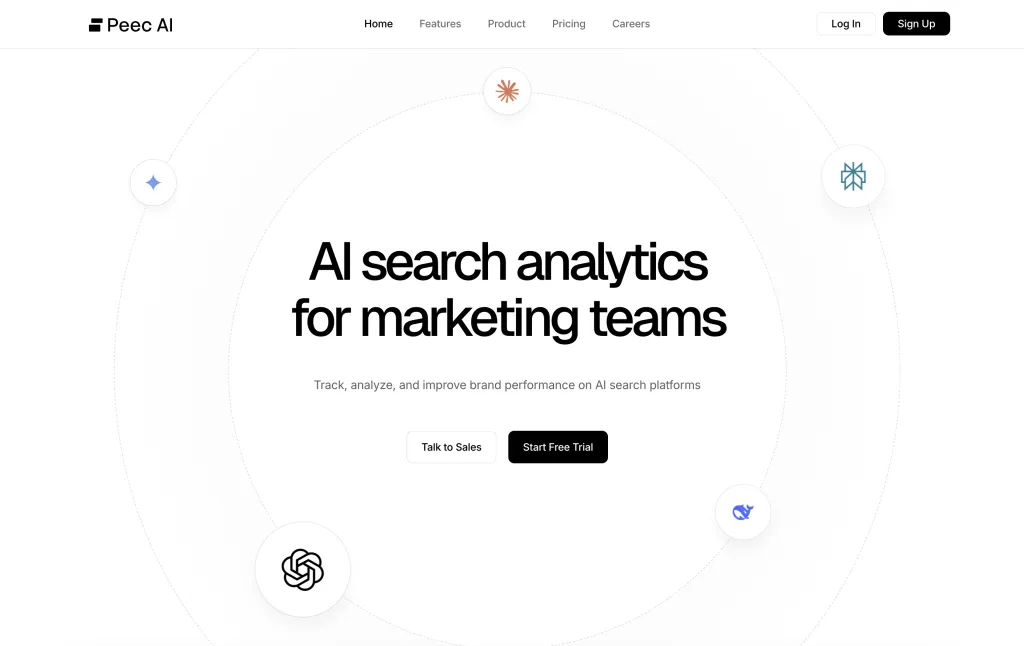
Why it’s a fit: Peec focuses on clarity and speed to insights. Its dashboards make it simple to compare visibility across assistants, screenshot or export snapshots, and brief stakeholders quickly. It tends to minimize setup overhead, which is helpful for fast-moving teams.
Notable coverage: ChatGPT, Perplexity, Claude, Gemini; optional Copilot/AI Overviews as available.
Consider if… You need quick readouts and frequent stakeholder updates without heavy configuration.
3. LLMrefs
Best for: Solo marketers and startups who want a straightforward scoring/benchmarking model.
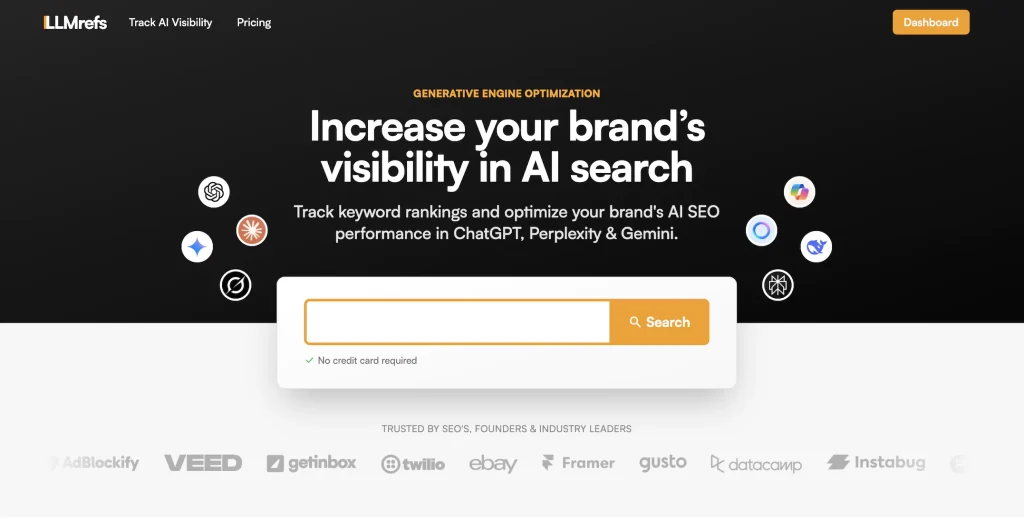
Why it’s a fit: LLMrefs keeps things simple: track presence, compare share of assistant answers, and benchmark over time. The streamlined approach makes it easy to adopt and explain to non-specialists.
Notable coverage: ChatGPT, Perplexity, Claude; selected additions vary by plan.
Consider if… You want to start measuring AI visibility with minimal cost and complexity, then upgrade later.
4. Surfer AI Tracker
Best for: Organizations already using Surfer that want native AI visibility inside a familiar ecosystem.

Why it’s a fit: If Surfer is your content home base, the AI Tracker keeps your analysis and optimization in one place. The benefit is less tool-switching and easier adoption for writers and editors already trained on Surfer’s workflows.
Notable coverage: Major assistants (ChatGPT family, etc.), with expanding lists over time.
Consider if… Consolidation and smoother content workflows matter more than having the broadest standalone AI-tracking feature set.
5. Scrunch AI
Best for: Enterprise teams that need deeper governance, automation, and integrations around AI visibility.
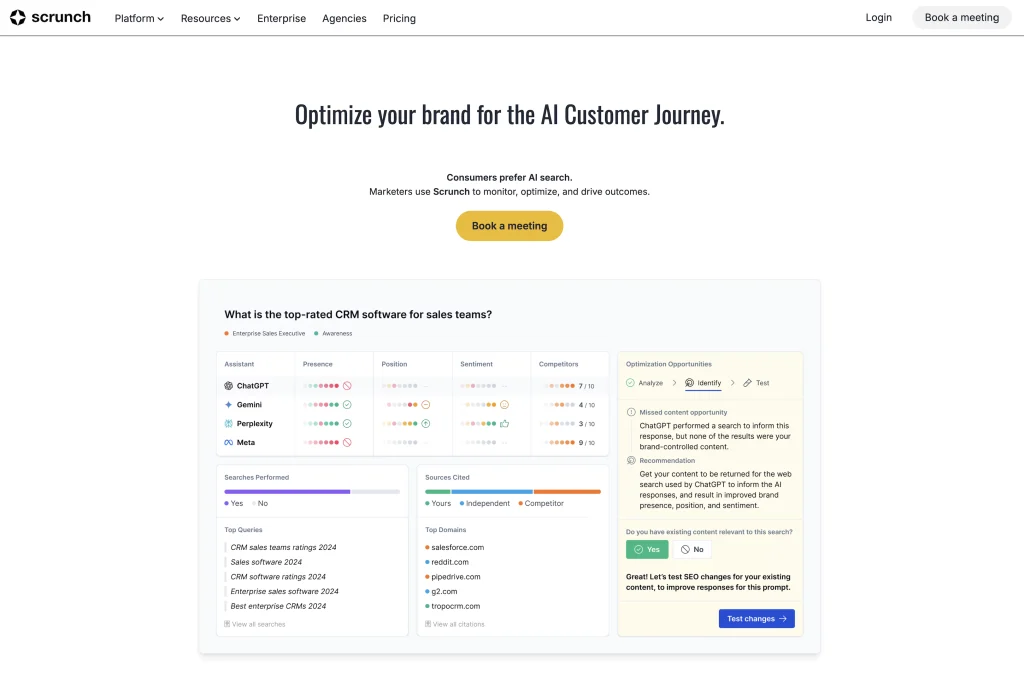
Why it’s a fit: Scrunch emphasizes scale: multi-brand management, advanced permissions, and integration pathways (BI, data warehouses, ticketing) that enterprises expect. It’s suited for teams that want AI visibility to flow into existing analytics and operations.
Notable coverage: Broad assistant coverage with enterprise-grade options.
Consider if… You need robust controls, audit trails, and a path to automate workflows across departments.
6. Rankscale AI
Best for: Budget-conscious teams that need essential monitoring and room to grow.

Why it’s a fit: Rankscale aims to provide core tracking at a lower price point, so you can start measuring AI presence without overcommitting. It’s a sensible stepping stone while you validate the channel.
Notable coverage: Core assistants like ChatGPT, Perplexity, Claude; selective expansion depending on plan.
Consider if… You want proof-of-value first, then plan to move up-market later.
7. AthenaHQ
Best for: Mid-market teams that want deeper analytics without going full enterprise.
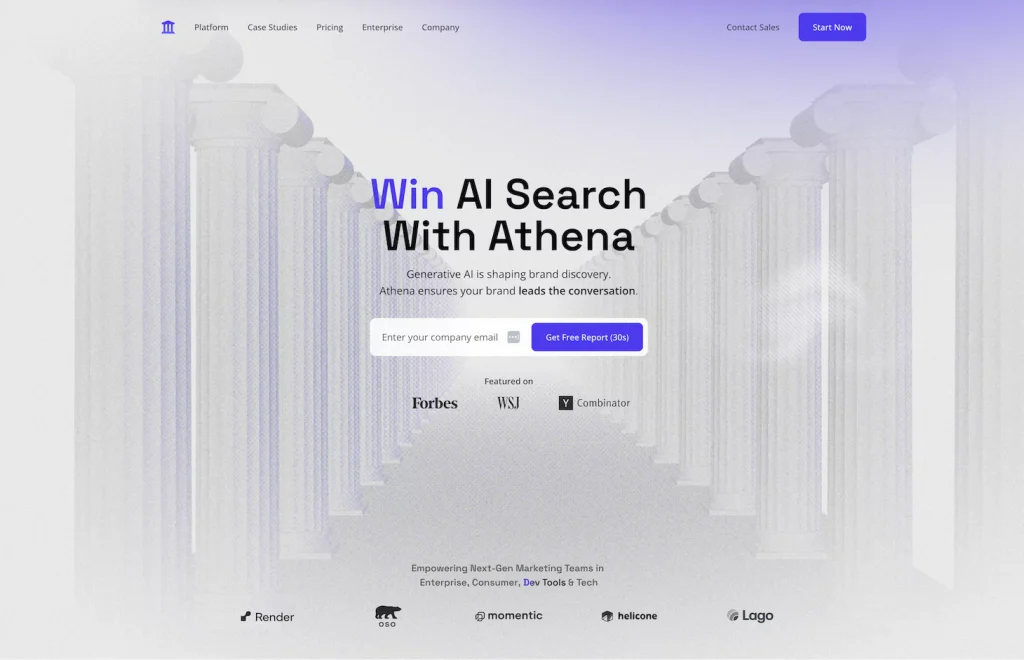
Why it’s a fit: AthenaHQ focuses on visibility analytics you can actually act on, segmentation by brand/topic, trend deltas by assistant, and straightforward workflows for turning insights into content and GEO fixes. It’s more powerful than lightweight trackers but easier to onboard than heavy enterprise stacks.
Notable coverage: ChatGPT, Perplexity, Claude, Gemini; optional Copilot/AI Overviews depending on plan.
Consider if… You’ve outgrown entry-level tools and need richer analysis and reporting but don’t want enterprise pricing/complexity.
When SE Ranking is Still the Right Move
Stick with SE Ranking if you value suite consolidation, classic SEO features, plus an AI layer, along with simpler onboarding in a tool your team already knows.
If your priority is keeping rank tracking, technical audits, content workflows, and AI visibility together, you may get more leverage by deepening adoption rather than adding another platform. Consider augmenting with a lightweight tracker for any gaps in engine coverage or reporting.
FAQs
Do these tools track cited vs. uncited mentions?
Many tools distinguish between responses that cite your brand/content and those that mention you without a link/citation. This matters for credibility, E-E-A-T signals, and sales enablement.
Which engines matter most right now?
For most teams: ChatGPT and Perplexity first, then Claude and Gemini. Track Google AI Overviews/AI Mode and Copilot where relevant to your audience.
How often should I refresh prompts/intents?
Quarterly at minimum. Refresh faster during launches or when you see volatility, treat prompts like evolving keywords.
How do I report AI visibility alongside SEO KPIs?
Create a shared scorecard: Organic traffic & rankings + AI visibility (presence, citation rate, category share, changes since last period). Add call-outs where AI presence correlates with brand lift or assisted conversions.
Conclusion
AI visibility is now a core marketing metric, not a side project. If SE Ranking gives you the convenience of an all-in-one suite, these alternatives help you widen engine coverage, improve client-ready reporting, and pressure-test your brand’s presence across ChatGPT, Perplexity, Claude, Gemini, and emerging surfaces like Google AI Overviews and Copilot.
Start with a focused trial. Mirror the same prompts and intents across two tools for seven days, then compare presence, citation rate, and movement by engine. If the data shows clear lift, either augment SE Ranking with a lightweight tracker or consolidate into the platform that best fits your workflow.
If you want agency-grade reporting and multi-brand scale out of the gate, begin with Rankability’s AI Analyzer as your control. If you prefer a minimal dashboard to brief stakeholders, try Peec AI. On a tight budget, validate the channel with Rankscale AI, then upgrade when you see traction.
Pick the path that gets you to faster decisions with cleaner reporting. Your goal isn’t just to be visible in AI answers. It’s to measure, improve, and prove that visibility drives the pipeline.
Free GEO Checklist – Download the complete 97-point checklist to optimize your brand for AI-powered search engines like ChatGPT, Gemini, and Perplexity.