

AI search is now a real acquisition channel. When buyers ask ChatGPT, Gemini, Claude, Perplexity, or Copilot for advice, the answers they see shape shortlists and purchasing decisions.
Writesonic’s GEO helps you understand if and how your brand appears inside those AI answers. If you need broader engine coverage, deeper reporting, or workflows that turn gaps into fixes, the alternatives below are worth a look. You will see engine coverage, refresh cadence, citation capture, and pricing at a glance, plus a quick note on who each tool is best for.
Quick Picks
- Best overall for agencies: Rankability’s AI Analyzer
- Best dashboards & SOV tracking: Peec AI
- Best low-cost on-ramp: LLMrefs
- Best enterprise visibility + misinformation checks: Scrunch AI
- Best data depth & analytics: Profound
- Best action-center workflows: AthenaHQ
- Best ultra-budget daily tracker: Rankscale AI
Comparison Table
Pricing changes often, so verify on vendor pages before purchase.
| Tool | Best for | Starting price* | Engines/coverage (examples) | Notes |
|---|---|---|---|---|
| Rankability AI Analyzer | Agencies wanting monitoring and integrated content optimization | from $124/mo billed annually (suite) | ChatGPT, Gemini, Claude, Perplexity, Grok, DeepSeek, Copilot; Google AI Overviews & AI Mode. | Analyzer pairs tracking with on-page/content workflows; strong for multi-brand portfolios |
| Peec AI | Clean cross-engine dashboards & share-of-voice | €89/mo (Starter) | ChatGPT, Perplexity, Google AIO; add-ons expand to more engines | Scales by prompts/regions; good competitor diffs |
| LLMrefs | Low-cost starter for SMBs/solo | $79/mo (Starter) | ChatGPT, Perplexity, Gemini (others emerging) | Simple LS/visibility score; leaner dataset vs. enterprise tools |
| Scrunch AI | Enterprise GEO infrastructure (beyond monitoring) | $300/mo (Starter) | ChatGPT, Gemini, Perplexity, Google AIO | Adds misinformation/gap detection; AXP/activation layer emerging |
| Profound | Data depth & enterprise analytics | $499/mo (Starter) | ChatGPT, Perplexity, Google AIO | Robust reporting, SOV, and history; higher TCO |
| AthenaHQ | Action-center workflows with RBAC | $295+/mo (Starter) | ChatGPT, Perplexity, Google AIO/AI Mode, Gemini, Claude, Copilot, Grok | Credit-based; build “what to fix” into process |
| Rankscale AI | Ultra-budget daily tracking | $20/mo (Essentials) | ChatGPT, Claude, Perplexity, Google AIO | Daily cadence; young product, confirm refresh & exports |
*Starting prices change often – verify current pricing before purchase.
Who This Guide Is For
- Agencies reporting across many clients who need repeatable workflows and clear client-facing dashboards
- In-house teams validating AI visibility alongside SEO and content ops
- Founders/marketers who need actionable tasks, not just “you’re mentioned/not mentioned” reports
How We Evaluated
- Engine coverage: ChatGPT, Gemini/AI Overviews / AI Mode, Claude, Perplexity, Copilot, and regional engines
- Sampling transparency & citations: does the tool show sources/screens and store history?
- Actionability & workflows: can teams move from “gap” → “assignment” → “fix” quickly?
- Scaling & collaboration: multi-brand support, roles, exports, APIs, and history depth
- Pricing-to-value: clarity on credits/prompt counts, regions, and add-ons
The Alternatives
1. Rankability’s AI Analyzer
Best for agencies wanting monitoring + integrated content optimization.

Rankability extends its SEO stack into AI search by testing branded and commercial prompts across top answer engines, mapping where and how your pages, or competitors’, are cited. The win is speed: diagnose gaps and move straight into optimization using the same ecosystem (Analyzer plus Content Optimizer and keyword research).
If you already run client content through Rankability, this cuts copy-paste and CSV wrangling, making it one of the best AI optimization tools for visibility for agencies.
Pricing is bundled within Rankability plans (Core from $124/mo billed annually; Analyzer access on higher tiers, confirm current seat and prompt limits). Best for agencies standardizing reporting and fixes in one environment. Watch-outs: confirm current engines/markets and refresh cadence.
2. Peec AI
Best for structured cross-engine reporting with share-of-voice.
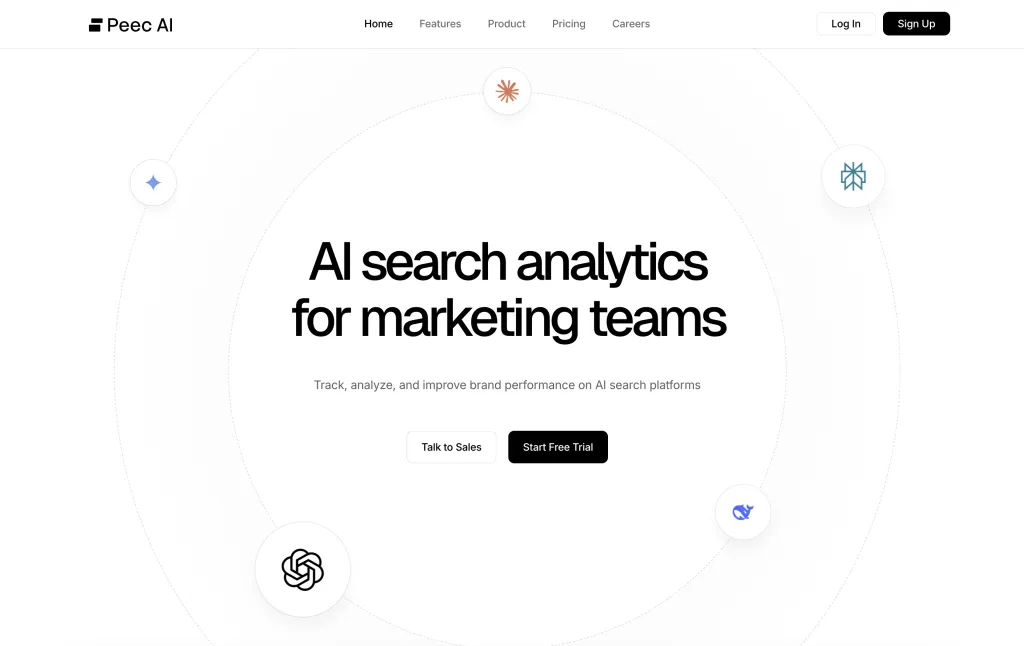
Peec focuses on multi-platform monitoring with share-of-voice, sentiment, and citation source analysis. Pricing scales by prompts; the entry tier is listed in euros and includes unlimited seats, which helps teams.
Agencies appreciate clean exports for client decks. Validate sampling frequency if you need stronger statistical confidence. Best for teams wanting neat SOV dashboards without switching their SEO stack. Watch-outs: costs can scale with tracked prompts; engine inclusion varies by tier.
3. LLMrefs
Best affordable on-ramp for startups/SMBs.
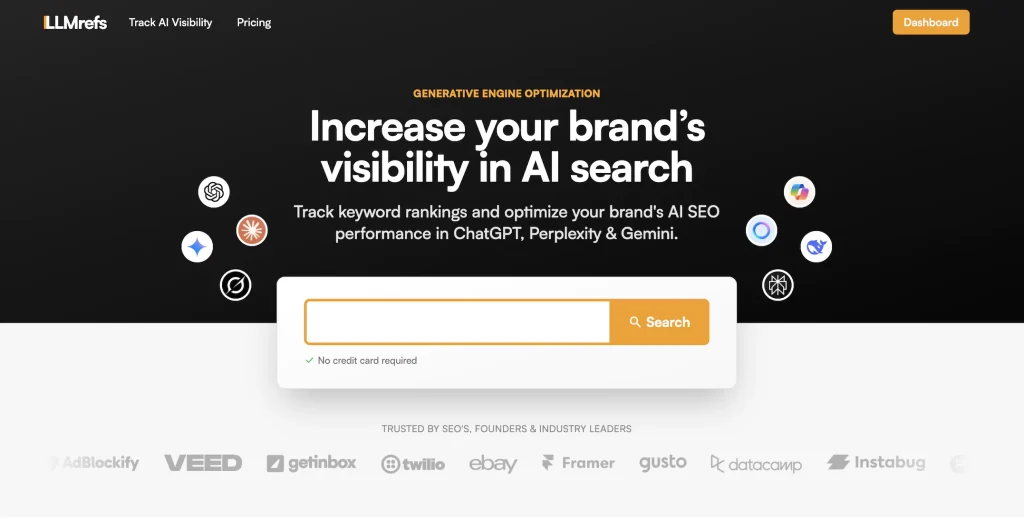
LLMrefs blends AI “rank” views with a simple score, live keyword crawling, weekly trends, and competitor benchmarks. The Pro plan is aggressively priced and includes CSV exports, making it a low-risk way to begin. Freemium exists for simple tests.
Coverage spans major AI engines; confirm specifics at signup. Best for solo marketers and small teams validating AI visibility quickly. Watch-outs: smaller datasets and weekly cadence may miss fast-moving topics.
4. Scrunch AI
Best for enterprise GEO infrastructure (beyond monitoring).
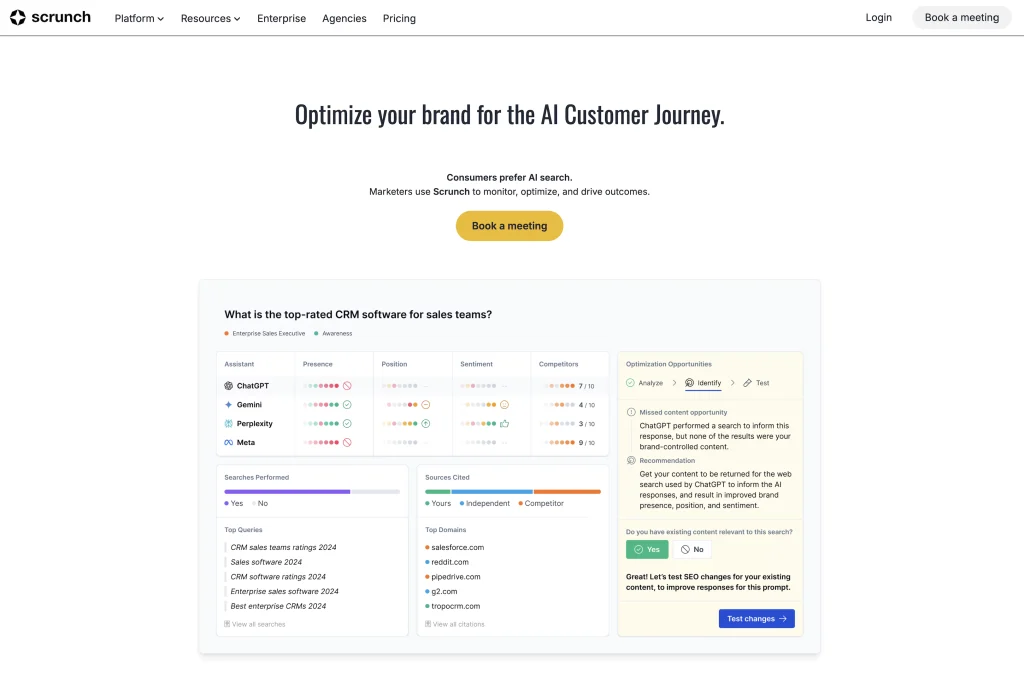
Scrunch positions itself as a bridge between technical implementation and visibility analytics. With its Agent Experience Platform (AXP), the roadmap pushes into “make content machine-readable for AIs” and misinformation detection aimed at measurable lifts for big brands.
Pricing starts at $300/mo (Starter) with enterprise tiers and agency programs. Best for enterprise brands and agencies investing in next-gen AI discovery infrastructure. Watch-outs: AXP rollout and UI polish are evolving; can be overkill for simple monitoring.
5. Profound AI
Best for data depth and enterprise analytics.
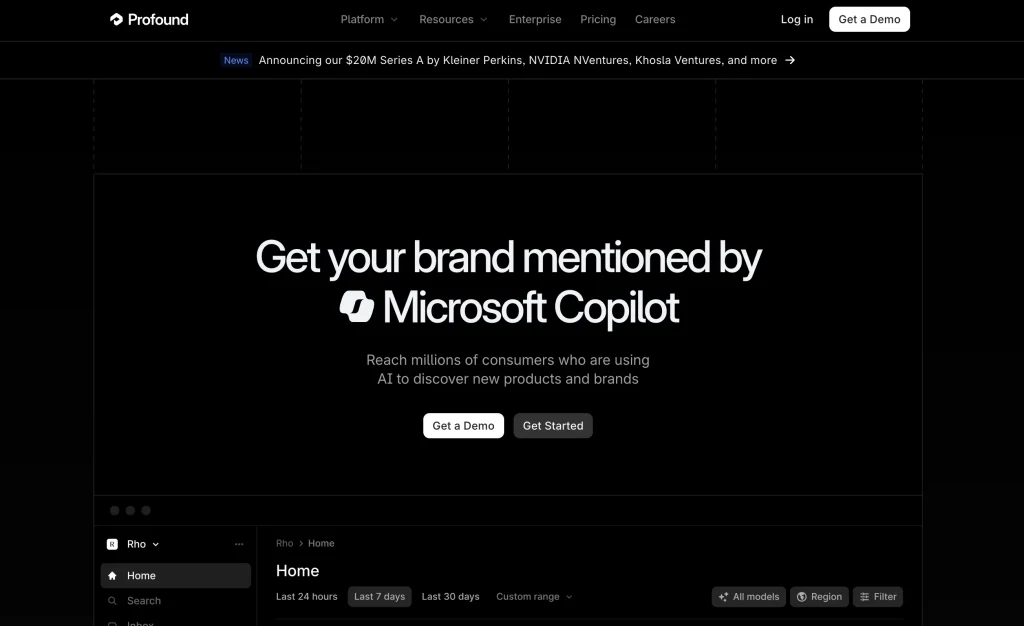
Profound ingests large volumes of AI responses and citations, exposing demand via Conversation Explorer and an AI Visibility Dashboard. The Lite plan is publicly listed at $499/mo; enterprise tiers are available.
Coverage includes ChatGPT, Perplexity, and Google AI Overviews. Best for large teams needing scale, integrations, and advanced analysis. Watch-outs: higher cost and operational overhead; confirm quotas and integrations upfront.
6. AthenaHQ
Best for action-center workflows to close gaps.
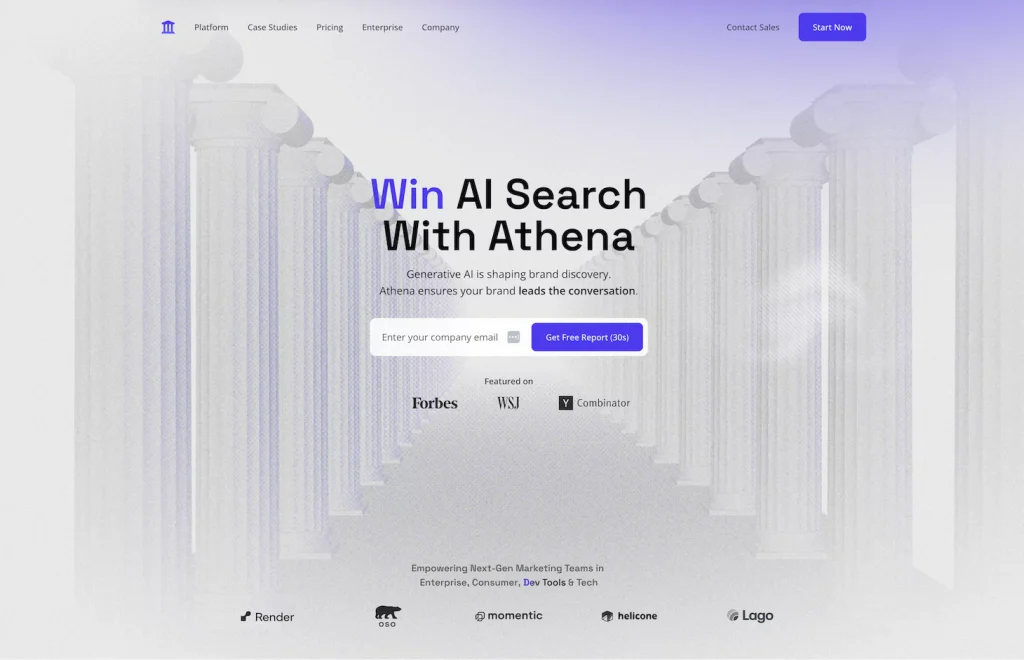
AthenaHQ focuses on comprehensive monitoring with competitive benchmarks and an action-center approach to remediation. They publish research and target mid-market agencies.
Pricing appears mid-range; verify directly. Best for teams wanting hands-on workflows plus benchmarks. Watch-outs: rapidly evolving feature set, confirm engines, quotas, and reporting cadence.
7. Rankscale AI
Best ultra-budget tracker for quick visibility checks.

Rankscale offers credit-based tiers with an entry point around $20/mo and a lean feature set oriented toward visibility snapshots, competitor comparisons, and KPI tracking such as visibility score and average position.
A solid starter if you just need directional monitoring. Best for budget-conscious teams wanting a low-risk starting point. Watch-outs: fewer enterprise-grade features and integrations than higher-priced platforms.
Decision Guide
Step 1 – Define your primary need
- Audit fast: LLMrefs, Rankscale AI
- Ongoing reporting: Peec AI, AthenaHQ
- Optimize content from insights: Rankability AI Analyzer, AthenaHQ
- Enterprise analytics/governance: Profound, Scrunch AI
Step 2 – Align budget to tiers
- Budget (<$100/mo): LLMrefs, Rankscale AI
- Mid ($100–$400/mo): Rankability AI Analyzer, Peec AI, AthenaHQ
- High/Enterprise ($400+): Profound, Scrunch AI
Step 3 – Must-haves checklist
- Engines/locales you care about (US, UK, AU, multilingual, etc.)
- Refresh cadence & screenshot/citation capture
- Competitive benchmarking (brand/domain/page)
- Seats, roles, history depth, exports/API
- Security posture (SSO, SOC2), data handling
- Total cost (base price, credits, add-ons)
FAQs
What’s the difference between GEO and SEO?
SEO tracks and improves rankings on classic SERPs. GEO tracks and improves how AI engines cite and recommend your brand inside answers (e.g., ChatGPT, Perplexity, Google’s AI Overviews/AI Mode).
Which engines should I prioritize first?
Start with the engines your audience actually uses: typically ChatGPT, Perplexity, Gemini/AI Overviews/AI Mode, and (if relevant) Claude/Copilot. Confirm per market and language.
How often should prompts be re-sampled?
Most teams start with daily for top keywords and weekly for long-tail. Increase frequency during launches or competitive shifts.
Do I need developer resources to act on insights?
Not necessarily. Tools like Rankability’s Analyzer and AthenaHQ emphasize marketing-friendly fixes; enterprise stacks (e.g., Scrunch/Profound) offer deeper analysis that may involve more technical resources.
Can I use multiple tools together?
Yes. Many teams combine a low-cost tracker (LLMrefs/Rankscale) for cadence with an optimization-first or enterprise platform for deeper fixes and reporting.
Final Thoughts
If you want GEO monitoring and a direct path to fixes, Rankability’s AI Analyzer is the most balanced starting point for agencies and in-house teams. If you primarily need dashboards, start with Peec AI or AthenaHQ; if you need deep enterprise analytics, look at Profound or Scrunch AI; and if budget is your constraint, LLMrefs or Rankscale AI will get you moving.
Free GEO Checklist – Download the complete 97-point checklist to optimize your brand for AI-powered search engines like ChatGPT, Gemini, and Perplexity.