

Google does not penalize AI content under its own policies. But for agencies publishing across many client sites, the sharper question is whether it is safe to publish AI content at scale without triggering manual actions or quiet underperformance. Google has applied manual actions to spammy AI-generated content, and there is evidence its algorithms can detect low-quality machine-written text.
We Analyzed 487 Search Results to See If Google Penalizes AI Content
Rankability analyzed 487 Google search results for competitive commercial keywords, scoring each top-ranking page with its AI content detector. The 2026 result was:
83% of Top Google Search Results Are Not Using AI-Generated Content
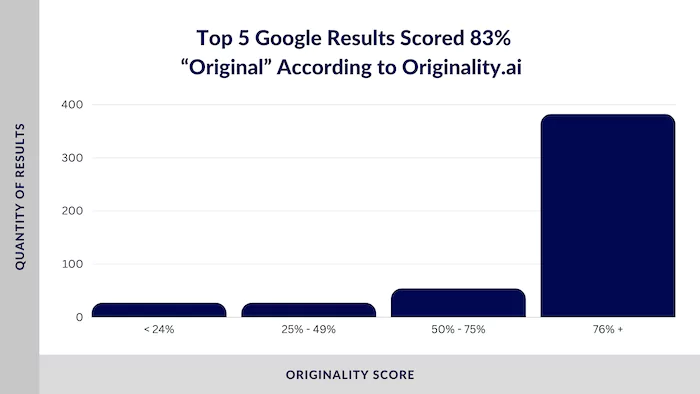
While this is a tiny case study with a small sample, it shows that Google’s algorithms favor human-generated SEO content.
How we ran this study
For the 2026 run, Rankability pulled 487 top-ranking Google results and scored the readable content of each page with its in-house detector (gptzero+originality, blend v1). A page counts as human-written when its blended AI-probability score is 30 or below, AI-generated when it is 70 or above, and mixed in between.
The headline 83% is the share of pages Rankability could fetch and score that read as human-written. Pages that could not be reliably retrieved were excluded rather than guessed. This is a directional study with a focused sample, refreshed annually and reviewed before publication.
A separate comparison of detector labels across AI and traditional search visibility found differences between result sets, but those labels neither verify authorship nor predict citation position. Detector output should therefore be treated as classification evidence, not proof of who wrote a page or what will rank.
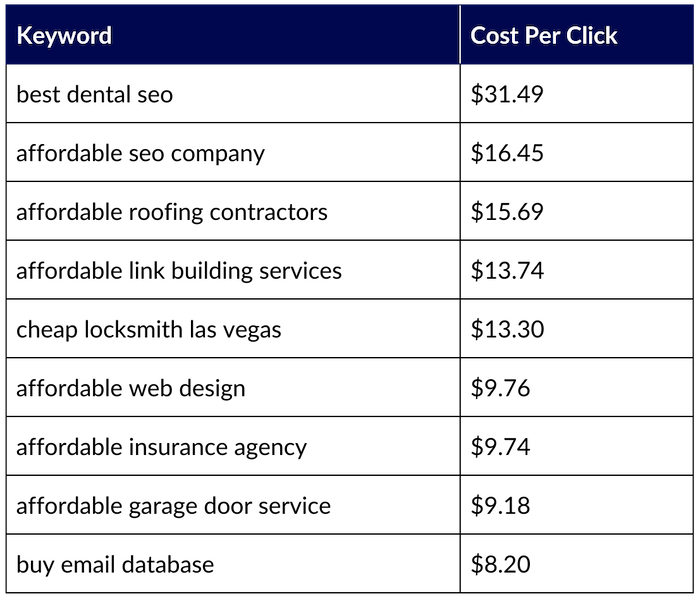
Here’s a sample of the keywords we used for the study:
This raises an important question:
Can Google detect AI content?
Recent algorithm updates may have proven that Google can detect auto-generated content created by Large Language Models.
Anecdotal Evidence
The last spam update saw mass deindexation of entire websites (many through manual actions) and algorithmic deindexation.
For example, we generated content using ChatGPT for the keyword “SEO training Houston,” and this content registered as 100% AI.
After the recent updates, it was completely removed from Google’s index, which was deserving because it was low-quality content.
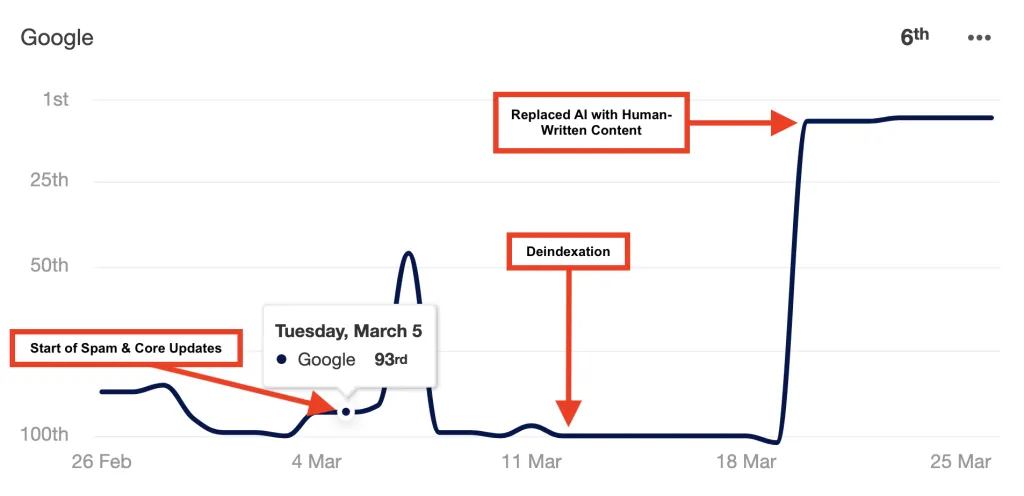
So, we replaced it with human-generated content and upgraded the quality.
Within hours, it was reindexed, and now it’s ranking in the top 10. This is an anecdotal example, but we’ve seen similar situations across many campaigns.
It’s not always deindexation, but it’s also underperformance.
For example, we tested using AI-generated content for “SEO for dentists,” and it performed poorly for months:
So then I rebuilt it with NLP (natural language processing) in mind and used a human writer to create high-quality content.
Here are the results:
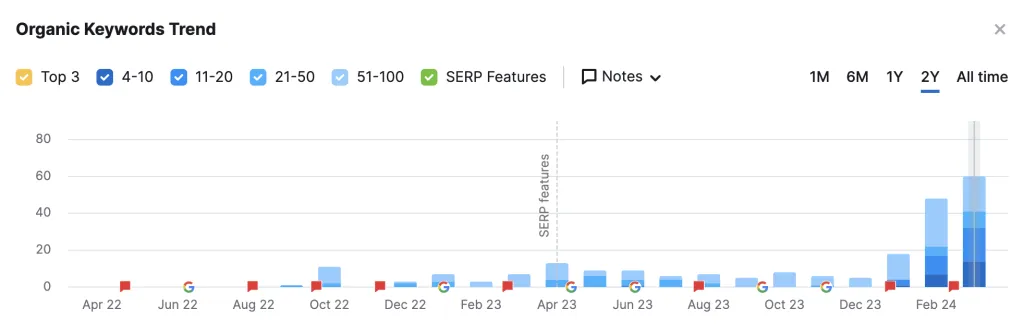
In our experience working on countless campaigns and in studying thousands of Google Search Results, we’ve seen that high-quality content written by a human performs better than LLM content.
Algorithmic Preference of User-Generated Content (UGC)
It’s no secret that Google now loves Reddit, Quora, and other UGC-driven websites.
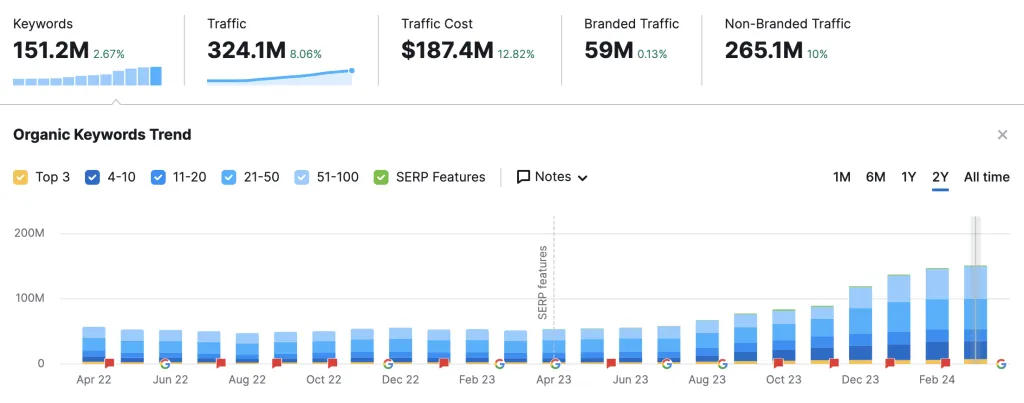
The question is, why? Google’s algorithm prefers UGC because it probably doesn’t resemble LLM-driven content. This is pure speculation, but it’s something to consider.
It’s not always about what Google punishes; it’s sometimes about what is rewarded.
Common Sense
Google has one of the world’s most sophisticated large language models with Google Gemini. They’re also rolling SGE (search generative experience) any day now.
We’re talking about a trillion-dollar company that’s been at the forefront of AI technology for over a decade. It would be foolish to think they can’t detect low-quality AI-generated articles.
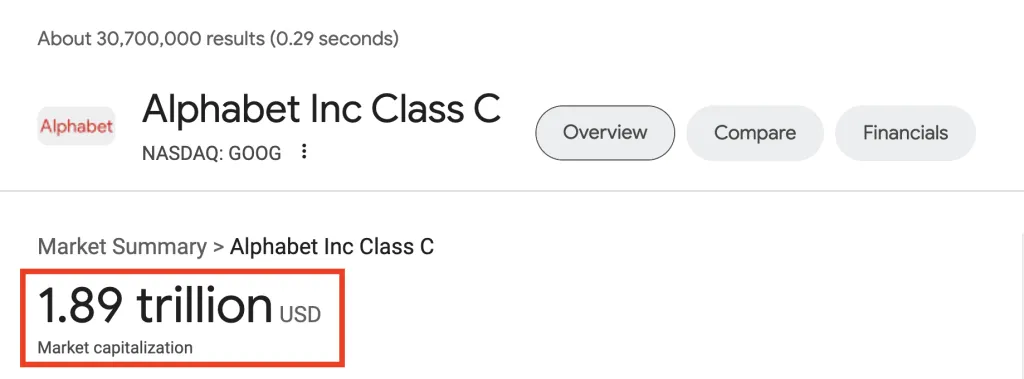
They may not be able to detect AI content with human touch, but there’s a high probability that they can detect AI-written content that’s low-quality.
That said, Google can’t roll out algorithmic changes that are too aggressive because of collateral damage.
So, they will likely only turn the dial enough to attack the lowest-hanging fruits like spammy content that uses AI-generated text without considering user experience or quality.
Does this mean you should never generate content with AI writing tools?
No. In fact, we have AI-generated content that’s ranking right now on this website, such as “Are H1 Tags a Google Ranking Factor” and “Is Keyword Density a Google Ranking Factor?”
The key is that you have to use the AI technology the right way.
Here’s how:
Review Google’s Spam Policies
Google is not against ALL forms of AI content.
For example, they say:
“Using automation—including AI—to generate content with the primary purpose of manipulating ranking in search results is a violation of our [Google’s] spam policies. That said, it’s important to recognize that not all use of automation, including AI generation, is spam. Automation has long been used to generate helpful content, such as sports scores, weather forecasts, and transcripts.”
And:
“Appropriate use of AI or automation is not against our guidelines.” – Google Search Central
Finally, John Mueller’s take on the discussion:
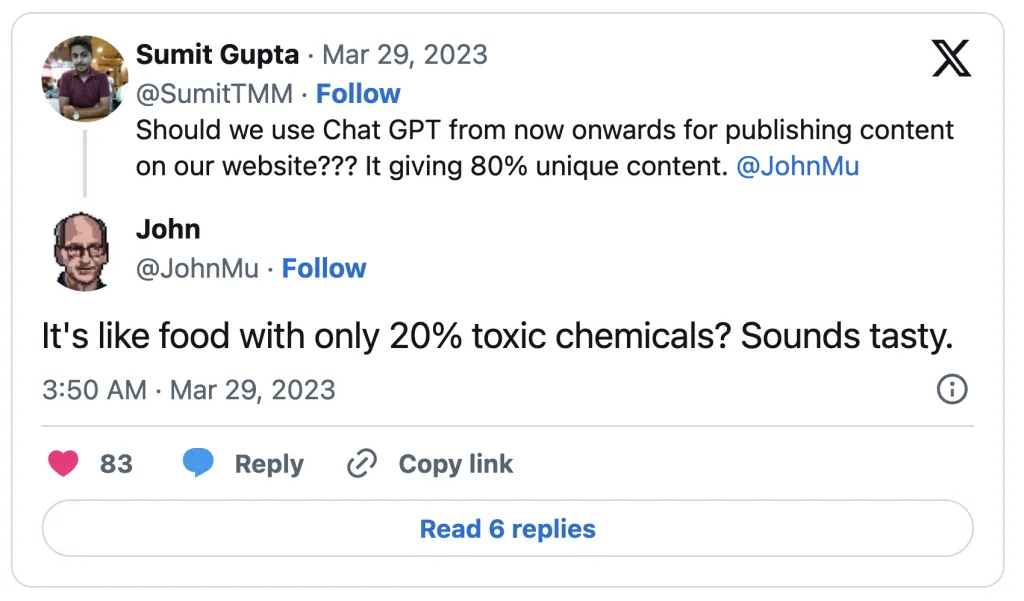
Google’s goal is to show the most relevant and helpful content
So, if you can achieve that goal with AI content, then go for it.
With Google’s webmaster guidelines in mind, here’s how to use generative AI to create people-first content:
Always Consider the Primary Purpose of Your Content
The sole purpose of creating content is to help someone get closer to their goals. It’s not about you. It’s always about who is actually consuming the content.
Too many people doing Search Engine Optimization (SEO) forget this part. They’re fixated on search rankings but don’t even consider the target audience and what happens after you rank.
Related: Best Content Optimization Tools
You need to reverse this equation in your content creation process. What is the goal of the content you’re about to create? If the sole purpose is to “get more traffic,” then you’re not thinking from the right perspective.
The objective of content marketing is to generate some type of conversion.
So, if it’s informational content at the top of the funnel, the goal is to move the searcher deeper into your funnel. That means you’d like to offer a lead magnet to get them on your email list.
If you’re targeting commercial queries, the goal could be signing up for a free trial, purchasing a product, calling for more information, or submitting a lead form.
Start with the end in mind; your content should always match the search intent of the target keyword.
Care More About the Quality of Content, Not Content Publishing Velocity
New technologies have enabled content creators to use automation to generate content at scale using AI.
But this is a classic “Just because you can, doesn’t mean you should” situation.
The truth is that history repeats itself. Before Google’s Panda update, scaling thin content was all the rage.
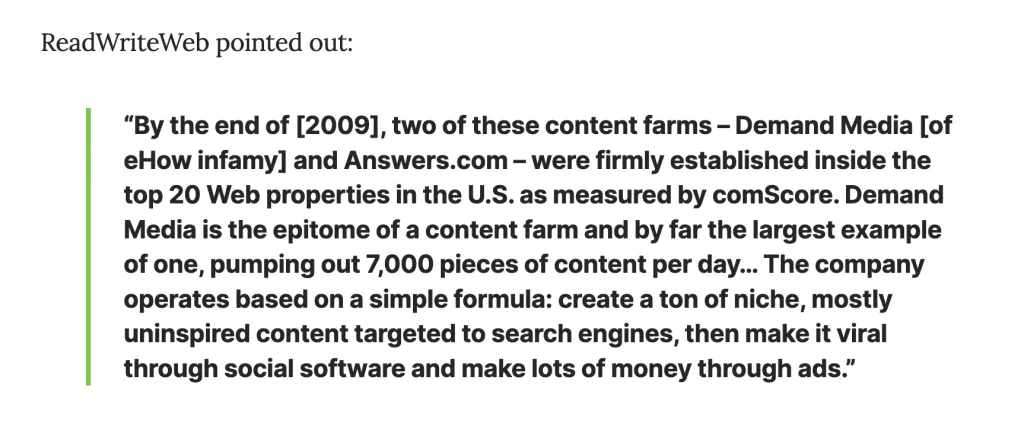
But Google ended that when Panda slaughtered countless websites with thin, poor-quality content.
Here’s the deal:
If you want sustainable SEO results, you need to focus on content quality.
And guess what?
You can’t have both content quality and scale. The concepts are opposed to each other.
It’s not possible to create high-quality content at scale unless you have a massive team of subject matter experts and content writers and an enormous content budget.
Google’s algorithm has the “Helpful Content System” built into it. This system is designed to reward high-quality content and punish the opposite.
It’s far from perfect, but read the writing on the wall.
Focus on quality, not quantity.
Stop Keyword Stuffing
The misuse of NLP tools has led to overoptimized content.
It’s not NLP, which is a proven concept; that’s the problem; it’s how these AI tools are used.
For example, I’m writing this content inside of Rankability and using the NLP recommendations to build something highly relevant for the target keyword.
The key to correctly using an NLP tool like Rankability is to focus on a topic, not keywords.
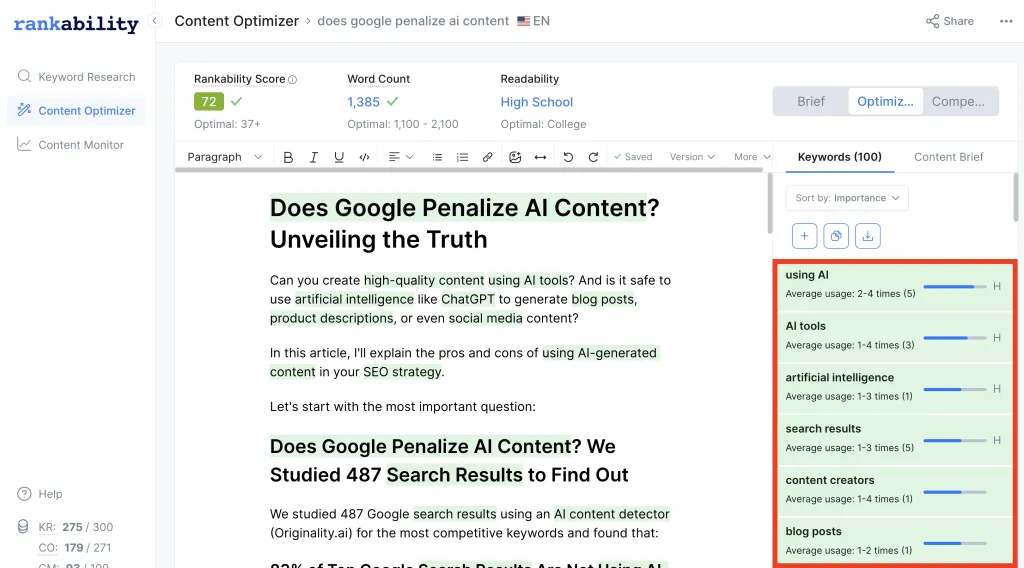
I view the NLP recommendations as gaps in my content.
So, to build a hyper-relevant asset, I need to narrow those topic gaps and make my content deeper.
At the end of the day, don’t worry about how often you mention an exact keyword phrase. Focus on narrowing the topic gaps and write naturally.
Be Careful with AI Content Tools
There’s a flood of AI content tools on the market right now. And I’m not necessarily opposed to any of them.
But I am opposed to how people use them. It’s so easy to click a few buttons and generate content now, and as a result, it breeds laziness.
And if you study Google’s E-E-A-T (Experience, Expertise, Authoritativeness, and Trustworthiness) guidelines, they mention “effort” countless times.
In short, low-effort content shouldn’t be rewarded. And that’s exactly what these AI tools incentivize.
Most people auto-generate and have little to no human intervention. This is a very dangerous game to play.
So, if you want to use these tools, ensure that the AI content undergoes a human-led editorial process.
You need to add human elements to it and make it appealing to users.
Final Thoughts
Using anecdotal evidence, search engine rankings, and common sense, I believe that Google rewards original content that’s clearly written by a human. Does it penalize AI content? Not all of it, but it likely has the ability to detect the lowest quality, auto-generated AI content created via LLMs.
Create High-Quality, SEO-Optimized Content
Use AI the right way with Rankability’s NLP-powered content optimization. Get premium data and expert guidance to create content that ranks and converts.
Try the free AI Content Detector to check whether client content reads as human-written, then use Rankability’s Content Optimizer to improve quality, relevance, and information gain before publishing.