

Ahrefs has been a go to SEO platform for keyword research, backlink data, and competitive analysis for years. With AI Content Helper, Ahrefs is trying to fold content optimization directly into that ecosystem so you can plan and optimize articles inside the same interface you use for research.
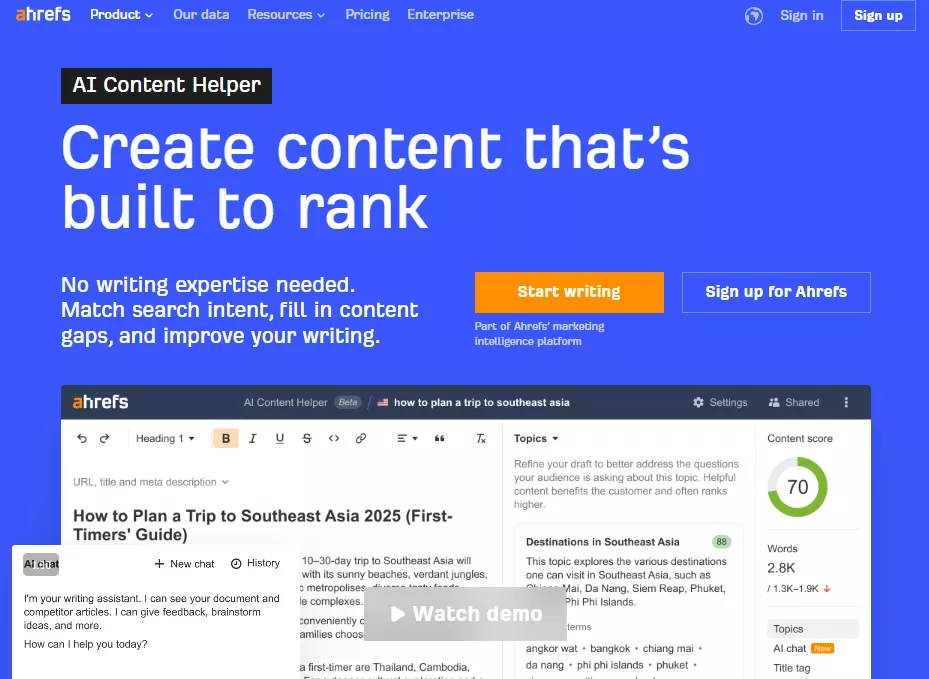
In practical terms, you choose a target keyword, let Ahrefs scan top-ranking pages, then work inside an editor that scores topic coverage, flags content gaps, and suggests improvements in real time. The promise is simple: use AI to create content that lines up with search intent and earns more organic search traffic without guessing what to include.
This Ahrefs AI Content Helper review focuses only on content-related features. We will look at how it handles research, topic gaps, content score, AI writing tools, and refresh workflows for blog posts and other web pages. The goal is to help SEO professionals, content creators, and small businesses decide whether this is the right optimization tool for their SEO strategy.
Quick summary
Ahrefs AI Content Helper turns SERP and keyword data into a guided writing workflow that lives inside the Ahrefs platform. You enter a target keyword, choose search intent, and then grade your draft against top-ranking pages so topic gaps and weak sections are easy to spot.
Where it is especially helpful
- Identifying low-effort content updates that recover lost organic traffic
- Filling topic gaps on important articles that already have backlinks and Domain Rating behind them
- Giving content teams a shared checklist for coverage without forcing them into a separate SEO tool
Where it feels limited
- It optimizes page SEO and topic coverage, not technical SEO or full SEO audits
- You still have to write and fact-check most of the content, then use AI to refine rather than fully automate content production
- Pricing plans are tied to Ahrefs features and add-ons, which can be overkill if you mainly want a content optimization tool
What Ahrefs AI Content Helper is
Ahrefs AI Content Helper is an AI powered writing assistant and optimizer inside the Ahrefs SEO platform. It uses Ahrefs SEO data and competitor content to show you which topics and keywords appear on top-ranking pages, then scores your draft based on how comprehensively it covers those themes.
Key features you work with in the editor include:
- Topic and coverage analysis – AI grades your content against top-ranking pages for a chosen query and highlights sections that are undercovered or missing.
- Color-coded topics – sentences are tagged by subtopic so you can see distribution at a glance and avoid over-weighting one idea while ignoring another.
- Meta data helpers – AI suggestions for title tags and meta descriptions based on what is currently working in search results.
- AI chat and feedback – an embedded chat experience where you can ask for ideas, get feedback on structure, or request improvements to specific paragraphs.
The outcome is a repeatable “research → outline → draft → optimize” loop that uses AI to keep you close to what search engines reward, without turning into a generic AI content generator.
Who Ahrefs AI Content Helper is best for
AI Content Helper fits best inside an environment where your team is already leaning on Ahrefs as a primary SEO tool.
Ideal users include:
- SEO experts and SEO professionals who want topic coverage help without leaving their main SEO platform
- Content teams that write a steady volume of long form content and want consistent briefs and content score targets
- Digital marketing agencies and in-house marketers who need repeatable use cases for refreshing older content and improving SEO performance over time
If you do not already have an Ahrefs subscription, AI Content Helper makes less sense as a standalone writing assistant. There are lighter AI writing tools that focus on ease of use and lower cost for teams that mainly want help to create content rather than run deep competitor research.
Feature Breakdown
1. Keyword and SERP context inside AI Content Helper
AI Content Helper always starts from a keyword and a SERP snapshot. You pick a target keyword, and the tool pulls in the top-ranking pages to understand what searchers expect to see on that topic.
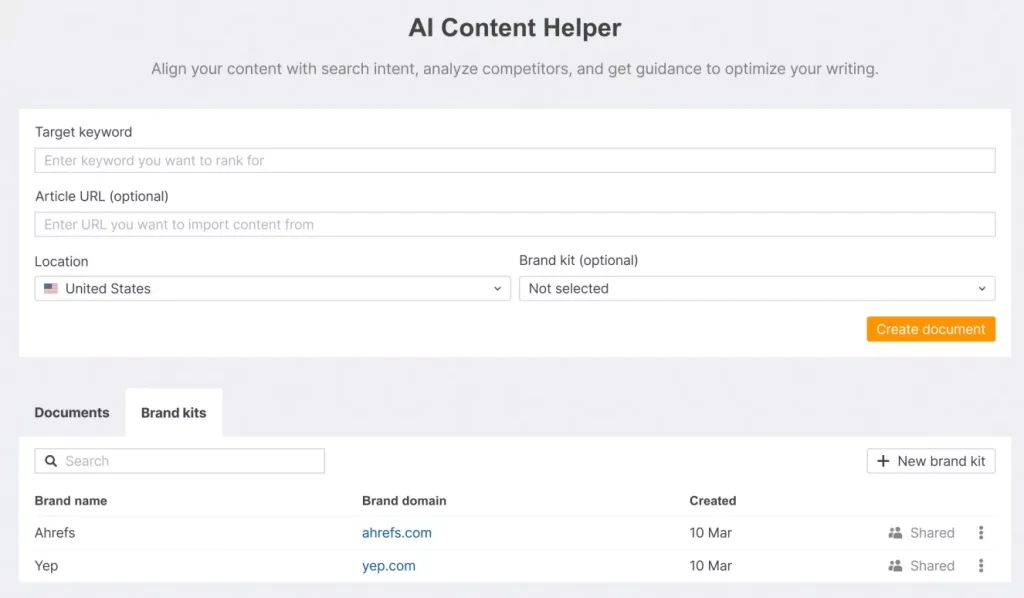
It shows you which URLs are winning, how they structure their content, and which angles dominate the search results for that query.
Inside the AI Content Helper interface, this context powers the topic suggestions, content score, and gap analysis you see while you write. Instead of guessing what to include, you are working from a live view of what already earns visibility for that keyword.
2. Topic suggestions, coverage analysis, and content score
Once you paste in a draft or start from scratch, AI Content Helper analyzes your article against those top-ranking pages. It looks at headings, recurring entities, and common subtopics, then returns:
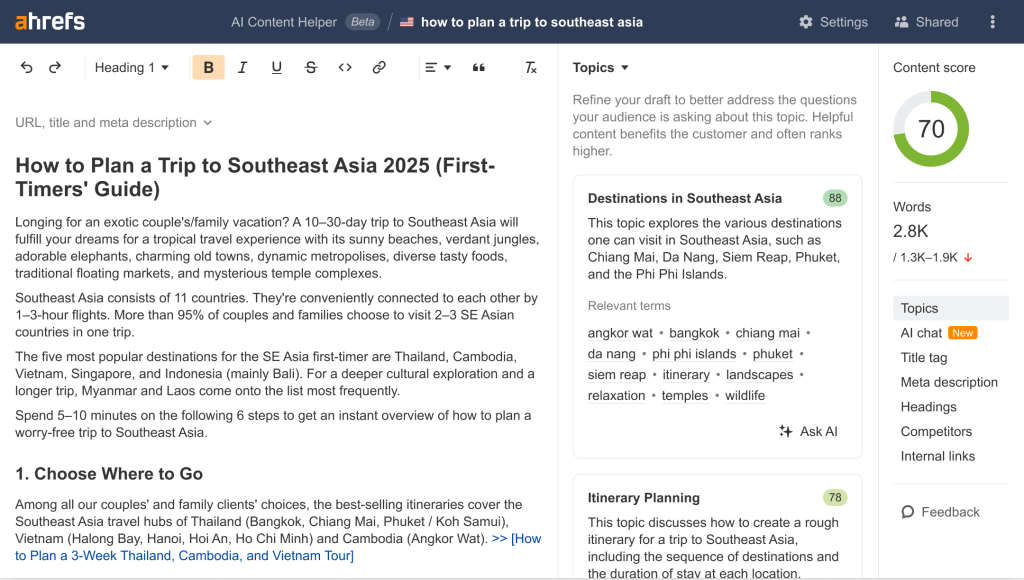
- A content score that reflects how well you cover important ideas for the chosen keyword
- A list of recommended topics and questions that frequently appear on top-ranking pages but may be missing from your draft
- A visual breakdown of which sections map to which topics, so you can see where the content is thin or over weighted
This is the core of the tool. It is less about word count and more about topical completeness. For content teams, the score and topic lists work like a shared checklist: everyone can see what must be covered for a page to compete, without turning every brief into a manual audit.
3. Color-coded highlighting for topic gaps
AI Content Helper also uses color-coded highlighting to make topic coverage easier to digest.
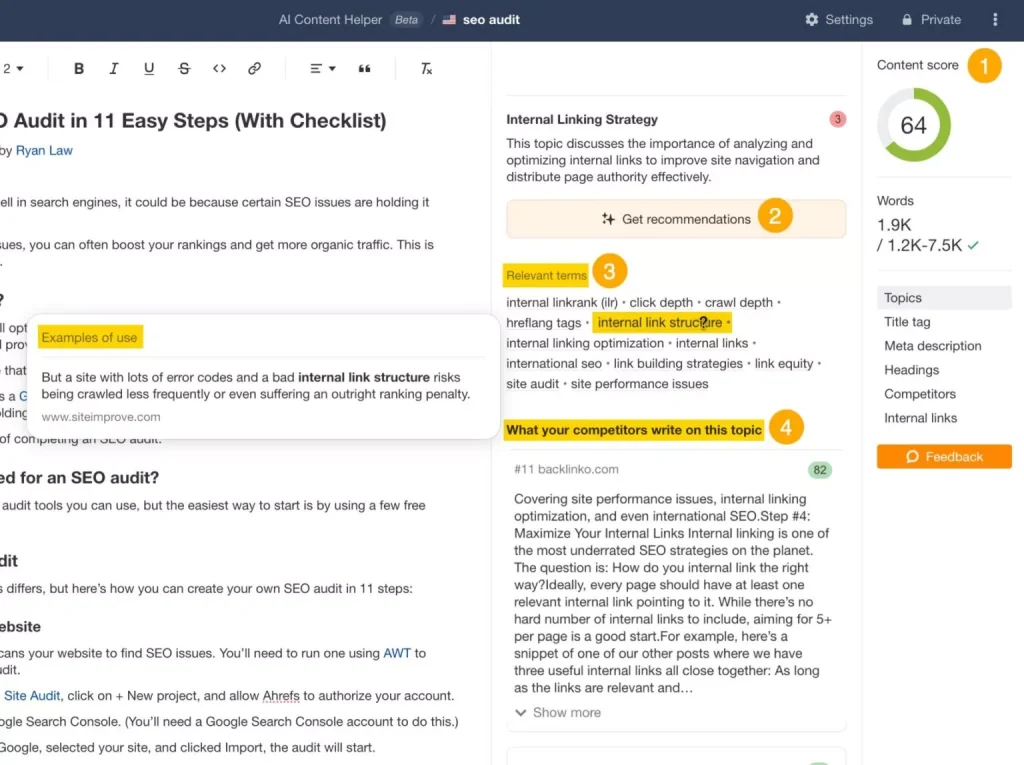
Sentences and sections are tagged with colors that map to individual topics, so you can scan the page and see:
- Which topics are covered well
- Which topics are barely mentioned
- Where you have long stretches of text that never touch a recommended topic at all
This matters when you are trying to optimize content that already gets some organic traffic but is stuck below top positions. Instead of skimming through a long article line by line, you can immediately see which ideas need more depth and where to add new paragraphs or examples.
4. AI assistance for micro edits, not full drafts
Although you can ask AI Content Helper to write or rewrite sections, the tool is positioned more as a writing assistant than a one click article generator.
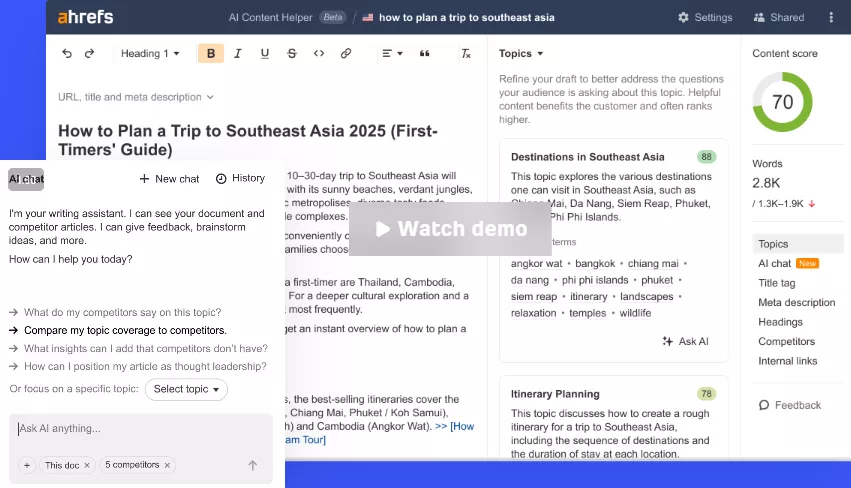
Inside the editor you can:
- Ask AI to improve clarity, tighten wording, or simplify a paragraph
- Generate alternative titles and meta descriptions that better reflect the finished draft
- Request suggested headings or bullet points when you are stuck on a section
The workflow works best when you bring your own expertise and use AI to refine and expand, not to replace, your perspective. It keeps you close to your brand voice while still taking advantage of AI for speed and polish.
Related: Ahrefs Brand Radar Review
5. Refresh workflows for existing content
AI Content Helper shines when you use it to update content that is already published.
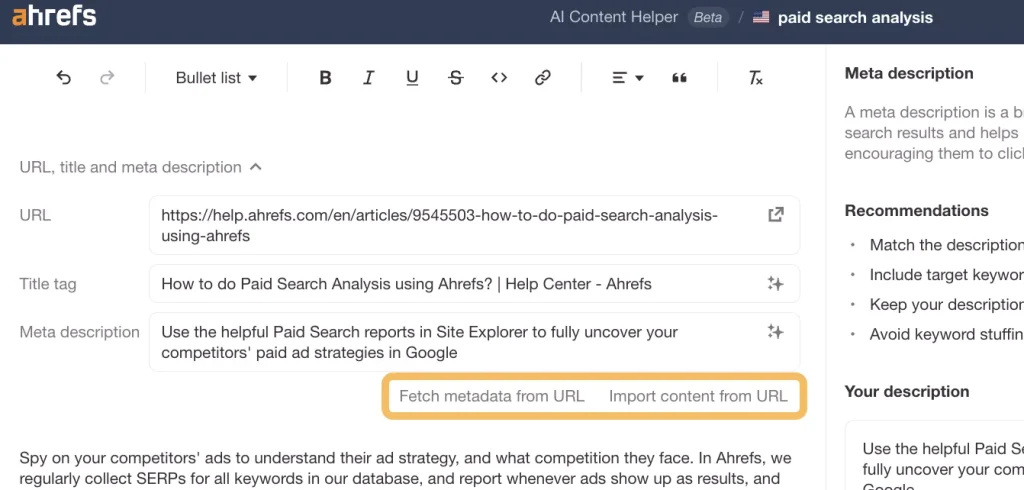
The process is simple:
- Paste in the URL of an existing article and choose the primary keyword you want to target.
- Let AI Content Helper compare your page with current top-ranking pages.
- Use the content score, topic list, and color-coded gaps to outline very specific updates: new sections, better examples, or improved explanations.
- Edit directly in the helper, update your CMS, and then monitor performance over time.
This makes it a practical tool for ongoing optimization, not just new content production. You can chip away at your most important pages one by one and give each of them a more complete, search aligned treatment without guessing what to fix.
Pricing and plans
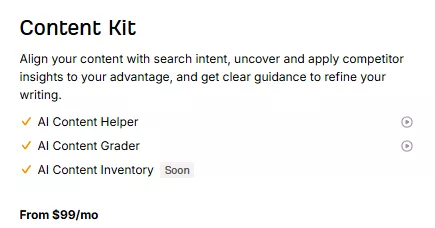
Ahrefs is very clear that AI Content Helper is a paid add-on, not a free tool tucked into the platform. There are two pricing layers to think about: your core Ahrefs plan and the Content Kit add-on that includes AI Content Helper. Content Kit pricing starts from 99 dollars per month.
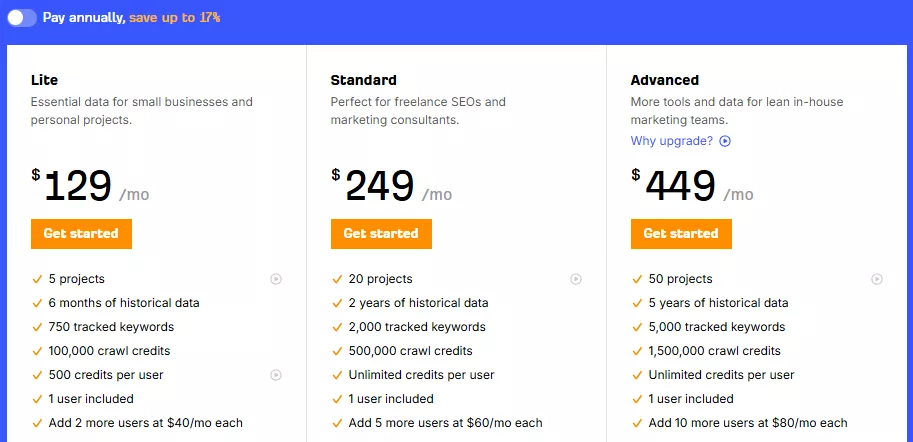
According to the pricing page, core plans start at: Ahrefs
- Lite – $129 per month
- Standard – $249 per month
- Advanced – $449 per month
- Enterprise – $1,499 per month (annual commitment)
A useful detail from Ahrefs’ own documentation is that AI Content Helper is available either as a standalone paid add-on or as part of Content Kit, and Content Kit itself can be purchased on its own without a full Ahrefs subscription. You manage this from Account Settings → Billing → Subscription.
Pros and cons
Pros
- Integrated directly into the Ahrefs tool, so you can move from keyword ideas and competitor research to content optimization without extra exports
- Helps you see topic gaps and coverage issues quickly using content score, topic lists, and color-coded overlays
- Provides practical AI features for metadata, structural edits, and feedback without forcing you to auto-generate entire articles
- Strong for content refreshes where you already have authority and backlink data, but need better coverage to keep ranking
Cons
- Requires an Ahrefs subscription plus a paid add-on, which makes it an expensive way to get a writing assistant if you do not need full Ahrefs features
- Optimizes content based on what competitors already cover, which can lead to “me too” content if you do not add unique insights
- Focuses on topic coverage and on-page SEO rather than broader tasks like SEO audit, technical fixes, or AI search tracking
Best alternative if you want a specialist content optimizer
If you like the idea of an AI-assisted content score and topic analysis, but do not need a full Ahrefs subscription, a dedicated content optimizer can be a better fit.
Tools like Rankability Content Optimizer focus only on search engine optimization for content.

Rankability combines IBM Watson and Google NLP to surface topic suggestions and keyword ideas and is built from the ground up for agencies and SEO professionals who write and optimize content at scale.
Unlike a broad SEO platform, a specialist optimizer centers everything on the writing workflow: content brief creation, optimization against live search results, and ongoing coaching for team members who handle content production.
Rankability is featured in independent comparisons of the best SEO content optimization tools as a strong option when you want the deepest engine for on-page SEO rather than a generalist SEO platform.
If you mainly care about the content layer and are willing to pair it with other free tools for things like AI detection tools or basic keyword research, a specialist may be the best alternative.
Is Ahrefs AI Content Helper worth it?
So, is Ahrefs worth adding AI Content Helper on top of your existing stack? It depends entirely on how you use Ahrefs today.
If Ahrefs is already the center of your search engine optimization workflow and you live inside Site Explorer, rank tracking, and other SEO metrics every day, then AI Content Helper is a logical extension. It helps you close content gaps faster, gives content teams clearer direction, and slots into a content strategy that you are already managing in Ahrefs.
If you are not an Ahrefs user, or you only need help to write high-quality articles that have a shot at featured snippets and better organic keywords, AI Content Helper is harder to justify. The pricing model, the dependency on a broader platform, and the focus on competitor content make it less attractive as a standalone writing assistant.
Used well, AI Content Helper is a solid optimization layer that can turn AI into a practical writing partner rather than a novelty. Just remember that no AI feature can replace a clear SEO strategy, thoughtful content writing, and consistent measurement of organic search traffic through tools such as Google Search Console and analytics. Use AI to guide, not to drive, and you will get the most from what Ahrefs AI Content Helper offers.