

INKforall is a popular starting point because it wraps a lot into one platform: an AI writer, SEO score-driven editing, templates for common writing tasks, and even add-ons like a plagiarism checker and image generation features (AI Image, Image Generator).

For many content creators, that “all-in-one” approach is enough to get drafts moving and reduce writer’s block.
But once you’re producing content at volume, the pain usually shows up in the optimization layer: tighter alignment to search intent, clearer SERP-led brief workflows, more reliable semantic coverage guidance, and repeatable systems for updating old content across multiple pages.
This guide focuses on INKforall alternatives that are first and foremost content optimization tools. In other words: tools that help you turn drafts into quality content that competes in search engines, and that help content marketers and marketing agencies standardize content production across blog posts, landing pages, and product descriptions.
Table of Contents
- Quick Picks (TL;DR)
- What We Looked For (and why it matters)
- Quick Comparison Snapshot
- The 7 Best INKforall Alternatives
- How to Choose Based on Your Use Case
- FAQs
- Conclusion
Quick Picks (TL;DR)
- Best overall for agencies: Rankability
- Best “score-as-you-write” experience: Surfer SEO
- Best research + brief + optimize combo: Frase
- Best for enterprise editorial teams: Clearscope
- Best for deep strategy and topic authority: MarketMuse
- Best for refresh workflows and monitoring: Dashword
- Best budget semantic optimizer: NeuronWriter
What We Looked For (and Why It Matters)
When you’re comparing alternatives, it’s easy to get distracted by AI copywriting tools and flashy content generation features. Those can help with speed, but optimization is what decides whether your content actually performs.
Here’s what matters most for choosing the best tools to improve SEO content quality:
- Search intent alignment (not just keywords): The tool should help you build pages that match what’s already ranking and why.
- SERP-led guidance: Better tools start with competitor analysis and on-page patterns, not just generic “add more terms” suggestions.
- Workflow fit: Brief → draft → optimize → publish → refresh. If you’re bouncing between docs and tabs, your system won’t scale.
- Ease of use: A clean user interface reduces friction for writers and editors, especially if you’re onboarding a team.
- Integrations: Google Docs support can be a big deal for content teams. Some tools also offer a browser extension for in-the-flow editing.
- Pricing options that scale: Look for realistic limits (word limit, usage caps, or credits) that match your output.
- Support and governance: If you’re a business owner or running a team, customer support and permissions matter more than one-off features.
Quick Comparison Snapshot
Pricing changes often, so verify on vendor pages before purchase.
| Tool | Best for | Starting price* | AI & Search Coverage | Notes |
|---|---|---|---|---|
| Rankability | Agencies and teams that want a repeatable optimization workflow | $149/mo | SERP-led briefs + live scoring + semantic coverage | Built for operational consistency across many pages |
| Surfer SEO | Writers who want fast, in-editor scoring | $199/mo | Live content score + NLP term guidance | Strong usability, popular for SEO articles |
| Frase | Research + briefs + optimization in one place | $45/mo | SERP research + outline/brief builder + optimizer | Solid for blog content at smaller team size |
| Clearscope | Editorial standards at enterprise scale | $129/mo | Keyword-driven grading + optimization suggestions | Great consistency for large content operations |
| MarketMuse | Strategy-first topical authority planning | $99/mo | Topic modeling + gap analysis + briefs | Strong for content strategy, heavier learning curve |
| Dashword | Ongoing refreshes and content upkeep | $39/mo | Briefs + optimizer + monitoring | Great for old content updates and reporting |
| NeuronWriter | Budget semantic optimization + language support | $23/mo | NLP-driven suggestions across many languages | Value option, UI can feel less polished |
*Starting prices change often – verify current pricing before purchase.
The 7 Best INKforall Alternatives
1. Rankability
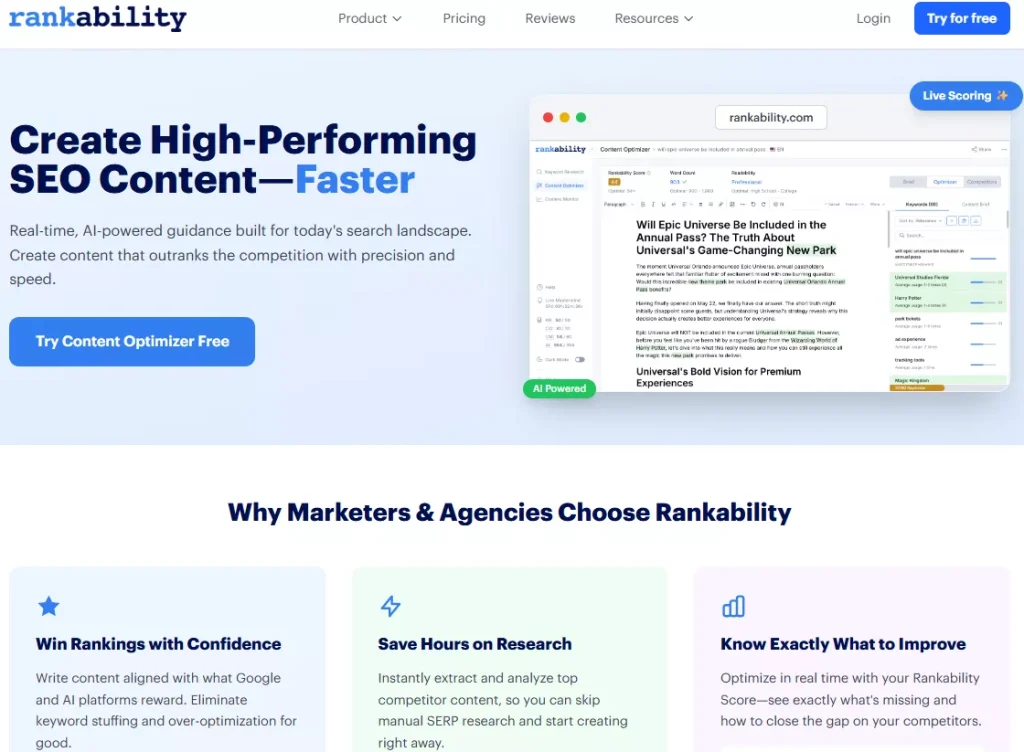
If you’ve outgrown INKforall’s “optimize inside a single editor” loop and you want a more systemized SEO optimization workflow, Rankability is built for that. It’s designed to make optimization repeatable, not just possible.
Best for
- Marketing agencies, SEO teams, and anyone managing consistent output across multiple clients or sites
Standout features
- SERP-led brief creation that keeps content creation anchored to real-world ranking patterns
- Live scoring and semantic guidance that’s practical for editors and writers, not just SEO specialists
- Workflow support that maps well to high-volume content production (briefs, optimization, refreshes)
Where it’s a stronger fit than INKforall
- You’re optimizing lots of pages and need consistent standards for quality content, not just “make the score go up”
- You care about knowledge management around how you build and update content, so the process is easier to repeat
Potential drawbacks
- If you mainly want a lightweight AI writer with lots of AI templates and quick content generation, it can be more “SEO tool” than you need
Pricing note
- Starts higher than many budget options, so it’s best when performance and consistency matter more than cheapest entry
2. Surfer SEO
Surfer SEO is the classic “score-as-you-write” alternative. If you liked INKforall’s task-based momentum, Surfer can feel familiar, but with a stronger focus on SEO content and a widely adopted workflow.

Best for
- Content marketers and writers shipping lots of blog posts who want fast optimization feedback
Standout features
- Real-time content score and clear optimization targets
- Strong adoption across teams because of ease of use
- Helpful when your writing needs are mostly SEO articles and blog article workflows
Where it’s a stronger fit than INKforall
- You want a tight editing loop with fewer distractions from non-SEO features like AI Image tools
- You want stronger alignment to what’s ranking, especially when you’re optimizing around search intent
Potential drawbacks
- Many teams still need a separate system for deeper SEO strategy and knowledge bases
- Limits and plan tiers can matter if you’re scaling volume
*Note: Surfer SEO joined Positive Group in an acquisition finalized in October 2025, so agencies should watch for shifts in packaging, pricing, and product direction.
3. Frase
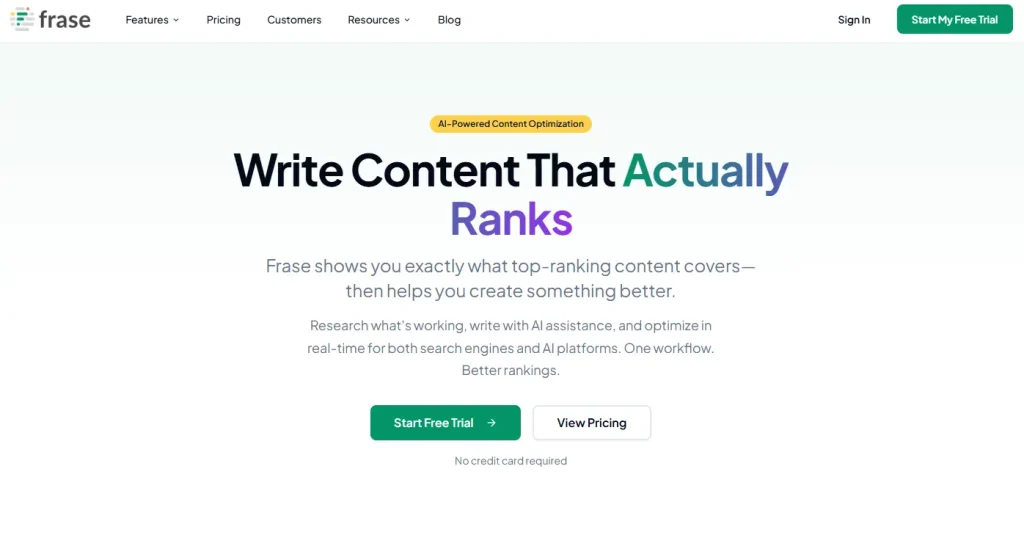
Frase is a great fit when you want research, outlining, and optimization under one roof. It’s often the “small team” alternative when INKforall starts to feel too template-driven and not SERP-driven enough.
Best for
- Solo creators and small business teams that need a practical research-to-brief workflow
Standout features
- SERP research that helps you build an outline that maps to real competitors
- Brief creation that supports long-form content without feeling overly rigid
- Useful for content creators who want to reduce writer’s block with structured inputs, not just more AI text
Where it’s a stronger fit than INKforall
- You want better upfront planning for blog content and content marketing
- You want the optimizer connected to research, not just an editor checklist
Potential drawbacks
- If you need deep enterprise governance or large-scale editorial ops, it may feel lightweight
4. Clearscope
Clearscope is built for teams that care about editorial standards and consistent output. If you’re publishing with many writers and editors, it’s one of the cleanest ways to keep content quality stable.

Best for
- Enterprise teams and high-output editorial operations
Standout features
- Clear grading system that’s easy to QA at scale
- Strong guidance for improving content quality without turning every draft into a robotic rewrite
- Plays nicely with editorial workflows when many stakeholders review the same page
Where it’s a stronger fit than INKforall
- You don’t need an all-in-one AI assistant or content generation suite. You want a focused optimization layer.
- You’re producing lots of pages where consistency matters more than creative variety
Potential drawbacks
- No “free plan” in the way some AI writing assistants offer
- The enterprise plan cost can be hard to justify for Small Business use cases
5. MarketMuse
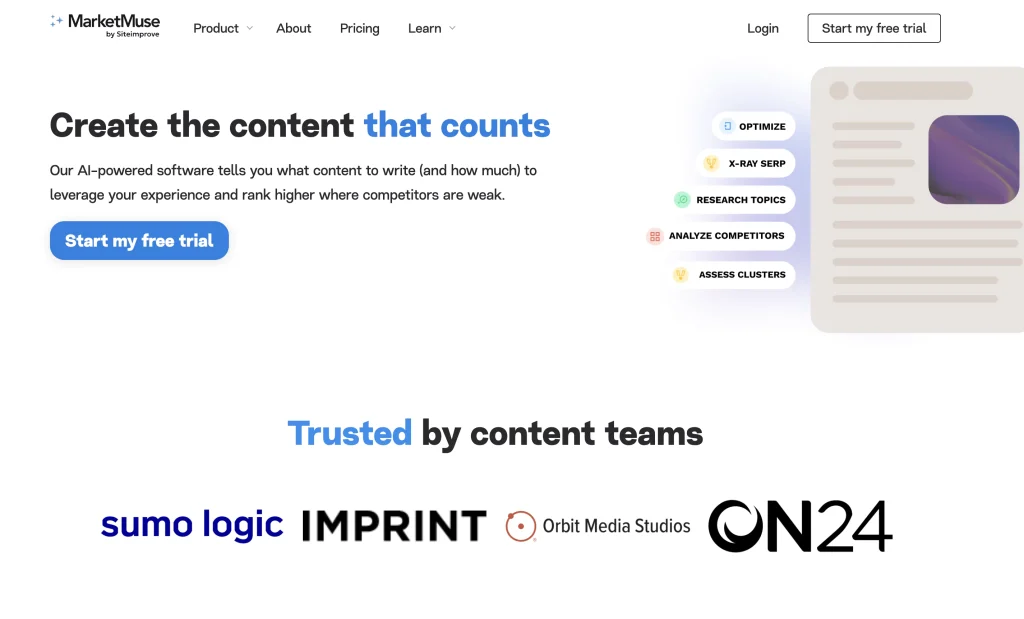
MarketMuse is the strategy-first pick. It’s not just “optimize this draft.” It’s “plan authority across the site, then optimize pages to match that plan.”
Best for
- Content strategists and teams building topical authority across many pages
Standout features
- Topic modeling and gap analysis to find what you’re missing
- Strong for planning content clusters and improving internal consistency
- Helps when you’re not just publishing blog posts, but also improving landing pages and evergreen hubs
Where it’s a stronger fit than INKforall
- You need stronger SEO strategy guidance than a score-driven editor loop
- You’re trying to build defensible coverage, not just publish more generated content
Potential drawbacks
- It can take longer to learn than simpler tools, and it’s less “instant gratification” than task cards
6. Dashword
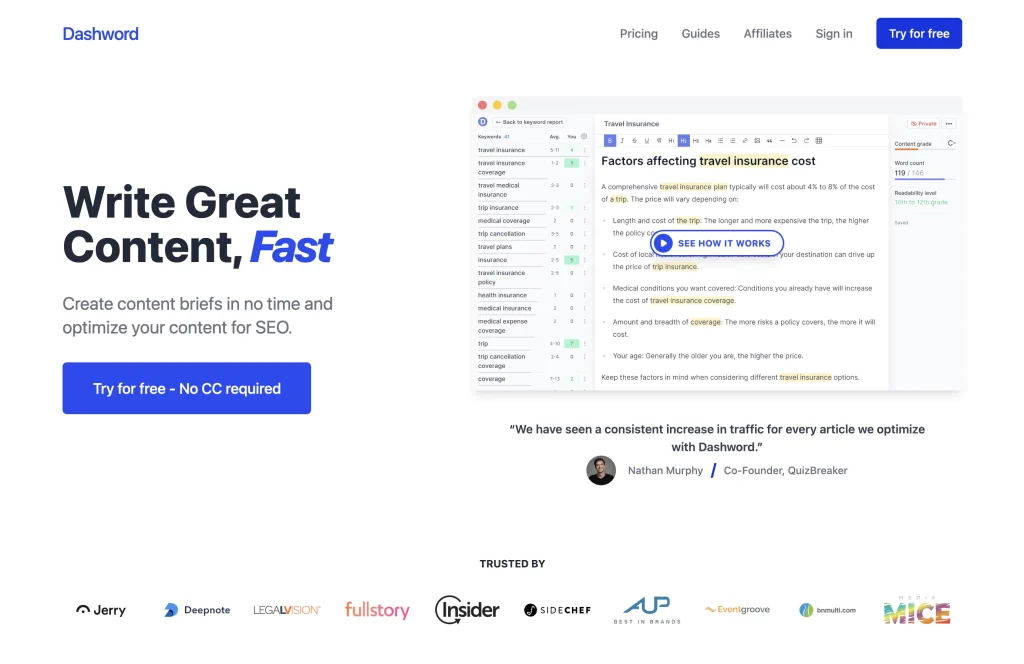
Dashword shines in the “keep content fresh” stage. If you’re updating old content regularly, it’s a straightforward system for refresh workflows.
Best for
- Teams managing a library of existing pages and older blog posts
Standout features
- Clear briefs and optimization guidance for refreshes
- Monitoring and upkeep features that help you prioritize what to update next
- Useful if you’re trying to protect search engine ranking gains over time
Where it’s a stronger fit than INKforall
- INKforall can help you optimize a page, but Dashword is built around ongoing content maintenance and prioritization
Potential drawbacks
- It’s less about broad AI-powered platform features like image generation or a big AI writer suite
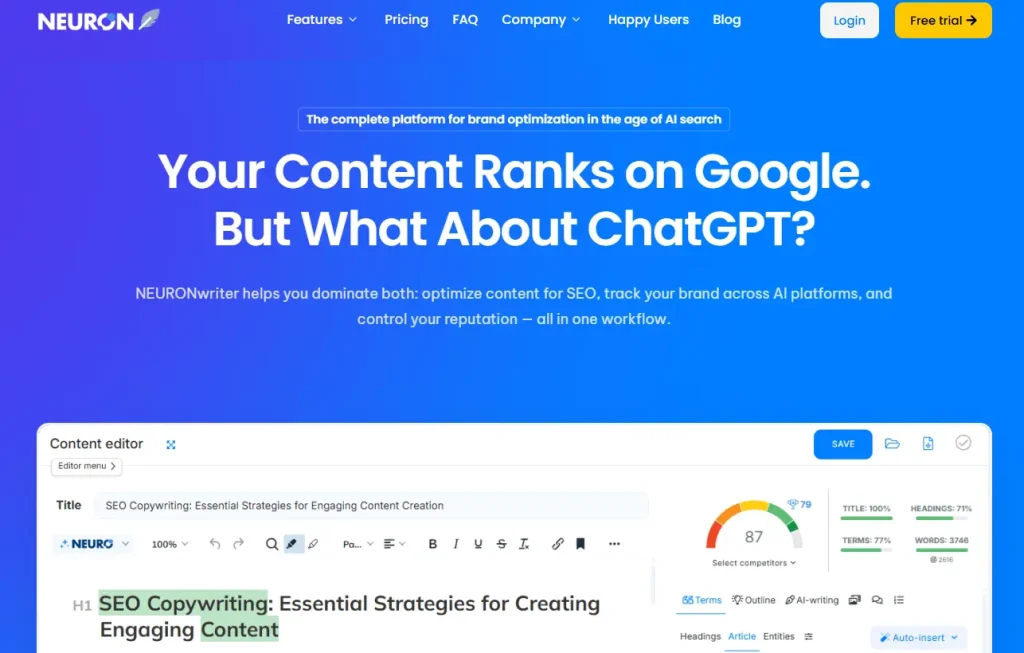
7. NeuronWriter
NeuronWriter is the budget alternative that still offers meaningful semantic guidance. If you need language support and a low starting cost, it’s often the value pick.
Best for
- Budget-focused teams, multilingual sites, and creators who want semantic suggestions without enterprise pricing
Standout features
- Strong language models coverage across many languages
- Helpful semantic recommendations for SEO content
- Useful for product descriptions and smaller-site optimization projects where cost matters
Where it’s a stronger fit than INKforall
- You want a straightforward semantic optimizer without a big stack of AI templates and ancillary tools
Potential drawbacks
- The user interface can feel less refined than premium tools
How to Choose the Right Alternative
- If you’re an agency: prioritize repeatable workflows, QA, and consistency across clients.
- If you’re a solo creator: prioritize research-to-brief speed and low friction in daily writing tasks.
- If you’re enterprise: prioritize governance, editorial standards, and predictable output.
- If you refresh content often: prioritize monitoring and a workflow for updating old content.
Also, don’t confuse “AI writing assistants” with “content optimization tools.” Jasper AI, Copy.ai, and similar AI-powered tools can help draft social media posts and quick copy, but they usually aren’t the best fit when the goal is improving SEO content inside competitive SERPs.
If you do rely on AI text heavily, make sure you still have a process that checks search intent, structure, and factual accuracy, not just a paraphrasing tool that produces unlimited words.
FAQs
Does INKforall have pricing tiers worth comparing?
Yes. INKforall pricing and plan limits can work well for individual creators, especially if you value an AI writer, templates, and a built-in plagiarism checker. The trade-off is that teams often want more SERP-led optimization depth once volume grows.
Do any of these include an AI writer or “Boss Mode” style command workflow?
Some tools offer AI writing and command-style drafting (sometimes called Command Mode), but the primary reason to choose the tools above is their optimization layer and workflow, not pure content generation.
What about tools that do keyword difficulty or full keyword research tools?
Those are useful, but this list is intentionally focused on content optimization. Many teams pair an optimizer with separate keyword research tools and reporting systems.
Do I need Google Docs integration?
If your writers live in Docs, it’s a major win. If your team writes directly in an editor, it’s less important, but it can still reduce friction.
Conclusion
INKforall is a solid starter if you want a broad marketing tool that covers AI writing, templates, and lightweight optimization in one place. But if you’re serious about scalable SEO success, the best alternatives are the ones that make optimization repeatable, not random.
If you want the most structured “brief → optimize → refresh” workflow that fits agencies and teams, Rankability is the one to evaluate first, especially if you’re trying to standardize how you ship improvements across many pages without losing quality.