

If you’re using Ryte primarily to improve on-page copy and publish stronger pages, you might be better served by a dedicated content optimizer.

Ryte’s broader value is website analysis across multiple pillars, but content teams often want a tighter workflow: build a content brief, write, optimize, and publish updates that actually move search results.
This guide focuses on Ryte alternatives and competitors that are purpose-built for improving content quality and enabling repeatable publishing. I’m not going to rehash the full “Compare Ryte” deep dive since there’s already a dedicated Ryte review.
Instead, we’ll focus on practical Ryte competitors you can evaluate when content performance is the priority, plus a quick note on what to do if you relied on Ryte as a Site Analyzer for broader website analysis.
Quick Picks (TL;DR)
- Best overall for agencies: Rankability
- Best “score-as-you-write” editor: Surfer SEO
- Best research + brief workflow: Frase
- Best for editorial precision: Clearscope
- Best for deep content strategy: MarketMuse
- Best lightweight optimizer for writers: Dashword
- Best budget semantic optimizer: NeuronWriter
What We Looked For (and Why It Matters)
- On-page scoring that drives action: You want clear page optimization priorities, not a vague checklist.
- SERP-led recommendations: Competitive pages should shape the suggestions, so you’re not optimizing in a vacuum.
- Workflow from keyword to publish: Strong tools support a content brief, drafting, and optimization without duct-taping docs together.
- Team fit and ease of use: Seat counts, collaboration, and a user-friendly interface matter when you’re scaling output across SEO teams.
- Signals beyond a single page: Some tools help with content strategy across a library, not just one post.
- Practical add-ons: Some platforms also include SEO monitoring, SEO metrics, and reporting features that reduce tool sprawl and help digital marketers tie content changes to outcomes.
Quick Comparison Snapshot
Pricing changes often, so verify on vendor pages before purchase.
| Tool | Best for | Starting price* | AI & Search Coverage | Notes |
|---|---|---|---|---|
| Rankability | Agencies that want briefs, optimization, and monitoring in one workflow | $149/mo | Dual NLP (Watson + Google), SERP-led optimization, AI writing, AI search visibility workflows | Built for client work and repeatable SEO reports, not just single articles |
| Surfer SEO | Content teams that want a live score while writing | $119/mo | Real-time scoring, NLP term guidance, content auditing, AI writing add-ons | Great for fast drafts and quick iteration on web pages |
| Frase | Solo creators and small teams that want research + briefs + optimization | $45/mo | SERP research, briefing, optimization, AI drafting | Strong value if you want research-to-draft-to-optimize in one place |
| Clearscope | Editorial teams that care about consistency and precision | $129/mo | Grading framework, term suggestions, content inventory workflows | Premium feel, great for standardizing content quality across writers |
| MarketMuse | Larger sites that need portfolio-level planning | $99/mo | Topic modeling, gap detection, prioritization, brief support | More strategic than “editor-first,” best for planning at scale |
| Dashword | Teams that want briefs + optimization with a clean UI | $39/mo | Brief builder + optimization workflow, AI writing support | Simple interface for content marketers and small businesses |
| NeuronWriter | Budget-focused semantic optimization | $23/mo | SERP analysis, semantic recommendations, AI writing support | Affordable, solid for SEO professionals who want pragmatic guidance |
*Starting prices change often – verify current pricing before purchase.
The 7 Best Ryte Alternatives
1. Rankability
Why it’s a strong Ryte alternative:
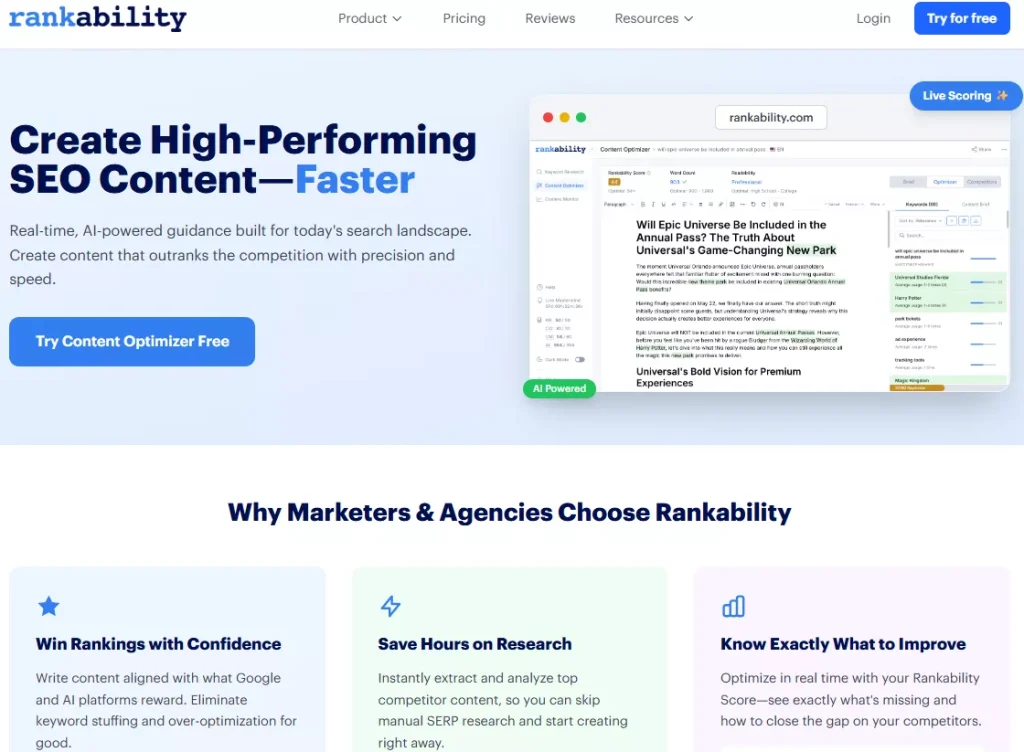
Rankability is built as an agency-grade content optimization system, not a general SEO platform. You get SERP-led recommendations, a structured workflow for briefs and updates, and a clear path from draft to measurable movement in search engine rankings.
Best for:
SEO teams and agencies that need repeatable delivery, consistent quality, and clear proof-of-work outputs.
Standout features:
- Dual NLP approach (Watson + Google) for richer topic coverage
- Optimizer workflow designed around fixing what’s actually holding pages back
- Built-in systems for running consistent campaigns across clients
- Reporting and monitoring features that help you connect changes to website traffic and broader online presence
When it’s the right fit:
If you’re running content as a production line, Rankability is strong because it supports the entire process, including the “what changed and why did rankings move?” conversation clients always ask.
Customer support and adoption:
For most teams, the difference between “we bought a tool” and “we actually use it” comes down to onboarding, clarity, and support. Prioritize tools with responsive customer support and training resources, especially if multiple stakeholders are involved.
2. Surfer SEO
Why it’s a strong Ryte alternative:
Surfer is popular because it makes optimization feel immediate. The editor is centered on real-time scoring and clear term guidance, which is ideal for teams that want to move fast and ship improvements consistently.

Best for:
Content teams that want a “write, optimize, publish” loop with minimal friction.
Standout features:
- Live scoring while you write
- Built-in competitor analysis that keeps recommendations grounded in the current SERP landscape
- Auditing features to support refreshes, updates, and ongoing SEO optimization
- Useful for quickly improving high-impact pages without overcomplicating the workflow
Practical note:
If your writers love checklists and instant feedback, Surfer tends to click quickly, which is often a big win for content marketing execution.
*Note: Surfer SEO was acquired by Positive Group in October 2025, which likely means tighter integration with a broader marketing ecosystem and a bigger push into AI-powered SEO features.
3. Frase
Why it’s a strong Ryte alternative:
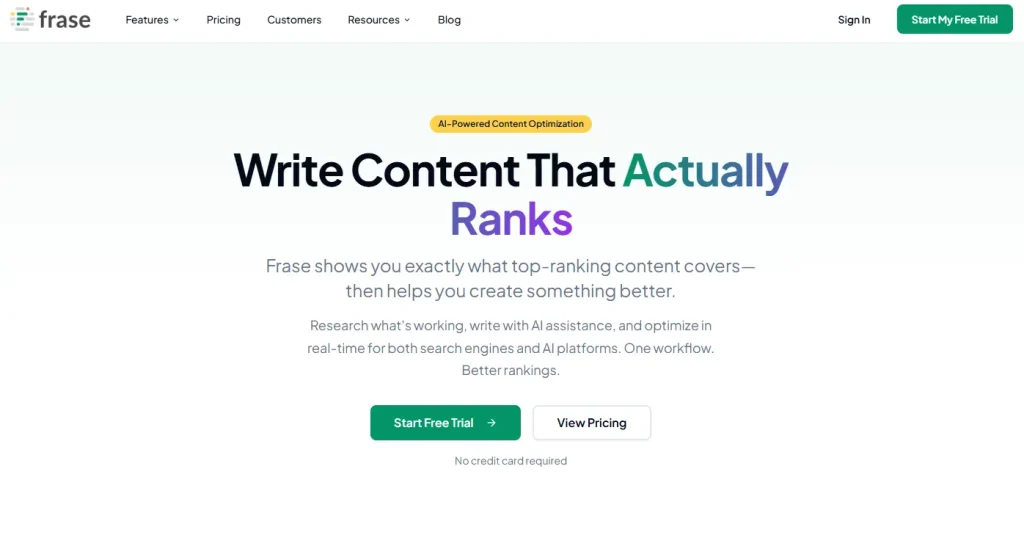
Frase shines when research time is the bottleneck. It’s built to reduce manual SERP scanning and help you produce stronger outlines and drafts, then optimize them in the same environment.
Best for:
Solo operators, lean in-house teams, and anyone who wants a streamlined research-to-draft pipeline.
Standout features:
- Research workflows that accelerate outline creation and briefing
- A practical keyword research tool style experience for topic discovery and question coverage
- Optimization layer to tighten coverage and improve search results performance
Why teams choose it:
For digital marketers doing both strategy and writing, Frase can replace a lot of scattered tabs with one focused workflow.
4. Clearscope
Why it’s a strong Ryte alternative:
Clearscope is built for editorial standards and consistency. The grading approach helps teams align on what “good” means, especially when multiple writers are involved and you’re optimizing at scale.

Best for:
Editorial teams and agencies that want consistent quality control across a content library.
Standout features:
- Clear grading framework that helps align writers and editors
- Strong guidance for topic completeness and high-quality on-page improvements
- Helpful for creating internal standards that scale across a team
User reviews angle:
When you’re evaluating a tool like Clearscope, user reviews can be especially helpful because most feedback centers on consistency, editor experience, and whether teams stick with the workflow over time.
5. MarketMuse
Why it’s a strong Ryte alternative:
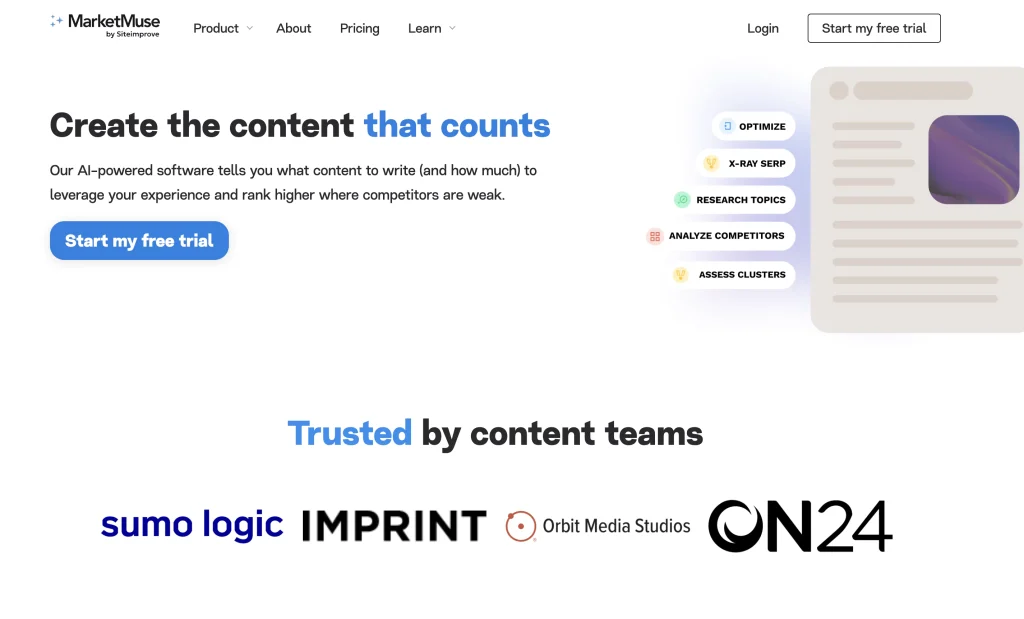
MarketMuse is less about tweaking a single draft and more about making better decisions across a whole site. If your biggest problem is “what should we write next and where are we weak,” it’s one of the more powerful tools for data analysis and planning.
Best for:
Content leaders managing large sites who need prioritization and gap identification.
Standout features:
- Topic modeling and competitive gap detection
- Prioritization that supports long-term SEO strategies and smarter planning
- Insights that help website owners decide what to update versus what to create from scratch
What to expect:
It’s geared toward advanced features and planning, so it’s best when your bottleneck is strategy, not just drafting.
6. Dashword
Why it’s a strong Ryte alternative:
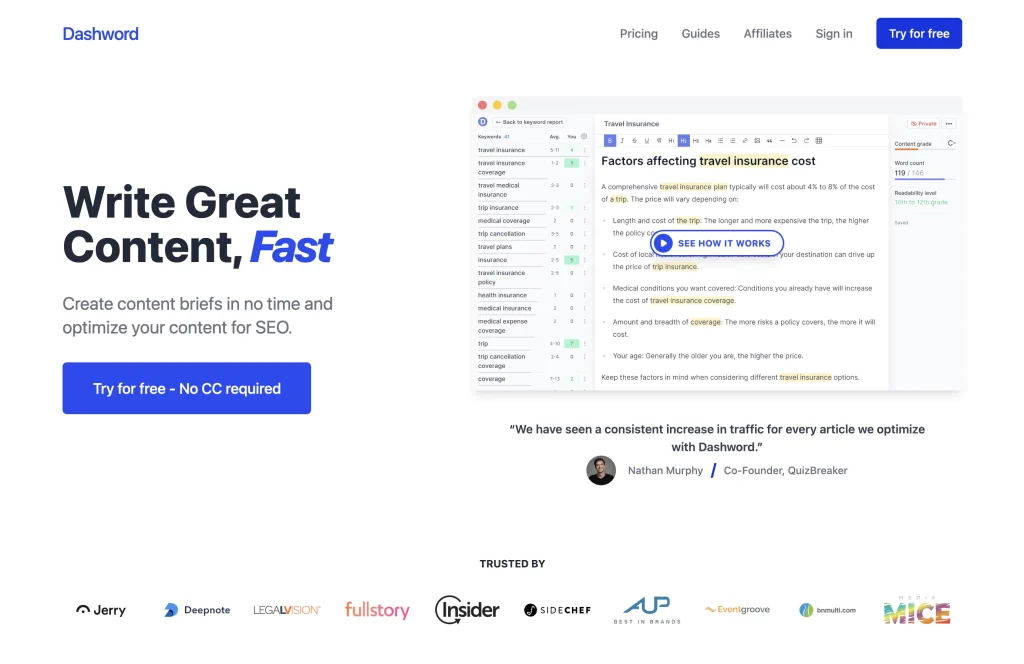
Dashword keeps the workflow clean. It’s particularly useful if you want a straightforward brief builder and optimizer without an overly complex UI.
Best for:
Content marketers and small businesses that want to ship better pages quickly.
Standout features:
- Clean content brief workflow that’s easy to hand to writers
- Practical optimization steps that don’t overwhelm the user
- A quick path from draft to publish for teams that need consistency
Reporting note:
If you need custom reports for stakeholders, make sure the tool’s export options match your workflow, or plan to layer reporting elsewhere.
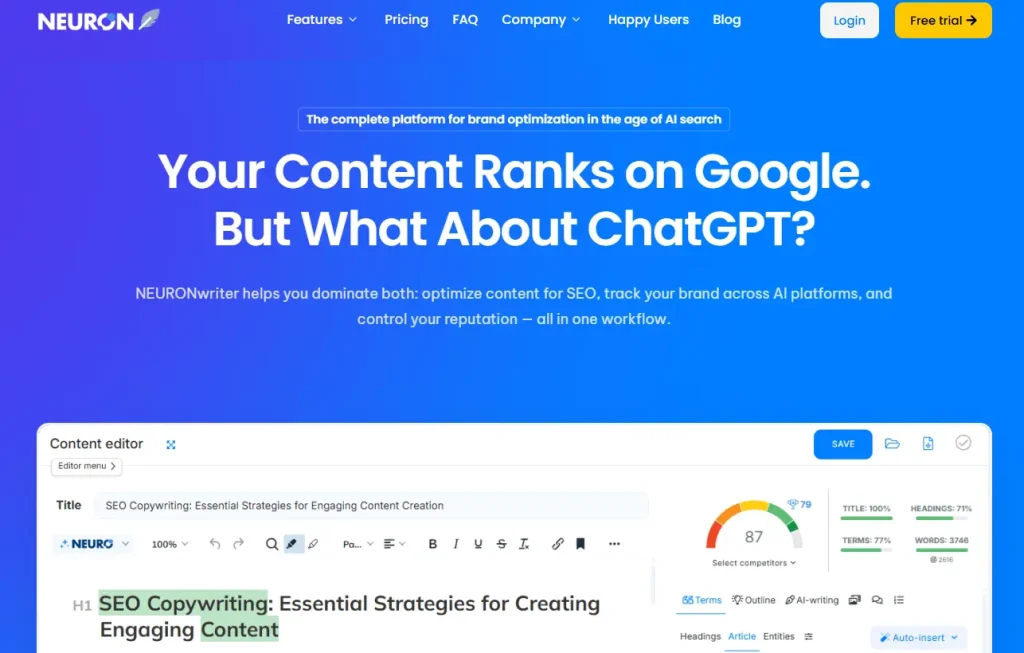
7. NeuronWriter
Why it’s a strong Ryte alternative:
NeuronWriter is a budget-friendly option that still brings meaningful semantic guidance to your workflow. It’s a good fit when you want practical improvements without premium pricing.
Best for:
Budget-conscious teams that still want semantic coverage guidance.
Standout features:
- SERP-based semantic suggestions
- Editor workflow that supports improvement without heavy overhead
- Practical option for optimizing at volume
Budget note:
If you’re specifically hunting for free alternatives, most serious optimizers still gate key features behind paid tiers. In that case, focus on lowest-cost plans that still deliver useful guidance.
How to Choose the Right Tool
If you’re comparing the best tools to create SEO-optimized content, choose based on your bottleneck:
- Need an agency-grade workflow and repeatability: Rankability
- Need the fastest editor loop with a clear score: Surfer
- Need research, outlines, and optimization in one place: Frase
- Need editorial consistency across writers: Clearscope
- Need strategic planning across a large content library: MarketMuse
- Need a lightweight tool your team will adopt quickly: Dashword
- Need budget semantic guidance: NeuronWriter
What if you used Ryte for site audits?
If Ryte was your primary Website Audit solution, you might still want a specialized crawler alongside any content tool. Many teams pair a content optimizer with Screaming Frog for technical crawling and duplicate content checks, which helps surface SEO issues that content scoring won’t catch.
If you’d rather keep everything inside a broader SEO Platform, suites like SE Ranking or Moz Pro can cover additional layers like rank tracking, backlink analysis, and SEO monitoring, then you can add a dedicated optimizer only if you need deeper content workflows. The key is not forcing a content tool to become your all-in-one site analyzer.
Where AI fits (and where it doesn’t)
Most of these tools now include AI-powered SEO features, and some even add AI chatbots or drafting helpers. The best use of AI tools here is speeding up research, outlining, and iteration, while the core optimization decisions should still be grounded in competitive analysis and what’s actually winning in the SERP.
Also, don’t confuse “AI writing” with “better rankings.” High performance still comes from relevance, structure, and clear value, plus a clean technical foundation.
Related: Best AI Search Rank Tracking Tools
Conclusion
Ryte can be strong for broad website performance oversight, but when your main goal is improving content quality and pushing keyword rankings upward, a dedicated optimizer is usually the better buy. Start with the tool that matches your workflow, then evaluate how quickly you can produce valuable insights and detailed reports your team can act on.
If you want a more agency-ready system that’s built around repeatable execution and clear outcomes, Rankability is a smart place to start, especially when you’re managing multiple stakeholders and need a process your team will actually run.