

If you’re evaluating Scalenut alternatives, you’re usually trying to solve one of three problems:
- You want more reliable optimization guidance (less fluff, more “this is what ranks”)
- You need a cleaner workflow for briefs, writers, editing, and updates
- You want your content to perform not just in Google, but across AI-influenced discovery too

This guide compares seven credible options across optimization accuracy, research depth, team workflow, and starting price.
Quick Picks (TL;DR)
- Best overall for agencies and content teams: Rankability
- Best “optimize-as-you-write” experience: Surfer SEO
- Best value for research + briefs: Frase
- Best for editorial teams with strict standards: Clearscope
- Best for strategy, topical planning, and prioritization: MarketMuse
- Best for refresh workflows and monitoring: Dashword
- Best budget-friendly optimizer: NeuronWriter
What we looked for (and why it matters)
- Optimization quality: Are topic/entity suggestions consistently relevant, or do they push filler?
- Research depth: Can you quickly see patterns in top results and build a better outline?
- Workflow fit: Does it support briefs, collaboration, and exporting cleanly to your writing process?
- Update capability: Can you revisit content later, re-optimize, and track what changed?
- AI usefulness: Does AI accelerate the work without creating generic output?
- Price-to-value: Does cost scale reasonably as you publish more?
Quick Comparison Snapshot
*Pricing changes often, so verify on vendor pages before purchase.
| Tool | Best for | Starting price* | AI & Search Coverage | Notes |
|---|---|---|---|---|
| Rankability | Agencies and teams that want reliable optimization + workflow | from $124/mo (billed annually) | Google-first optimization + AI-assisted briefs/writing | Strong end-to-end content workflow (brief → optimize → monitor) |
| Surfer SEO | Teams that want fast, guided optimization inside an editor | $99/mo | Google-first optimization + AI writing options | Great for production velocity, can get “score chasing” if unmanaged |
| Frase | Lean teams that want research → brief → optimization value | $45/mo | Google + strong AI-assisted research/optimization | Best bang-for-buck for briefing and quick drafts |
| Clearscope | Editorial teams that need consistency and governance | $189/m | Google optimization + some AI visibility features | Premium feel, built for quality control and content inventory |
| MarketMuse | Content strategy, topical planning, and prioritization at scale | $99/mo | Google-first strategy + AI-driven planning | Excellent for “what to write next” and authority building |
| Dashword | Refresh workflows, briefs, and ongoing content upkeep | $39/mo | Google-first optimization + content monitoring | Simple, clear briefs and refresh-first mindset |
| NeuronWriter | Budget optimization with SERP-based guidance | $23/mo (annual) | Google-first optimization + AI drafting | Solid value, UI and depth vary by tier |
*Starting prices change often. Treat these as “from” numbers.
The Alternatives
1. Rankability (Best overall)
If you want optimization guidance you can trust and a workflow your team can actually run, Rankability is the strongest Scalenut alternative on this list. It’s built around a simple loop: build a brief, optimize the draft with live guidance, then monitor performance so you know what to refresh later.
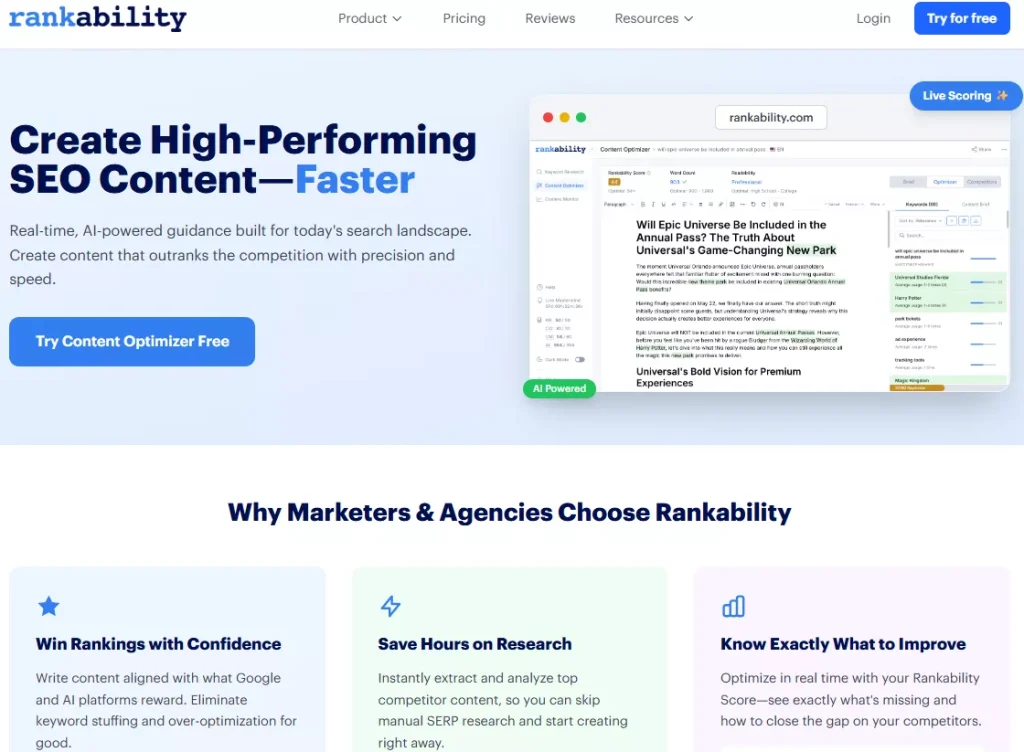
Instead of treating “content optimization” as a one-time score chase, Rankability leans into repeatable production. That matters for agencies and teams publishing weekly, managing multiple writers, and needing consistent output quality across clients or business units.
Good fit if: You want a system your team can run repeatedly without turning optimization into busywork.
2. Surfer SEO
Surfer is popular because it’s immediately usable. You open the editor, paste a draft, and it tells you what to add, remove, or adjust. For teams moving fast, that “in-editor guardrail” is valuable.

Where Surfer shines is speed and adoption. Writers tend to “get it” quickly, and you can standardize production without building a complicated SOP from scratch.
The caution is the same one that applies to any score-driven tool: if your team optimizes for points instead of outcomes, content can become bloated. The fix is simple: treat recommendations as prompts for coverage and clarity, not a checklist you must hit 100%.
Good fit if: You want fast onboarding and a straightforward editor that helps writers self-correct.
Note: Surfer SEO announced in late October 2025 that it was acquired by Positive Group (formerly Sarbacane Group). If you’re an agency, this is worth paying attention to because acquisitions can impact product direction, packaging, pricing, and support over time.
3. Frase
Frase is a strong Scalenut alternative when you care about research and briefing speed. It’s particularly good at helping you assemble an outline quickly, identify common subtopics from top pages, and turn that into a draft your writers can work from.
For lean teams, Frase often replaces multiple steps: SERP review → outline → brief → initial draft. If you’re trying to tighten cycle time from “keyword to publish,” it’s a practical option.
Good fit if: You want a high-leverage research-to-brief workflow without enterprise pricing.
4. Clearscope
Clearscope tends to show up in teams that prioritize brand and editorial quality, not just speed. It’s a great fit when you need consistent standards across many writers, editors, and stakeholders.

It’s also useful when optimization is part of a larger governance process: content inventory, prioritization, and maintaining quality across existing pages. If your workflow includes approvals and multiple revisions, Clearscope fits that environment well.
Good fit if: You have an editorial operation and want consistent, repeatable quality control.
5. MarketMuse
MarketMuse is less about “fix this draft right now” and more about “build authority over time.” It’s a strategic tool that helps you plan clusters, find gaps, and prioritize what to publish next.
If you’re making decisions at the portfolio level, MarketMuse is strong. It’s especially useful when your biggest constraint isn’t writing, it’s picking the right content bets and building topical depth in a structured way.
Good fit if: You’re scaling content and need better prioritization and authority-building strategy.
6. Dashword
Dashword is a clean Scalenut alternative for teams that care about two things: solid briefs and keeping content updated. It’s simple and focused, which is a feature, not a downside.
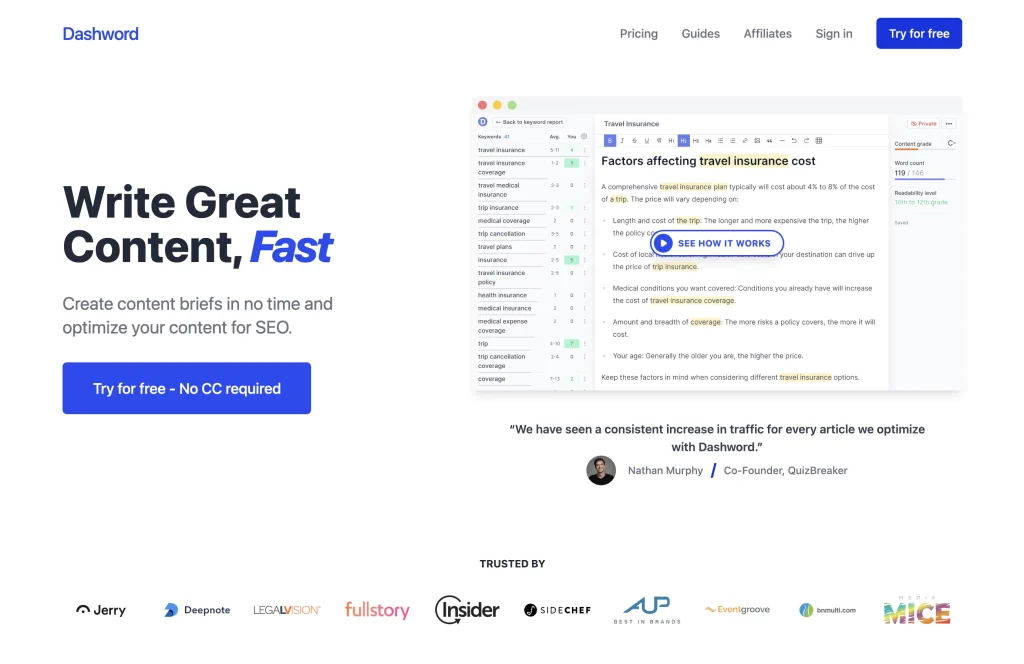
If you’re running a refresh program (updating existing pages regularly), Dashword’s approach can make that much easier to operationalize. It tends to work best when your team wants clarity, not complexity.
Good fit if: You want a refresh-first workflow and straightforward briefs.
7. NeuronWriter
NeuronWriter is often the “good enough” optimizer for smaller teams. You still get SERP-driven guidance and a scoring framework to reduce guesswork, plus AI drafting features depending on tier.

It’s not trying to be an enterprise governance platform. It’s a budget-friendly optimizer that can help you cover the right topics and structure content more competitively than writing blind.
Good fit if: You want a low-cost optimization tool that still gives real direction.
Scalenut vs these alternatives: when to switch
Scalenut is positioned as an all-in-one platform: planning, writing, and optimization in one place. That’s helpful when you’re starting out or you want fewer tools.
Switch when one of these becomes true:
- You need higher-trust optimization guidance. If recommendations don’t consistently map to what’s ranking, you’ll waste time.
- You need a cleaner team workflow. Agencies and multi-writer teams usually outgrow “one person in one doc.”
- You care about refresh and durability. Publishing is only half the game. Keeping winners winning matters.
- You want more than a draft generator. AI drafts are easy. A repeatable process that produces winners is harder.
If you’re comparing top tools for optimizing content for SEO, focus less on who has the most features and more on which one your team will actually run every week.
Migration checklist (Scalenut → new tool)
- Export your content plan: keywords, clusters, priority pages, and status
- Standardize your brief template: audience, intent, angle, proof points, internal links, CTAs
- Rebuild your optimization rules: what you’ll accept vs ignore (avoid score chasing)
- Map your workflow: who briefs, who writes, who optimizes, who QA’s, who publishes
- Pick a pilot set: 5–10 pages you’ll optimize end-to-end and measure
- Create a refresh cadence: decide how often winners get re-checked and updated
- Document your SOP: so output quality doesn’t depend on one person
FAQs
Do content optimization scores guarantee rankings?
No. Scores can help you avoid obvious gaps, but rankings come from matching intent, being genuinely helpful, and earning trust signals over time. Use scores as guidance, not the finish line.
Should I use a separate AI writer and a separate optimizer?
You can, but it often creates workflow friction. If your optimizer includes briefs, editing guidance, and exports, you’ll move faster and get more consistent outcomes.
Which tool is best for agencies?
Typically, the best agency fit is the one that supports multi-client workflows, consistent briefs, collaboration, and a repeatable optimization process.
What’s the biggest mistake teams make with these tools?
Turning optimization into checklist writing. If you add terms just to hit a score, content gets longer but not better.
What matters more: briefs or optimization?
Briefs. A strong brief makes the draft good before optimization even starts. Optimization should be refinement, not rescue.
How often should I refresh content?
For important pages: start with a monthly check. For everything else, quarterly is a solid baseline. Adjust based on volatility in your niche.
Conclusion
Scalenut is a solid all-in-one starting point, but once you care about repeatability, team workflow, and long-term performance, you’ll usually get better outcomes with a tool built specifically for optimization and operations. If you want the most “agency-ready” option on this list, Rankability is a strong first place to look.