

Seobility is best known as an all-in-one SEO platform, but it also includes a dedicated content optimization feature set centered on TF*IDF analysis and an in-app editor.

If your goal is to tighten topical relevance on a page by comparing it against top-ranking competitors, Seobility’s content tools can help you do that without adding another standalone platform.
This review focuses only on Seobility’s content-related features, specifically the TF*IDF Content Optimization Tool and the adjacent Keyword Research Tool that supports content planning.
Quick summary
Seobility’s content optimization workflow is TF*IDF-driven: it analyzes top-ranking pages, identifies relevant terms and missing topics, then gives recommendations on which terms to use and how often. You can also edit and optimize directly in Seobility’s live editor.
Seobility is a strong fit if you want:
- A straightforward “compare my page vs the SERP” optimization loop
- Term and topic gap detection that’s easy to apply quickly
- A lightweight editor-based workflow for refreshing existing pages
What Seobility’s content optimization tool is
Seobility’s TF*IDF Content Optimization Tool is designed to help you optimize new or existing content based on an analysis of top-ranking pages. From there, it focuses on practical outputs:
- Identifying relevant terms and missing topics
- Recommending which terms to use and how often
- Letting you edit and optimize directly in a live editor
This is not positioned as a full “briefing suite” today. Seobility does reference a content brief feature as “coming soon,” so you should treat briefing as roadmap rather than a core part of the current content optimization workflow.
Who it’s best for
Best for
- Site owners and marketers who want fast, clear guidance to improve an existing page
- Teams that prefer a simple editor workflow over a full content production pipeline
- SEOs who like TF*IDF-style recommendations as a final pass before publishing
Not ideal for
- High-output content teams that need deep briefing, drafting, and review workflows inside one content tool
- Agencies that need a structured, repeatable process across many clients and writers
Feature breakdown
1. TF*IDF analysis (the core optimizer)
This is the centerpiece. Seobility analyzes top-ranking pages and uses TF*IDF to determine which terms appear to matter in the SERP landscape, then compares that against your content.

How to use it (quick SOP)
- Choose your keyword and set the search engine and result count for analysis.
- Run the analysis and review the “missing topics” and term recommendations.
- Apply changes in the live editor, starting with headings and section coverage first, then refining term usage.
2. Recommendations: terms, frequency guidance, and topic gaps
Seobility explicitly frames its output as “clear recommendations on which terms to use and how often,” plus identification of missing topics.

One practical note: frequency guidance is most useful when it’s treated as a directional signal. If you try to “hit the number” mechanically, you can end up with repetitive copy. Used with editorial judgment, it’s a solid way to catch obvious coverage gaps.
3. Live editor (apply optimizations in-app)
A standout convenience is that Seobility lets you “edit and optimize your content directly” in its live editor.
That matters because TF*IDF tools often fail at the last mile: exporting lists of terms is easy, but actually turning them into better content takes time. Having edits inside the same interface keeps the loop tight for refreshes and incremental improvements.
4. Keyword Research Tool (content planning support)
While not the content optimizer itself, Seobility’s Keyword Research Tool supports content planning by generating related keyword ideas (including questions and related searches) and letting you analyze a URL or domain to see which keywords it ranks for.

For content work, this is useful for:
- Expanding subtopics and FAQs
- Finding secondary keyword angles to include in the outline
- Spotting competitor topic coverage you may have missed
Pricing considerations
Seobility offers three plans:
- Basic: Free
- Premium: 14-day free trial, then $50/month
- Agency: $200/month

From a content optimization standpoint, the key detail isn’t just the monthly price. It’s that Seobility uses a pooled usage model called “tool requests per day.”
The TF*IDF tool and Keyword Research tool both draw from this same shared daily request limit (along with other Seobility tools). That means heavy content teams can run into the cap faster than expected if they’re using multiple tools throughout the day.
Practically, it’s worth mapping out how many tool requests you’ll use per page (keyword research + TF*IDF runs + re-checks) so you can choose the plan that fits your publishing volume.
Pros and cons
Pros
- Clear TF*IDF-based optimization tied to top-ranking page analysis
- Identifies missing topics and provides term usage guidance
- Built-in live editor makes implementation faster
Cons
- TF*IDF and frequency guidance can encourage “term chasing” if used without editorial judgment
- Content brief tooling is referenced as “coming soon,” so current workflow is more “optimize” than “brief-first”
- Daily tool request limits may not scale well for agency-level publishing volume
A strong alternative to consider (especially for agencies)
If your content workflow is less about “optimize a page with TF*IDF” and more about producing consistently better pages at scale, it can help to look at a content optimizer that’s designed around agency workflows.
Rankability’s Content Optimizer is a strong alternative when you need:
- A more structured content system for production teams (not just post-draft optimization)
- Competitive inputs that go beyond traditional SERPs, including competitor discovery via AI platforms that influence what gets cited and recommended
- Knowledge-base grounded drafting support so outputs stay on-brand and fact-anchored across clients
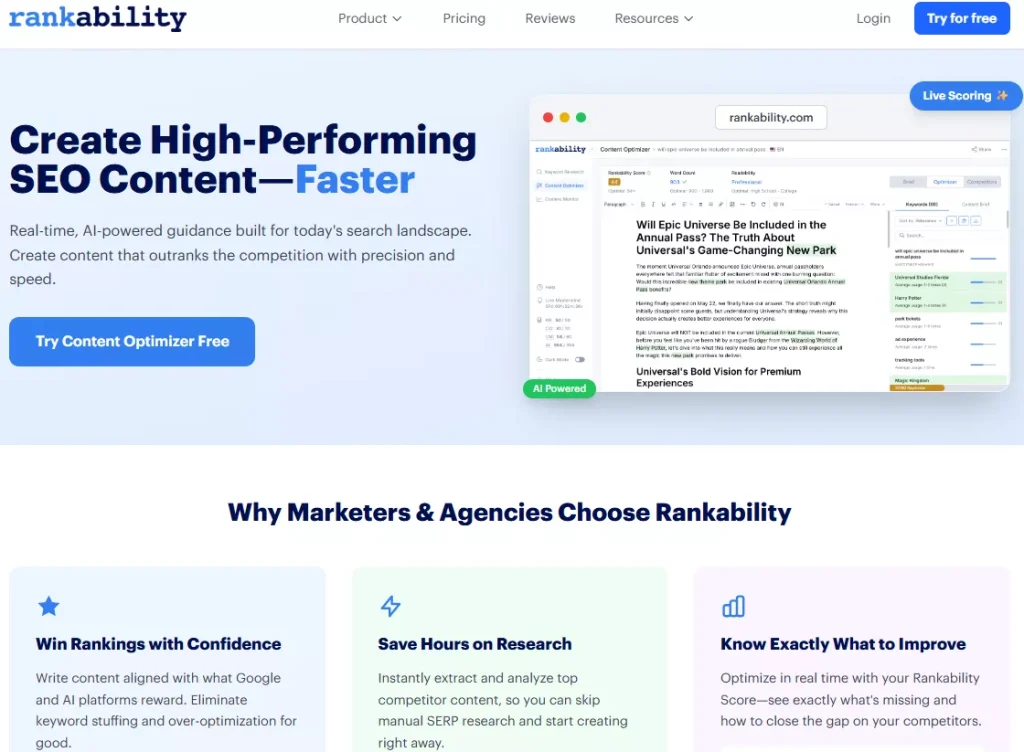
If you’re comparing options broadly, this guide to the top content optimization tools for SEO can help you shortlist based on your workflow and volume.
Verdict
Seobility’s content optimization features are a practical fit for marketers who want a clear, SERP-informed TF*IDF loop with recommendations you can apply quickly in a live editor.
If you’re mainly refreshing existing content and want straightforward guidance, Seobility can do the job well. If you’re an agency or production team that needs a more scalable, brief-to-output system with broader competitive inputs and stronger guardrails around accuracy and brand consistency, you’ll likely be happier with a dedicated content optimizer built for that workflow.