

If you run an agency, the real question about SEOmonitor isn’t “what does it do?” — it’s “is it worth it for managing multiple client campaigns, and what else should we compare before we commit?” This review answers both.
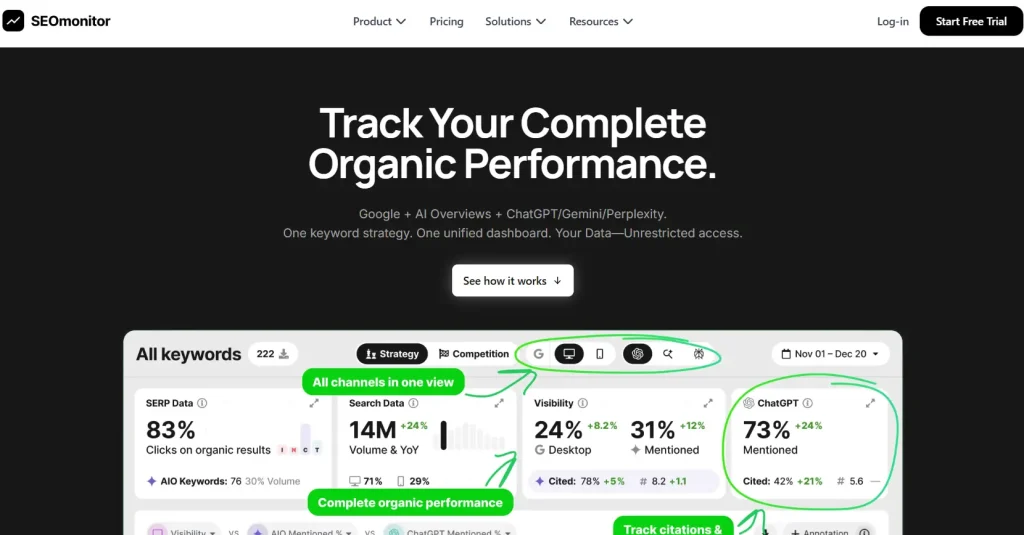
SEOmonitor is best known as an SEO platform for agencies, and its Content Writer is one of its more useful features because it connects content creation to existing SEO campaigns, keyword data, Content Audit opportunities, ranking pages, and post-publish performance tracking. That campaign-connected approach is what makes it different from content optimization tools that only hand you a score or a list of terms to add — and it’s the part agency buyers care about most when deciding whether it earns a seat in the stack.
This review is written for agency owners and in-house leads who are weighing the buy-or-compare decision. It focuses on the content-related workflow — topic discovery, article strategy, brief creation, AI-assisted drafting, real-time optimization, published article tracking, and how the tool fits a repeatable, multi-client SEO process — because that’s where SEOmonitor either fits your delivery system or it doesn’t.
It does not re-review SEOmonitor’s full Ranktracker, backlink analysis, Local SEO, link building, forecasting feature, or SEO Reporting tools except where those features directly support the content workflow. And because no agency should buy a platform without weighing the field, we point you to the full comparison further down so you can decide with eyes open.
Quick Summary
SEOmonitor Content Writer is best for SEO teams and agencies that want to move from keyword opportunities to optimized content without jumping between Google Sheets, keyword research tools, AI tools, content briefs, and separate reporting dashboards.
Its biggest strength is that it uses your existing SEO campaign data. SEOmonitor says Content Writer can help teams create SEO-focused content from opportunities found in Content Audit, then track published articles across Google rankings, AI Overview citations, and brand mentions in ChatGPT, Gemini, and Perplexity.
That makes it useful for turning keyword opportunities into SEO content, creating outlines from ranking pages, drafting with AI, optimizing content in real-time, and tracking SEO performance after publishing.
The tradeoff is that SEOmonitor may feel more platform-heavy than necessary if you only need a lightweight content optimization tool, and its per-article and platform pricing can add up across a portfolio of clients.
Is it worth it for your agency? It’s a strong yes if you already live inside SEOmonitor for keyword tracking and reporting; it’s more of a “compare first” if content production is your real bottleneck. Before you commit, read our breakdown of the top SEOmonitor alternatives for agencies so you can weigh it against the tools agencies most often switch to.
Table of Contents
- What Is SEOmonitor Content Writer?
- Who Is SEOmonitor Best For?
- Key Content Optimization Features
- SEOmonitor Content Writer Pros and Cons
- Ease of Use
- SEOmonitor Pricing and Free Trial
- SEOmonitor Content Writer Alternatives
- FAQs
- Final Verdict
What Is SEOmonitor Content Writer?
SEOmonitor Content Writer is an AI-powered content writing and optimization workflow inside SEOmonitor.
It helps SEO professionals turn opportunities from Content Audit into new, optimized content. According to SEOmonitor’s Help Center, Content Writer is built to close the gap between your campaign and the top 10 ranking pages by creating outlines, generating articles, and giving optimization guidance based on specialized metrics.
In plain English, it helps you go from:
“We found a content opportunity”
to:
“Here’s the outline, draft, optimization guidance, and performance tracking.”
The basic workflow looks like this:
- Find a content opportunity
- Choose an article strategy
- Generate an SEO-focused outline
- Create an AI-assisted draft
- Optimize the content in real-time
- Compare the draft against the live version if refreshing content
- Publish or mark the article as published
- Track keyword performance, Visibility Score, and search rankings
That makes it more than a basic AI content writing tool. It’s closer to a campaign-connected content optimization workflow.
Who SEOmonitor Content Writer is Best For
SEOmonitor Content Writer is best for teams that already run structured SEO campaigns and want content production connected to SEO data.
It’s a strong fit for SEO agencies, SEO professionals, and content teams that need to turn keyword data into article briefs, draft content faster, and track the performance of published content.
It’s especially useful if your team already uses SEOmonitor for keyword tracking, SEO monitoring, client reports, or search performance analysis. In that case, Content Writer becomes a natural extension of the existing SEO process.
Best for
- SEO agencies managing multiple client campaigns.
- SEO professionals who want to connect content strategy to keyword opportunities.
- Content teams that want briefs, drafts, optimization, and performance tracking in one workflow.
- Teams that need Google Search Console data and search rankings connected to published content.
- Agencies that want to show how SEO content affects web traffic, Visibility Score, and organic search performance.
Not ideal for
- Writers who only need a simple editor.
- Small businesses that publish content occasionally.
- Teams looking for a free version of a standalone content optimization tool.
- Agencies that need a dedicated workflow for service pages, landing pages, ecommerce pages, and Local SEO pages.
- Users who want a pure keyword research tool rather than a content writing and optimization workflow.
Key Content Optimization Features
1. Content Audit and Topic Discovery
SEOmonitor’s strongest content feature is the way Content Writer connects to Content Audit.
Content Audit is SEOmonitor’s integrated dashboard for identifying opportunities to improve the ranking pages tied to tracked keywords. SEOmonitor describes it as a way to find actionable insights for improving content and reaching SEO goals.
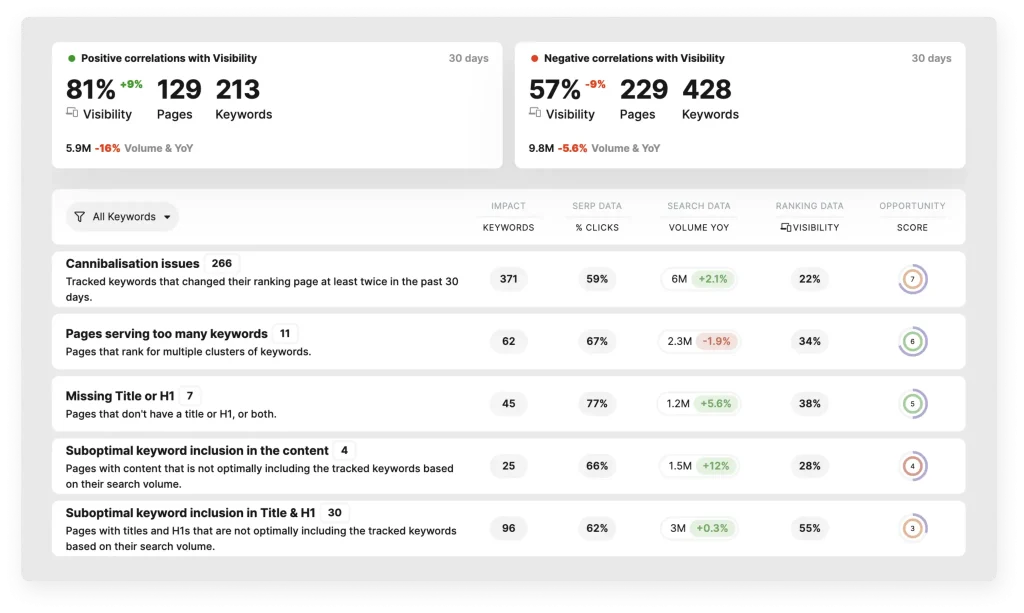
This matters because many content workflows break before the writing starts.
The SEO strategist finds keyword opportunities in one tool. The writer drafts in another. The editor optimizes in another. Then the account manager reports from a separate dashboard.
SEOmonitor tries to bring these steps closer together.
With Content Audit, users can find opportunities such as missing pages, weak ranking pages, or content gaps, then move those opportunities into Content Writer. From there, they can build the outline, draft the article, optimize it, and eventually track performance.
This is useful because SEO content shouldn’t start with a random prompt. It should start with a clear keyword strategy, search volume, search intent, and business value.
SEOmonitor helps answer the question:
“What should we create or improve next?”
That’s where the tool is strongest.
2. Article Strategy
Before generating an article, SEOmonitor lets users choose an article strategy.
The available options include Authority Enhancer, Fresh Perspective, and Comprehensive Guide. SEOmonitor describes these as different strategic directions for creating or improving an article based on the competitive landscape.
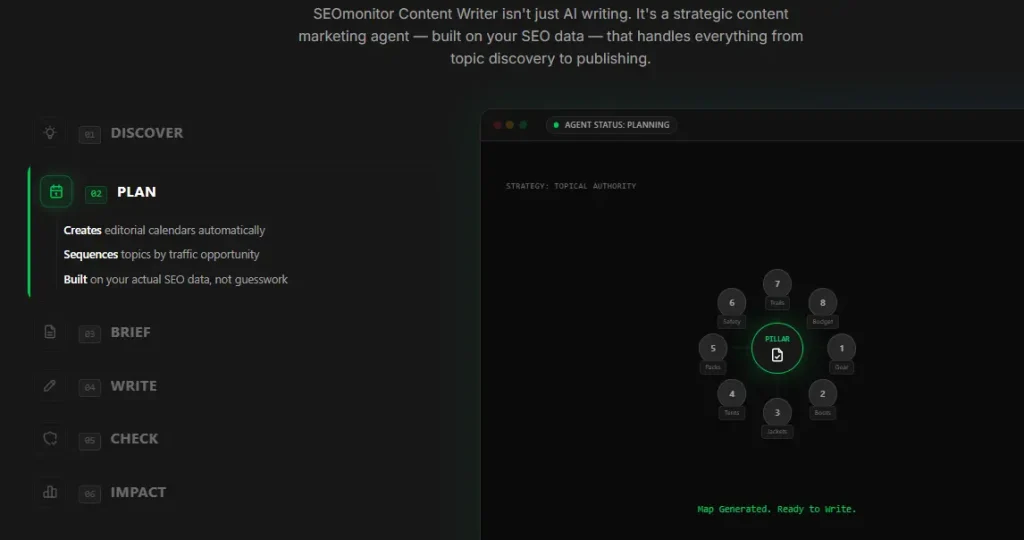
This is a smart step because not every article needs the same treatment.
- Some pages need more depth.
- Some need a fresher angle.
- Some need to better match search intent.
- Some need to close topical gaps against ranking pages.
- Some need to improve conversion rate, not just rankings.
This feature helps users think strategically before the AI Writer creates the draft. That’s important because one of the biggest problems with AI tools is that they make it too easy to generate generic content.
SEOmonitor’s strategy step gives the content workflow more direction.
3. Competitor-Based Briefs and Outlines
Once the topic and article strategy are selected, SEOmonitor creates an outline based on the competitive SERP.
According to SEOmonitor’s Help Center, Content Writer analyzes top informational pages and uses those insights to create an outline with a title, headings, guiding questions, and keyword guidance.
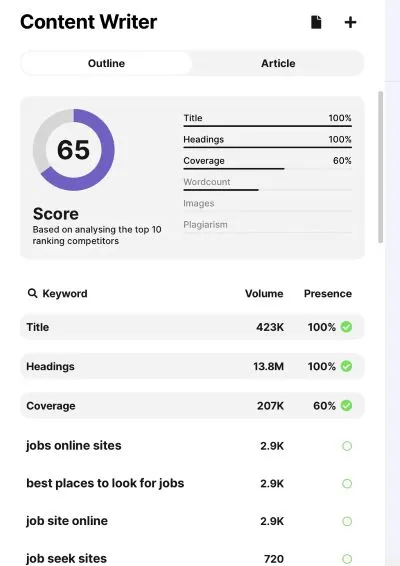
This is the core content optimization feature.
The tool looks at ranking pages, identifies what competitors are covering, and turns that information into a structure the writer can use.
A strong outline can help content teams understand:
- What the target keywords are
- What search intent needs to be satisfied
- Which subtopics ranking pages cover
- Which questions should be answered
- Which SERP features may influence the content format
- Where the current draft may be thin
This is useful for SEO professionals because it translates competitor analysis into a practical content brief.
That said, competitor-based outlines can also create me-too content if your team follows them too closely.
The goal is not to copy the SERP. The goal is to understand the baseline and then create something better.
That might mean adding original examples, expert commentary, first-party data, Case Studies, product experience, or a clearer point of view.
SEOmonitor can help you understand what ranking content has in common. Your team still needs to add what makes the page worth ranking.
4. AI Writing and Real-Time Optimization
SEOmonitor’s Content Writer can generate an article from the outline and update the SEO Score in real-time as the article is customized.
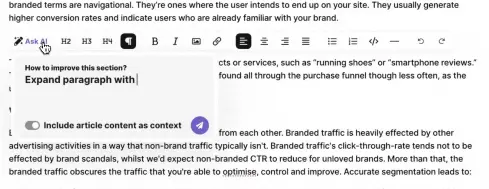
The Help Center explains that the SEO Score measures the title, headings, and content against top informational SERPs, and evaluates whether commonly ranked keywords are included in the right places. It also includes an Ask AI feature that can provide contextual improvements for readability, coherence, and SEO quality.
This is useful because writers can draft, edit, and optimize content in one place.
Instead of writing first and optimizing later, the writer can see where the content is strong or weak while they work.
The AI Writer is best used for:
- Creating a first draft
- Expanding thin sections
- Improving readability
- Generating alternate intros
- Turning outlines into structured content
- Helping content teams move faster
But it should not replace human editing.
The final draft still needs fact-checking, brand voice, examples, internal links, unique insights, and review from someone who understands the client’s business.
This is especially important for SEO agencies. Clients don’t want generic content that sounds like every other article in the search results. They want content that reflects their actual services, expertise, proof, and positioning.
So the SEO Score should be treated as a guardrail, not the goal.
The goal is not to hit a score. The goal is to create useful, accurate, differentiated content that satisfies search intent and helps the business win more qualified organic search traffic.
5. Keyword Data, Search Volume, and Coverage
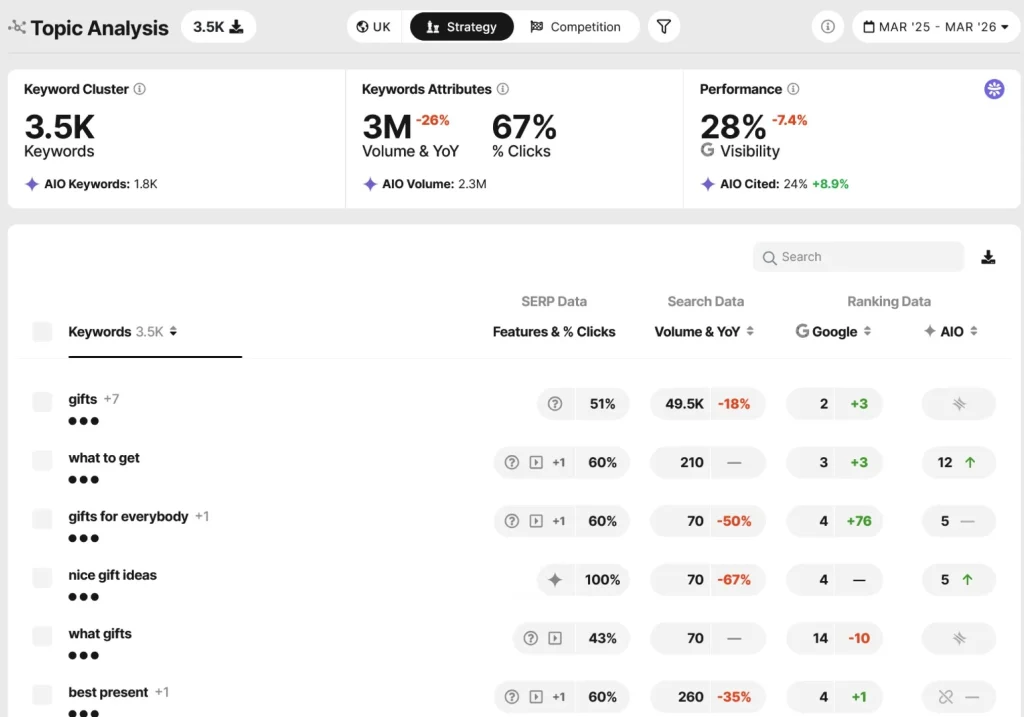
SEOmonitor gives users keyword data inside the content workflow.
The Help Center says Content Writer shows keyword search volume, coverage percentages, and average coverage for top-ranking keywords.
This helps solve a common content problem.
A writer may know the main keyword, but not the supporting search terms that matter.
An SEO expert may have keyword data, but not a simple way to turn it into writing guidance.
SEOmonitor brings those two worlds together by showing target keywords, search volume, and coverage data where the content is being created.
That helps the team make better decisions about:
- Which terms deserve emphasis
- Which related topics need coverage
- Which sections need more depth
- Which keyword suggestions are relevant
- Which terms should be ignored because they don’t match intent
This is a practical feature for content teams that want to optimize content without keyword stuffing.
6. Live Version Comparison
SEOmonitor includes a Live view that lets users compare the working draft against the published version.
This is especially useful for content refreshes.
A lot of SEO content work is not about creating brand-new articles. It’s about improving existing pages that have lost traffic, dropped in average position, or stopped performing as well as they used to.
With a live comparison, teams can see what exists now, what changed in the draft, and whether important sections were removed during the rewrite.
This supports a better long-term SEO process because content optimization is not a one-time task. It’s ongoing.
For content refreshes, this feature can help teams:
- Protect sections that already work
- Identify missing topics
- Improve outdated information
- Align the page with current search intent
- Avoid unnecessary rewrites
- Strengthen the page without losing existing rankings
This makes SEOmonitor more useful than a basic AI Writer for long-term content optimization.
7. Post-Publish Performance Tracking
One of SEOmonitor Content Writer’s best features is that it tracks content after publishing.
SEOmonitor says the Article Performance Dashboard can track daily keyword rankings, Visibility Score, traffic metrics from Google Search Console, and cannibalization issues when other pages rank for the target keywords.
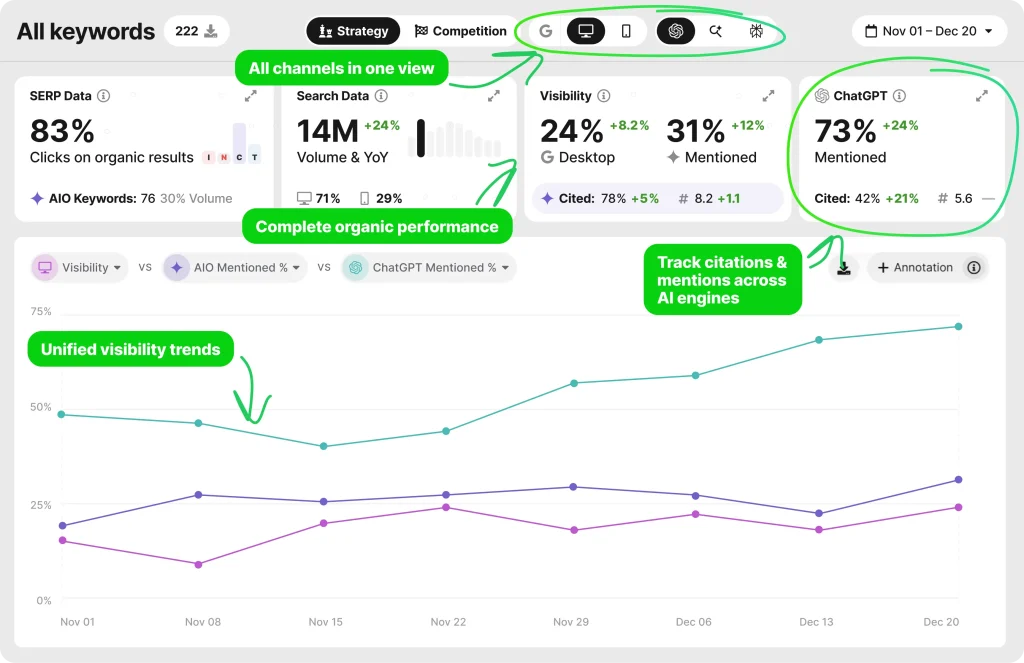
This is important because most content optimization tools stop at the draft.
SEOmonitor connects content creation to SEO performance after the article goes live.
That helps agencies answer questions like:
- Did the article improve search rankings?
- Are the target keywords moving?
- Is the page gaining visibility?
- Is Google Search Console showing more impressions or clicks?
- Is another page competing with this article?
- Is the article contributing to search performance?
This is a strong feature for agencies because client reports should not just show deliverables. They should show outcomes.
Publishing four articles is activity.
Improving rankings, traffic, Visibility Score, and search performance is progress.
8. AI Visibility Tracking
SEOmonitor also connects Content Writer to AI visibility.
SEOmonitor says published articles can be tracked for Google rankings, citations in AI Overviews, and brand mentions in ChatGPT, Gemini, and Perplexity.
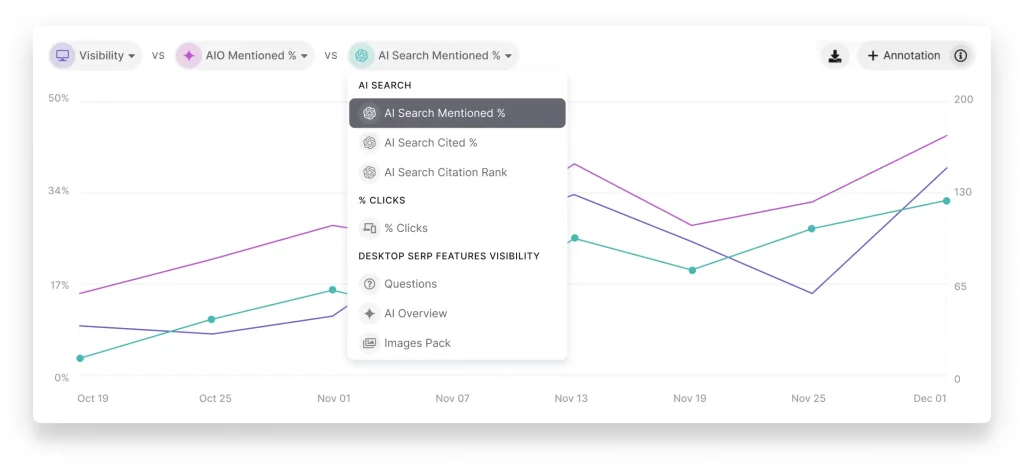
That’s relevant because SEO content is no longer only competing for traditional search rankings.
Content now needs to influence:
- Google organic results
- AI Overviews
- ChatGPT answers
- Gemini responses
- Perplexity citations
- Other AI search experiences
This gives SEOmonitor a more modern content optimization angle.
However, AI visibility is not controlled by one article alone. It can also depend on brand authority, third-party mentions, citations, reviews, PR, social media presence, and broader entity strength.
So Content Writer can support AI visibility, but it should not be treated as a complete AI search strategy by itself.
SEOmonitor Content Writer Pros and Cons
Pros
- SEOmonitor Content Writer connects content creation to real SEO campaign data.
- It helps teams find content opportunities through Content Audit.
- It generates outlines from ranking pages and competitor insights.
- It gives real-time optimization guidance.
- It includes AI-assisted content writing.
- It shows keyword data, search volume, and coverage guidance inside the editor.
- It supports content refreshes with live page comparison.
- It tracks published content performance with keyword tracking, Visibility Score, Google Search Console data, and cannibalization insights.
- It includes AI visibility tracking for AI Overviews and major AI platforms.
- It’s useful for SEO agencies and content teams managing ongoing SEO campaigns.
Cons
- It may be more than you need if you only want a simple content editor.
- The best value likely comes when you’re already using SEOmonitor.
- AI-generated drafts still need human editing.
- The workflow appears more article-focused than commercial-page-focused.
- It may not be the best fit for landing pages, service pages, ecommerce pages, or Local SEO pages that need deeper business-specific inputs.
- Competitor-based optimization can lead to generic content if the team does not add unique insights.
- It is not a replacement for a full keyword research tool, link building tool, or backlink analysis platform.
Ease of Use
SEOmonitor Content Writer has a logical workflow, but the user experience is built more for SEO professionals than casual writers.
The flow is simple enough:
Content Audit → opportunity → strategy → outline → draft → optimize → publish → track.
The learning curve comes from knowing how to interpret the SEO data.
For an SEO agency, that’s a benefit. The tool is designed around real campaign work, keyword tracking, content strategy, and client reporting.
For a writer who just wants a clean document editor, it may feel heavier than necessary.
SEOmonitor does provide a Knowledge Base, and its pricing page mentions full setup support with the Free Trial.
For agencies, the best onboarding path is to build one pilot article first. Let an SEO expert choose the opportunity, have the strategist approve the outline, let the writer draft or edit the content, and then track the article after publishing.
Once that works, turn it into a repeatable SOP.
SEOmonitor Pricing and Free Trial
SEOmonitor’s pricing page advertises a 14-day Free Trial and full setup support.

Its Content Writer page also positions the content workflow around a per-article model, with SEOmonitor stating that users can create articles for €5 per article.
Before choosing SEOmonitor specifically for content optimization, evaluate the full pricing model.
Ask:
- Is Content Writer included in your pricing plan?
- Is there a separate price tag per article?
- Do you need the broader SEOmonitor platform to get the full value?
- How many articles will your team produce each month?
- Do you need keyword tracking, client reports, and SEO monitoring in the same platform?
- Will this replace other SEO tools in your workflow?
If you already use SEOmonitor, Content Writer may be an easy add-on to your SEO process.
If you only need a standalone content optimization tool, compare the total cost against other tools before committing.
SEOmonitor Content Writer Alternatives
SEOmonitor Content Writer fits best as a campaign-connected content optimization tool for teams already using SEOmonitor for SEO campaigns, keyword tracking, Content Audit, and client reporting. But no agency should sign off on a platform without seeing the field — so if you’re still in the buy-or-compare phase, this is your next step.
For the full side-by-side, read our guide to the top SEOmonitor alternatives for agencies — it compares Rankability, Semrush, Ahrefs, SE Ranking, Surfer SEO, Clearscope, and more on the criteria that matter for multi-client delivery: rank tracking, white-label reporting, content workflow, and AI search visibility. If your bottleneck is content production rather than tracking, you’ll also want to look at the top tools for optimizing content for SEO like Surfer SEO, Frase, SE Ranking, Clearscope, and Rankability Copywriter.
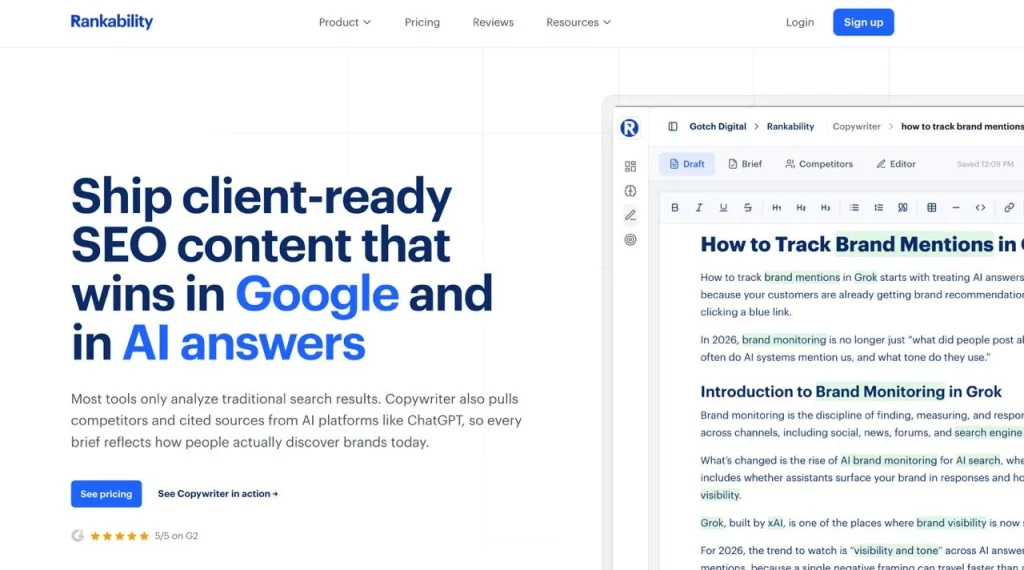
For content production specifically, Rankability Copywriter is the alternative we recommend for agencies, because it’s built around agency deliverables — helping teams move from brief to draft to uniqueness to optimization to final delivery while using Google SERPs, AI-cited sources, and a client Knowledge Base to create more accurate, differentiated, client-ready content.
Pick SEOmonitor Content Writer when:
- You already use SEOmonitor.
- You want Content Audit and Content Writer in one workflow.
- You care about tracking published article performance inside the same platform.
- You want content tied to keyword tracking, Visibility Score, and Google Search Console data.
Pick Rankability Copywriter when:
- You want a dedicated agency content workflow.
- You create commercial SEO content, not just informational articles.
- You want briefs built from Google and AI-cited sources.
- You want drafts grounded in a client Knowledge Base.
- You want a uniqueness step so content does not become a rewrite of ranking pages.
- You care about creating content that is optimized, accurate, differentiated, and client-ready.
FAQs
Is SEOmonitor Content Writer a content optimization tool?
Yes. SEOmonitor Content Writer helps users identify content opportunities, create SEO-focused outlines, generate AI-assisted drafts, optimize content in real-time, and track published article performance.
Does SEOmonitor Content Writer use keyword data?
Yes. SEOmonitor says Content Writer uses top-ranking pages to identify keywords for a topic and shows search volume, coverage percentages, and average coverage for those terms.
Does SEOmonitor Content Writer track rankings?
Yes. SEOmonitor says published articles can be tracked for Google rankings, Visibility Score, and performance metrics. Its Content Writer page also mentions AI Overview citations and brand mentions in ChatGPT, Gemini, and Perplexity.
Does SEOmonitor Content Writer integrate with Google Search Console?
Yes. SEOmonitor says its article performance workflow includes Google Search Console traffic metrics for published articles.
Does SEOmonitor Content Writer replace human writers?
No. It can help create outlines, drafts, and optimization guidance, but human review is still needed for accuracy, expertise, brand voice, examples, internal links, and originality.
Is SEOmonitor Content Writer good for agencies?
Yes. It’s especially useful for agencies already using SEOmonitor because it connects content creation to SEO campaigns, keyword tracking, client reports, and performance monitoring.
Does SEOmonitor Content Writer help with AI Overviews?
Yes. SEOmonitor says published articles can be tracked for AI Overview citations and brand mentions in ChatGPT, Gemini, and Perplexity.
Does SEOmonitor offer a free trial?
Yes. SEOmonitor’s pricing page advertises a 14-day Free Trial.
Final Verdict: Is SEOmonitor Worth It for Your Agency?
For agencies, SEOmonitor is worth it when you already run client campaigns inside it — keyword tracking, Content Audit, and reporting. In that case Content Writer is a natural add-on, and its biggest advantage is the full workflow: find opportunities in Content Audit, choose an article strategy, create an outline, draft with AI, optimize in real-time, publish, and track performance afterward. That makes it more complete than a basic AI Writer and more connected than many standalone content optimization tools.
The honest tradeoff is that SEOmonitor is most valuable as part of the broader platform. If your agency only needs a content editor — or if content production, not rank tracking, is your real bottleneck — paying for the whole platform may be more than you need, and the per-article and platform costs add up across a client portfolio.
So the buy-or-compare call comes down to your bottleneck. If you want rankings, reporting, and content connected in one platform you already use, SEOmonitor is a serious option. If you’re not locked in, weigh it against the alternatives covered above before you commit.
And for agencies that want a more focused workflow for creating optimized, differentiated, client-ready content across many page types, Rankability Copywriter is the better alternative.