
TextOptimizer is a useful tool for improving semantic relevance, finding related terms, and strengthening how well a page covers a topic.
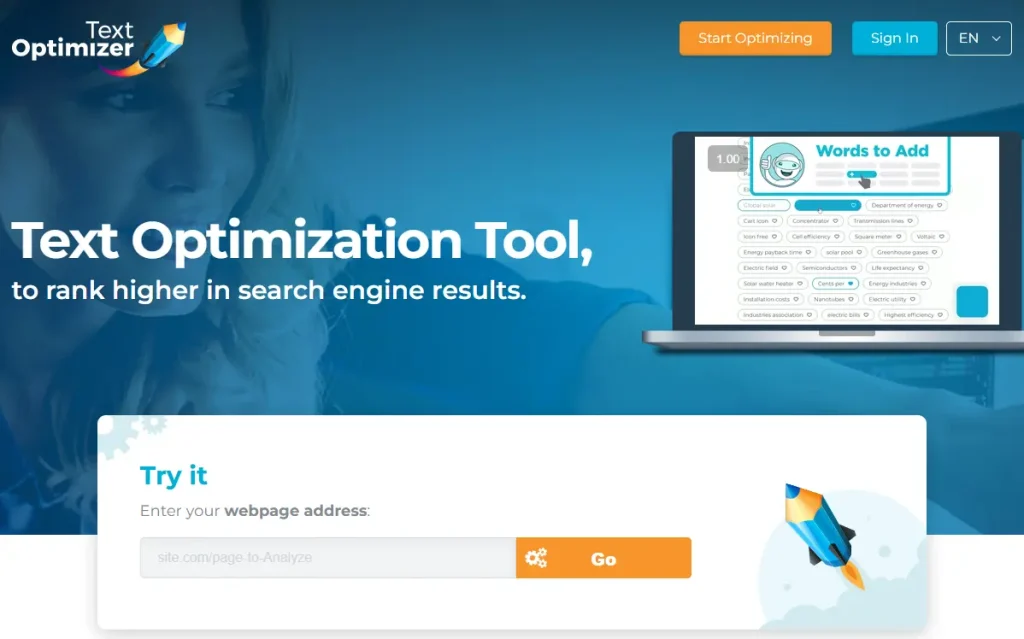
But for agencies, semantic analysis is only one part of the job.
If you’re managing content for multiple clients, you probably need more than a list of terms to add to a blog post.
You may need content briefs, real-time scoring, AI-assisted drafting, optimization workflows, Google Docs support, keyword research tools, rank tracking, client reporting, and a repeatable process for improving SEO performance across many webpages.
That’s where the right TextOptimizer alternative can make a big difference.
Some tools are built for simple content grading. Others are better for content strategy, competitor analysis, content gaps, AI content workflows, or agency-level content operations. The best option depends on how your team actually creates, optimizes, and updates content.
Quick Picks
If you want the fastest shortlist, start here.
- Best overall for agencies: Rankability
- Best for real-time content optimization: Surfer SEO
- Best for AI briefs and drafting: Frase
- Best for editorial content quality: Clearscope
- Best for content strategy and topical authority: MarketMuse
- Best for simple content briefs and optimization: Dashword
What We Looked For
We compared these TextOptimizer alternatives based on the criteria that matter most for agencies and SEO teams managing real production workflows.
- Content optimization depth: Does the tool give clear SEO recommendations beyond basic keyword density?
- Search engine results page analysis: Does it use live search results, competitor pages, and ranking factors to guide the workflow?
- Semantic analysis: Does it help identify related keywords, relevant keywords, related terms, questions, and topic gaps?
- Content workflow: Can content teams create briefs, optimize drafts, improve existing pages, and collaborate efficiently?
- AI support: Does it include artificial intelligence, machine learning, AI content support, or AI search visibility features?
- Agency usability: Is it practical for multiple team members, multiple clients, and repeatable SEO strategies?
- Pricing and scalability: Are paid plans clear, and does the tool offer enough value for ongoing client work?
Comparison Table
Here is a quick comparison table before the full reviews.
| Tool | Best for | Starting price* | AI & Search Coverage | Notes |
|---|---|---|---|---|
| Rankability | Agencies needing SEO content optimization, research, and visibility workflows | See website | Google, local, YouTube, and AI search visibility workflows | Best overall fit for agencies that need content optimization plus reporting and client workflow support |
| Surfer SEO | Real-time content scoring and SERP-based optimization | $99/mo annually | Google and AI visibility tracking | Strong content editor, Google Docs support, and clear page-level SEO recommendations |
| Frase | AI briefs, content research, and drafting | $49/mo | Google, GEO optimization, AI visibility tracking, site audits, and AI content workflows | Good for teams that want research, optimization, and AI writing in one interface |
| Clearscope | Premium editorial optimization and content grading | $129/mo | Google and AI search visibility support | Clean workflow, strong content grader, unlimited users, and writer-friendly recommendations |
| MarketMuse | Content strategy, topical authority, and content gaps | Free plan available | Search-focused strategy, topic modeling, and content planning | Best for larger sites and teams making strategic content decisions |
| Dashword | Simple briefs, optimization, and content monitoring | $99/mo | Search-focused content optimization and monitoring | Lightweight option with content briefs, optimization, monitoring, and a free first report |
*Pricing changes often. Verify current pricing and plan limits directly on each vendor’s website.
Best TextOptimizer Alternatives Reviewed
1. Rankability
Why it’s a strong TextOptimizer alternative:
Rankability is the best overall TextOptimizer alternative for agencies because it supports more than semantic optimization.
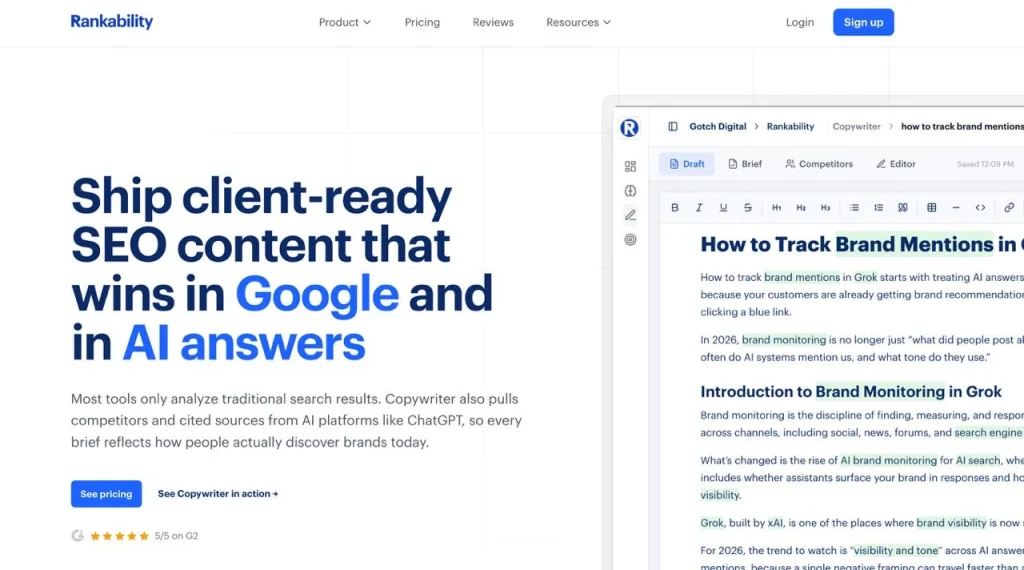
TextOptimizer can help identify related terms and improve topical relevance, but agencies usually need a fuller workflow. They need to find opportunities, create briefs, optimize content, track keyword rankings, measure search visibility, and report results back to clients.
Rankability is built around that agency workflow.
Instead of treating content optimization as a one-page exercise, Rankability connects research, content creation, optimization, and performance tracking. That makes it a stronger fit for agencies that need to improve quality content across many clients without duct-taping together separate tools.
Best for:
SEO and digital marketing agencies that want a repeatable content optimization workflow for client campaigns.
Standout features:
- Content optimizer with content score guidance
- AI-assisted content briefs and drafts
- Keyword research and content planning workflows
- Support for improving existing content pages
- Search visibility tracking across Google and AI search
- Client reporting and agency workflow support
- Built for teams managing multiple clients and team members
Where it beats TextOptimizer:
Rankability is stronger when the goal is not just to improve one page semantically, but to build a full content optimization system.
For example, an agency can use it to identify content ideas, build a brief around a target keyword, create or optimize the draft, review SEO recommendations, and then monitor the impact on search performance over time.
That’s the difference between a content optimizer and a broader agency SEO workflow.
Potential drawback:
If you only need a lightweight semantic analysis tool for occasional writing, Rankability may be more platform than you need.
Practical note:
Choose Rankability if your agency wants one workflow for keyword analysis, briefs, AI content support, optimization, and visibility tracking instead of relying on disconnected content tools.
2. Surfer SEO
Why it’s a strong TextOptimizer alternative:
Surfer SEO is one of the strongest TextOptimizer alternatives if your main priority is real-time page optimization.
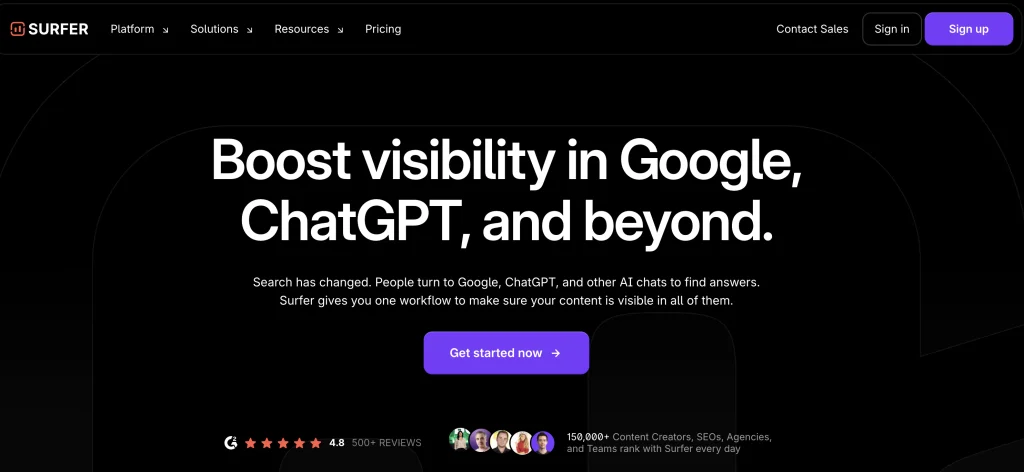
Its content editor gives writers and SEO teams a live content score while they work. It analyzes competing pages in the search results and provides recommendations around related terms, headings, word count, questions, and structure.
That makes it useful for optimizing a new article before publishing or improving an existing page that’s underperforming.
Best for:
Content teams that want live scoring, SERP-based recommendations, and an easy-to-use content editor.
Standout features:
- Real-time content editor
- Content score feedback
- SERP analysis
- Keyword suggestions and related term guidance
- Google Docs and WordPress workflow support
- Page audit features for improving existing content
- AI search visibility tracking on current plans
- Free tools, including a Chrome extension
Where it beats TextOptimizer:
TextOptimizer focuses heavily on semantic relevance. Surfer SEO is more workflow-driven.
Instead of only telling you which concepts or terms to include, Surfer gives a clearer page SEO workflow for writers. You can see recommendations as you write, compare against competitors, and adjust the content before handing it off for final review.
This is especially useful when multiple writers need to follow the same optimization process.
Potential drawback:
Surfer can push teams toward chasing a score if they don’t have strong editorial oversight. A high SEO Score doesn’t automatically mean the content is better for the target audience.
Practical note:
Surfer SEO is a strong pick if your agency already has content strategy handled and mostly needs a reliable tool for optimizing drafts and existing webpages.
3. Frase
Why it’s a strong TextOptimizer alternative:
Frase is a practical TextOptimizer alternative for agencies that want content research, AI briefs, AI writing, and optimization in one platform.
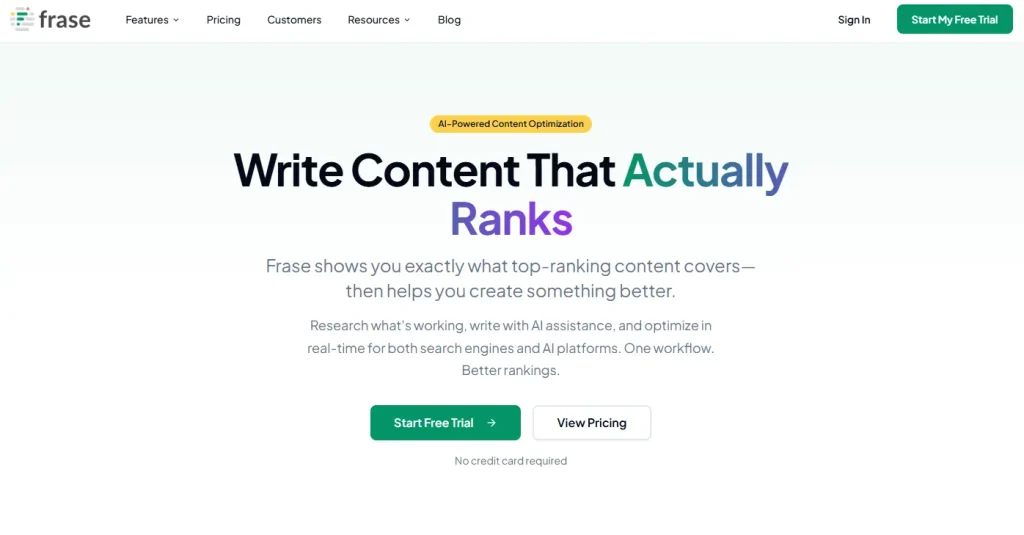
It helps teams analyze search queries, review competitor content, create outlines, generate drafts, and improve content based on search intent. That makes it useful when your bottleneck is the heavy lifting that happens before a writer starts drafting.
Frase has also expanded beyond traditional content optimization into GEO optimization, AI visibility tracking, site audits, and broader AI-assisted workflows.
Best for:
Lean agencies, content creators, and SEO teams that want faster research, briefs, and drafts.
Standout features:
- AI-powered content research
- Brief and outline builder
- SERP research and competitor analysis
- SEO and GEO content optimization
- AI visibility tracking
- Site audits
- Internal linking support
- API access on current plans
- 7-day free trial
Where it beats TextOptimizer:
Frase is stronger when you need to move from keyword ideas to an actual content workflow.
For example, instead of only identifying relevant keywords and related terms, your team can use Frase to study competitor pages, build an outline, generate a draft, and optimize the finished piece.
That makes it a better fit for teams producing content at scale.
Potential drawback:
AI-generated drafts still need human editing. Frase can speed up content production, but it shouldn’t replace editorial judgment, subject-matter expertise, or fact-checking.
Practical note:
Frase is a good choice if your agency needs an affordable all-in-one workflow for content research, AI content, briefs, and optimization.
4. Clearscope
Why it’s a strong TextOptimizer alternative:
Clearscope is one of the strongest options for teams that care about editorial adoption.
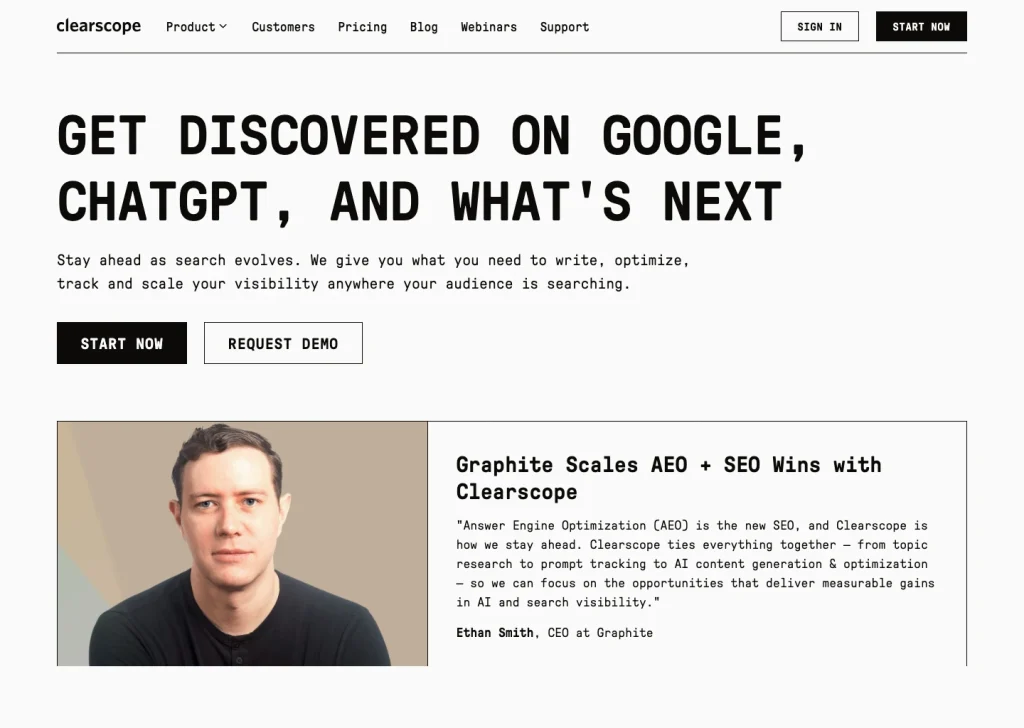
A lot of SEO tools overwhelm writers with too many metrics, filters, and advanced features. Clearscope keeps the workflow clean. It gives writers clear optimization guidance, a content grade, related keyword suggestions, and search intent support without making the process feel overly technical.
That makes it especially useful for agencies working with writers, editors, and clients who need simple direction.
Best for:
Editorial teams, content marketers, and agencies that want clean optimization guidance and high adoption.
Standout features:
- Content grader
- Related terms and keyword suggestions
- Content optimization reports
- Search intent-driven recommendations
- AI and search visibility features
- Content inventory support
- Unlimited users and projects on current plans
- Strong sharing and exporting options
- Customer support and onboarding included
Where it beats TextOptimizer:
Clearscope is better for content teams that need a professional writing workflow.
TextOptimizer can help with semantic coverage, but Clearscope makes the optimization process easier for writers to understand and follow. It’s especially useful when you want to improve content quality without forcing every writer to think like a technical SEO.
Potential drawback:
Clearscope is more expensive than some alternatives, especially for smaller teams. It also isn’t trying to be an all-in-one SEO platform with backlink analysis, technical SEO, or deep rank tracking.
Practical note:
Choose Clearscope if your agency values content quality, writer adoption, and clean SEO recommendations over having the broadest possible feature set.
5. MarketMuse
Why it’s a strong TextOptimizer alternative:
MarketMuse is a stronger fit when your agency needs content strategy, not just page-level optimization.
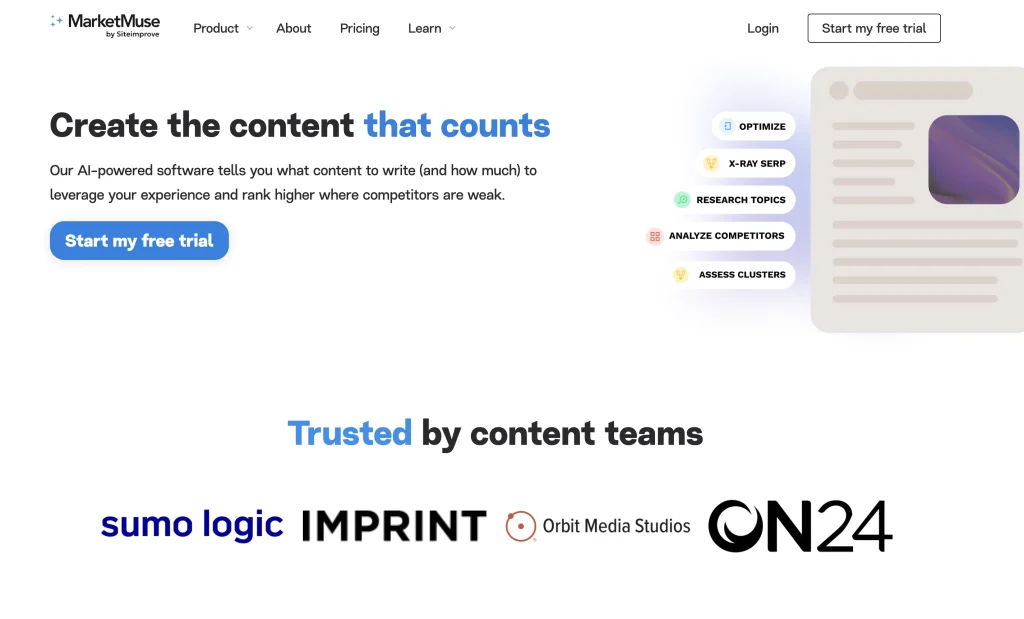
It helps teams understand content gaps, topic authority, competitor coverage, and what to create or update next. That makes it more strategic than many content optimizer tools that focus only on a single URL and target keyword.
For agencies managing large websites, MarketMuse can help prioritize which content pages matter most instead of treating every keyword the same.
Best for:
Larger content teams, enterprise sites, and agencies managing long-term content marketing strategy.
Standout features:
- Topic modeling
- Content gap analysis
- Content brief generation
- Content strategy documents
- SERP X-ray and heatmap-style research
- Topic and keyword analysis
- Site inventory features on paid plans
- Free version for limited usage
Where it beats TextOptimizer:
MarketMuse is better when you’re trying to answer bigger strategic questions.
For example:
- Which topics are we weak on?
- Which pages should we update first?
- Where do competitors have stronger coverage?
- Which topics support our authority?
- What content should we create next?
TextOptimizer can help optimize a single piece of content. MarketMuse is better for building and prioritizing a larger content strategy.
Potential drawback:
MarketMuse can be more complex than simpler content optimization tools. It may also be more than you need if your team only wants a content editor for individual articles.
Practical note:
Choose MarketMuse if your agency works with larger sites and needs strategic support for content gaps, topical authority, and long-term SEO efforts.
6. Dashword
Why it’s a strong TextOptimizer alternative:
Dashword is a simple, practical alternative for teams that want content briefs, optimization, and monitoring without a complicated interface.
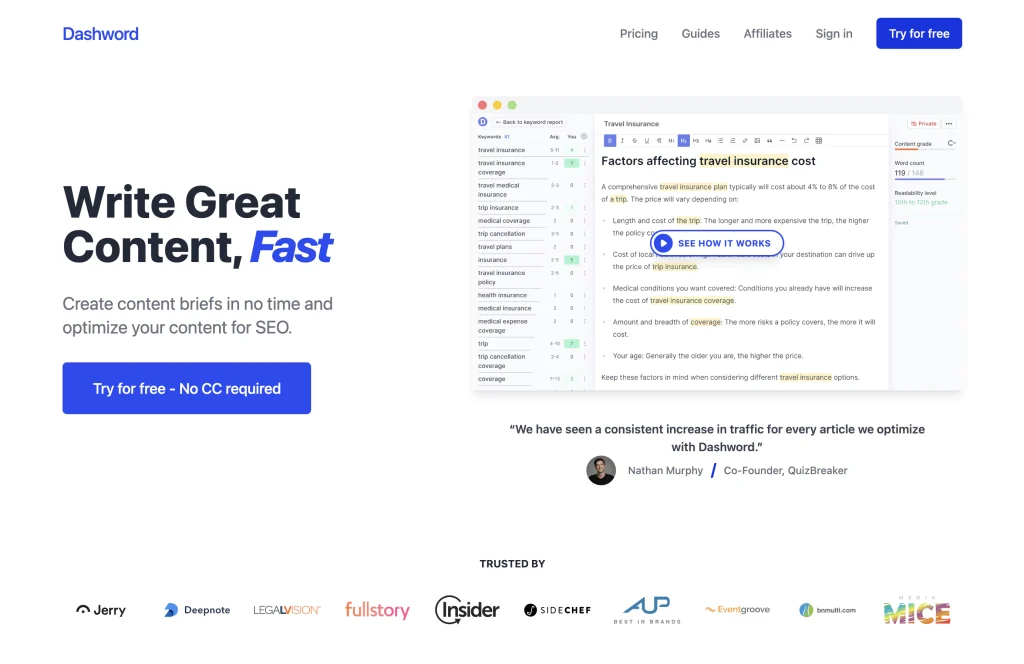
It helps teams create briefs, analyze competitors, optimize content, and monitor published pages. It’s not as deep as some advanced tools, but that simplicity can be a benefit for smaller teams.
If your agency wants something easier to adopt than a heavier all-in-one SEO platform, Dashword deserves a look.
Best for:
Small agencies, freelancers, and teams that want simple briefs and content optimization.
Standout features:
- Content brief builder
- Content optimization
- Real-time scoring
- Competitor outline analysis
- Content monitoring
- AI Writer
- Google Docs add-on
- Free first report
- Free tools like a meta description generator and content brief generator
Where it beats TextOptimizer:
Dashword is more practical for day-to-day content workflows.
TextOptimizer is useful for semantic analysis, but Dashword gives teams a clearer path from research to brief to optimization. It can help content teams create a better outline, review related keywords, improve a draft, and monitor content decay after publishing.
Potential drawback:
Dashword may not be the best fit if your agency needs deeper AI search tracking, advanced reporting, or broader all-in-one SEO features.
Practical note:
Dashword is a good fit if you want a lightweight content optimization tool that’s easy for writers and marketers to use.
How to Choose the Right TextOptimizer Alternative
The best choice depends on what you actually used TextOptimizer for.
If you used TextOptimizer mainly for semantic analysis, then Surfer SEO, Clearscope, and Dashword are the closest alternatives. They can help you improve topical coverage, identify related terms, and optimize individual pages.
If you used it to improve content quality before publishing, Surfer SEO and Clearscope are probably the easiest fits. Both give writers clear feedback while they work.
If you need briefs, drafts, and AI-assisted workflows, Frase is a better choice. It’s especially useful when your team needs to speed up research and production.
If you’re making strategic decisions across a large site, MarketMuse is stronger. It’s better for content gaps, topic authority, and planning what to create or update next.
If you’re an agency that needs one repeatable workflow across clients, Rankability is the strongest overall fit. It connects content optimization with research, AI search visibility, reporting, and client-facing SEO work.
Here’s the simplest way to decide:
- Choose Rankability if you want an agency SEO workflow.
- Choose Surfer SEO if you want live optimization and scoring.
- Choose Frase if you want AI briefs and drafting.
- Choose Clearscope if you want clean editorial optimization.
- Choose MarketMuse if you want content strategy and topical authority planning.
- Choose Dashword if you want a simple optimizer with briefs and monitoring.
What If You Used TextOptimizer for Semantic SEO?
If your main use case was semantic SEO, don’t just look for another tool that gives you related keywords.
That’s useful, but it’s not enough.
Modern search engine optimization has moved beyond adding terms to a page. Search engines evaluate relevance, usefulness, intent satisfaction, authority, user experience, and many other ranking factors. AI search adds another layer because language models may summarize, cite, or ignore your content based on how well it answers the search term and related queries.
So instead of asking, “Which tool gives me the best list of terms?” ask:
- Does this help us create better content?
- Does this improve the reader’s experience?
- Does this help us understand the target audience?
- Does this support our broader SEO strategies?
- Does this help us monitor what happens after publishing?
That’s why many of the top SEO content optimization tools now include briefs, content scoring, AI tools, content monitoring, and search visibility features.
The goal is not to stuff more relevant keywords into a page. The goal is to create a better answer than what’s already ranking.
TextOptimizer Alternatives by Use Case
Best for agencies
Rankability is the best fit for agencies because it supports the full workflow: keyword research, briefs, content optimization, AI search visibility, reporting, and client management.
Best for live optimization
Surfer SEO is best for teams that want real-time recommendations inside a content editor.
Best for briefs and AI drafting
Frase is best for teams that want to go from content research to outline to AI-assisted draft quickly.
Best for editorial teams
Clearscope is best for writers and editors who need clean recommendations without a cluttered workflow.
Best for strategic content planning
MarketMuse is best for teams that need topic modeling, content gaps, and site-level strategy.
Best lightweight option
Dashword is best for smaller teams that want simple briefs, optimization, and monitoring without too much complexity.
FAQs
What is the best TextOptimizer alternative?
The best TextOptimizer alternative depends on your workflow. Rankability is the best overall option for agencies, while Surfer SEO and Clearscope are stronger for real-time content optimization. Frase is better for AI briefs and drafting, MarketMuse is better for content strategy, and Dashword is better for simple optimization workflows.
What is the best TextOptimizer alternative for agencies?
Rankability is the strongest fit for agencies because it combines content optimization with research, AI search visibility, reporting, and client workflow support.
Are there free TextOptimizer alternatives?
Some tools offer a free plan, free version, free trial, free report, or free tools. MarketMuse has a limited free option, Dashword offers a free first report, and Frase offers a free trial. Surfer also offers free tools, including a Chrome extension.
Which TextOptimizer alternative is best for Google Docs?
Surfer SEO, Clearscope, and Dashword are strong options if Google Docs support is important to your writing workflow.
Which alternative is best for AI content?
Frase is a strong choice for AI-assisted briefs and drafting. Rankability is also a strong option for agencies that want AI content support connected to SEO research, optimization, and visibility workflows.
Do these tools replace all-in-one SEO platforms?
Not always. Some tools focus mostly on content optimization. Others add features like site audits, rank tracking, AI search visibility, content monitoring, or reporting. If you need technical SEO, backlink analysis, domain authority metrics, link building tools, or a full keyword tool, you may still need a broader SEO platform.
Should I use Rank Math or Yoast SEO instead?
Rank Math and Yoast SEO are SEO plugin options for WordPress. They’re useful for basics like title tag guidance, meta descriptions, image optimization, spelling mistakes, readability signals, passive voice checks, and page SEO reminders. But they don’t replace dedicated content optimization tools that analyze competitors, content gaps, semantic coverage, or search engine results page data.
Conclusion
TextOptimizer is useful for semantic analysis, but agencies usually need more than related terms and keyword suggestions.
The right alternative should help your team create better briefs, improve content quality, optimize pages in real time, monitor SEO performance, and support a repeatable content workflow.
Rankability is the strongest overall fit for agencies that want content optimization connected to broader SEO and AI search visibility. Surfer SEO, Frase, Clearscope, MarketMuse, and Dashword are also strong options depending on your workflow, budget, and team structure.