Prove your agency's search impact across Google and AI answers.

Tracker rolls keyword rankings, AI mentions, and citations into one visibility score your clients actually understand. Watch the 2-minute overview.

G2
5.0 on G2

Trusted by agencies managing SEO at scale

Agencies report with confidence

Real reviews from agencies tracking client visibility across Google and AI platforms with Rankability.

“I use Rankability for all aspects of our clients' local SEO campaigns, and it really speeds up our content production process. The reporting features are great for getting snapshots of how our clients are ranking in traditional Google search and on AI platforms.”

Aaron T.
Agency Owner · G2

“Rankability is simple to use, extremely clear on what improvements can be made, and includes tools to make those improvements. I especially appreciate the ability to change which AI platforms you're tracking and the frequency of that tracking. It can also track your local SEO rankings as well!”

Bryan S.
CEO & Co-Founder · G2

“Rankability has been developed with the agency needs in mind. The ability to provide access to my writing team has been fantastic, and the functionality was very intuitive for the team to jump into right away. Relevance is more important than search volume, keyword difficulty, or anything else.”

Chad E.
President · G2

Frequently asked questions about Tracker

What is Tracker?
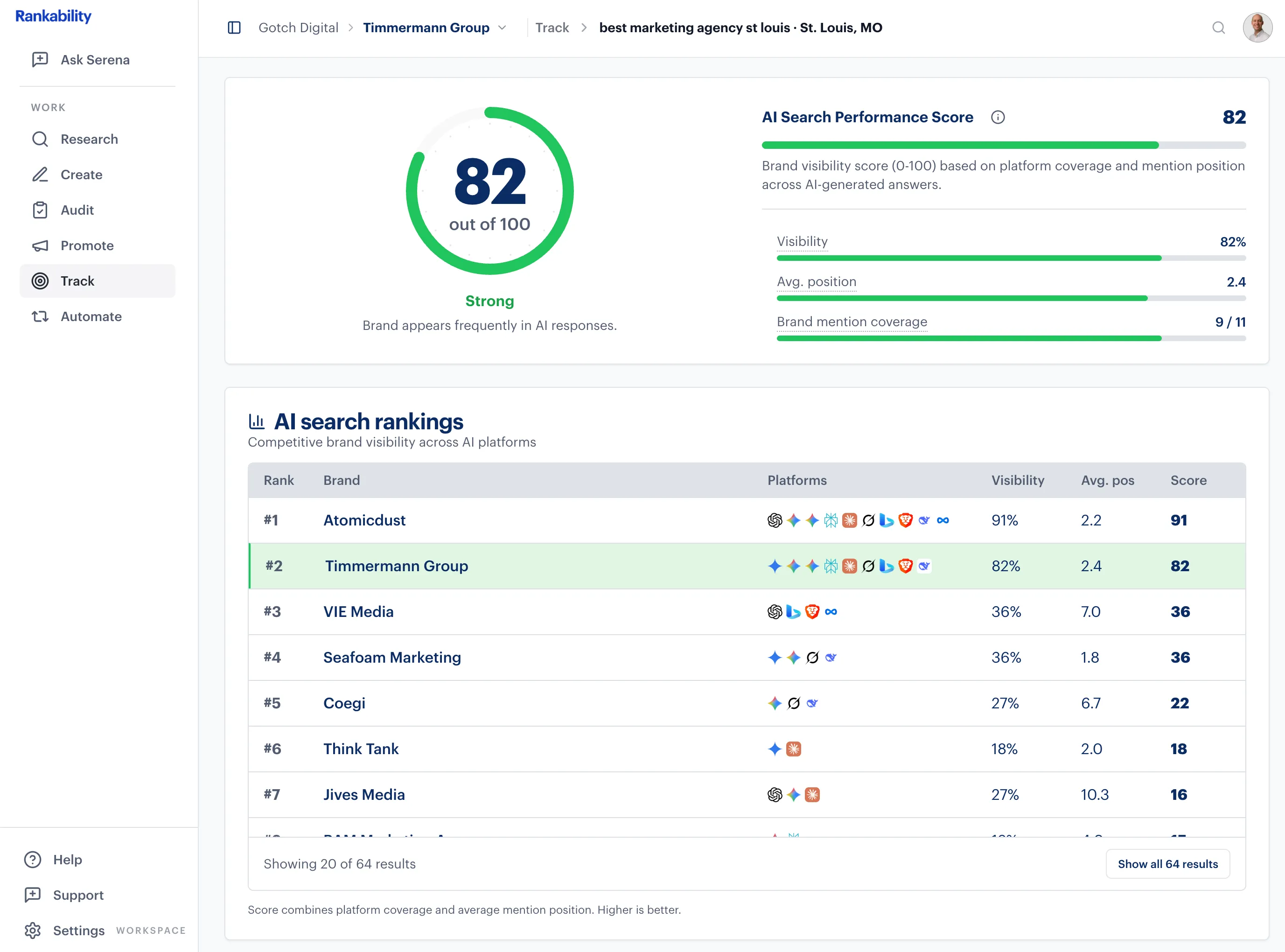
Tracker is Rankability's visibility monitoring engine. It shows where your brand shows up across traditional search, AI answer engines, and video search — all in one place — and rolls everything up into a single Search Performance Index so you can see, at a glance, whether your visibility is going up or down.
What does Tracker actually track?
Three things, side by side: your classic Google rankings, how often AI tools mention and cite your brand when people ask them questions, and your presence in video and local results. Most rank trackers only do the first one. Tracker was built for a search landscape where customers ask ChatGPT before they scroll Google.
Which search engines and AI platforms does it monitor?
Traditional search: Google organic (top 100), Bing, DuckDuckGo, and Brave. AI answer engines: ChatGPT, Perplexity, Google AI Overviews, Google AI Mode, Gemini, Claude, Grok, Microsoft Copilot, Brave AI, and DeepSeek. Video and local: YouTube search, the Google video pack, TikTok search, and the Google local pack (map results).
What is the Search Performance Index (SPI)?
The SPI is a single 0–100 score that summarizes your overall search health, so you don't have to read a dozen separate charts to know how you're doing. It blends your traditional rankings, how often AI engines mention you, how often they cite your site as a source, and your video presence into one number you can track over time and report to clients.
How is AI visibility different from a normal keyword ranking?
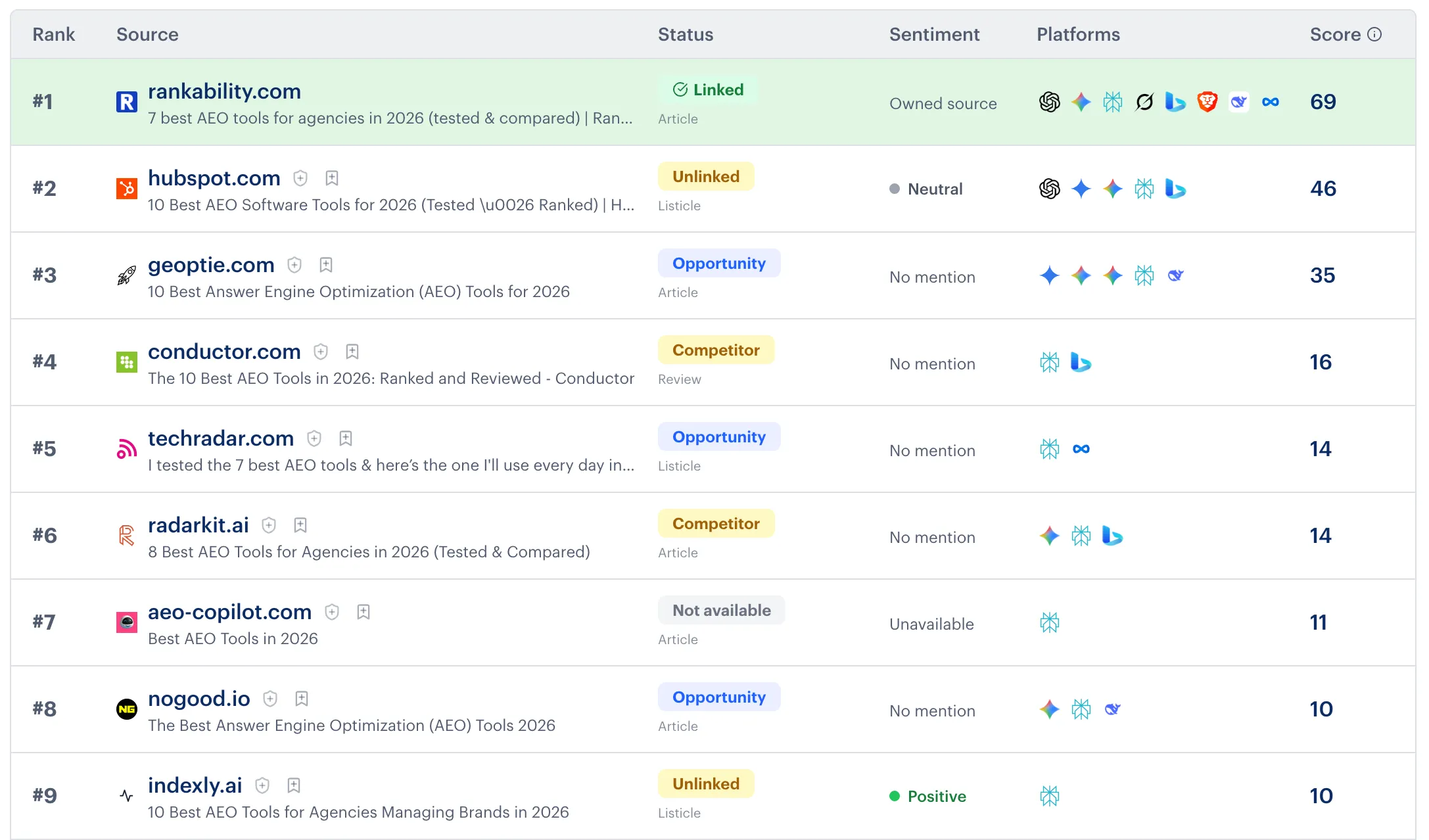
A Google ranking tells you what position your page sits at. AI visibility tells you whether the AI actually named your brand in its answer, whether it linked to your site as a source, and whether it spoke about you positively, neutrally, or negatively. Tracker captures all of that — the mention, the sentiment, where you landed in the AI's list of recommendations, and which of your pages got cited.
Why does AI citation tracking matter?
When an AI answers a question, it pulls from a handful of sources — and those sources get the visibility and the clicks. Tracker keeps a running feed of every citation you win, lose, or move on, so you know exactly which pages AI engines trust and can double down on what's working.
How does local pack (map) tracking work?
For local businesses, a single ranking isn't enough — your rank changes depending on where the searcher is standing. Tracker drops a grid of search points across a map around your business (3×3, 5×5, or 7×7) and checks your local pack rank at each one, so you can see your true coverage across a neighborhood or city instead of one misleading average. The grid centers on your real business address, not the city center, so suburban locations show up where customers actually search.
Can I track competitors?
Yes. Tracker automatically surfaces the competitors showing up for your keywords and compares their SPI and platform coverage against yours, so you can see who's winning AI mentions, who owns the local pack, and where you have room to catch up.
Can I track more than one keyword or location?
Yes. A single project can track a list of keywords, and you can group or tag them (for example, "money pages" or "service areas") to filter your scores and charts down to the segments you care about.
How often is the data refreshed?
You choose. Tracker lets you set independent schedules for different platform groups — for example, check Google daily but run AI engines weekly — so you get fresh data where it matters without burning through scans where it doesn't. You can also run a one-time benchmark scan whenever you want an instant snapshot.
What's the difference between a tracking project and a benchmark?
A tracking project runs on a recurring schedule for ongoing monitoring. A benchmark is a one-time snapshot — perfect for baselining a new client, building a pitch, or capturing a "before" picture ahead of a campaign.
Can I share reports with my clients?
Yes. Every project can generate a shareable, read-only link to a clean, white-labeled dashboard. Your clients see their visibility and trends without logging in, and you don't have to export a single screenshot.
Do I need a separate tool for AI search and for Google rankings?
No — that's the point. Tracker covers traditional rankings, AI answer engines, local pack, and video in one project, on one dashboard, under one score. One tool instead of three subscriptions and three exports.
Where does the data come from — is it accurate?
Tracker pulls live results directly from each platform and records exactly what was returned. If a brand wasn't mentioned, it says so — it never invents a mention or a citation. When a scan can't complete, it's flagged rather than guessed, so the numbers you report to clients are real.
Does Tracker work for agencies managing multiple clients?
Yes. Tracker is built for agencies — organize projects by client, compare performance across your portfolio, set per-client scan schedules, and hand each client their own white-labeled report link.

Make your agency the team that can measure modern search.

Track Google, local, and up to 9 AI platforms in one score — then share dashboards your clients understand.