

What should your agency prioritize to help clients appear in AI answers? These AI SEO statistics examine how traditional rankings, content relevance, technical accessibility, and authority relate to AI citations.
Here, AI SEO means improving a website’s visibility in AI-powered search and answers. The focus is on whether platforms surface and cite your content—not simply on using AI to produce it.
This report combines two original Rankability studies: 48 months of demand data across 3,751 AI and search-related keywords, plus an analysis of 1,645 AI citations and 916 traditional search results across 31 topics. Use the 35 AI citation statistics plus four search-demand shifts to inform your AI SEO strategy, evaluate common optimization claims, and decide what to measure for clients.
Key AI SEO statistics
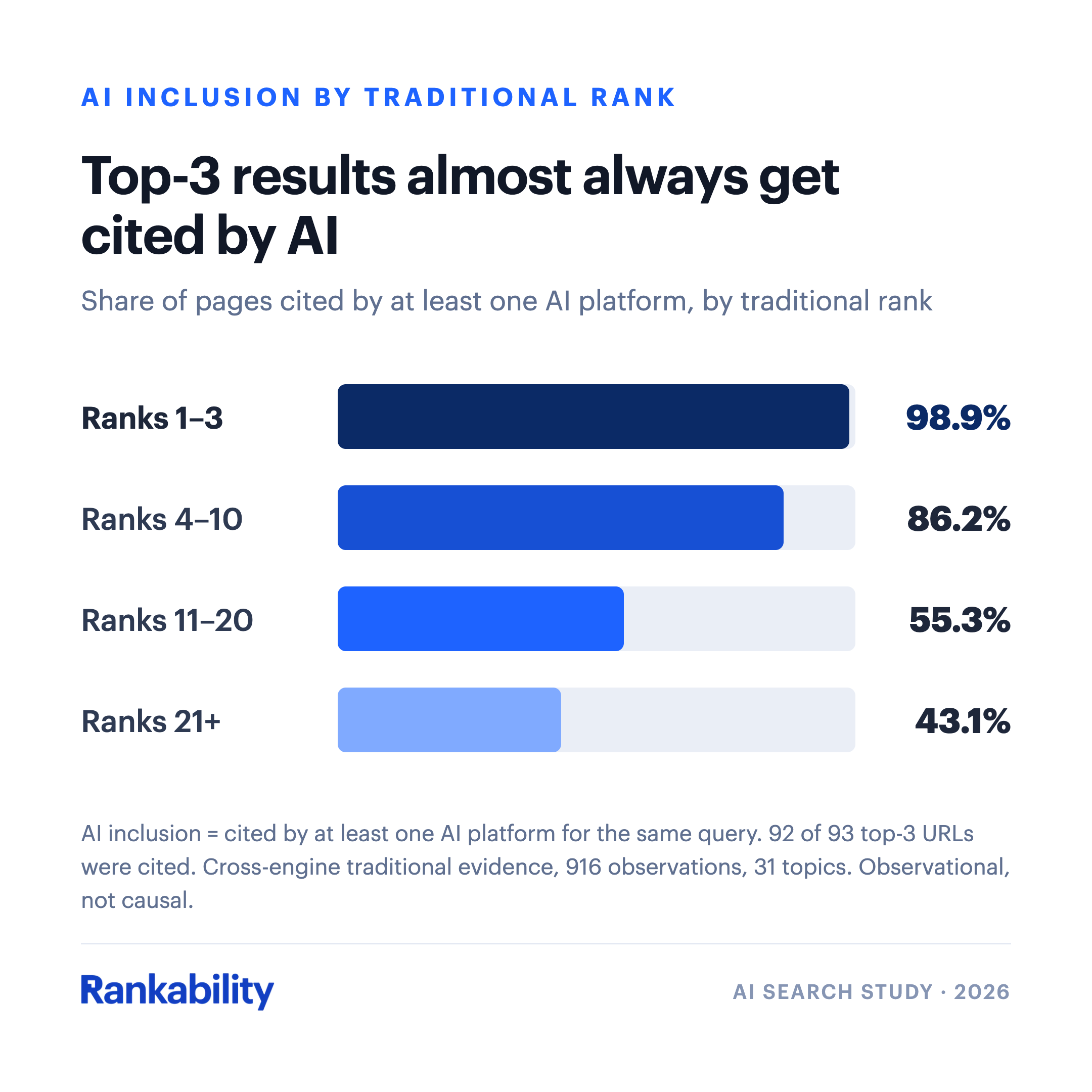
- Traditional positions 1–3 had a 98.9% chance of being cited by AI.
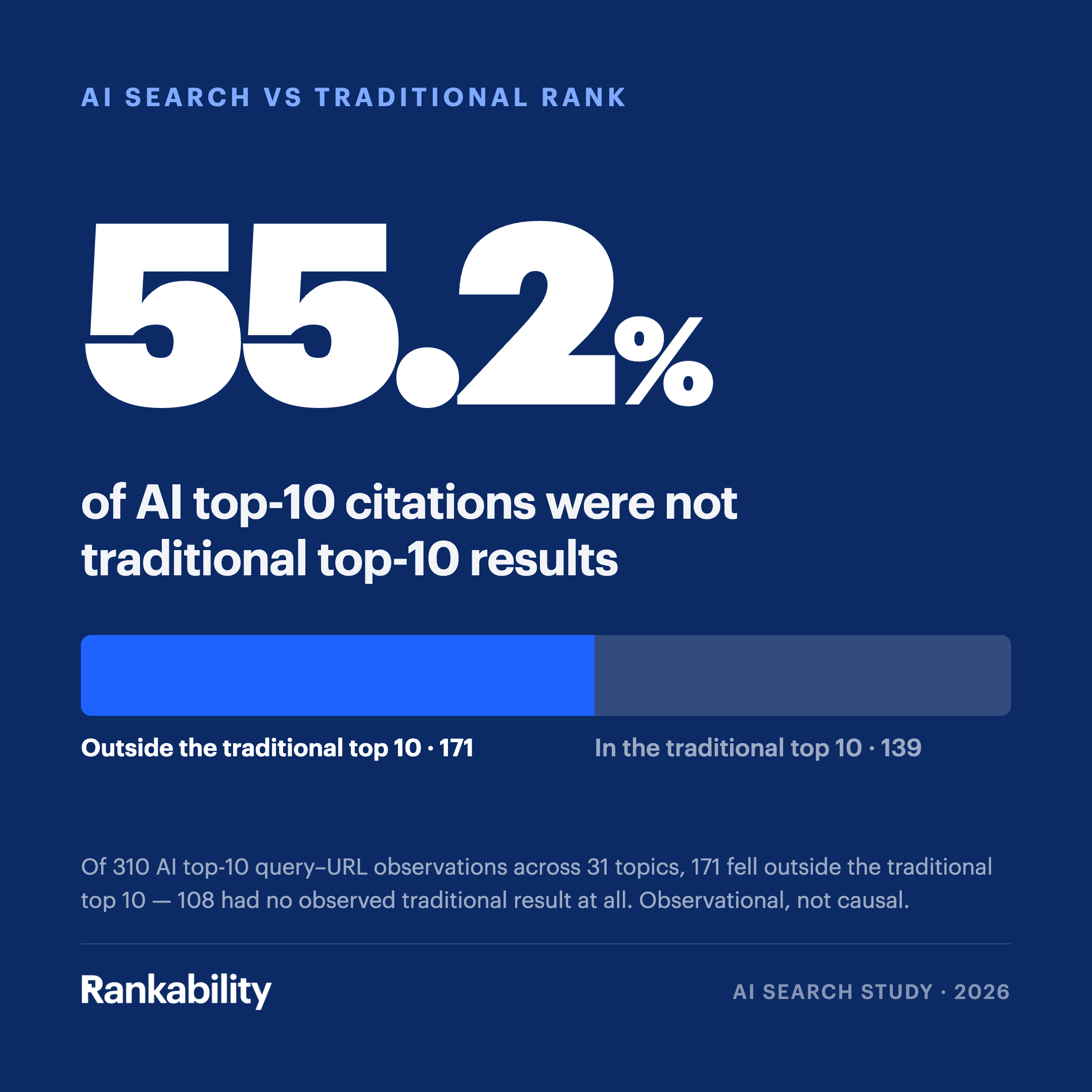
- 55.2% of top-10 AI citations did not rank in the traditional top 10.
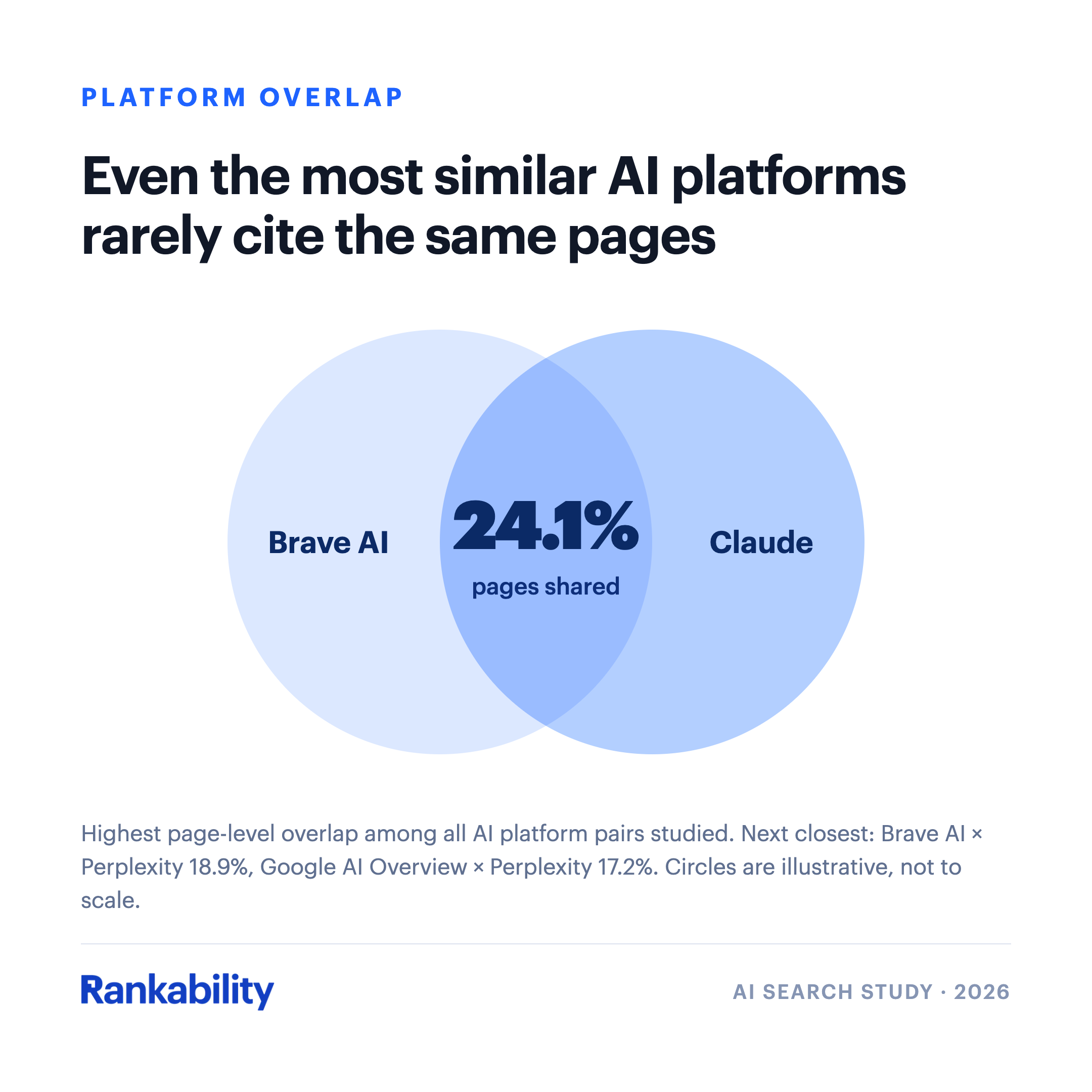
- No pair of AI platforms shared more than 24.1% of the pages they cited.
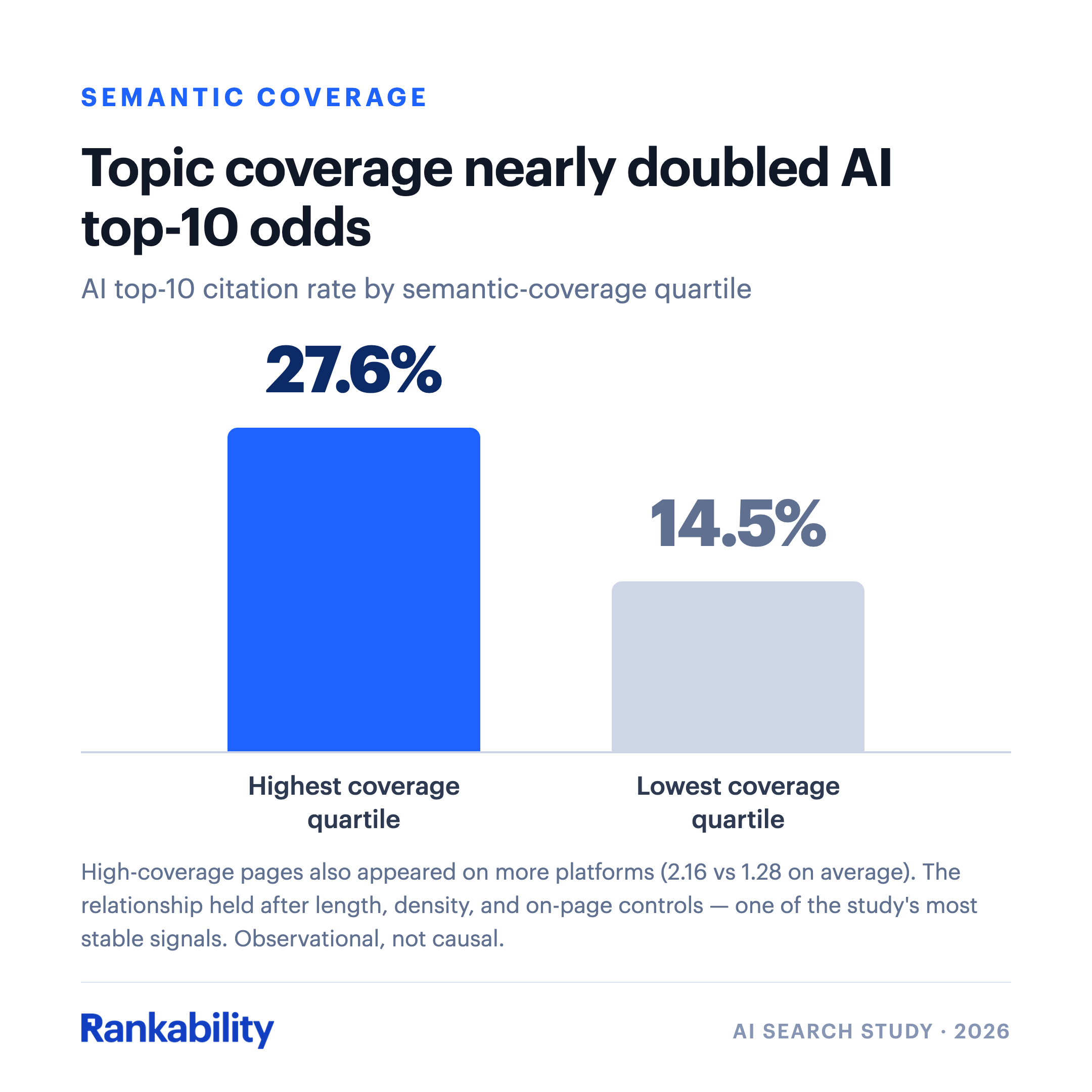
- Thorough topic coverage nearly doubled the top-10 AI citation rate: 27.6% versus 14.5%.
- 72.8% of AI-cited pages had no page-level referring domains.
- Search demand for AI-agent topics grew nearly 22× in three years.
Research note: Search volume indicates interest, not product usage or market share. The citation findings show relationships in the observed data, not proof that changing one page element will cause an AI platform to cite it. Sample sizes vary because some analyses required different types of page or third-party data.
Review the study methodology and downloadable evidence.
AI search demand over 48 months
Rankability analyzed a fixed panel of 3,751 terms using Google Keyword Planner as the primary demand source. Monthly values were lightly smoothed where needed to reduce bucketing noise, and indexed comparisons rebased themes to a shared starting point.
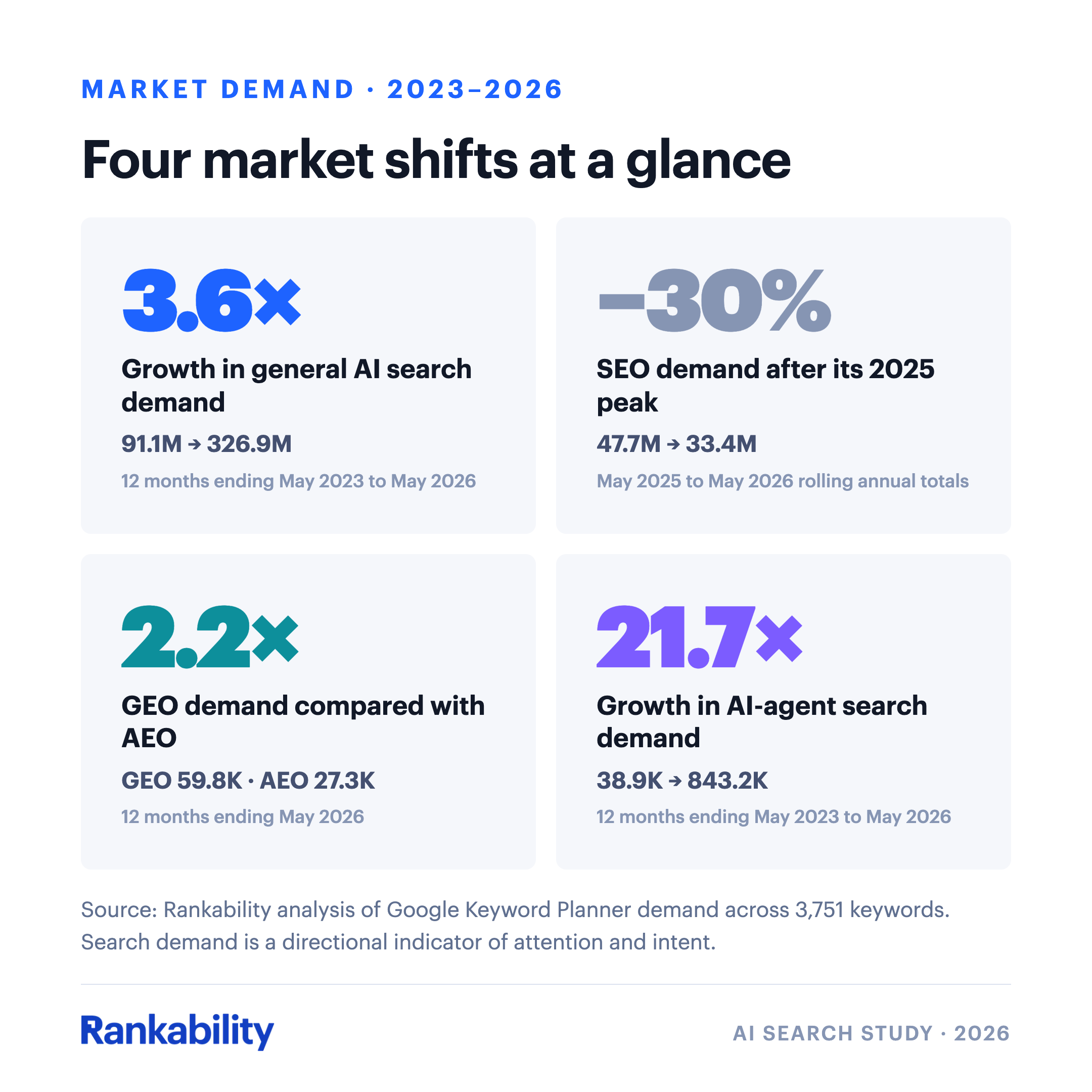
| Finding | What the demand data showed |
|---|---|
| Search demand for general AI topics grew 3.6× in three years | Annualized search demand increased from about 91 million in the 12 months ending May 2023 to about 327 million in the 12 months ending May 2026—an increase of roughly 260%. |
| SEO search demand fell 30% after peaking in 2025 | This was the first sustained decline in the four-year panel rather than a short seasonal dip. |
| GEO attracted roughly twice as much search demand as AEO | Both categories had almost no search volume in 2023, grew quickly through 2024 and 2025, and leveled off in early 2026. Both remained small compared with established search terminology. |
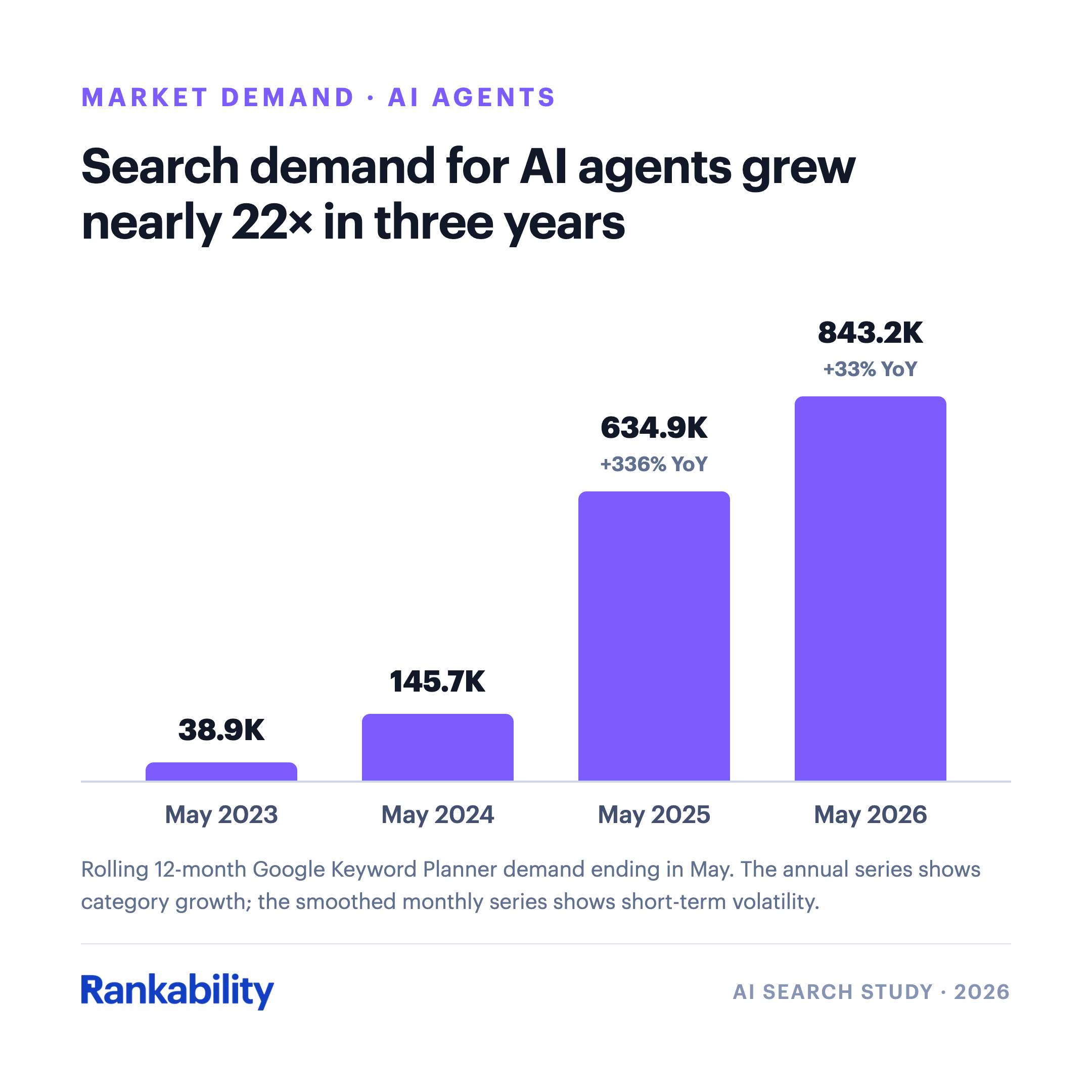
| AI-agent search demand grew nearly 22× in three years | Demand accelerated through 2024 and 2025 before becoming more volatile, suggesting that attention was shifting from broad discovery toward implementation questions. |
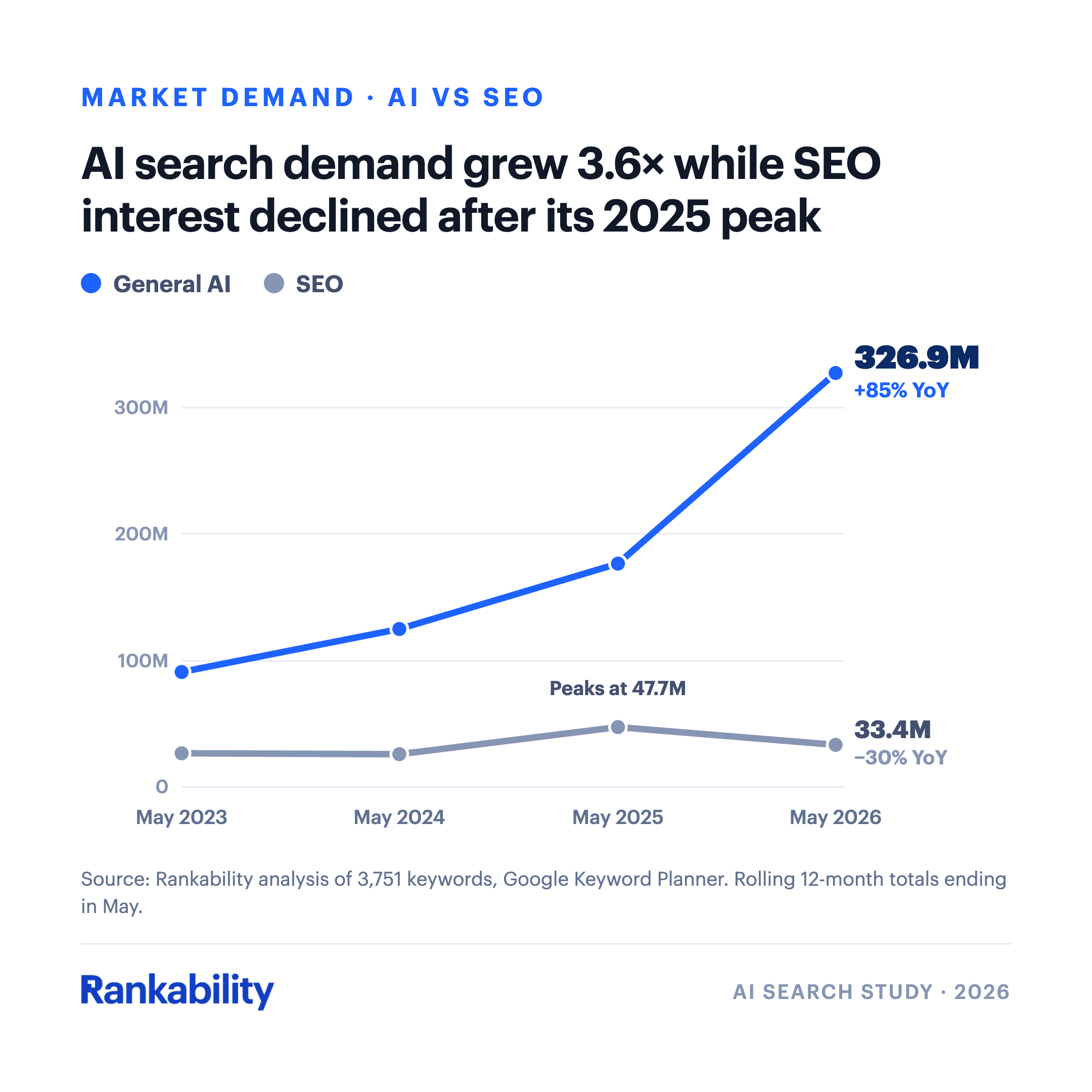
The clearest directional change is the widening gap between general AI and SEO demand. AI demand reached 326.9 million in the 12 months ending May 2026, while SEO demand fell from its 2025 peak to 33.4 million.
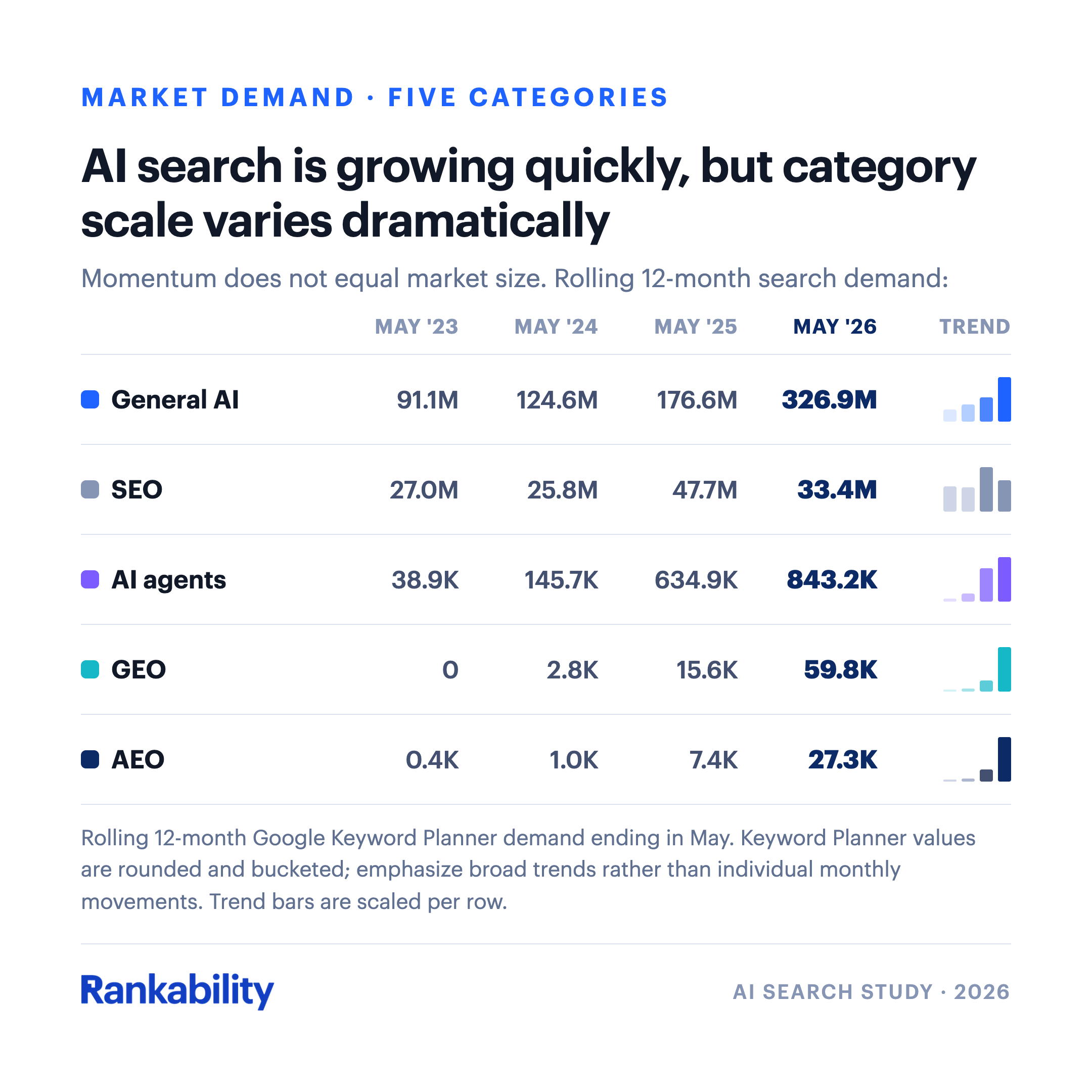
The smaller categories grew quickly without approaching the scale of general AI or SEO. Looking at the five themes together keeps rapid percentage growth in perspective.
AI-agent demand produced the sharpest sustained increase among the emerging categories, rising from 38,900 to 843,200 over three years.
These findings do not mean traditional search has disappeared. They show attention expanding toward AI answers while the terminology around AEO, GEO, and AI agents continues to settle. The underlying work still overlaps: publish accessible evidence, establish entities clearly, earn third-party corroboration, and measure conventional rankings and AI visibility separately.
Download the complete 48-month demand report
Traditional search and AI visibility
- Pages that ranked highly in traditional search were much more likely to be cited somewhere by AI. AI cited 98.9% of traditional positions 1–3 and 90.0% of traditional top-10 results, compared with 49.3% of results outside the top 10. But citation inclusion did not guarantee prominent placement: only 44.8% of traditional top-10 results also appeared among the first 10 AI citations. Traditional rankings improved the odds of entering the AI citation pool, but did not determine citation position.
The simplest takeaway: Ranking well helps you get considered by AI, but it does not guarantee a prominent citation.
- 55.2% of top-10 AI citations did not rank in the traditional top 10. Of 310 top-10 AI citations, 108 had no observed traditional ranking and 63 ranked below the top 10. Only 29.1% of the exact pages appeared in both channels for the same query, showing that AI and traditional search often surface different results.
An earlier Rankability study reached the same conclusion at the domain level. Across 2,824 AI citations, 32.8% of cited domains did not appear in the measured organic results. Better Google positions were strongly associated with citations among domains that already ranked, but traditional position explained almost none of the overall pattern once non-ranking cited domains were included. Ranking helped, but it was not the only path into an AI answer.
Platform fragmentation and source reuse
-
Pages cited for several searches were nearly three times as likely to appear among the top AI citations. Pages cited across eight or more queries had a 43.3% top-10 rate, compared with 15.5% for pages cited for only one query. They also appeared on 3.33 AI platforms on average.
-
No pair of AI platforms shared more than 24.1% of the pages they cited. Brave AI and Claude had the highest overlap; the other platforms differed even more. The number and concentration of sources varied widely by platform, although results from platforms with smaller samples require more caution. See how this plays out for one buyer question in our AEO agencies for SaaS report.
The earlier ranking study also showed how differently AI platforms used organic search. Sources without a measured organic ranking accounted for only 12.2% of Perplexity citations but 77.0% of ChatGPT citations, with the other platforms falling between those extremes. Perplexity’s top results most closely resembled Google, Brave AI aligned most closely with Brave, and Copilot with DuckDuckGo. ChatGPT did not closely match any measured search index. Because this was a single snapshot, these results show platform differences rather than permanent rules about how each engine works.
Common page foundations
-
99.9% of accessible AI-cited pages had a title tag. Rankability found one in 1,597 of 1,598 pages, making title tags standard but almost useless for differentiating pages that AI platforms already cite.
-
H1 tags appeared on 97.8% of AI-cited pages and 98.1% of traditional search results. Their presence was almost identical across the two channels.
-
98.5% of AI-cited pages had internal links, with a median of 12 links per page. Link count was nearly neutral for citation order, so basic internal connectivity was normal rather than a proven scaling lever.
-
76.0% of AI-cited pages had external links, but only 4.0% used formal reference-style links. External-link count was weak, offering no evidence that adding more outbound links alone improves citation order.
-
50.5% of AI-cited pages contained a table. Relevant tables had a modest relationship with citation performance even after other page characteristics were considered, but tables were not a universal requirement.
Titles, H1s, and headings
A comparison of 1,422 AI citations and 802 traditional search results found topic-relevant titles in 85.9% and 95.1% of each sample, respectively. Relevant titles were associated with stronger AI citation performance, but not with better traditional Rankability Tracker Domination scores. This does not prove that rewriting a title will cause visibility gains.
Download the comparison tables, sample denominators, and model outputs.
-
Only 4.8% of AI citations came from pages with the complete search query in the title tag. Most cited pages matched the topic without repeating the full query: partial topic matches accounted for 81.2%. Exact-match titles had a 30.9% top-10 rate, but the broader evidence points to topic relevance—not forced query repetition—as the useful takeaway.
-
The median title was 57 characters in both AI and traditional results. Top-10 AI citation rates ranged from 15.8% to 22.9% across five title-length groups, with no title length showing a consistent advantage.
-
Only 22.7% of AI-cited pages used exactly the same wording in the title tag and H1. The traditional search rate was similarly low at 24.2%. Top-10 AI citation rates barely changed as the wording became less similar, suggesting that titles and H1s can describe the same topic without being identical.
-
Only 4.0% of AI citations came from pages with the complete search query in the H1. Exact-match H1s had a 32.3% top-10 rate, compared with 19.9% for partial matches and 11.6% for H1s that did not mention the topic. But after accounting for overall page relevance, a relevant heading mattered more than repeating the query word for word.
-
Pages with multiple H1 tags appeared in AI and traditional search at nearly identical rates. Multiple H1s appeared on 11.9% of AI-cited pages and 11.1% of traditional results. They were neither disqualifying nor an established advantage.
-
97.6% of AI-cited pages used H2 headings, but keyword-matched H2s did not provide a clear advantage. Top-10 rates rose from 11.2% for H2s that did not mention the topic to 32.7% for exact matches. That advantage disappeared after accounting for other page characteristics.
-
Nearly half of cited pages skipped a heading level. Rankability found skipped levels on 49.5% of 1,233 pages. Pages without skips had a 21.8% top-10 citation rate versus 15.9% for pages with skips, but the study does not prove that correcting the hierarchy caused the difference.
Technical accessibility and page signals
-
93.9% of accessible AI-cited pages had a meta description. Relevant descriptions were associated with stronger citation rates at first, but the advantage disappeared after other page characteristics were considered. A useful meta description is a sign of a well-formed page, not a proven AI ranking lever.
-
Only 2.7% of AI-cited URLs contained the complete search query. Most URLs still mentioned at least part of the topic: exact or partial matches appeared in 86.2%. Relevant URLs were associated more with appearing across several AI platforms than with citation position.
-
Most AI citations came from domains that did not mention the search topic. These domains accounted for 85.4% of the analyzed citations. Only 10 citations—0.6% of the full dataset—came from domains that exactly matched the query, and exact-match domains showed no clear advantage.
-
99.5% of the AI-cited pages Rankability retrieved were HTML pages, not PDFs. Of 1,241 working URLs, 1,235 contained usable HTML and only six were PDFs. The PDF sample was too small to compare performance responsibly, and 32 requested URLs could not be retrieved.
-
92.5% of AI-cited pages exposed their main content without requiring JavaScript rendering. About one in 13 pages, or 7.5%, required a browser to render the content first. Another 88 pages exposed an H1 only after rendering. This does not prove that the AI platform rendered the page itself; it may have relied on a search index or another retrieval system.
Content depth, focus, and evidence
-
AI-cited pages had a median length of 2,681 words, but longer pages did not earn better citation positions. The middle half ranged from about 1,430 to 4,305 words, while top-10 citation rates stayed between 17.0% and 20.7% across six length groups. Once topic coverage was considered, additional length provided no clear advantage.
-
94.3% of analyzed page bodies did not contain the complete search query. Pages that used the exact phrase had a higher top-10 citation rate, but they were also more relevant overall. Repeating the exact phrase more often did not independently improve citation position.
-
Pages that covered a topic thoroughly were nearly twice as likely to earn a top-10 AI citation. High-coverage pages had a 27.6% top-10 rate, compared with 14.5% for low-coverage pages. They also appeared on 2.16 AI platforms on average versus 1.28. The relationship remained after accounting for other page characteristics.
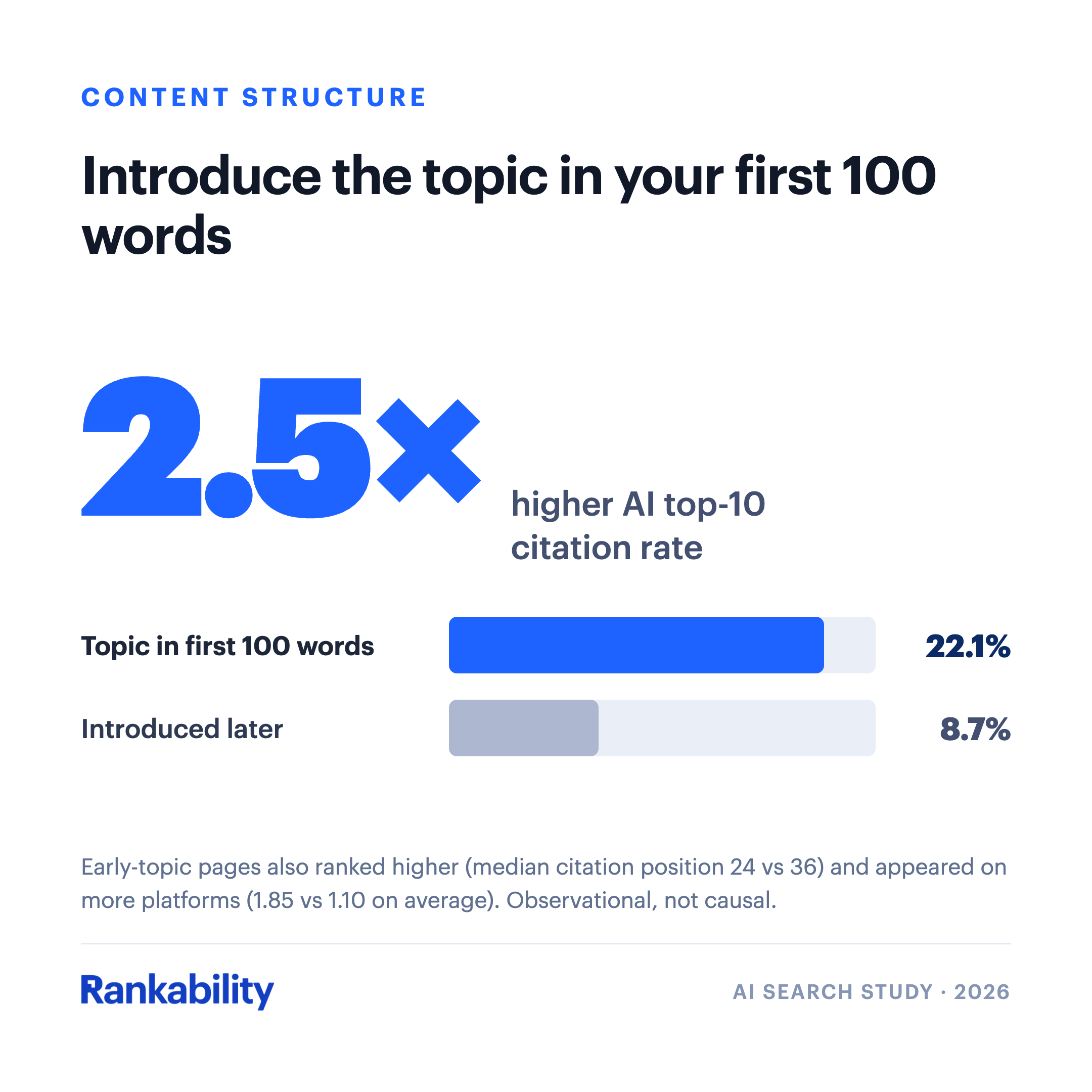
- Pages introducing the topic within 100 words had a 22.1% top-10 rate, versus 8.7% otherwise. Their median citation position was 24 rather than 36, and they appeared on 1.85 platforms on average rather than 1.10.
-
The location of a page’s strongest passage had little relationship with its AI citation position. The strongest passage began around word 865 at the median, about 36% through the page, but moving it earlier did not provide a clear advantage. Introducing the overall topic early mattered more than positioning one information-dense passage.
-
Covering the topic thoroughly mattered more than using highly original wording. High-coverage pages had similar top-10 citation rates whether wording originality was high or low—26.8% and 24.7%. Low-coverage pages reached only 13.5% and 10.6%.
-
Pages with more specific facts appeared on more AI platforms, but their top-10 advantage was modest. The most fact-rich pages had a 21.5% top-10 citation rate, compared with 17.0% for the least specific pages. They appeared on 1.98 platforms on average versus 1.39. Names and entities showed the clearest relationship, while prices and methodology details showed smaller signals.
-
Nearly half of the pages that ranked in both traditional and AI top 10s included first-party evidence. The exact share was 45.9%. At least one unique fact appeared on 79.9% of the analyzed pages, although the study cannot prove that original evidence alone caused their visibility.
-
Listicles and comparison pages earned 63.6% of citations—but most searches explicitly asked for “best” or “top” results. Twenty-four of the 31 queries used one of those terms, explaining much of the apparent format preference. Pages that closely matched the search intent had a 20.4% top-10 rate versus 8.3% for poorly aligned pages. After accounting for relevance, being a listicle provided no clear advantage by itself.
Links, authority, schema, and provenance
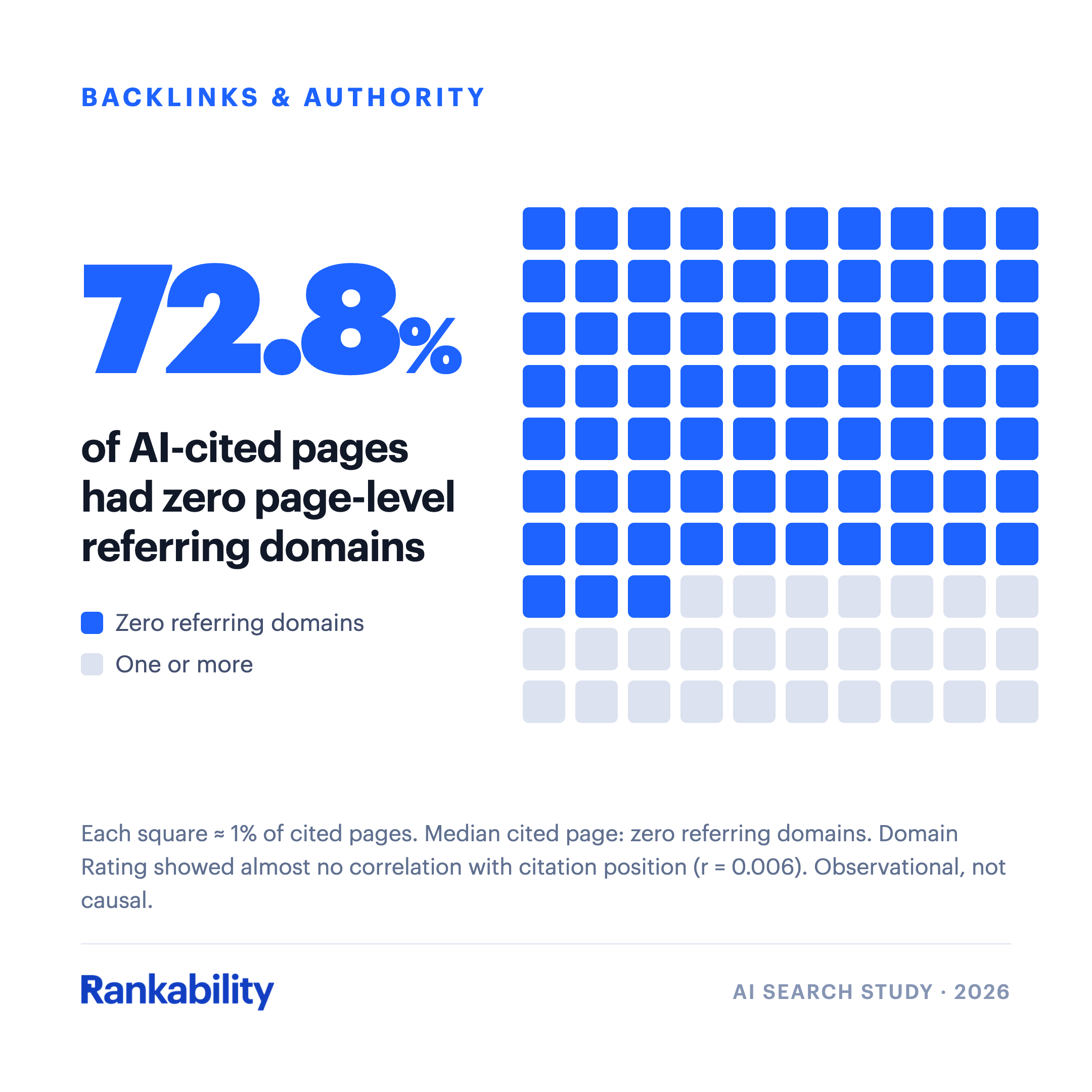
- Nearly three-quarters of AI-cited pages had zero page-level referring domains. The exact share was 72.8%, and the median cited page had zero. This shows backlinks were not a citation prerequisite, not that links never matter.
-
One in four AI-cited pages came from a domain with a DR below 40. The median domain rating was 63, but domain authority had almost no relationship with citation position among pages that were already cited.
-
No schema type consistently improved AI citation position. Article schema appeared on 58.4% of AI-cited pages, Image schema on 62.9%, and FAQ schema on 32.7%. Schema can clarify a page’s meaning and eligibility without acting as a universal citation boost.
-
AI and traditional results shared the same 61-day median age. Although 80.5% of AI-cited pages with reliable dates were less than six months old, freshness did not separate AI citations from traditional results. Newer was not automatically better.
-
AI-only results were more likely to contain content that detectors classified as AI-written or mixed. The detector applied that label to 72.9% of AI-only pages, compared with 43.7% of traditional-only pages. The classification did not predict a better citation position, and the detector could not verify who actually wrote the content.
Study methodology and downloads
The citation analysis is an August 2026 observational snapshot built from the same 31-topic set across traditional and AI search. The main comparison contains 1,645 distinct AI query–page observations and 916 traditional query–page observations. The AI observations span Claude, Gemini, DeepSeek, Meta AI, Perplexity, Microsoft Copilot, Brave AI, Grok, ChatGPT, Google AI Mode, and Google AI Overviews.
Traditional performance refers to Rankability Tracker’s cross-engine traditional-search evidence, not a Google-only ranking study. URLs were normalized before query-level comparisons so superficial URL variants did not count as different pages. “Top 10” means the first 10 observed results within the relevant traditional or AI citation order for the query.
Page-feature analyses used successfully retrieved HTML pages. Where a source page did not expose usable title or heading evidence, the comparison used a rendered-page fallback when available and excluded challenge pages, soft errors, and unresolved responses. This is why denominators differ between findings. For example, the final title comparison contains 1,422 AI observations and 802 traditional observations, while the broader query–page universe contains 1,645 and 916.
The demand analysis used a fixed panel of 3,751 terms from Google Keyword Planner covering June 2022 through May 2026. Because Keyword Planner reports bucketed values, the study emphasizes rolling and indexed trends; monthly values were lightly smoothed where needed. Search demand measures expressed interest, not usage, revenue, or market share.
Important limitations:
- The citation study shows associations within the observed topics and snapshot; it does not establish universal ranking factors or causation.
- Twenty-four of the 31 queries contained “best” or “top,” so page-format findings should not be generalized to every query intent.
- AI answers, citations, and result order can change by platform, model, location, account state, and time.
- A missing traditional result means no result was observed in the tracked comparison set; it does not prove that the URL could not rank elsewhere.
- Third-party authority metrics and automated content classifiers are imperfect proxies and are not proof of quality or authorship.
Download the editorial media kit or review the supporting title comparison tables, sample denominators, model outputs, H1 comparison tables, page-one thresholds, and AI-versus-human classifier aggregate.
For citation or editorial review, use the canonical report URL: https://www.rankability.com/blog/ai-search-statistics/.
What these statistics mean for your AI SEO strategy
Start with technical accessibility: return usable HTML, provide a descriptive title, and use a clear heading structure.
Then focus on the factors with the strongest and most consistent relationships:
- Match the query’s real intent.
- Introduce the topic clearly near the beginning.
- Cover the expected concepts and entities thoroughly.
- Add specific facts, examples, prices, tests, methods, or first-party evidence.
- Measure traditional and AI visibility separately.
- Track the AI platforms that matter to your audience instead of relying on one blended total.
Do not replace those fundamentals with keyword repetition, forced exact-match wording, arbitrary word counts, schema volume, or backlink targets.
Measure your AI SEO progress
Use these findings to set priorities, then track whether your clients appear in the AI answers that matter to their buyers. Monitor mentions and citations alongside traditional rankings so you can explain what changed.
Rankability Tracker monitors your brand’s AI search visibility and citations across the platforms your audience uses. Traditional rankings, local visibility, and supported video-search surfaces provide additional context in the same client workspace.
AI SEO FAQ: additional page features
Do FAQ, summary, and table-of-contents blocks help AI citations?
FAQ content appeared on 63.8% of AI-cited pages, summaries on 26.7%, and tables of contents on 11.4%. None provided a consistent advantage once other page characteristics were considered. Add these blocks when they improve comprehension or navigation, not merely to target citations.
Do images and alt text help AI citations?
Meaningful images appeared on 84.8% of AI-cited pages, and the median page provided alt text for 96.3% of its images. Better alt-text coverage did not provide a clear citation advantage. Use informative images and write alt text for accessibility and meaning, without keyword stuffing.
Do ordered and unordered lists help AI citations?
Unordered lists appeared on 84.2% of AI-cited pages and ordered lists on 30.7%, but neither showed a clear citation advantage after other page characteristics were considered. Use lists when information is genuinely sequential or easier to scan, rather than breaking up prose solely for AI extraction.
Do video embeds and transcripts help AI citations?
Only 7.3% of AI-cited pages embedded a video and 1.5% included a transcript. Video embeds showed no consistent citation advantage, while too few pages had transcripts to draw a reliable conclusion. Put important video claims and evidence in accessible HTML or a useful transcript.