

More SEO teams now report on rankings beyond Google, including AI answers, local pack visibility, and citation presence inside tools like ChatGPT and Gemini. When you compare the best SEO reporting tools, that shift matters because a rank tracker built for ten blue links can miss the channels clients now ask about in monthly reviews.
This roundup exists for agencies, in-house marketing teams, and consultants who need reporting software that turns scattered SEO data into decisions. The quick answer is Rankability Reporter as the top pick, because its proprietary Search Performance Index tracks total search performance across traditional search engines, local pack, AI answers, AI citations, and video search, which makes it unusually aligned with how search visibility actually works in 2026.
The tools below were selected using practical criteria: reporting depth, dashboard clarity, white-label capability, integrations, multi-client workflow, pricing transparency, and how well each platform connects rankings to business conversations. A reporting tool is only useful if you can explain results, defend strategy, and show what changed, so this list favors platforms that help you prove performance rather than simply export charts.
| Tool | Best for | Starting Price | Key Strength |
|---|---|---|---|
| Rankability Reporter | Agencies tracking Google and AI search visibility | Contact for pricing | SPI score unifies traditional, local, AI, citation, and video visibility |
| Semrush | All-in-one reporting across SEO and marketing channels | Pro: $139.95/month | Broad reporting plus strong integrations and client portals |
| Ahrefs | Search performance reporting tied to backlink and content data | Lite: $129/month | Excellent link intelligence and clean ranking reports |
| AgencyAnalytics | Agencies needing fast white-label client reporting | Freelancer: $79/month | Purpose-built agency dashboards and automated reports |
| SE Ranking | Budget-conscious teams managing multiple client campaigns | Essential: $65/month | Strong value across rank tracking, audits, and reporting |
| Looker Studio | Teams building custom SEO dashboards from mixed data sources | $0 | Flexible visualization for blended reporting |
| Moz Pro | Smaller teams that want straightforward SEO reporting | Starter: $49/month | Accessible reporting with trusted core SEO metrics |
1. Rankability Reporter — Best for agencies reporting on total search visibility
Rankability Reporter stands out because it treats SEO reporting as a visibility problem, not just a keyword position problem. Its Search Performance Index, or SPI, is the clearest example of that approach because it measures total search performance across traditional search engines, local pack, AI answers, AI citations, and video search in one framework.
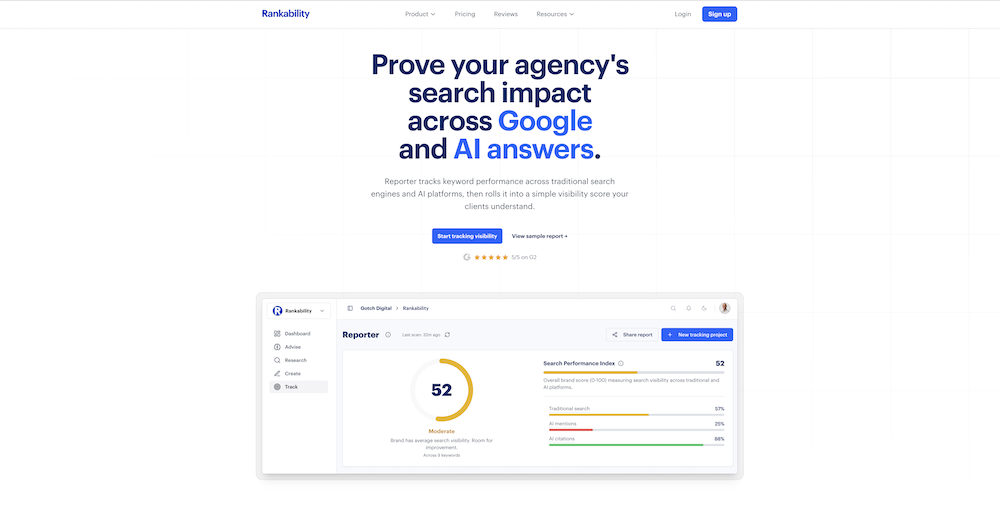
That matters for agencies because client reporting has changed faster than most software categories admit. A dashboard that ignores ChatGPT, Gemini, and AI citation presence can understate brand discovery, while a dashboard that only counts mentions without showing classic rankings can overstate impact, so Rankability’s blended model reflects how modern search journeys actually fragment across platforms.
Key features:
- Proprietary Search Performance Index that combines multiple visibility surfaces into one reporting signal
- Tracking across traditional search, local pack, AI answers, AI citations, and video search
- White-label reporting for agency delivery
- API access for scalable reporting workflows
- Built within a broader agency workflow covering research, writing, optimization, tracking, and advising
Pricing: Contact for pricing
Ideal for: SEO agencies and marketing teams that need one reporting layer for Google search and AI search visibility.
Bottom line: Rankability Reporter is the strongest fit if your reports must explain total search presence rather than only keyword movement.
2. Semrush — Best for all-in-one marketing reporting
Semrush remains one of the most complete reporting platforms because it connects keyword rankings, site audits, backlinks, organic traffic trends, competitor data, and PPC context in one ecosystem. That breadth matters when clients want a single narrative that links SEO performance to broader demand generation instead of reviewing disconnected exports from several tools.
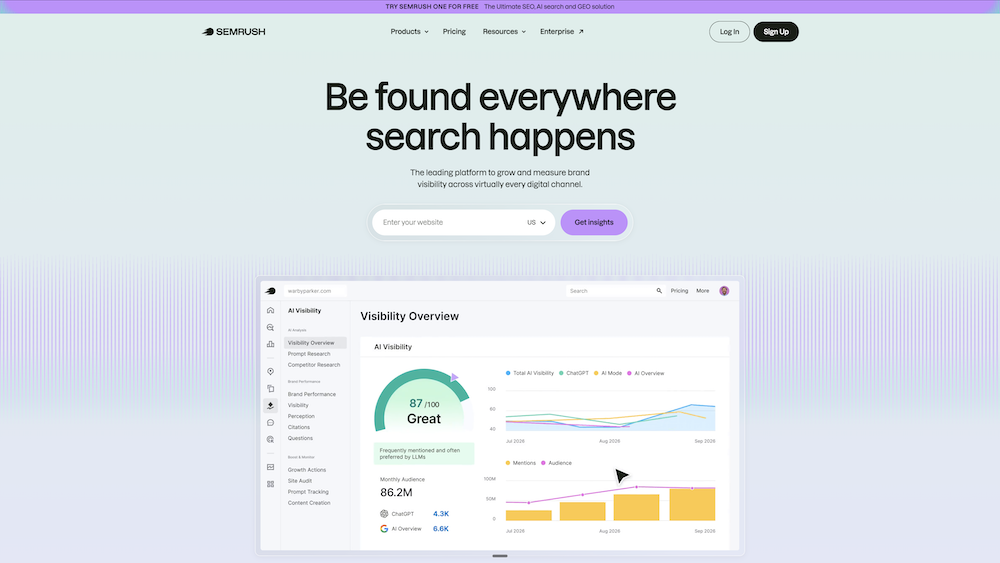
Its reporting strength is not just the volume of data but the number of ways you can package it. My Reports, integrations, and client-facing dashboard options make Semrush especially useful for agencies that need recurring, semi-automated reporting without rebuilding templates every month.
Key features:
- My Reports builder for custom SEO and marketing reports
- Position Tracking for keyword visibility and competitor comparisons
- Site Audit and Backlink Analytics data in the same reporting environment
- Integrations with Google Analytics and Google Search Console
- Client Portal option for ongoing stakeholder access
Pricing: Pro: $139.95/month; Guru: $249.95/month; Business: $499.95/month
Ideal for: Agencies and in-house teams that want broad SEO reporting plus adjacent marketing data.
Our take: Semrush is the safest all-around choice when you need one platform to support reporting across SEO, paid, content, and competitor intelligence.
3. Ahrefs — Best for backlink-led SEO reporting
Ahrefs is especially strong when reporting must explain authority growth, link acquisition, and content performance alongside rankings. Its backlink index remains one of the platform’s defining assets, and that gives your reports more strategic weight when keyword changes are driven by off-page improvements rather than on-page edits alone.
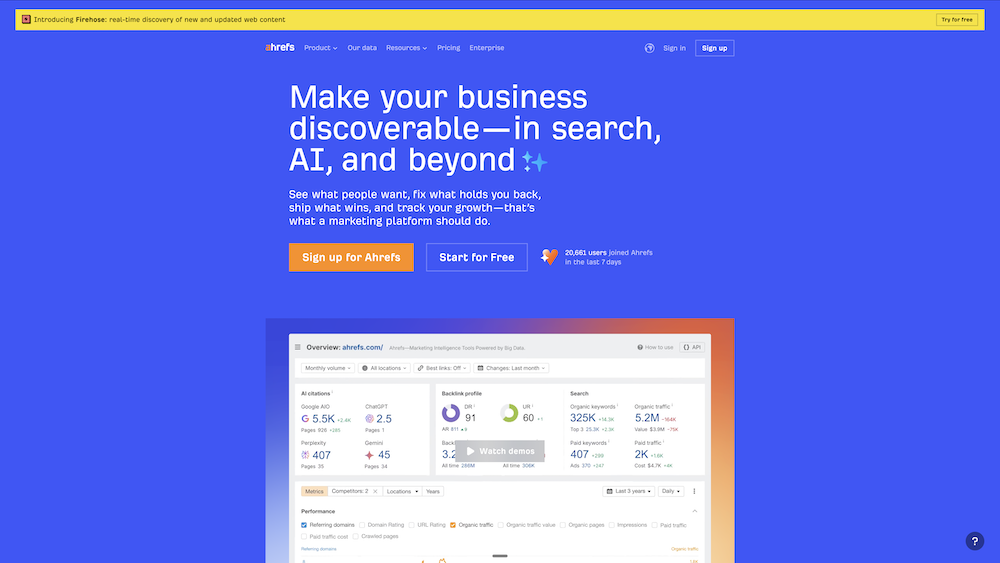
The interface is also cleaner than many enterprise-style reporting tools, which helps when clients need less noise and more signal. Ahrefs works best for teams that already think in terms of pages, links, and search demand patterns, because its reports are strongest when interpreted through that lens.
Key features:
- Rank Tracker with scheduled visibility reporting
- Site Explorer for backlink and organic performance reporting
- Competitive comparison across domains and pages
- Content performance insights tied to search demand
- Clear historical trend views for rankings and links
Pricing: Lite: $129/month; Standard: $249/month; Advanced: $449/month; Enterprise: $1,499/month
Ideal for: SEO teams that want reporting anchored in backlink intelligence and content performance.
Why it stands out: Ahrefs gives reports stronger explanatory power when link equity and page-level competition are central to the story.
4. AgencyAnalytics — Best for fast white-label client dashboards
AgencyAnalytics was built around agency reporting needs, and that focus shows in the product structure. Instead of asking you to adapt a general SEO platform into a client reporting system, it starts with dashboards, scheduled reports, branded delivery, and multi-client management as the core workflow.
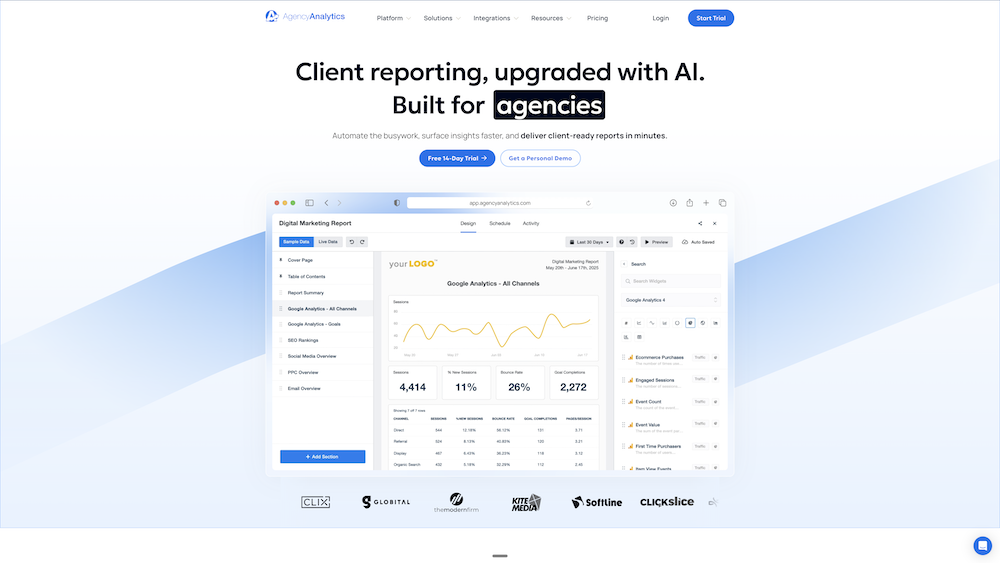
That specialization makes it efficient for agencies with many accounts and recurring deliverables. If your biggest reporting pain is time spent formatting decks, updating PDFs, and pulling data from multiple channels, AgencyAnalytics often reduces operational drag faster than deeper but more complex SEO suites.
Key features:
- White-label dashboards and scheduled reports
- Drag-and-drop report builder for client-facing deliverables
- Integrations with SEO, PPC, email, call tracking, and analytics tools
- Multi-location and multi-client management
- Goal and budget widgets for business-context reporting
Pricing: Freelancer: $79/month; Agency: $239/month; Agency Pro: $479/month
Ideal for: Agencies that prioritize polished client reporting and automation over deep native SEO research.
Worth noting: AgencyAnalytics is often the most practical choice when reporting speed and presentation quality matter as much as raw SEO depth.
5. SE Ranking — Best for value-conscious multi-client reporting
SE Ranking has improved steadily into a credible reporting platform for agencies and smaller teams that need strong coverage without premium-suite pricing. Its mix of rank tracking, website audit data, competitor monitoring, and report automation gives you enough depth to build useful client narratives without paying enterprise-level rates.
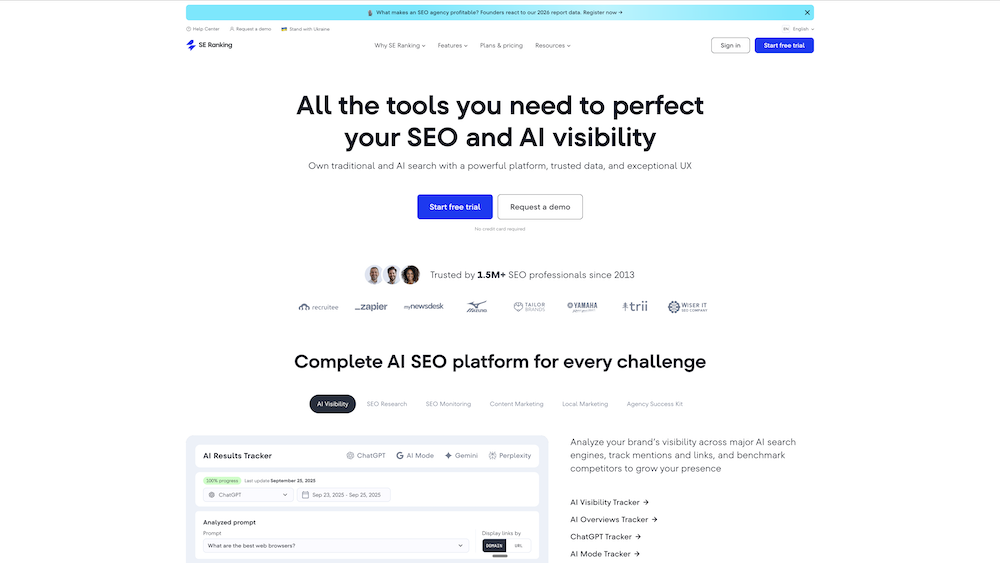
The value proposition is not just lower cost but lower compromise than many budget tools. For teams managing many local or mid-market campaigns, SE Ranking often hits the balance point where reporting is detailed enough for professional use but simple enough to deploy quickly across accounts.
Key features:
- Automated SEO reports with white-label options
- Keyword rank tracking with local and mobile support
- Website audit and competitor research modules
- Google Analytics and Google Search Console integrations
- Lead generation and agency add-ons on higher plans
Pricing: Essential: $65/month; Pro: $119/month; Business: $259/month
Ideal for: Small agencies and in-house teams that want capable reporting at a moderate price point.
The verdict: SE Ranking is one of the strongest budget-to-capability options for teams that need scalable reporting without overbuying.
6. Looker Studio — Best for custom dashboards from mixed data sources
Looker Studio is not a dedicated SEO reporting tool, but it remains one of the most useful reporting layers in the category because it lets you combine data from Google Search Console, Google Analytics, ad platforms, CRM systems, and third-party connectors. That flexibility matters when leadership wants one dashboard that ties SEO visibility to leads, revenue, and channel mix.
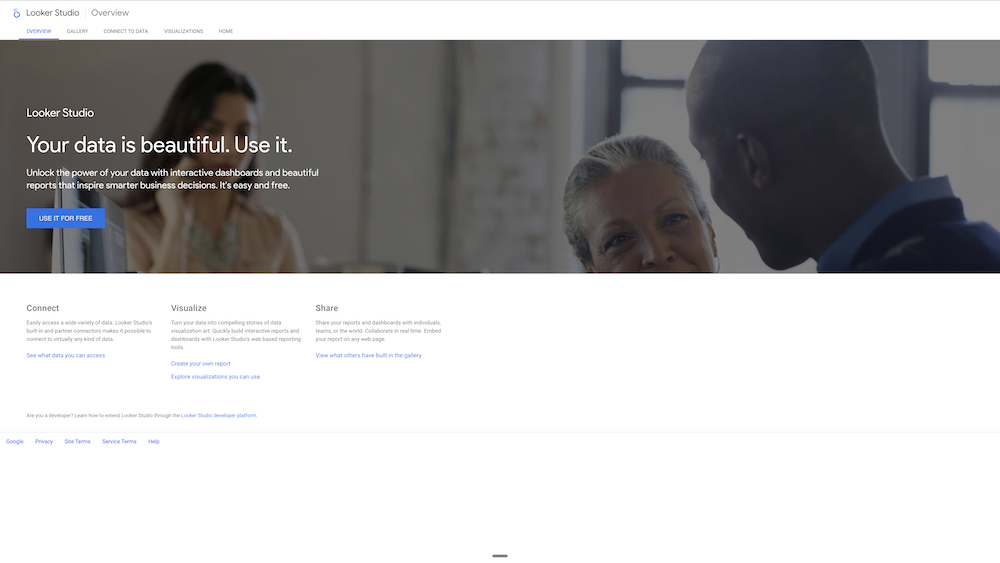
Its weakness is the same as its strength: you must build the system yourself. Looker Studio is best when your team knows what should be measured and needs a customizable presentation layer, not when you want built-in SEO interpretation from day one.
Key features:
- Free dashboard builder with customizable visualizations
- Native connections to Google products
- Blended reporting across SEO and business data sources
- Shareable live dashboards for stakeholders
- Strong flexibility for executive and client reporting templates
Pricing: Free
Ideal for: Teams that need custom SEO dashboards combining search data with broader business metrics.
Best if you need: Looker Studio is the right fit when your reporting challenge is integration and visualization more than data collection.
7. Moz Pro — Best for straightforward SEO reporting for smaller teams
Moz Pro remains relevant because it keeps reporting approachable. Many teams do not need a deeply configurable reporting stack; they need reliable rank tracking, site crawl insights, and understandable metrics that support monthly decision-making without a steep learning curve.
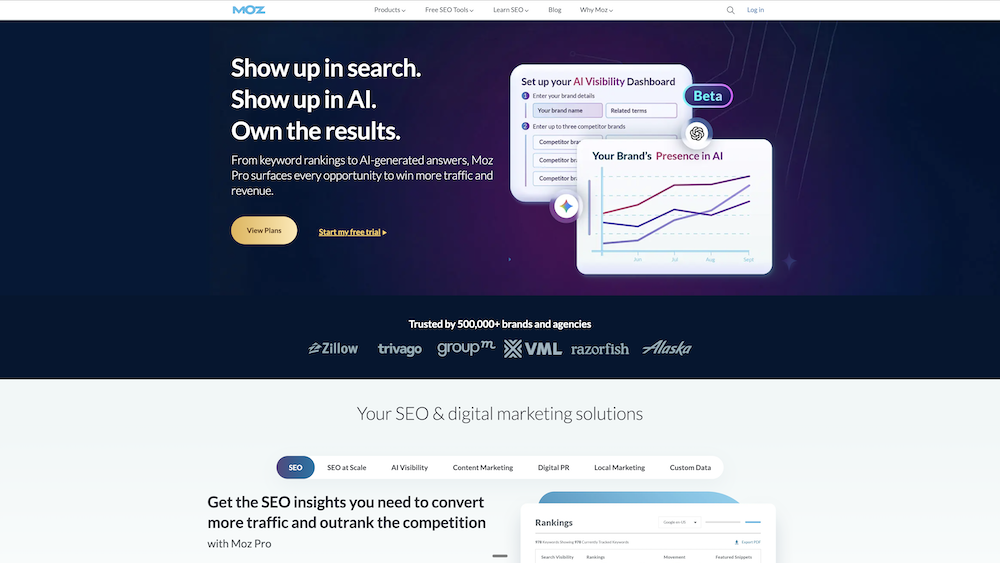
That simplicity is useful in smaller organizations where SEO reporting is reviewed by general marketers, founders, or account managers instead of specialist analysts. Moz’s reporting environment is less expansive than Semrush or Ahrefs, but it often makes sense when clarity and ease of use matter more than exhaustive data breadth.
Key features:
- Rank tracking and keyword visibility reporting
- Site Crawl diagnostics for technical SEO reporting
- Link Explorer for backlink monitoring
- Custom reports and campaign-based tracking
- Competitive keyword visibility insights
Pricing: Starter: $49/month; Standard: $99/month; Medium: $179/month; Large: $299/month
Ideal for: Small businesses and lean marketing teams that want accessible SEO reporting.
Bottom line: Moz Pro works well when you need dependable SEO reporting without the complexity of a larger all-in-one suite.
How We Chose the Best SEO Reporting Tools
This list prioritized reporting usefulness over feature sprawl. A platform scored higher if it could help you answer the questions clients and stakeholders actually ask: what improved, what declined, why it changed, and what should happen next.
We evaluated each tool on six factors: data coverage, report clarity, automation, white-label capability, integration depth, and pricing transparency. That framework matters because a powerful crawler or keyword database does not automatically produce a better report, especially when the final audience is a client, CMO, or executive team.
We also weighed whether each platform reflects the current shape of search. Google rankings still matter, but local pack performance, AI answer visibility, and citation presence now influence discoverability, so tools that acknowledge those surfaces earned stronger placement.
Finally, we considered operational fit. Agencies need multi-client workflows, repeatable templates, and scalable delivery, while in-house teams often need custom dashboards tied to business outcomes, which is why this list includes both dedicated SEO platforms and flexible reporting layers.
FAQs
What is the best SEO reporting tool for agencies?
Rankability Reporter is the strongest agency option if you need visibility reporting across Google and AI search surfaces. AgencyAnalytics is a close alternative if white-label dashboard speed is your main priority.
Which SEO reporting tool has the best value?
SE Ranking offers one of the best value profiles because it combines rank tracking, audits, integrations, and white-label reporting at a lower entry price than many larger suites. It suits smaller agencies and lean teams especially well.
Is Looker Studio enough for SEO reporting on its own?
Looker Studio is enough if you already have reliable data sources and want a custom dashboard layer. It is less effective if you need native SEO research, rank tracking, and built-in interpretation in one tool.
What should an SEO report include in 2026?
A strong SEO report should include rankings, visibility trends, traffic impact, technical issues, content performance, and business outcomes. For many brands, it should also address local pack presence and AI search visibility.
Are white-label SEO reports worth paying for?
Yes, if you manage clients at scale and need consistent delivery without manual formatting every month. White-label reporting saves time, improves presentation quality, and reduces reporting friction across accounts.
Conclusion
The right reporting tool depends less on raw data volume and more on the kind of story you need to tell. If your reports must explain total visibility across traditional search, local results, AI answers, citations, and video surfaces, Rankability Reporter is the clearest starting point because its SPI model matches how search exposure now spreads across channels.
If you want the broadest all-in-one marketing context, Semrush remains a strong choice. If backlinks drive your reporting narrative, Ahrefs is hard to beat, while AgencyAnalytics and SE Ranking make the most sense for agencies optimizing either workflow speed or budget efficiency.
Start here: choose the tool that matches your reporting audience before you compare feature lists. A client-facing agency dashboard, an executive SEO scorecard, and an analyst workbench solve different problems, and the best platform is the one that makes your next recommendation easier to defend.