

Frase turns page-one SERP analysis into a practical writing workflow for content writers, SEO professionals, content marketers, and content creators.
Start with a target keyword and Frase scans top search results, including People Also Ask, using natural language processing, topic modeling, machine learning, and artificial intelligence to clarify search intent, outline the sections readers expect, and reveal content gaps.
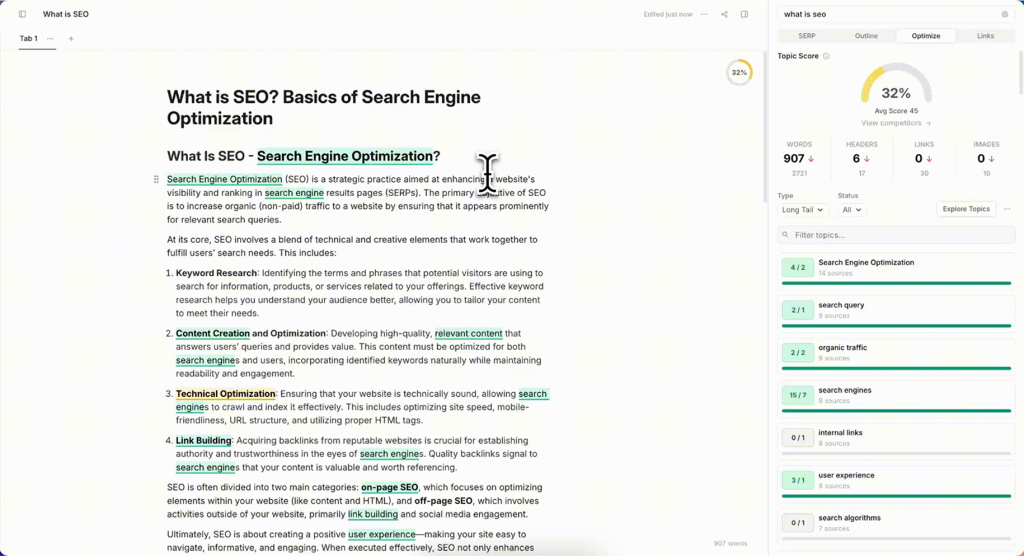
In the editor, a real-time Content Score (sometimes called a topic score) provides content scoring guidance and optimization suggestions on word count, headings, and topic coverage, while the AI Writing Assistant speeds up Content Writing for blog posts, landing pages, and longer guides.
Research, briefs (via Outline Builder), drafting, internal linking prompts, and content analysis live in one place, which helps both individual users and marketing teams move faster inside a repeatable content creation process. For teams trying to publish SEO-friendly content consistently, that consolidation can be a game-changer.
This Frase review focuses on content features: research and briefing, editor guidance, practical AI assistance, support resources, and how Frase contributes to a repeatable content strategy that improves performance in search engines and supports stronger organic traffic over time.
Quick summary
Frase consolidates four steps, research, briefing, drafting, and optimization, so your article ships with a tighter match to search intent and stronger coverage of what users expect to find. Editors get clear checkpoints (questions answered, headings organized, reasonable word count, and coverage of essential subtopics) without jumping between SEO tools.
It works especially well for teams that care about content research before drafting and want a user-friendly interface that helps maintain consistency across the writing process.
Where it’s especially helpful
- Building a credible outline on a deadline
- Refreshing older articles with missing sections and weak internal linking
- Turning scattered content ideas into a single brief that a distributed team can follow
- Helping SEO experts and writers align on what top-ranking articles are actually covering
What Frase AI is
Frase acts like a co-pilot for planning and producing search-focused content:
- Research panel: common headings from competitors, People Also Ask, and references to top results
- Question Research: question mining from SERPs so you can see what questions people are asking
- Brief builder: assemble sections, questions, external links, and planned internal links into a single handoff
- Editor guidance: Content Score with real-time cues for coverage and structure
- Generation: an AI writer that can draft or expand sections you’ll later review and refine
The outcome is a repeatable “research → outline → draft → optimize” loop that cuts guesswork and keeps quality checks inside the document. If your team already uses a separate keyword research tool for monthly search volume and long-tail keywords, Frase fits nicely as the content execution layer for AI-powered content optimization.
Who it’s best for
- Writers who want solid scaffolding before they draft
- SEOs who need articles to align with search results patterns and audience questions
- Small teams that benefit from consistent briefs and fewer tool handoffs
- Small businesses that want a powerful tool for content marketing without building a complex stack
- Content marketers who want stronger content outlines and clearer optimization guardrails
Who may need more
- Teams that want deep keyword databases in the same tool (pair Frase with your keyword platform)
- Orgs that require advanced permissions or complex review workflows
- Teams that want broader reporting integrations like Google Analytics baked directly into the content workflow
- Companies that need more advanced features for enterprise collaboration and governance
Key Feature Breakdown
1. Research features & SERP analysis
Frase is strongest before you write. Its SERP research workflow helps you understand what’s already working so you can create something more complete and useful.

What you see
- A scan of page-one coverage: common headings, recurring topics, and typical word counts
- Question mining from People Also Ask and competitor FAQs
- Related themes that frequently appear on ranking articles for the target search query
- A snapshot of top-ranking articles so you can quickly compare structure and angle
How to use it (quick SOP)
- Skim the top-ranking pages and label the intent (informational, transactional, or mixed).
- Collect only the questions your reader truly needs answered.
- Mark subtopics competitors cover that you don’t, these become H2/H3s or supporting posts in your cluster.
2. Briefs, Outline Builder, and content structure
Open a new document for the keyword, then use the Outline Builder to import competitor headings, merge key questions, and shape a clear brief.

Frase is good at turning SERP findings into usable content outlines, which is one of its standout features for both solo users and support teams that need repeatable handoffs.
Brief checklist
- Working title + intent + the main features you’ll cover
- Section plan with one-line notes on what each part should achieve
- The most important questions mapped to sections
- Planned citations (external links) and at least one internal link
- Notes on tone, examples, and proof points
This keeps the writer, editor, and SEO aligned from kickoff to draft. It also reduces revision cycles because your content creation process starts with a shared plan instead of a blank doc.
If your team drafts in Google Docs, Frase can still be used upstream for the brief and downstream for optimization checks.
3. Editor: Content Score, topic coverage, and guidance
Draft in the editor while watching the Content Score and coverage prompts. Use them to catch omissions, don’t chase a number for its own sake.
Focus on
- Coverage of essential subtopics, not just keywords
- Headings that answer the questions you pulled earlier
- A credible word count range for the query (no padding)
- Readable structure with scannable sections and a clear takeaway
Frase’s content scoring is helpful when it’s treated like a checklist, not a finish line. The best results come when you combine the score with human judgment and keep the human touch in examples, expertise, and brand voice.
That balance matters because search rankings improve when content is both well-covered and genuinely useful, not just “optimized.”
4. AI Writing Assistant (strengths & limits)
The assistant is great for turning an outline into a first pass, smoothing transitions, and generating alternative intros or summaries. It helps speed up creating content, especially when the hardest part is getting momentum.
Frase supports AI-powered writing, but it still works best when paired with human review and strong editorial standards, especially for SEO-focused content writing.
Keep a tight review loop:
- Generate
- Fact-check
- Personalize with brand/SME input
- Tighten wording
- Re-check coverage
Publish only after human edits. That’s how you protect content quality and ensure genuinely high-quality content. Like most of the best AI writing tools, Frase can accelerate drafting, but it can’t replace editorial judgment.
This is where Frase can support content marketers and SEO experts without replacing them.
5. Content Opportunities: gaps, clusters, and internal linking
Use this view to identify pages to improve, spin off supporting articles, and add internal links with descriptive anchors.

Over time, this reinforces content clusters, strengthens site structure, and improves discoverability. It can also support better search engine rankings by helping existing content connect more clearly across a cluster.
Workflow tip: Have a strategist build the brief, a writer draft with the editor’s guidance, an editor polish and fact-check, and an SEO add final internal links before publishing. Run one pilot article end to end and save the brief as a template for future pieces.
Real-world use cases
- New blog posts designed to meet intent and answer key questions
- Consolidated FAQ section pages
- Product pages and case studies that need stronger structure and proof
- Knowledge base entries with consistent outlines
- Refreshing existing pages that lost momentum in search rankings
- Turning key answers into short posts or an AI chatbot/answer engine experience (e.g., Frase Answers)
For small businesses and lean teams, Frase can be a practical way to ship more new content without losing structure or quality.
Performance notes, learning curve, and pitfalls
Learning curve: light to moderate; most of it is knowing when to stop optimizing.
Common gains: faster briefs, fewer revision loops, clearer alignment with what wins on page one.
Pitfalls: over-optimizing for the score, inflating word counts, and leaving internal links until after publish (plan them in the brief instead).
The platform is straightforward enough for individual users, but teams usually get more value once they standardize how they use briefs, content outlines, and final optimization passes.
Pricing
Frase offers three pricing plans: Starter plan, Professional plan, and Enterprise plan, which scale based on users, monthly content projects, and analytics limits. Plans start at $45/mo on the Starter plan.

You can also buy Rank-Ready AI Documents à la carte, with optional add-ons like the API and Frase Answers. Depending on your setup, you may also see references to add-ons like a Pro Add-On for expanded usage and additional features.
If you’re evaluating pricing plans, look closely at project limits, user seats, and whether your team needs add-ons or just the core editor workflow. For some buyers, a free trial is the best way to test whether Frase matches their writing process before committing to a paid plan.
Pros & cons
Pros
- Strong page-one research and competitor analysis (incl. PAA)
- Consistent briefs via Outline Builder
- Useful Content Score and coverage prompts while you write
- Smooth handoffs for team members working on the same piece
- User-friendly interface that supports a repeatable content creation process
Cons
- AI drafts still need human editing
- Score-chasing can hurt readability if left unchecked
- Not a keyword database, use it alongside your research suite
- Some advanced features and workflow needs may require a higher tier or additional tools
Where Frase fits among content editors
Frase is a “research → outline → optimize” specialist. It’s a good fit if you like starting with evidence (page-one patterns and questions) and then drafting with guardrails. If you prefer to draft first, you can still use Frase for a final coverage and linking pass.
Many buyers also compare it with Surfer SEO when evaluating the best SEO content optimization tools and broader SEO content tools.
Frase stands out for question mining, content research workflow, and practical briefing support, especially for content teams that want structure without a heavy learning curve. Its SEO features are strongest in research, outlining, and optimization guidance rather than deep keyword database functionality.
Frase Content Optimization Tool vs. Rankability Content Optimizer
If your team wants topic-first optimization with agency-scale workflows (vs. primarily question mining and brief assembly), Rankability Content Optimizer is the standout Frase alternative.

How Rankability differs
- Topic-first, writer-safe scoring: Encourages coverage aligned to search intent and reduces pressure to repeat terms.
- Brief → Optimize → Publish flow: Generate content briefs instantly, draft with a live topic score, refine with an AI assistant, and export.
- Agency-friendly: Built to support multi-client production with roles, templates, and SOPs; fits neatly into broader SEO strategy and AI-search tracking stacks.
- Focus on differentiation: Instead of mirroring page-one phrasing, Rankability helps you hit required coverage while leaving room for POV, product expertise, and case studies, the pieces that earn trust and links.
Pick Frase when: you want fast question mining (e.g., PAA), quick outline creation, and a straightforward editor with a visible score for solo writers or small teams.
Pick Rankability when: you want streamlined, topic-first scoring that resists keyword stuffing, faster content briefs, and an agency-oriented workflow that scales across many clients.
FAQ
Is Frase good for long-form content?
Yes – expand from the outline, then refine with the score and editorial review.
Can Frase replace a writer?
No. It speeds drafting and reveals gaps; humans ensure accuracy, tone, and judgment.
Does it help with internal linking?
Yes – plan targets in the brief and reinforce clusters after publish with Content Opportunities.
How do we get up to speed fast?
Run one pilot article from research to publish, save the brief as a template, and use chat or email customer support when you need help. Most teams ramp up quickly once they standardize the brief format.
Verdict
As a content optimization feature set, Frase delivers a smooth path from SERP analysis to a publish-ready draft with real-time scoring and pragmatic guidance. It’s a strong option for content marketers, SEO experts, and teams that want a practical system for content research, content outlines, and optimization in one place.
Use it to produce SEO-optimized content that aligns with search intent, fills topic gaps, and reads well for your target audience, then layer on your team’s expertise to rise above look-alike AI output and improve organic traffic over time.