

October 13, 2026 · 11 AI platforms · two separate prompts
AI’s shortlist changes for agencies
Observed tool mentions out of 11 AI platforms.
- Overall questionOtterlyAI10 of 11
- For SEO agenciesPeec AI8 of 11
39 tools · 113 tool/platform mentions · 42 cited URLs in the overall results
Rankability appeared in 1 of 11 overall results and 7 of 11 agency results. Missing answers and our own cited content are disclosed below.
Choosing an alternative to Profound? Use these results to build a shortlist, then compare the tools against your agency’s needs.
About this list: Rankability publishes this study and sells software in this category. The order reflects AI mentions, not hands-on product ratings. We tested two questions separately on October 13, 2026. There were 10 usable answers for the overall question and 9 for the agency question, out of 11 platforms each. See limitations and methods.
The Profound alternatives leaderboard
We asked: “What are the best Profound alternatives?”
Tools are ordered by how many AI platforms named them. Equal counts are tied and shown alphabetically; No. is list position. Missing answers are not confirmed absences.
| No. | Tool | Platforms naming it |
|---|---|---|
| 1 | OtterlyAI | 10 of 11 |
| 2 | Ahrefs | 9 of 11 |
| 3 | AthenaHQ | 9 of 11 |
| 4 | Peec AI | 9 of 11 |
| 5 | Semrush | 9 of 11 |
| 6 | Scrunch AI | 8 of 11 |
| 7 | BrightEdge | 5 of 11 |
| 8 | SE Ranking | 5 of 11 |
| 9 | Writesonic | 5 of 11 |
| 10 | AirOps | 4 of 11 |


How the list changes for SEO agencies
We also asked: “What are the best Profound alternatives for SEO agencies?”
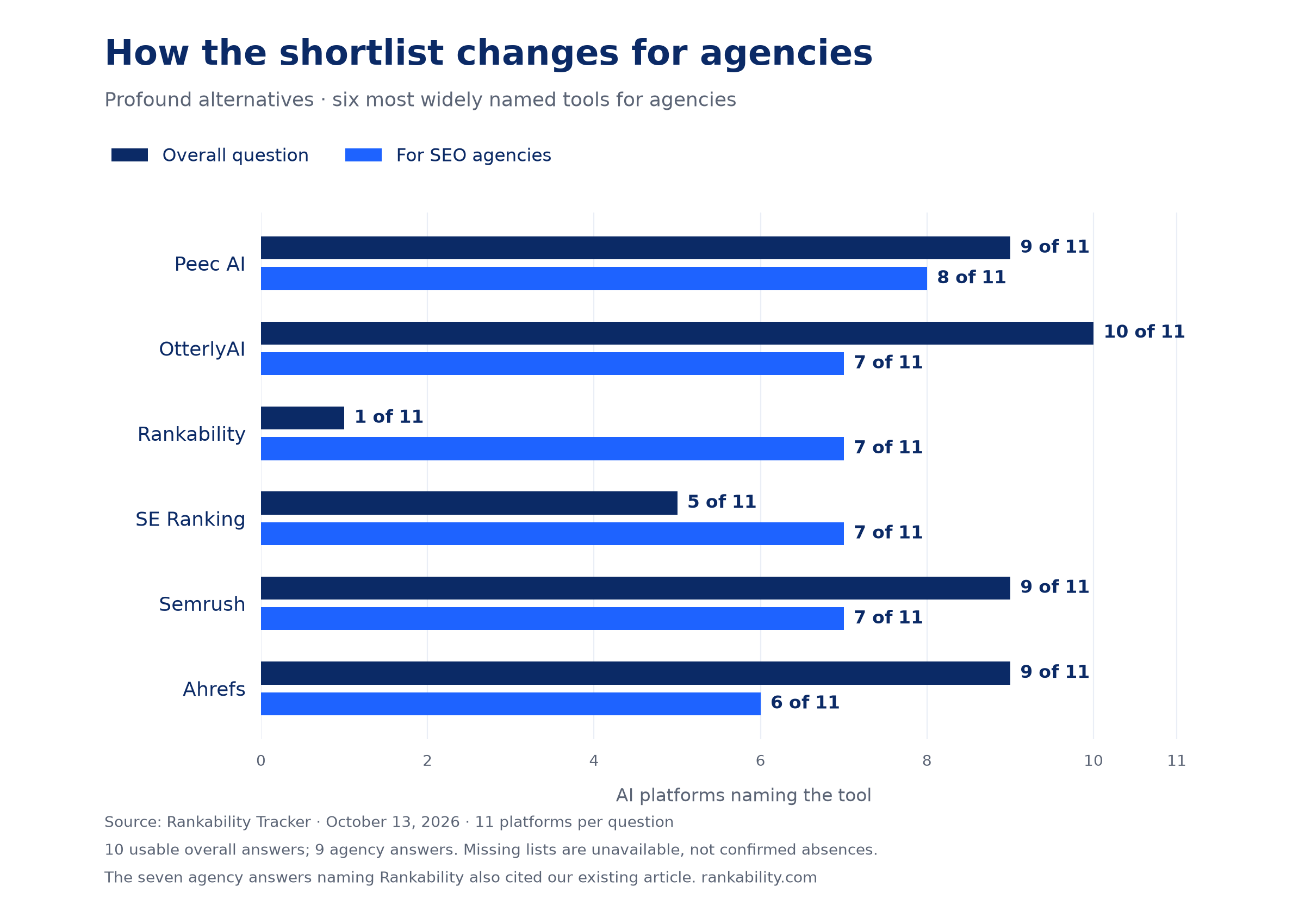
Peec AI led this question. Rankability appeared in 7 of 11 agency results, compared with 1 of 11 overall. These results are separate from the main list. The table includes every tool named by at least two platforms.
| No. | Tool | For agencies | Overall |
|---|---|---|---|
| 1 | Peec AI | 8 of 11 | 9 of 11 |
| 2 | OtterlyAI | 7 of 11 | 10 of 11 |
| 3 | Rankability | 7 of 11 | 1 of 11 |
| 4 | SE Ranking | 7 of 11 | 5 of 11 |
| 5 | Semrush | 7 of 11 | 9 of 11 |
| 6 | Ahrefs | 6 of 11 | 9 of 11 |
| 7 | Scrunch AI | 5 of 11 | 8 of 11 |
| 8 | AthenaHQ | 4 of 11 | 9 of 11 |
| 9 | Writesonic | 4 of 11 | 5 of 11 |
| 10 | AirOps | 2 of 11 | 4 of 11 |
| 11 | Search Atlas | 2 of 11 | 0 of 11 |
| 12 | Similarweb | 2 of 11 | 2 of 11 |


Source disclosure: The same seven agency platforms that named Rankability also cited our existing Profound alternatives article. These results are not fully independent of our own content; the overlap does not establish why AI selected us. Rankability remains outside the overall top 10.
Six most widely named tools for agencies. Source: Rankability Tracker · October 13, 2026 · 11 platforms per question; 10 usable overall answers and 9 agency answers. The questions are measured separately. rankability.com · Download chart
The 10 most widely named alternatives
These summaries follow the overall order. Descriptions are based on official vendor pages reviewed on October 13, 2026; suggested use cases and questions are our editorial guidance. We did not test product accuracy or run hands-on trials. AI-generated prices and feature claims are not treated as verified facts.
1. OtterlyAI — AI search monitoring
Tracks AI answers and citation sources, with prompt research and optimization tools. Consider it for: dedicated AI search monitoring. Check: whether your plan covers every client, engine, and refresh you need.
2. Ahrefs — Brand Radar
Offers custom prompt tracking and an AI Visibility Index for researching brands and cited pages. Consider it for: AI visibility research alongside Ahrefs. Check: which Brand Radar capabilities your quote includes.
3. AthenaHQ — Visibility and content optimization
Combines AI visibility measurement, citation tracking, and content gap analysis. Consider it for: turning visibility findings into content work. Check: who reviews and implements its recommendations.
4. Peec AI — AI search analytics
Tracks visibility, position, sentiment, and citations, with CSV, API, and Looker Studio reporting options. Consider it for: AI search analysis and reporting. Check: the models, countries, and reporting access included in your plan.
5. Semrush — SEO and AI visibility
Offers AI visibility capabilities within a broader SEO platform. Consider it for: combining conventional SEO research with AI search measurement. Check: the complete price for the modules and capacity you need.
6. Scrunch AI — Brand representation in AI
Focuses on AI visibility and how AI systems represent a brand. Consider it for: examining the customer experience in AI answers. Check: which monitoring, diagnostic, and implementation features are included.
7. BrightEdge — Enterprise SEO and AEO
Brings AI visibility, mentions, citations, and conventional SEO into an enterprise workflow. Consider it for: a broader enterprise search program. Check: the implementation scope required for your team.
8. SE Ranking — SEO and AI search tracking
Combines conventional SEO research and tracking with AI search capabilities. Consider it for: reporting on both search channels. Check: the quote for AI features, agency reporting, API access, and white labeling.
9. Writesonic — AI search and content workflows
Connects AI visibility work with content creation and optimization. Consider it for: producing content alongside monitoring. Check: the review controls between a suggested change and publication.
10. AirOps — Content operations
Combines AI discovery measurement with content workflows. Consider it for: teams creating and updating content at scale. Check: the setup required for your content system and editorial review process.
How to choose a Profound replacement
Give shortlisted vendors the same brief:
| Requirement | What to check |
|---|---|
| Measurement | Your client questions, brands, countries, languages, and refresh schedule; dated answers and citations. |
| Client reporting | Separate client accounts, permissions, report branding, exports, and API access. |
| Total cost | Clients, prompts, models, refreshes, seats, add-ons, setup, and billing term. |
| Content work | How a visibility finding becomes a reviewed, implemented change—and which steps your team handles. |
| Switching | Exporting historical answers and citations, retaining a baseline, and documenting changes in measurement. |
Trial a few client accounts before moving everyone. Use the same questions and inspect the actual answers. Different sampling methods produce different visibility scores; a higher dashboard score alone does not establish better customer outcomes.
Considering Rankability? See how Tracker works for agencies. It lets you inspect brand mentions, citations, and search results for client topics. This is our own commercial information; it does not affect the measured order.
Research details
The overall answers named 39 tool families across 113 tool/platform pairs. The separate agency answers named 25 families across 74 pairs. Repeated names count once per platform.
Other alternatives named in the broad capture
View the other 29 alternatives
Some are broader SEO suites or specialized products, rather than full Profound replacements. The complete roster and platform sets are also downloadable.
- Alhena — 3 of 11
- Geoptie — 3 of 11
- ZeroRank AI — 3 of 11
- Answer Socrates — 2 of 11
- Brandlight — 2 of 11
- Conductor — 2 of 11
- Rankscale AI — 2 of 11
- Similarweb — 2 of 11
- AI Rank Lab — 1 of 11
- Am I On AI — 1 of 11
- Ayzeo — 1 of 11
- Bluefish AI — 1 of 11
- Demand-Genius — 1 of 11
- Frase — 1 of 11
- GetMint — 1 of 11
- GrackerAI — 1 of 11
- Hall — 1 of 11
- HubSpot AEO — 1 of 11
- LLM Pulse — 1 of 11
- MentionBird — 1 of 11
- Moz Pro — 1 of 11
- Nightwatch — 1 of 11
- Orchly — 1 of 11
- Quattr — 1 of 11
- Rankability — 1 of 11
- seoClarity — 1 of 11
- ShopMentions — 1 of 11
- Track My Visibility — 1 of 11
- ZipTie — 1 of 11
Which platforms named which alternatives
The same 10 tools as the main list. ✓ = named, ✕ = not named in a usable answer, — = unavailable. Scroll horizontally for all platforms.
| Tool | ChatGPT | Google AI Overview | Google AI Mode | Gemini | Perplexity | Claude | Microsoft Copilot | Grok | Meta AI | DeepSeek | Brave Search AI |
|---|---|---|---|---|---|---|---|---|---|---|---|
| OtterlyAI | Named | Capture unavailable | Named | Named | Named | Named | Named | Named | Named | Named | Named |
| Ahrefs | Not named | Capture unavailable | Named | Named | Named | Named | Named | Named | Named | Named | Named |
| AthenaHQ | Named | Capture unavailable | Named | Named | Not named | Named | Named | Named | Named | Named | Named |
| Peec AI | Named | Capture unavailable | Not named | Named | Named | Named | Named | Named | Named | Named | Named |
| Semrush | Named | Capture unavailable | Not named | Named | Named | Named | Named | Named | Named | Named | Named |
| Scrunch AI | Named | Capture unavailable | Not named | Named | Not named | Named | Named | Named | Named | Named | Named |
| BrightEdge | Not named | Capture unavailable | Not named | Named | Not named | Named | Named | Not named | Not named | Named | Named |
| SE Ranking | Not named | Capture unavailable | Not named | Named | Named | Not named | Named | Named | Not named | Named | Not named |
| Writesonic | Not named | Capture unavailable | Not named | Not named | Named | Named | Not named | Named | Named | Not named | Named |
| AirOps | Not named | Capture unavailable | Not named | Named | Not named | Not named | Not named | Named | Named | Not named | Named |
Source: Rankability Tracker · October 13, 2026 · 39 tool families across 11 platforms. — means unavailable, not zero. Counts use the full roster. rankability.com
What the cited sources show
View the most frequently cited pages
The overall question returned 42 distinct citation URLs; the agency question returned 70. Citations and product mentions are counted separately. This table shows the ten most widely cited URLs overall, with agency counts alongside. Exact URL variants remain separate.
| Cited source | Overall | For agencies |
|---|---|---|
| g2.com · alternatives | 6 of 11 | 2 of 11 |
| geoptie.com · best profound alternatives | 5 of 11 | 2 of 11 |
| alhena.ai · profound alternatives | 4 of 11 | 5 of 11 |
| writesonic.com · profound alternatives | 4 of 11 | 4 of 11 |
| answersocrates.com · best profound alternatives | 2 of 11 | 0 of 11 |
| appscribed.com · profound alternatives | 2 of 11 | 0 of 11 |
| blog.hubspot.com · profound alternatives | 2 of 11 | 0 of 11 |
| medium.com · profound ai alternatives why i think ahrefs brand radar is the smarter | 2 of 11 | 0 of 11 |
| seranking.com · profound alternatives | 2 of 11 | 1 of 11 |
| airops.com · profound alternatives | 2 of 11 | 0 of 11 |
Several pages are published by vendors, including Geoptie, Writesonic, and AirOps. A Medium comparison attributed to Tim Soulo also appears. These are interested sources, not independent product tests.
Our previous comparison at this same URL was cited by 7 agency platforms and none overall. The answers were collected before this research update was published.
The overall ChatGPT answer included source names but no structured citation URLs. We have not guessed those links. Both source CSVs retain every returned URL, including sources from answers without usable product lists.
Methodology and downloads
Missing answers: Google AI Overview failed for the overall question. For the agency question, Google AI Overview and AI Mode returned introductions and links without usable product lists. Their recommendations remain unavailable. Counts use all 11 configured platforms; missing data cannot establish that a tool was absent.
Read the full methodology and counting rules
Questions, timing, and scope
- Capture date: October 13, 2026 (UTC). The broad run started at 2026-10-13T16:55:08.495Z and completed at 2026-10-13T17:02:58.997Z; the agency-specific run started at 2026-10-13T16:55:11.286Z and completed at 2026-10-13T17:00:35.233Z.
- Prompts: “What are the best Profound alternatives?” and “What are the best Profound alternatives for SEO agencies?”
- Configuration: 11 AI platforms per prompt, English, no location specified. Each was a one-time benchmark; no recurring schedule was added.
- Usable recommendation lists: 10 for the broad prompt and 9 for the agency-specific prompt. The broad Google AI Overview failed; the agency-specific Google AI Overview and AI Mode retained introductions but no usable shortlist.
- Collection: exact-run Rankability Tracker results retrieved through the Rankability MCP. We did not combine older saved results or use Google organic rankings as AI votes.
Counting names and ordering the list
We reviewed the extracted labels against each retained answer body. A software family counts once per platform when it is presented as an alternative or a named option in that answer. Repeated mentions, section order, sentiment, and citations do not add votes. Names that occur only in reference snippets do not count.
We exclude Profound and Profound Enterprise as the incumbent, source publishers, and AI engines named as monitoring coverage. Gemini’s agency answer separately listed ancillary SEO and analytics tools; those supporting tools are excluded from the alternative shortlist and recorded in the exclusions CSV. Other broad SEO suites explicitly presented as alternatives remain included even when they are not direct feature-for-feature replacements.
We combine spelling and product-family aliases. Examples include Otterly.AI/Otterly AI/OtterlyAI, Scrunch/Scrunch AI, Ahrefs/Ahrefs Brand Radar, Semrush/its AI toolkit labels, and Writesonic/Writesonic GEO. Family-level counts do not imply that every feature or module is included in a vendor’s base plan. Original labels and the alias rules remain available in the research JSON.
The main order is broad-prompt distinct platform coverage, descending. Ties appear alphabetically. The No. column and numbered product sections indicate list order; they do not break coverage ties. Coverage is the platform count divided by 11, rounded to a whole percent. Source downloads also retain the shared coverage rank.
This is one answer per platform per prompt on one date. It does not establish long-term recommendation frequency, product accuracy, service quality, conversion results, or causation. Failed and incomplete captures remain unavailable, and the two prompt populations are not pooled.
Download the evidence
Download the complete research JSON: both questions, answers, timestamps, labels, counts, sources, aliases, and exclusions. Archived AI claims may be wrong or outdated; they are evidence of the answers, not verified specifications.
Download individual CSV files
Overall question
- All alternatives (CSV)
- Platform coverage (CSV)
- Cited sources (CSV)
- Excluded labels and reasons (CSV)
Agency question
Frequently asked questions
View answers about rankings, citations, and pricing
Which Profound alternative did AI name most often?
OtterlyAI overall: 10 of 11, including every usable answer. Peec AI for agencies: 8 of 11. These are dated visibility results, not quality ratings.
Is Rankability ranked first in this study?
No. It appeared in 1 of 11 overall and 7 of 11 agency results, tying with OtterlyAI, SE Ranking, and Semrush below Peec AI.
Does being cited mean a product was recommended?
No. A comparison page can be cited without its publisher being named as an alternative. We count citations and names separately.
Which alternative is cheapest?
This study does not rank prices. The AI answers contain inconsistent pricing claims. Ask vendors for quotes covering the same clients, prompts, models, reporting, and billing term.
Changelog
View publication history
| Date | Change |
|---|---|
| July 17, 2026 | Original Profound alternatives guide published. |
| October 13, 2026 | Updated with two separate AI benchmarks, measured ordering, disclosures, and evidence downloads. Simplified the copy and moved agency results directly below the main list. |