

RankIQ has a clear place in the market as a focused tool for bloggers and publishers who want help with topic selection, content briefs, and on-page SEO. When you start comparing RankIQ alternatives, though, you may realize you need deeper keyword research, broader SERP analysis, or a more complete SEO workflow.
That is especially true if you manage multiple sites, work inside an agency, or need stronger competitor analysis and SEO reporting. Some teams also want better rank tracking, AI writing support, or more flexible price-to-value across larger content operations.
This guide is practical by design. It is not a takedown of RankIQ, and it does not assume every user needs an all-in-one SEO platform.
Quick Picks
If you want the short version, start here before digging into the full feature comparison.
- Best overall for content optimization: Rankability
- Best for all-in-one SEO depth: Semrush
- Best for content scoring and on-page workflows: Surfer SEO
- Best for budget-conscious teams: SE Ranking
These picks reflect different priorities rather than one universal winner. Bloggers, agencies, consultants, and in-house content teams often need very different mixes of search coverage, AI coverage, reporting, and day-to-day usability.
What We Looked For
- SERP-based recommendations: We prioritized tools that turn live search results into usable optimization recommendations instead of generic writing advice.
- Content brief quality: Strong tools should help with content briefs, search intent alignment, topic selection, and draft direction before writing starts.
- Keyword research depth: We looked for useful databases, low-competition keywords, domain research, and enough search demand data to support real SEO strategy.
- Workflow usability: Writers, editors, content managers, and agencies need a content optimization workflow that is easy to follow and easy to hand off.
- Reporting and tracking: Rank tracking, SEO reporting, SERP overview data, and visibility insights matter once content is published.
- Price-to-value: We weighed starting price, feature breadth, and whether each platform makes sense for solo creators, consultants, or content teams.
Comparison Table
| Tool | Best for | Starting price* | AI & Search Coverage | Notes |
|---|---|---|---|---|
| Rankability | Agencies wanting an end-to-end content and SEO workflow | $199/month | Google plus AI search tracking across 11 platforms | Strong fit for agency collaboration, briefs, optimization, reporting, and advising |
| Semrush | Teams needing broad SEO tools and market visibility data | See website | Broad traditional search plus AI visibility features | Strong for keyword research, site audit, competitor analysis, and Position Tracking |
| Surfer SEO | Guided SEO content editor workflows | Contact sales for enterprise details | Google and AI search optimization workflow | Close fit for content scoring and draft improvement |
| SE Ranking | Lean teams wanting breadth with approachable UX | See website | SEO and AI visibility support | Good balance of rank tracking, content marketing, and usability |
| Ahrefs | SEO-led teams prioritizing data depth | $129/month | Search plus AI brand visibility features | Excellent for backlink analysis, domain research, and topic validation |
| NeuronWriter | Budget-minded optimization and AI writing | $23/month | Google and AI-focused optimization workflow | Popular in direct software alternatives comparisons |
| SEO.ai | AI-assisted drafting with SEO workflow support | Trial from $1 | Google and ChatGPT-oriented workflow | Built for faster planning, content generation, and publishing |
| SpyFu | Competitor keywords and search strategy research | $29/month | Search-focused with AI-assisted insights | Better for competitor analysis than pure content scoring |
*Pricing can change over time. Always use pricing verification on each vendor site before making a purchase decision.
Best RankIQ Alternatives
1. Rankability
Why it's a strong RankIQ alternative: Rankability is the closest fit here if you want focused content optimization without losing the bigger SEO workflow around it. It gives agencies and freelancers one system to research topics, build content briefs, score drafts against real competitors, and track visibility across Google and AI search.
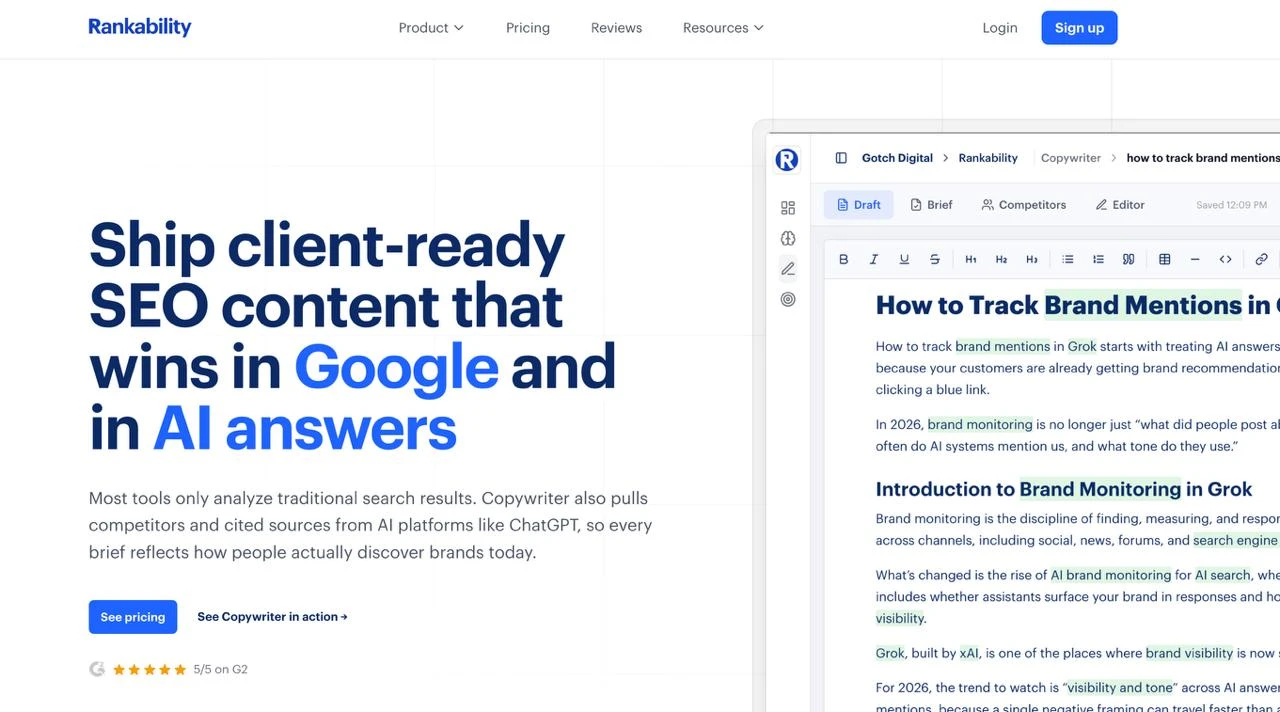
It also goes further than many optimization-first tools by connecting research, copywriting, optimization, reporting, and advising in one repeatable process. That makes it especially useful when multiple writers and editors need clear handoffs instead of scattered tools.
Best for: Content teams, freelancers, and agencies that want a focused optimization platform with structured workflows and client-ready reporting.
Standout features:
- Multi-source keyword research with clustering, competitor gap analysis, and exports
- AI- and Google-informed content briefs and drafting through Copywriter
- Content scoring with prioritized SEO checklists in Optimizer
- Reporter for rankings, AI mentions, and citations across 11 platforms
Practical note: If your work spans planning to proof, Rankability stands out because it is built exclusively for agency SEO workflow needs. It is less about isolated content scoring and more about consistent execution across clients.
2. Semrush
Why it's a strong RankIQ alternative: Semrush is a stronger option than RankIQ if your team needs much more than content optimization. It covers keyword research, domain research, competitor analysis, site audit, content marketing, local visibility, and broader SEO reporting inside one platform.

For teams managing search rankings across many campaigns, that breadth matters. You can move from Keyword Magic Tool and SEO Content Template into Position Tracking and competitive research without switching systems.
Best for: Teams that want one platform for content, research, rank tracking, and competitive SEO.
Standout features:
- Keyword Magic Tool for large-scale keyword discovery
- SEO Content Template for brief creation and optimization guidance
- Position Tracking for ongoing search visibility monitoring
- Domain and competitor research across SEO and advertising data
Why teams choose it: Semrush is often the shortlist tool when content is only one part of a larger SEO strategy. It is especially useful for in-house content teams and agencies that need feature comparison depth beyond writing support.
3. Surfer SEO
Why it's a strong RankIQ alternative: Surfer SEO is one of the most similar tools to RankIQ in daily use because it centers on content scoring and live SERP analysis inside an SEO content editor. It is designed for people who want guided on-page SEO improvements while drafting, editing, or refreshing pages.

Its workflow is narrower than Semrush or Ahrefs, but that focus is the point. Writers and content managers can work directly in the Content Editor and optimize around search intent and competitor page patterns.
Best for: Writers and content managers who want guided optimization inside a content editor.
Standout features:
- Content Editor for real-time optimization recommendations
- Audit workflows for improving existing pages
- Topical recommendations based on SERP patterns
- Integrations and training support through Surfer Academy
User reviews angle: Surfer SEO is commonly compared with RankIQ because both support draft improvement rather than just keyword discovery. If you want a familiar optimization-first experience, it deserves a close look.
4. SE Ranking
Why it's a strong RankIQ alternative: SE Ranking offers a practical middle ground between focused writing tools and broader SEO tools. It is appealing if you want rank tracking, keyword research, competitor analysis, and content marketing support without jumping straight to a heavier enterprise setup.
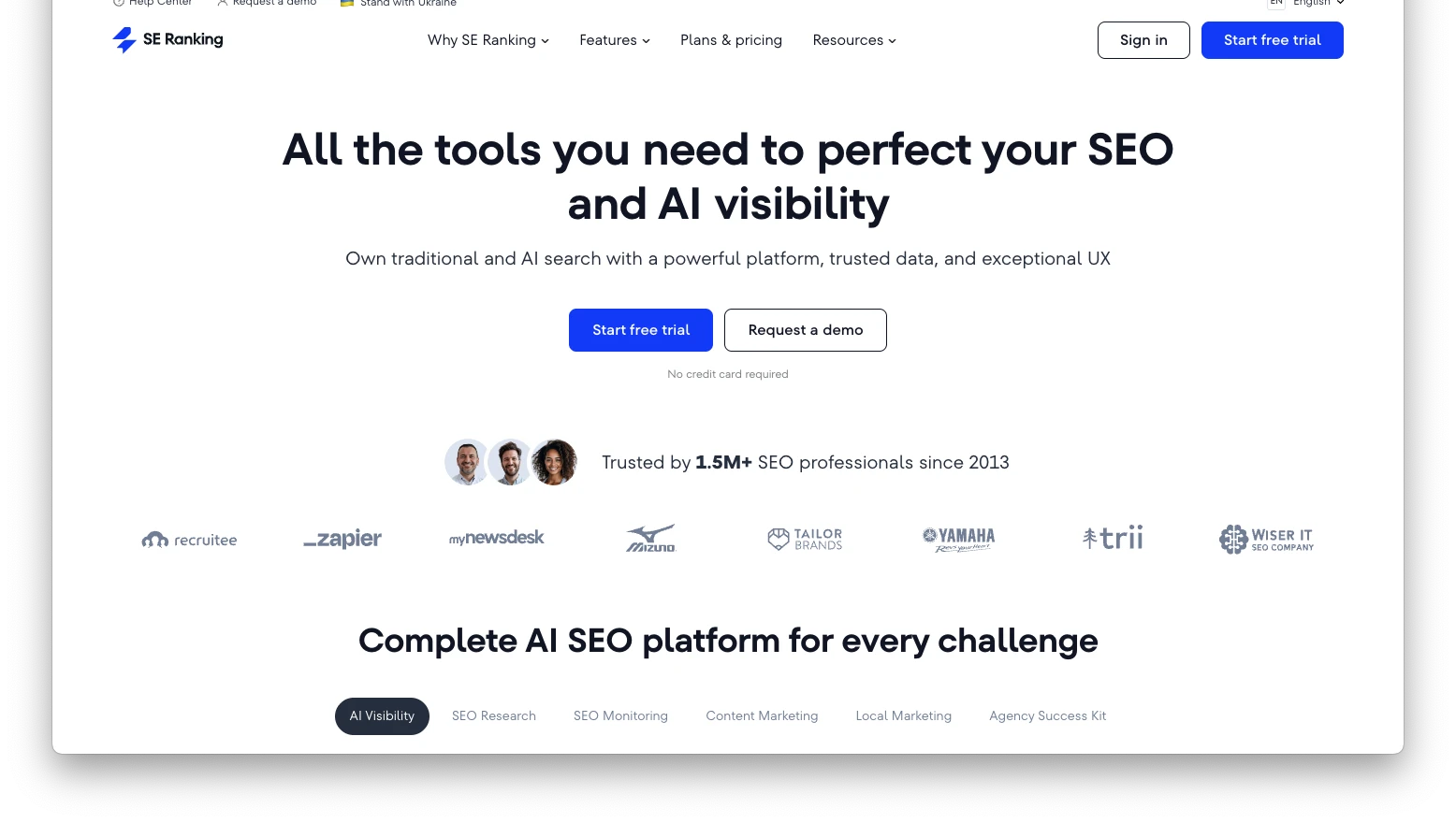
Its user-friendly interface is a major reason it appears on many shortlists. For small businesses, consultants, and lean teams, that balance can be more useful than a tool built only for content scoring.
Best for: Small businesses, consultants, and lean teams that want more than a writing assistant.
Standout features:
- Rank tracking and search visibility monitoring
- Keyword research and competitor analysis
- Content marketing and optimization support
- AI visibility tools with approachable UX
What to expect: SE Ranking is a good fit when you want broader search coverage at a manageable learning curve. It may not feel as optimization-centric as RankIQ, but it covers more of the surrounding SEO workflow.
5. Ahrefs
Why it's a strong RankIQ alternative: Ahrefs is ideal when your process starts with search demand, backlink analysis, and topic validation before any brief is written. It is less about guided content scoring and more about making sure you are targeting the right opportunities in the first place.

That makes it especially useful for SEO-led teams, publishers, and consultants who care about domain research, content gap analysis, and SERP overview data. If your issue with RankIQ is limited research depth, Ahrefs is a major upgrade.
Best for: SEO-led teams that start with search demand and link opportunity data.
Standout features:
- Keywords Explorer for deep keyword research
- Site Explorer for competitor and backlink analysis
- Content gap analysis for missed topic opportunities
- SERP overview and Site Audit for planning and validation
Reporting note: Ahrefs is stronger before and after content creation than during the writing process itself. It shines when your SEO strategy depends on robust data more than editor-led optimization prompts.
6. NeuronWriter
Why it's a strong RankIQ alternative: NeuronWriter comes up often in direct user comparisons because it offers SERP-based content optimization at a lower entry point. For solo creators and small teams, that can make it a realistic way to get content scoring and optimization recommendations without paying for a larger suite.
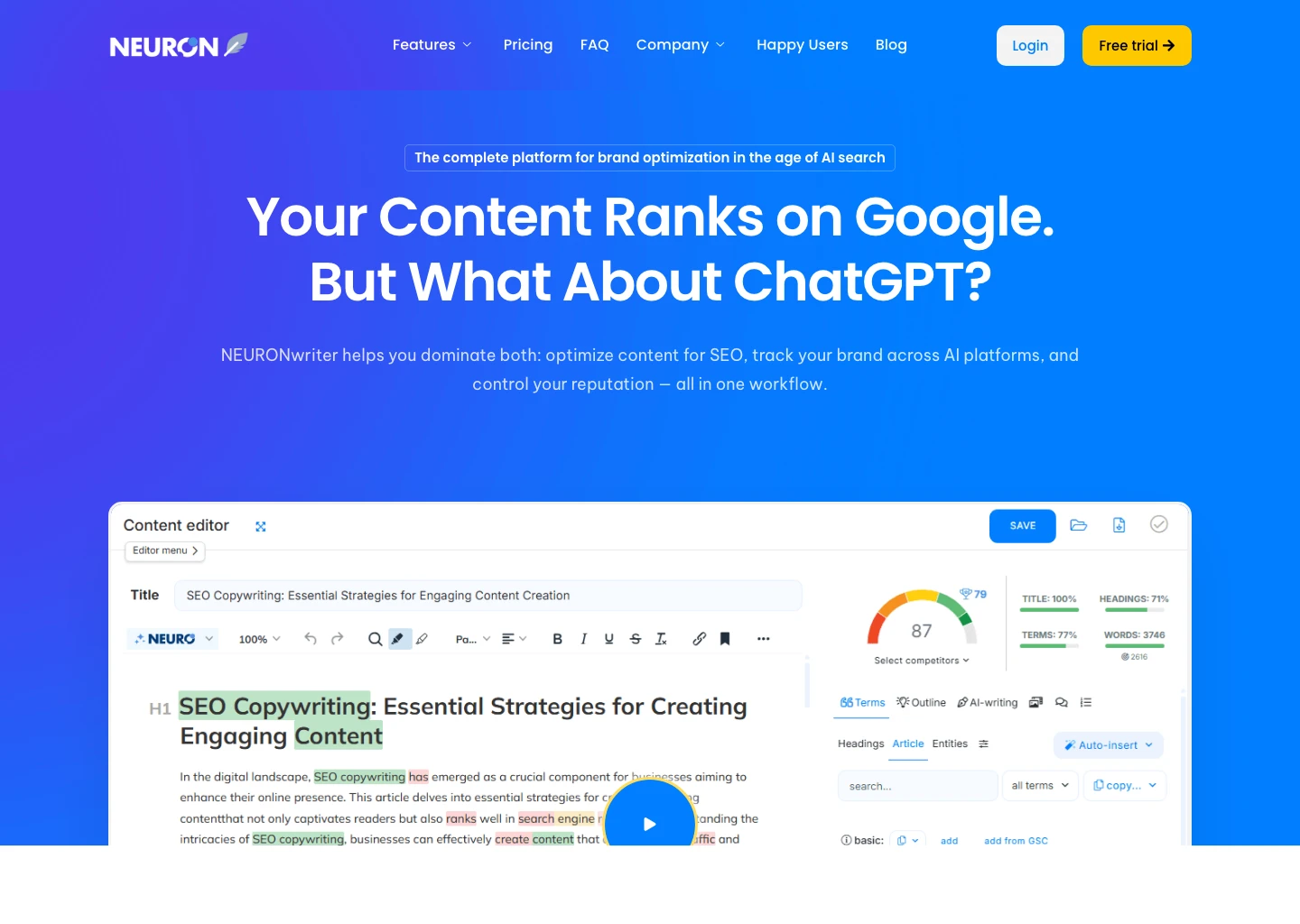
It also combines AI writing, competitor analysis, and content planning support in one platform. That blend makes it useful for users who want practical help producing content, not just evaluating it.
Best for: Solo creators and small teams that want optimization guidance without enterprise pricing.
Standout features:
- Content scoring and competitor analysis
- NLP-style term suggestions for on-page SEO
- AI content creation and planning support
- Integrations with Google Search Console, WordPress, and Shopify
Budget note: NeuronWriter is often one of the first tools to compare if cost is a major factor. Just make sure the lower starting price still matches your project limits, team needs, and workflow expectations.
7. SEO.ai
Why it's a strong RankIQ alternative: SEO.ai is appealing for teams that want AI-assisted drafting and optimization in one workflow. Instead of separating keyword research, content generation, internal linking, and publishing, it aims to compress those steps into a more automated system.

That makes it different from RankIQ, which is more focused on content planning and optimization support. If speed matters and you want AI writing visible throughout the SEO workflow, SEO.ai is worth considering.
Best for: Marketers who want to speed up content production while keeping SEO guidance visible during creation.
Standout features:
- Automated keyword research and topic relevance support
- AI-generated content aligned with search best practices
- Auto publishing, internal linking, and image generation
- SEO analytics, benchmarking, and CMS integrations
When it's the right fit: SEO.ai makes the most sense when content generation is the bottleneck. If you prefer more manual editorial control, a tool like Rankability or Surfer SEO may feel easier to manage.
8. SpyFu
Why it's a strong RankIQ alternative: SpyFu is not the closest replacement for RankIQ's content optimization workflow, but it can be the better choice if your real need is competitor keyword intelligence. It is built around competitor keywords, PPC crossover data, ranking history, and domain comparisons rather than draft-level content scoring.

That means it helps most before writing starts. If you want to discover opportunities competitors already rank for or buy in paid search, SpyFu gives you a different kind of edge.
Best for: Marketers who care more about competitor keyword intelligence and opportunity discovery.
Standout features:
- Competitor keyword research across SEO and PPC
- Ranking history and domain comparisons
- AI-assisted insights with ChatGPT integration
- Automated reporting and Google Search Console integration
Consider if you value: SpyFu is strongest when competitor analysis drives your content planning. It is less suitable if your top priority is an SEO content editor with detailed optimization recommendations.
How to Choose the Right RankIQ Alternative
If you want the closest optimization-focused replacement, start with Rankability or Surfer SEO. Both are strong for content scoring, SERP analysis, and improving drafts before publishing.
If you need broader SEO operations, compare Semrush, Ahrefs, and SE Ranking. Those tools give you more coverage for keyword research, rank tracking, site audit work, and domain research.
If price sensitivity matters, shortlist NeuronWriter and SE Ranking. If AI-assisted drafting matters most, look closely at SEO.ai.
If you are agency-side and need one repeatable system for multiple clients, Rankability deserves the first trial. It is built around collaboration, reporting, and proof of performance rather than a single editor view.
What If You Used RankIQ for Keyword Research
Some RankIQ users rely on it not just for optimization, but for topic selection and low-competition keywords. If that is your main use case, switching to a tool with deeper keyword databases and stronger SERP visibility will matter more than matching the writing interface.
Semrush, Ahrefs, SE Ranking, and SpyFu are the strongest options here. They give you better support for search demand analysis, competitor keywords, domain research, and broader opportunity discovery.
The key difference is where each tool helps most. Rankability, Surfer SEO, NeuronWriter, SEO.ai, Seodity, SiteGuru, Seobase, AccuRanker, and Search Atlas are more often considered during optimization or workflow design, while Semrush, Ahrefs, SE Ranking, and SpyFu are often stronger before the brief is even written.
Conclusion
The right alternative depends on what you want to replace. Some users need a close substitute for content scoring and content briefs, while others really need broader SEO tools for keyword research, reporting, and competitive visibility.
If you want the closest focused alternative, start with Rankability. If you need wider platform coverage, compare Semrush and SE Ranking next, then check Ahrefs if research depth is your top priority.
A short shortlist usually works better than comparing everything at once. Pick the tools that match your workflow first, then verify pricing, feature limits, and search coverage on the vendor site.
Need More Range Than RankIQ?
If RankIQ feels helpful but too limited for broader client work, start with Rankability pricing and then compare the wider category of the best SEO tools for agencies. If content optimization remains the main buying lens, use our best SEO content optimization tools guide as the next filter.
FAQs
Is There a Better Alternative to RankIQ?
It depends on your use case. Rankability and Surfer SEO are closer for content optimization, while Semrush and Ahrefs are stronger if you also need keyword research, competitor analysis, and broader SEO workflow coverage.
Which RankIQ Alternative Is Best for Beginners?
Rankability, Surfer SEO, and SE Ranking are good starting points for beginners. They offer clearer workflows and are generally easier to use than larger, more data-heavy SEO platforms.
What Tool Is Most Similar to RankIQ?
Rankability is one of the closest fits for a focused optimization workflow. Surfer SEO is also very similar for SERP-based content scoring and draft improvement.
Are There Cheaper Alternatives to RankIQ?
Yes. NeuronWriter and SE Ranking are commonly viewed as lower-cost options, depending on plan limits and the features you need. Always check current starting price details before choosing.
Can You Replace RankIQ With an All-in-One SEO Platform?
Yes, but the experience changes. Semrush, Ahrefs, and SE Ranking can replace large parts of the workflow, though they may not mirror RankIQ's exact content optimization experience.