
If you started with Writesonic for quick AI drafts and basic SEO, it can feel limiting once you are managing serious search performance across multiple pages or clients.

You might want deeper on-page optimization, clearer workflows for briefs and updates, or pricing that makes more sense as your content volume grows. That is where dedicated content optimization platforms shine.
Below are seven Writesonic alternatives that focus on SERP-led planning, semantic coverage, and repeatable workflows, taken from a larger comparison of AI content tools and verified against vendor sites and recent reviews.
Quick Picks (TL;DR)
- Best overall for agencies: Rankability
- Best “score as you write” editor: Surfer SEO
- Best research + briefs combo: Frase
- Best for enterprise editorial teams: Clearscope
- Best for deep content strategy: MarketMuse
- Best all-in-one AI writer + SEO at mid tier: Scalenut
- Best budget semantic optimizer: NeuronWriter
What We Looked For (and Why It Matters)
- Real SEO depth, not just AI text SERP analysis, semantic recommendations, and content scoring that reflect how Google and modern AI assistants evaluate pages.
- Briefs and workflows Ability to move from keyword to outline to draft to optimization in one system so teams do not live in scattered docs and sheets.
- Integrations and collaboration Google Docs, WordPress, or CMS integrations plus seat-based access for agencies and bigger teams.
- Pricing that scales with production Transparent starting tiers and reasonable limits for content volume, based on public pricing pages and third-party listings.
- Track record and reviews Verified ratings on G2, Capterra, and independent reviews where available, so you are not betting on untested tools.
Quick Comparison Snapshot
Pricing changes often, so verify on vendor pages before purchase.
| Tool | Best for | Starting price* | AI & Search Coverage | Notes |
|---|---|---|---|---|
| Rankability | SEO and digital agencies that want SERP-led briefs, real-time scoring, and monitoring in one place | From $97/mo; plan limits | Uses IBM Watson + Google NLP, real-time content scoring, briefs, and GEO-minded workflows | Built as an SEO operating system for agencies, not just a writer |
| Surfer SEO | Content teams that want a live score while writing | From $99/mo | NLP term suggestions, content score, content audits, optional AI writing | Very fast “optimize in one editor” workflow with strong Docs and WordPress integrations |
| Frase | Solo creators and small teams that want research + briefs + AI drafts in one workspace | From $49/mo | SERP research, AI brief generation, AI writer, content optimizer | Great value if you want an affordable research-to-publish workflow |
| Clearscope | Established editorial teams and agencies that obsess over accuracy | From $129/mo | NLP-driven term suggestions, A–F grading, inventory tracking | Precision content grading with unlimited users, priced for serious operations |
| MarketMuse | Larger sites that need topic modeling and content planning, not just page-level edits | From $99/mo+ | Topic modeling, SERP X-ray, Heatmap, inventory and strategy tools | More of an AI content workbench for planning and prioritization than a simple editor |
| Scalenut | Teams that want one place for clustering, writing, and optimization | From $49/mo | Topic clusters, SERP analyzer, content score, AI drafts | Strong for “one-tab” content workflows that blend AI writing with SEO |
| NeuronWriter | Bloggers and SMBs that want budget semantic optimization | From $23/mo | Semantic models, SERP analysis, AI writing and internal link suggestions | Very affordable, with multi-language support and solid reviews on AppSumo and Capterra |
Rankability plan limits: Starter is $97/month, Agency $297/month, and Agency Pro $497/month. Annual totals are $970, $2,970, and $4,970. All paid plans include unlimited client workspaces, unlimited team members, branded reports, and API/MCP access. Content allowances are 20, 80, and 160 projects per month; tracked AI query allowances are 100, 300, and 500, respectively, across all 11 included AI platforms. Google keyword tracking and Local Pack scans have separate allowances. Gotch Inner Circle is included with Agency Pro annual plans. Get Started.
*Starting prices change often – verify current pricing before purchase.
The Alternatives
1. Rankability
Rankability is built first and foremost as an AI SEO content optimizer for agencies, not a generic AI writer.
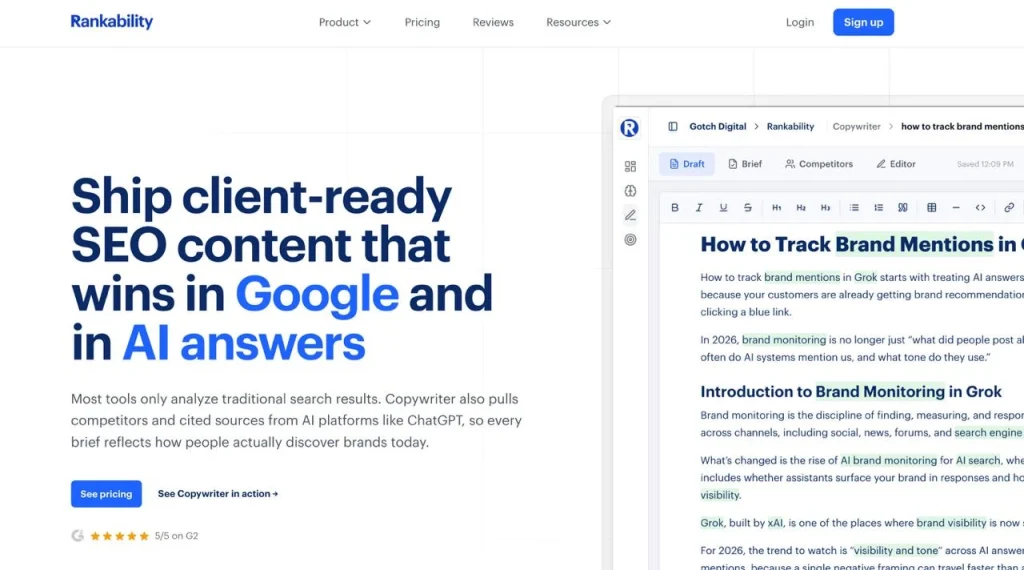
It blends IBM Watson and Google NLP to produce highly accurate semantic recommendations, wrapped inside a real-time editor that scores your content and surfaces gaps while you write.
The Copywriter sits alongside an AI SEO Writer and Keyword Finder, which means your team can go from keyword research to outline to optimized draft without leaving the platform. Agencies also get monitoring and GEO-minded features that tie content to AI search visibility, something you will never get from a simple copy generator.
Where it improves on Writesonic
- Real-time optimization score that reflects search behavior, not just readability
- Dual NLP engine (Watson + Google) for richer topic coverage
- Agency-friendly workflow with clear limits on optimizers, briefs, and monitored pages
- Strong focus on managing many clients and campaigns in one place
Good fit if: You run or work in an agency and want a single platform for content briefs, on-page optimization, and systematic SEO workflows.
2. Surfer
Surfer SEO stays popular because it makes optimization feel almost like a game. You open its Content Editor, paste or write your draft, and watch the content score and recommended terms respond in real time. It integrates neatly with Google Docs and WordPress, so writers can stay inside familiar tools.
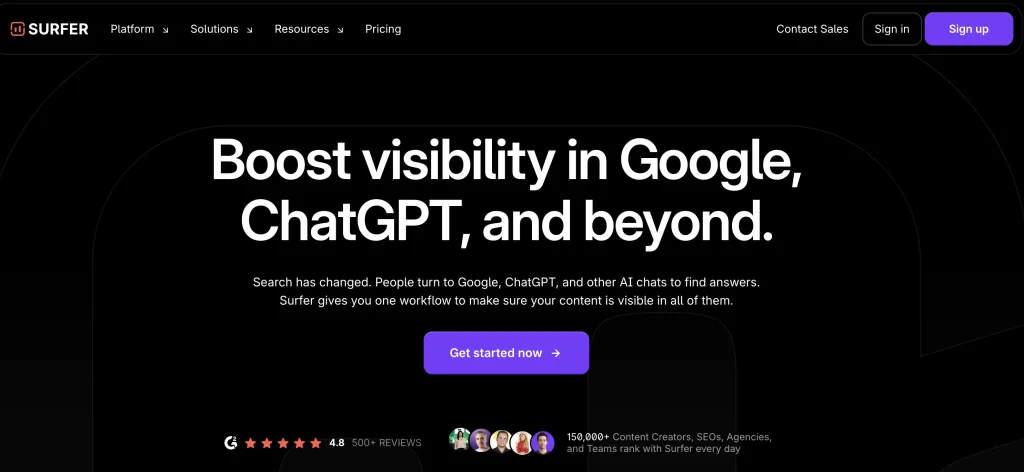
Surfer also offers content audits and an AI writer, although those may require higher-tier plans or add-ons, which pushes the total cost higher for heavy users.
Where it improves on Writesonic
- More mature content scoring that reflects topical coverage and competitive pages
- Tighter Docs and CMS integrations for in-workflow optimization
- Strong track record among SEO professionals for measurable on-page gains
Good fit if: You want the simplest possible “paste, optimize, publish” editor with clear scoring and you already rely on Docs or WordPress.
Note: In October 2025, Surfer was acquired by Positive Group, a European SaaS company. If you’re using or evaluating Surfer, it’s worth understanding how that deal could affect agencies long term.
3. Frase
Frase pulls together SERP research, outline generation, AI writing, and optimization into one interface. You enter a keyword, let Frase scan the top results, then generate a draft brief and structure that your writers can follow.
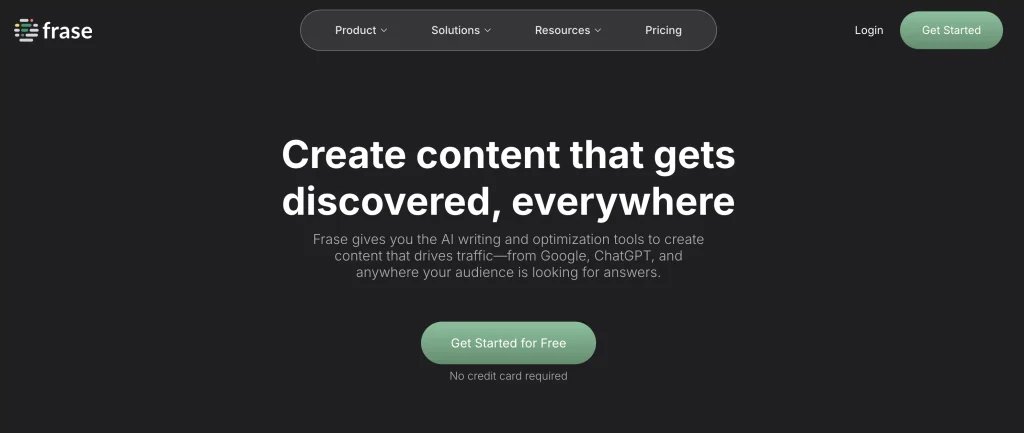
Its pricing starts lower than many competitors and the workflow is especially friendly for solo creators and small businesses who want to save research time without juggling several tools. The tradeoff is that its optimization recommendations are not quite as fine-tuned as top-tier semantic tools like Rankability or Clearscope.
Where it improves on Writesonic
- Better SERP-led research and brief generation
- Unified workflow that covers ideation through to optimization
- Competitive starter pricing for creators who need more than just AI text generation
Good fit if: You are a solo creator, in-house marketer, or small agency that wants an affordable research-to-publish pipeline rather than deep enterprise SEO features.
4. Clearscope
Clearscope is positioned as a premium content optimization platform for teams that live and die by their editorial calendar. It offers an A–F content grade, very precise keyword suggestions, and an interface tuned to professional writers and editors. It also integrates with Google Docs and WordPress, and allows unlimited users, which matters for larger teams.

Clearscope is not cheap, but many teams justify the cost through accuracy and collaboration features. Compared to Writesonic, it is far less about generating text and far more about editing drafts into best-in-class search assets.
Where it improves on Writesonic
- Highly accurate term and topic suggestions with clear grading
- Unlimited users and content inventory tracking
- Designed specifically for editorial workflows and complex team structures
Good fit if: You run an established editorial operation, care deeply about precision and collaboration, and you are comfortable with a premium price.
5. MarketMuse
MarketMuse behaves like an AI workbench for content strategy. Rather than just scoring single pages, it helps you analyze topics, identify gaps, and prioritize what to write next. Features like SERP X-ray, Heatmap, and inventory analysis help teams see where they are thin or over-invested.
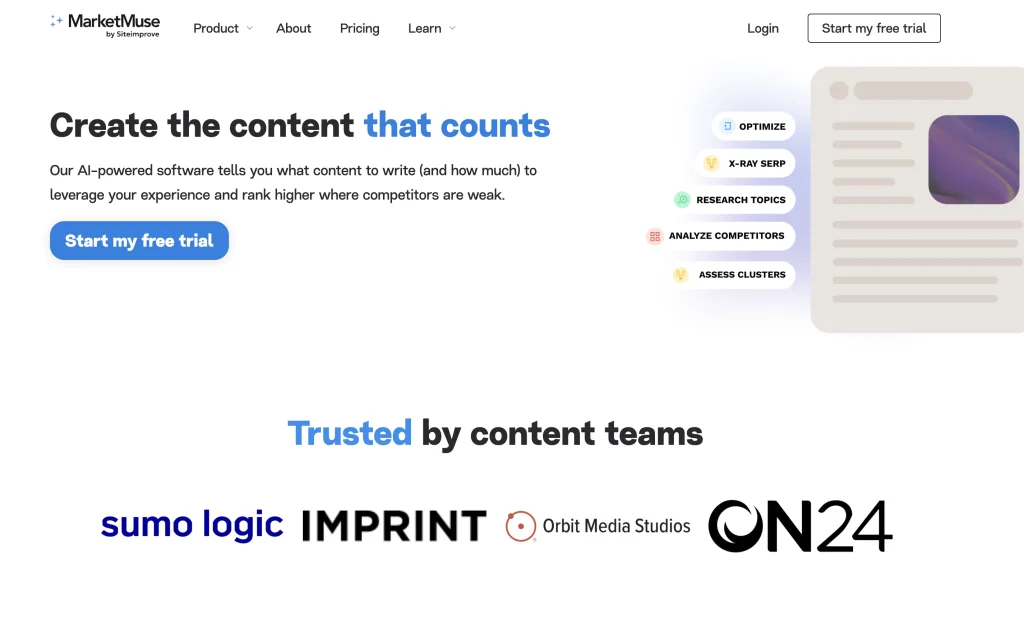
There is a free tier for testing, although serious usage moves quickly into three-figure monthly pricing. For the right team, the strategic insight justifies that cost.
Where it improves on Writesonic
- Focus on topical authority and portfolio-level planning, not just single articles
- Powerful gap analysis and prioritization across large sites
- Deep research tools for strategists and content leads
Good fit if: You manage a large site or network of sites and need to know which topics to double down on, rather than just how to tweak individual posts.
6. Scalenut
Scalenut aims to be your one tab for planning, drafting, and optimizing content. Topic clusters and SERP analyzers help you plan, Cruise Mode generates first drafts, and an optimization layer adds NLP keyword guidance and a content score.
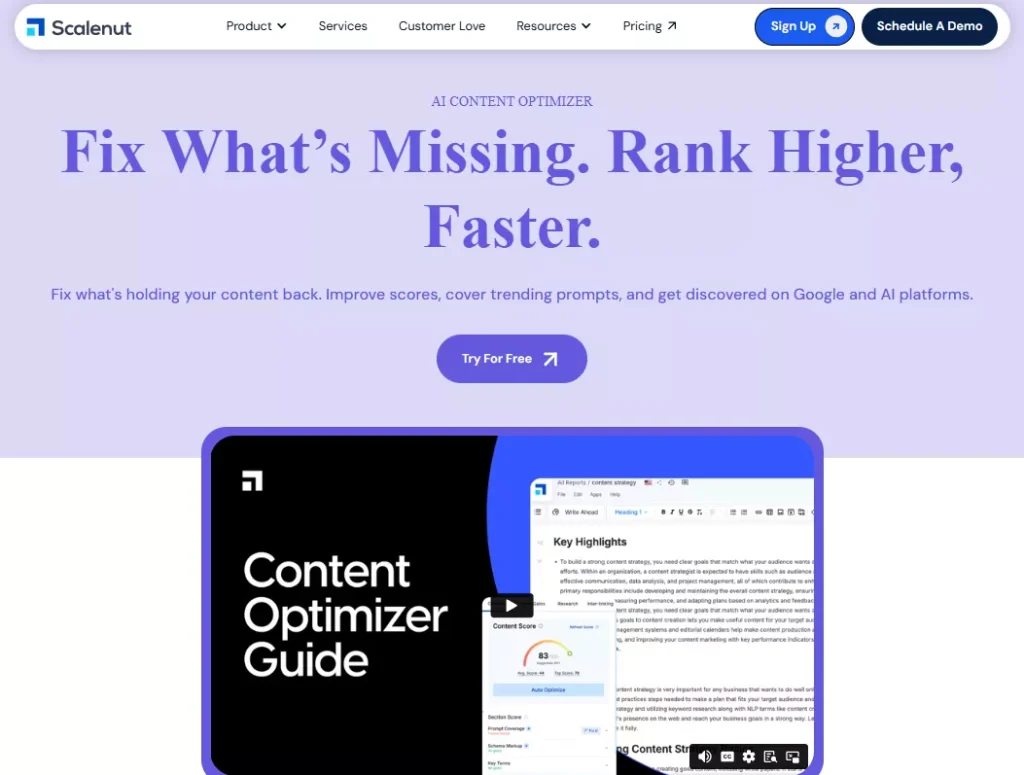
The experience feels closer to Writesonic in that you get strong AI drafting plus SEO help, but with more structured SEO workflows and emphasis on clusters.
Where it improves on Writesonic
- Built-in topic clustering and planning around search intent
- More structured SEO guardrails around AI drafts
- Tiers that are attractive for small to midsize teams looking for one combined suite
Good fit if: You like all-in-one AI writing platforms but want more serious SEO structure around your content.
7. NeuronWriter
NeuronWriter focuses on semantic optimization at an accessible price. It uses SERP analysis and language models to suggest terms and headings, and it includes AI writing, internal link ideas, and integrations with WordPress and Google Search Console.
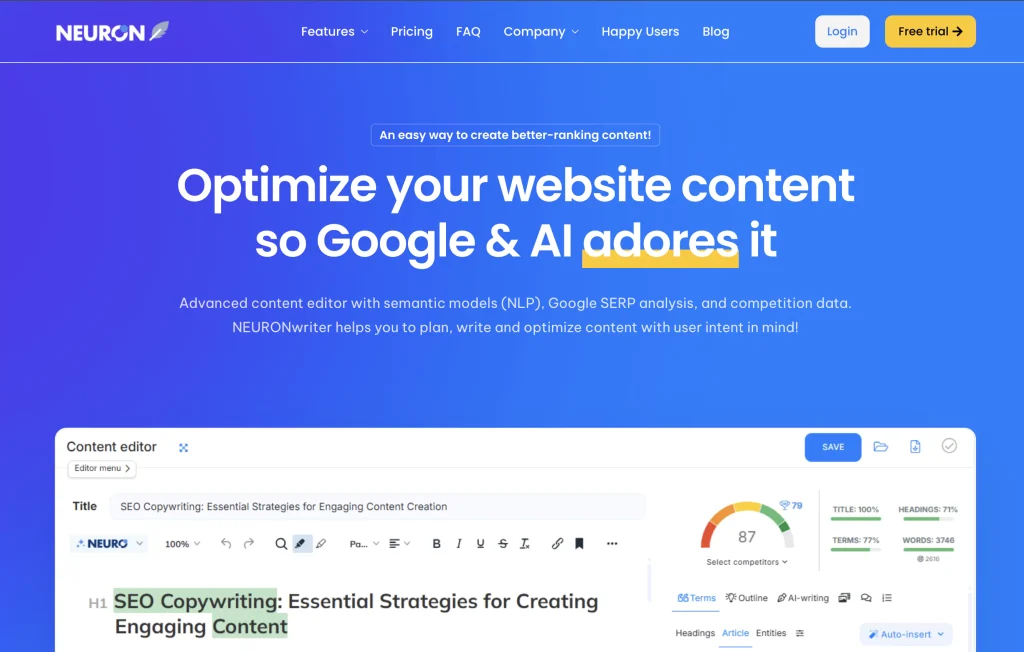
User ratings on Capterra and AppSumo are consistently high, which is impressive given its budget-friendly starting price. Most teams still edit AI output for quality, which is normal at this price point.
Where it improves on Writesonic
- Strong semantic optimization features at a lower cost
- Multi-language support and WordPress integration
- Popular among budget-conscious SEO practitioners
Good fit if: You need a low-cost way to upgrade your on-page optimization and are willing to keep a human in the loop for editing.
Writesonic vs These Alternatives: When To Switch
Writesonic started as a general AI writer and now leans into SEO features like real-time SERP analysis, NLP-driven keyword suggestions, and integrations with Ahrefs or Semrush. Its entry pricing is attractive and reviewers often praise how quickly it produces drafts.
You are likely ready for an alternative if:
- Your pages compete in difficult SERPs and need deeper topic coverage, not just more words
- You manage several clients or brands and need shared workflows, briefs, and content monitoring
- You are hitting credit limits or find it hard to control output quality and brand voice
- You care about building a stack of best AI SEO content optimization software rather than relying on one general AI writer
Which path to take
- Choose Rankability if you want an agency-grade operating system for briefs, on-page SEO, and monitoring.
- Choose Surfer if you want the fastest route from draft to optimized article with a live score.
- Choose Frase if you want value and need research plus briefs plus AI writing in one place.
- Choose Clearscope if editorial precision and collaboration matter more than price.
- Choose MarketMuse if you are planning content at the site or portfolio level.
- Choose Scalenut if you like the “one suite” approach and want tight AI + SEO in one UI.
- Choose NeuronWriter if you want a budget optimizer with solid semantic capabilities.
Buying Guide: How To Choose the Right Writesonic Alternative
- Start with your primary use case Agency vs in-house vs solo creator. Your use case decides whether you need workflows (Rankability, Clearscope), planning depth (MarketMuse), or value (Frase, NeuronWriter).
- Decide how important integrated SEO is If AI text is secondary to search performance, lean into optimization-first platforms rather than general writers.
- Check limits and seats, not just headline price Compare how many content projects, optimizations, or reports you get, and how many team members can collaborate.
- Look at learning curve and support Some tools are plug and play. Others assume you have an SEO lead who can drive adoption and training.
FAQs
Is Writesonic still worth using in 2025? Yes, especially if your main priority is fast AI drafting with basic SEO support at a friendly entry price. It is less compelling once search performance, workflows, and collaboration become the main objectives.
What is the best Writesonic alternative for agencies? Rankability is the standout for agencies because it combines briefs, optimization, and monitoring inside one system built specifically for SEO and digital marketing teams. Surfer and Clearscope are strong runners-up, depending on your preference for usability versus precision.
Which alternative is best for solo bloggers or small businesses? Frase, Scalenut, and NeuronWriter all offer attractive starting tiers and workflows that do not assume you have a large team. The right choice depends on whether you prioritize research, speed, or budget.
Can you use more than one of these tools together? Yes. Many teams use Rankability or Clearscope for core optimization while still keeping Frase or Scalenut for rapid ideation and drafting. The key is to avoid duplicate spend on overlapping features you do not use.
How often should you revisit your stack? At least once a year. Pricing, limits, and features change fast in this category, and periodic reviews ensure you are still getting good value for your production volume.
Conclusion
Writesonic is still useful for fast AI drafts, but it’s no longer the only option if you care about real search performance. Tools like Surfer, Clearscope, MarketMuse, and others give you deeper on-page optimization, better workflows, and more control as your content operation grows.
If you are running an SEO or digital agency and want a platform designed around your world, it’s worth testing a specialist solution like Rankability alongside the other tools on this list to see which stack drives the most predictable results.