<!-- Article Content -->
<section class="max-w-7xl mx-auto px-4 sm:px-6 lg:px-8">
<div class="article">
<!-- Page Header -->
<div class="text-center mb-12">
<div class="flex flex-col sm:flex-row items-center justify-center gap-4 text-sm text-gray-600">
<span>Research Study 2026</span>
<span>•</span>
<span>Updated: January 2026</span>
<!-- Quick Answer -->
<div class="bg-blue-50 border border-blue-200 rounded-lg p-6 mb-8">
<div class="flex items-center mb-3">
<svg class="w-6 h-6 text-blue-600 mr-2" fill="none" stroke="currentColor" viewBox="0 0 24 24">
<path stroke-linecap="round" stroke-linejoin="round" stroke-width="2" d="M13 16h-1v-4h-1m1-4h.01M21 12a9 9 0 11-18 0 9 9 0 0118 0z"></path>
</svg>
<h2 class="text-lg font-semibold text-blue-900">Research Finding</h2>
</div>
<p class="text-blue-800 text-lg leading-relaxed">
Based on analyzing 1,536 Google search results, <strong><em>we found no consistent correlation between keyword density and ranking</em></strong>. While relevant keyword usage remains important, our data suggests it's not a primary ranking factor in Google's algorithm. Instead, Google prioritizes factors like content quality, user experience, and relevance to user intent.
</p>
</div>
<!-- Key Finding Section -->
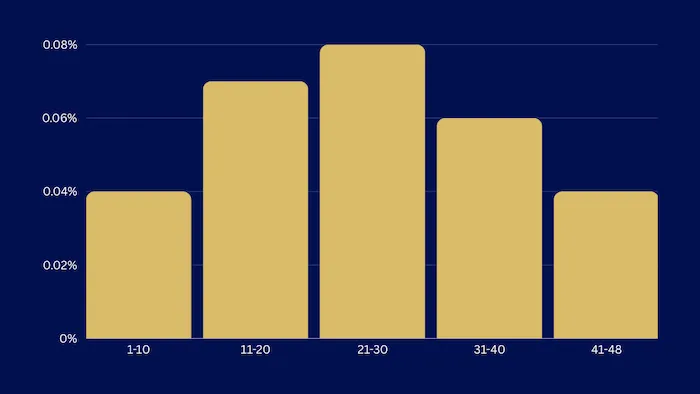
<h2>The Average Keyword Density for Top 10 Google Results is 0.04%</h2>
<p>Here's the complete data set based on analyzing 32 highly-competitive keywords:</p>
<table>
<thead>
<tr>
<th>Ranking Segment</th>
<th>Average Keyword Density</th>
</tr>
</thead>
<tbody>
<tr>
<td>1-10</td>
<td><strong>0.04%</strong></td>
</tr>
<tr>
<td>11-20</td>
<td>0.07%</td>
</tr>
<tr>
<td>21-30</td>
<td>0.08%</td>
</tr>
<tr>
<td>31-40</td>
<td>0.06%</td>
</tr>
<tr>
<td>41-48</td>
<td>0.04%</td>
</tr>
</tbody>
</table>
<p>The data shows a trend of decreasing average keyword density in higher ranking segments (1-10) compared to lower ranking segments (41-48), which might suggest that lower keyword density could be associated with better SEO practice.</p>
<img src="/assets/Keyword-Density-by-Ranking-Position-1_1758720579125.webp" alt="Chart showing keyword density by ranking position - top 10 results have 0.04% density while middle rankings have higher density up to 0.08%" class="mx-auto">
<p>This trend suggests that pages with a more moderate use of keywords tend to rank higher.</p>
<!-- Important Considerations Section -->
<h2>Important Considerations</h2>
<p>However, it's important to note a few key points:</p>
<ul>
<li><strong>Limited Dataset:</strong> The averages may not represent all keywords and domains accurately.</li>
<li><strong>Correlation vs. Causation:</strong> The graph shows a correlation, not causation. Lower keyword density doesn't automatically lead to higher rankings; it might simply be a characteristic of high-quality content that is naturally written and user-focused.</li>
<li><strong>Multifaceted SEO:</strong> Google's ranking algorithm considers many factors beyond keyword density, such as content quality, user experience, backlinks, and more. A holistic approach to SEO is generally more effective.</li>
<li><strong>Risk of Under-Optimization:</strong> An excessive focus on lowering keyword density can lead to content that is not sufficiently optimized for search engines. It's crucial to strike a balance, ensuring that keywords are used effectively to maintain SEO value while prioritizing natural, reader-friendly content.</li>
<li><strong>Context and Relevance:</strong> The context and relevance of keywords within the content are more important than the sheer number of keywords.</li>
</ul>
<p>In summary, while the data suggests that lower keyword density might be a characteristic of higher-ranking pages, it should not be the sole focus of SEO efforts. Quality and relevance should remain the primary goals.</p>
<p>AI citation data points in the same direction: <a href="/blog/ai-search-statistics/#does-keyword-density-matter-ai-search">94.3% of analyzed page bodies lacked the complete search query</a>, and repeating the phrase more often showed no independent citation-position advantage after accounting for relevance.</p>
<!-- Google's Official Stance Section -->
<h2>What Google Says About Keyword Density</h2>
<p>Keyword stuffing is a cardinal sin in Google's book. Their official guidelines clearly state that <em>"filling a web page with keywords or numbers in an attempt to manipulate rankings"</em> is against their policies. This practice often results in unnatural, repetitive content and is ultimately unhelpful to users.</p>
<p>Google has long discouraged an obsessive focus on keyword density. As former Head of Webspam Matt Cutts famously said, <em>"There's diminishing returns"</em> to keyword repetition.</p>
<p>While mentioning your target keyword a few times can be helpful, "keyword stuffing" offers minimal ranking benefit and risks crossing the line into gibberish or even penalty-worthy spam.</p>
<p>The emphasis has shifted from mere keyword presence to understanding context and intent. John Mueller, a Search Quality Analyst at Google, emphasizes the importance of focusing on natural writing.</p>
<p>Search engines, like humans, can detect forced keyword usage and prioritize content that provides genuine value and relevance to the user's query, not just a high frequency of certain words.</p>
<p>In essence, Google wants high-quality content that naturally incorporates relevant keywords. Regarding ranking, keyword density has taken a back seat to user engagement, comprehensiveness, and semantic understanding.</p>
<p>The SEO game is no longer about keyword juggling; it's about creating content that genuinely deserves to be ranked.</p>
<!-- Best Practices Section -->
<h2>Best Practices for Keyword Usage</h2>
<h3>Focus on Natural Writing</h3>
<p>Write for your audience first, search engines second. Use keywords naturally within the context of helpful, comprehensive content.</p>
<h3>Prioritize Content Quality</h3>
<p>Create content that thoroughly addresses user intent and provides genuine value rather than targeting specific keyword density percentages.</p>
<h3>Use Semantic Variations</h3>
<p>Include related terms, synonyms, and contextually relevant phrases rather than repeating the exact keyword.</p>
<h3>Avoid Keyword Stuffing</h3>
<p>Don't force keywords into content where they don't naturally fit. This can harm both user experience and rankings.</p>
<p>If a ranking decline follows a Google update, work through the <a href="/google-spam-update-checklist/" class="text-blue-600 hover:text-blue-800 underline">Google Spam Update Checklist</a> to rule out keyword stuffing and other documented spam-policy risks.</p>
<h3>Monitor User Engagement</h3>
<p>Focus on metrics like time on page, bounce rate, and user satisfaction rather than keyword density percentages.</p>
<!-- Conclusion Section -->
<h2>Conclusion: Keyword Density and SEO</h2>
<p>Based on the data analysis and the broader consensus, it's evident that keyword density, while not entirely irrelevant, is not a dominant factor in Google's ranking algorithm.</p>
<p>The key findings can be summarized as follows:</p>
<ul>
<li><strong>Low Density is Common in Top Rankings:</strong> The data analysis of the top 10 Google search results indicated an average keyword density of around 0.04%. This suggests that low, rather than high, keyword density is a characteristic of well-ranking pages.</li>
<li><strong>Quality and Relevance Over Quantity:</strong> SEO experts and companies generally agree that content quality and relevance should be prioritized over strict adherence to a specific keyword density. Writing naturally for the audience and ensuring the content is informative and engaging is more beneficial for SEO than targeting a particular keyword density.</li>
<li><strong>Diverse Views on Ideal Density:</strong> There is no consensus on the ideal keyword density, with recommendations varying widely. However, most agree that extremely high densities (e.g., above 7%) are unnecessary and potentially harmful, as they can be perceived as keyword stuffing.</li>
<li><strong>Shift in Google's Algorithm:</strong> Google's algorithm has evolved to focus more on understanding the context and semantics of content, reducing the emphasis on keyword density. This shift aligns with the broader movement towards user-centric content in SEO.</li>
<li><strong>No Clear Evidence of Penalization:</strong> While there are claims of penalization for high keyword density, the data does not conclusively support this. However, it is acknowledged that keyword stuffing, or the excessive use of keywords, is generally frowned upon by Google.</li>
</ul>
<p>In conclusion, while keyword density is a factor in SEO, it is not as critical as it once was. Instead of aiming for a specific keyword density, the focus should be on creating high-quality, relevant content that naturally includes keywords. This approach aligns more with current SEO best practices and the evolving nature of Google's search algorithms.</p>
<!-- Sources Section -->
<div class="mt-12 pt-8 border-t border-gray-200">
<details class="group">
<summary class="cursor-pointer flex items-center justify-between p-4 bg-gray-50 rounded-lg hover:bg-gray-100 transition-colors">
<span class="font-semibold text-gray-900">Sources & References</span>
<svg class="w-5 h-5 text-gray-500 group-open:rotate-180 transition-transform" fill="none" stroke="currentColor" viewBox="0 0 24 24">
<path stroke-linecap="round" stroke-linejoin="round" stroke-width="2" d="M19 9l-7 7-7-7"></path>
</svg>
</summary>
<div class="mt-4 p-4 bg-white rounded-lg border border-gray-200">
<div class="grid grid-cols-1 md:grid-cols-2 gap-2 text-sm">
<div>
<h4 class="font-semibold mb-2">Google Official Sources</h4>
<ol class="space-y-1 mb-4">
<li>1. <a href="https://developers.google.com/search/docs/essentials/spam-policies" class="text-blue-600 hover:text-blue-800" target="_blank">Keyword Stuffing Spam Policies - Google Developers</a></li>
<li>2. <a href="https://developers.google.com/search/docs/fundamentals/creating-helpful-content" class="text-blue-600 hover:text-blue-800" target="_blank">Creating Helpful Content - Google Developers</a></li>
<li>3. <a href="https://youtube.com/watch?v=Rk4qgQdp2UA" class="text-blue-600 hover:text-blue-800" target="_blank">Matt Cutts on Keyword Density - YouTube</a></li>
</ol>
<h4 class="font-semibold mb-2">SEO Research & Analysis</h4>
<ol start="4" class="space-y-1">
<li>4. <a href="https://www.gotchseo.com/keyword-density/" class="text-blue-600 hover:text-blue-800" target="_blank">Keyword Density Study - Gotch SEO</a></li>
<li>5. <a href="https://ahrefs.com/blog/keyword-density/" class="text-blue-600 hover:text-blue-800" target="_blank">Keyword Density Guide - Ahrefs</a></li>
<li>6. <a href="https://moz.com/learn/seo/keyword-density" class="text-blue-600 hover:text-blue-800" target="_blank">Keyword Density Guide - Moz</a></li>
<li>7. <a href="https://semrush.com/blog/keyword-density/" class="text-blue-600 hover:text-blue-800" target="_blank">Keyword Density Analysis - Semrush</a></li>
</ol>
</div>
<div>
<h4 class="font-semibold mb-2">Industry Publications</h4>
<ol start="8" class="space-y-1 mb-4">
<li>8. <a href="https://searchengineland.com/keyword-density-2024-guide" class="text-blue-600 hover:text-blue-800" target="_blank">Keyword Density 2024 Guide - Search Engine Land</a></li>
<li>9. <a href="https://searchenginejournal.com/ranking-factors/keyword-density" class="text-blue-600 hover:text-blue-800" target="_blank">Keyword Density Ranking Factors - Search Engine Journal</a></li>
<li>10. <a href="https://backlinko.com/keyword-density" class="text-blue-600 hover:text-blue-800" target="_blank">Keyword Density Study - Backlinko</a></li>
</ol>
<h4 class="font-semibold mb-2">Expert Commentary</h4>
<ol start="11" class="space-y-1">
<li>11. <a href="https://youtube.com/live/s7kP7LWM87Y" class="text-blue-600 hover:text-blue-800" target="_blank">John Mueller on Natural Writing - YouTube</a></li>
<li>12. <a href="https://yoast.com/keyword-density/" class="text-blue-600 hover:text-blue-800" target="_blank">Keyword Density Best Practices - Yoast</a></li>
</ol>
<p class="mt-3 text-xs text-gray-500">
<strong>Research Methodology:</strong> Analysis of 1,536 Google search results across 32 highly-competitive keywords to determine correlation between keyword density and ranking positions.
</p>
</div>
</div>
</div>
</details>
</div>
</div>
</section>
</div>