

You are not choosing between three interchangeable dashboards. You are choosing between three different operating models for measuring and improving visibility in AI search, and that decision affects your workflow, your client deliverables, and your margins.
The market reshaped itself in the first half of 2026: Profound raised a $96M Series C at a $1B valuation on February 24, 2026, and Scrunch was acquired by digital experience platform Sitecore for roughly $225M on June 3, 2026. Rankability, meanwhile, stayed independent and agency-focused with published, self-serve pricing starting at $99/mo.
When evaluating Profound AI vs Scrunch vs Rankability, the real question is not which platform has the loudest positioning. The real question is which one gives your agency the best mix of visibility score accuracy, share of voice insight, execution speed, and reporting consistency across many clients.
This comparison looks at pricing, data methodology, answer engine optimization coverage, workflow depth, integrations, reporting, and agency scalability. Each category includes a clear winner so you can decide based on fit rather than feature sprawl.
Quick Verdict (TL;DR): Profound AI vs Scrunch vs Rankability
Bottom line:
- Best for agency workflow (research → content → reporting): Rankability. It is a unified system for keyword research, content creation, on-page SEO, AI visibility tracking, and client reporting, with every plan including the full platform, unlimited clients, and unlimited users — which matters if you need one repeatable process instead of several disconnected tools.
- Best for enterprise AEO depth and dataset focus: Profound AI. Backed by $155M in total funding and used by brands like Target, Walmart, Figma, MongoDB, and Charlotte Tilbury, it tracks 10+ answer engines and now layers in Profound Agents for automation, which matters if your team values enterprise-grade research depth over execution inside one platform.
- Best for technical agent-experience optimization: Scrunch. Its Agent Experience Platform (AXP) serves machine-readable content to AI crawlers and can cut delivered page size by up to 98%. Note that Scrunch is now part of Sitecore (acquired June 2026), so its roadmap is tied to Sitecore’s DXP rather than to a standalone tool.
- Best for multi-client reporting and white label deliverables: Rankability. White label reporting, built-in Serena guidance, and API access on every plan make the platform practical for agencies that must standardize deliverables across accounts.
- Best for teams already in a broader SEO suite: Rankability. If you want AI visibility plus traditional Google, local, and video tracking in one place instead of bolting AEO onto SEMrush or Ahrefs workflows, Rankability is the stronger operational fit.
Head-to-Head Comparison Table: Profound AI vs Scrunch vs Rankability
The fastest way to compare these platforms is to separate pure AEO tracking from full content workflow support. Agencies usually regret buying on feature headlines alone because pricing transparency, multi-client management, and reporting depth determine whether the tool survives beyond the first pilot.
| Feature/Category | Profound AI | Scrunch | Rankability |
|---|---|---|---|
| Primary focus | Enterprise AEO visibility + Agents | AEO insights + Agent Experience Platform (now part of Sitecore) | Agency SEO workflow + AI visibility |
| Founded / status | 2024, NYC; independent; $155M raised, $1B valuation | 2023; acquired by Sitecore June 3, 2026 (~$225M) | Independent; agency-owned SEO + AI platform |
| AI platforms tracked | 10+ engines: ChatGPT, Perplexity, Google AI Overviews, Gemini, Claude, Grok, Meta AI, DeepSeek | 9 engines: ChatGPT, Claude, Gemini, Perplexity, Google AI Mode, Google AI Overviews, Meta AI, Copilot, Grok | ChatGPT, Gemini and other AI platforms plus Google SERPs, local, and video |
| Content workflow | Insights + Agents, Documents (automation layer) | Recommendations + technical audits/AXP | Research → writing → optimization → proof |
| Reporting | Enterprise dashboards; API on enterprise | Dashboards, citations, GA4 agent-traffic attribution | White label reporting + client-ready deliverables |
| Multi-client management | Enterprise setup; agency partner program | Moderate; now folded into Sitecore | Built for agencies; unlimited clients on every plan; trusted by 500+ agencies |
| Integrations | HubSpot, Google Workspace, Gamma, Parallel AI, Vercel; API (enterprise) | Google Analytics (GA4); Sitecore DXP integration | Integrations & API included on every plan |
| Onboarding | Sales-led; demo required; no self-serve signup | Self-serve plans from $250/mo (annual) | Self-serve checkout; full platform on day one |
| Support model | Demo-led; Profound University + certification | Demo/docs-led | Built-in Serena guidance on every plan |
| Pricing | Quote-based enterprise (site lists “customized enterprise pricing”); third-party reviews cite $399–$499/mo entry, $2,000–$5,000+/mo enterprise | Starter $250/mo and Growth $417/mo (annual billing); Enterprise custom | Published: Starter $99, Growth $199, Scale $399 per month (17% off annual) |
| Best-fit team | Enterprise in-house AEO team | Brands prioritizing technical agent-readability | Agencies managing many accounts |
| Broader SEO replacement potential | Limited | Limited | Stronger alternative to scattered SEMrush and Ahrefs workflows |
Pricing: Profound AI vs Scrunch vs Rankability
Pricing matters less than cost structure. For agencies, the wrong platform becomes expensive when every extra seat, project, export, or reporting request turns into a manual process that your team has to absorb.
The three platforms sit at very different price points. Rankability publishes three self-serve plans — Starter at $99/mo (10,000 credits), Growth at $199/mo (30,000 credits), and Scale at $399/mo (75,000 credits) — with annual billing saving 17%.
Crucially, every Rankability plan includes the full platform, unlimited clients, and unlimited users, so you scale by adding credits rather than paying per seat or per client.
Scrunch publishes self-serve pricing as well: a Starter plan at $250/mo on annual billing ($300 month-to-month) and a Growth plan at $417/mo on annual billing ($500 month-to-month), with Enterprise priced on request. Following Sitecore’s June 2026 acquisition, expect Scrunch’s commercial packaging to migrate toward Sitecore’s enterprise DXP motion over time.
Profound is the enterprise option. Its own pricing page states the platform is “currently available through customized enterprise pricing,” with no free trial and no self-serve signup — every plan requires a sales call.
Third-party reviews in early 2026 reported entry tiers in the $399–$499/mo range and enterprise deployments running $2,000–$5,000+/mo depending on platform count, seats, and features, but those figures are not published by Profound and should be confirmed in a demo.
What you should compare is total cost of ownership: seats, client limits, onboarding time, export flexibility, and API access. A platform that covers AI answer engines but still forces you back into separate writing, optimization, and reporting software often costs more than its sticker price suggests.
Agencies make money on repeatable delivery, so the cheapest line item is not always the cheapest operating model.
Category winner: Rankability — Published pricing from $99/mo with unlimited clients and users, plus full-workflow coverage, gives agencies a clearer path to ROI than quote-based enterprise tooling or per-seat AEO-only tools.
Data & AI Visibility Tracking: Profound AI vs Scrunch vs Rankability
This category is about methodology, not marketing language. AI visibility tracking only becomes useful when the platform can consistently monitor prompt tracking, brand mentions, AI citations, and answer presence across the channels your clients care about.
Profound is the strongest enterprise AEO contender here. It monitors 10+ answer engines — including ChatGPT, Perplexity, Google AI Overviews, Gemini, Claude, Grok, Meta AI, and DeepSeek — and pairs that with proprietary datasets like Prompt Volumes, Agent Analytics, and the Profound Index.
If your goal is competitive benchmarking across thousands of prompts with deep, enterprise-grade methodology, that research orientation is a real advantage, which is part of why brands like Target, Walmart, Figma, MongoDB, and Charlotte Tilbury use it.
Scrunch tracks nine engines (ChatGPT, Claude, Gemini, Perplexity, Google AI Mode, Google AI Overviews, Meta AI, Microsoft Copilot, and Grok) with daily monitoring of brand mentions, sentiment, and competitor benchmarking. Its distinctive layer is technical: the Agent Experience Platform (AXP) serves AI-optimized content directly to crawling agents, and it attributes AI crawler traffic through a Google Analytics GA4 integration so you can see which agents are actually visiting client sites.
Rankability takes a broader approach by combining AI visibility tracking across ChatGPT, Gemini, and other AI platforms with traditional Google SERPs, local search, video, and Google AI Overviews, which matters because agencies rarely report AI visibility in isolation from organic performance.
The tradeoff is straightforward. Profound’s enterprise depth and breadth of engines help in fast-moving, high-stakes categories, but standardized prompt libraries and unified SEO-plus-AI reporting are often easier to operationalize across dozens of accounts.
What to look for in any platform is prompt coverage, citation tracking, competitor comparisons over time, and clarity around methodology. A visibility score without prompt-level explanation is hard to defend in client reporting.
Category winner: Profound AI — For pure AEO research depth, breadth of answer engines, and enterprise-grade datasets, Profound has the edge.
Features & Workflows: Profound AI vs Scrunch vs Rankability
Tracking is not execution. Many AI search tools can tell you where you are missing, but agencies need a repeatable, end-to-end SEO workflow from planning to proof so the strategist, writer, and account manager can all move inside the same system.
Profound has moved beyond pure insight with Profound Agents (launched alongside its February 2026 Series C), plus Documents and a rebuilt Sentiment product, bringing orchestration and automation natively into the platform. It is a powerful enterprise workbench, though it is built around AI marketing automation rather than full traditional-SEO production. Scrunch focuses on diagnostics — citations, sentiment, technical audits, site maps, and agent-readability via AXP — so most teams will still need separate systems for keyword research, briefs, copy production, and reporting. For how these automation layers compare against the wider field of monitoring, content, and execution agents, see our roundup of the best AI SEO agents.
Rankability is built around integrated tools spanning the full agency workflow: Track (visibility across Google, AI platforms, local, and video), Research (keyword and content opportunity discovery and clustering), Create (research, brief, draft, optimize, and improve content), Audit (technical, local, content, brand, and page-level issues), Promote (backlink and authority analysis), plus Serena. That matters because an agency workflow is larger than AEO tracking: research entities, create a brief, improve on-page structure, apply schema, monitor rank tracking, and then turn those actions into a client-facing narrative.
Citation awareness is the key differentiator in 2026 content operations. AI answers summarize and sometimes cite source material, so the best platform is the one that helps you translate visibility findings into concrete content changes rather than leaving insights stranded in a dashboard.
For agencies running weekly production cycles, integrated workflow beats isolated intelligence.
Category winner: Rankability — It is the only option here positioned as a complete execution system (research, create, audit, promote, report) rather than an insight or automation layer alone.
Ease of Use & Onboarding: Profound AI vs Scrunch vs Rankability
Ease of use is not about whether the interface looks clean. It is about how long it takes to set up one client with prompts, competitors, reporting templates, permissions, and a workflow your team will actually repeat every week.
Scrunch and Rankability both offer self-serve onboarding, so you can be live without a sales cycle — Scrunch from $250/mo on annual billing, Rankability from $99/mo with the full platform unlocked on day one and unlimited users included. Profound, by contrast, has no self-serve signup and no free trial; every deployment starts with a demo and a sales conversation, which fits its enterprise motion but slows time-to-first-insight for smaller teams.
Rankability asks for a broader initial setup because it supports research, writing, optimization, and reporting, but that extra configuration pays off in time-to-first client-ready deliverable rather than just time-to-first dashboard, and Serena shortens the ramp. During a demo, ask how long it takes to templatize one vertical, what a strategist does weekly, and what a writer sees next.
Agencies do not scale on isolated insights; they scale on predictable handoffs between roles.
Category winner: Rankability — Self-serve from $99/mo with unlimited users and Serena gives teams the fastest path to a repeatable weekly process; Scrunch is a close second on raw speed-to-signal.
Integrations & API: Profound AI vs Scrunch vs Rankability
Integration depth determines whether a platform becomes part of your operating system or just another tab. Agencies usually need exports into Google Search Console, Google Analytics, Looker Studio, CMS workflows, and internal task systems even when the platform itself is strong.
Profound integrates with tools like HubSpot, Google Workspace, Gamma, Parallel AI, and Vercel and offers API access, but API and the deepest integrations sit on enterprise plans. Scrunch integrates with Google Analytics (GA4) for agent-traffic attribution and, post-acquisition, is being woven into Sitecore’s DXP — useful if you are a Sitecore shop, less so if you are not.
Rankability includes Integrations & API on every plan, with no enterprise gate, so you can connect data sources, report, export, and automate workflows from the Starter tier up. If you want to pull KPIs into internal dashboards, automate reporting pipelines, or standardize white label client deliverables without rebuilding the same spreadsheet every month, API availability without a price-tier upgrade is a practical advantage.
The right integration question is not “Does it connect to everything?” The right question is “Can my team move data from tracking to reporting to action without manual rework?”
Category winner: Rankability — API access and white label reporting included on every plan make it easier to operationalize across an agency stack.
Reporting & Client Deliverables: Profound AI vs Scrunch vs Rankability
Agencies do not just need dashboards. They need client deliverables that explain visibility changes over time, show where the brand appears or disappears by prompt category, and connect those changes to specific actions.
Profound’s enterprise dashboards are strong for in-house analysis, and Scrunch adds citation and GA4 agent-traffic reporting, but both still require an account manager or strategist to manually turn raw findings into a monthly client narrative — and neither leads with white label, agency-style reporting.
Rankability is purpose-built for agency reporting: white label reporting plus Serena (which surfaces weekly plans and recommendations from connected client data) reduce the work required to explain what changed, why it matters, and what happens next. That matters because non-technical stakeholders do not buy prompt tracking; they buy clarity and forward motion.
Great AEO reporting should connect AI visibility trends, competitor gaps, and content updates in one place — a report that cannot tie a visibility shift to a page revision is informative, but it is not persuasive.
Category winner: Rankability — White label reporting and Serena make it best suited to producing polished, repeatable client-ready reporting at scale.
Scalability for Agencies: Profound AI vs Scrunch vs Rankability
The real test is whether the same process works across 10, 50, or 200 client sites. A platform can feel strong in a pilot and still break operationally when you need standardized prompt sets, permissions, templates, and SOPs across multiple teams.
Profound scales well for research-heavy enterprises, especially those that already have a mature content and reporting stack and can absorb enterprise pricing and sales-led onboarding. Scrunch can serve brands prioritizing technical agent-readability, but as a newly acquired part of Sitecore, its future as a standalone agency tool is uncertain and its roadmap now sits inside a larger DXP.
Rankability is the most agency-native option because it is designed to replace scattered tools with one workflow your team runs across every client — and because unlimited clients and unlimited users are included on every plan, you scale by usage (credits) rather than by negotiating seats. The company states it is trusted by 500+ agencies, a meaningful signal because multi-client management is a product design choice, not just a feature set.
A scalable platform reduces dashboard sprawl and increases process consistency. If your team has to reinvent prompts, reports, and next steps for every account, you are not scaling software, you are scaling labor.
Category winner: Rankability — Unlimited clients and users, white label reporting, and a unified operating model fit agency growth better than enterprise-priced or recently-acquired AEO tools.
About Profound AI
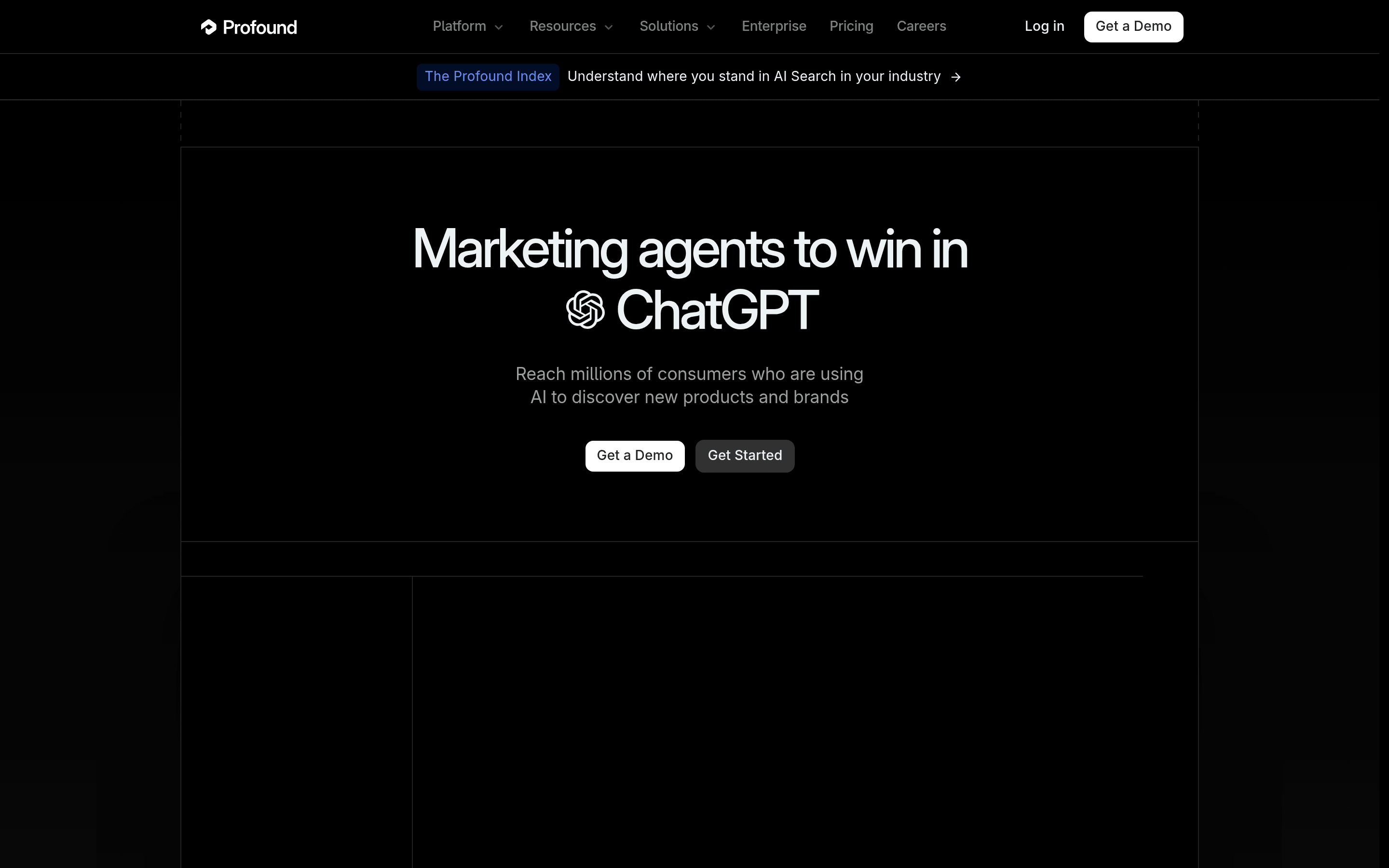
Profound is an enterprise AEO visibility platform founded in 2024 in New York City by James Cadwallader (CEO) and Dylan Babbs (CTO). It has raised roughly $155M across a $3.5M seed, a $20M Series A led by Kleiner Perkins, a $35M Series B led by Sequoia, and a $96M Series C led by Lightspeed Venture Partners in February 2026 at a $1B valuation.
Its core appeal is depth: dataset quality, prompt-level insight across 10+ answer engines, and — as of 2026 — Profound Agents for native automation. Customers include Ramp, DocuSign, Figma, Target, Walmart, MongoDB, Charlotte Tilbury, US Bank, and Gamma.
That makes Profound a stronger fit for enterprise in-house AEO teams or large agencies that already have content operations handled elsewhere. Because pricing is quote-based and onboarding is sales-led, validate in a demo how visibility is measured across engines, how prompts are managed at scale, how often data refreshes, and what the all-in annual cost is before treating its research advantage as decisive.
About Scrunch
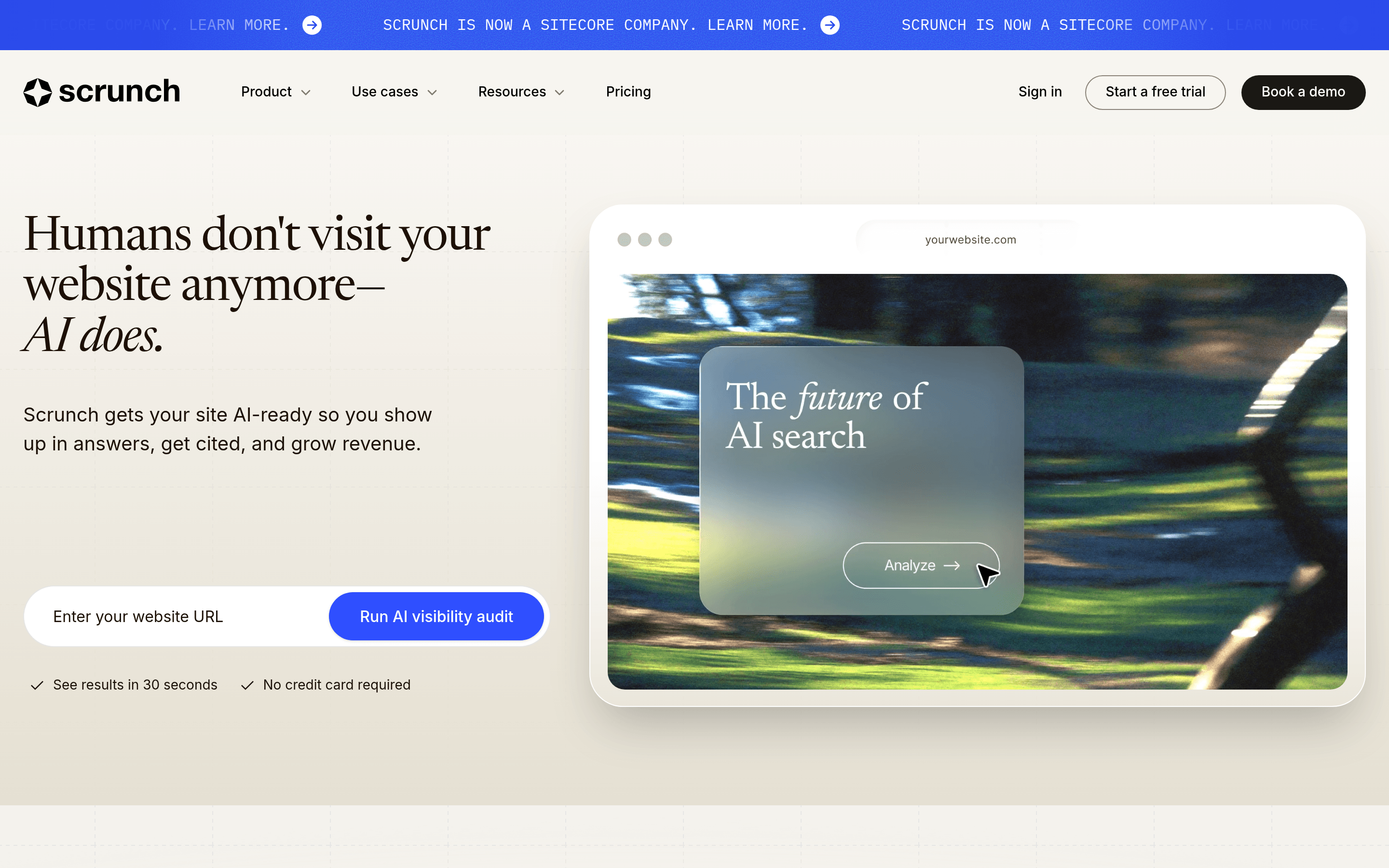
Scrunch was founded in 2023 by Chris Andrew (CEO) and Robert MacCloy (CTO) and raised about $19M — a $4M seed led by Mayfield (March 2025) and a $15M Series A led by Decibel (July 2025), with angels including Clara Shih, TJ Parker, and Bryant Chou. On June 3, 2026, Sitecore acquired Scrunch for a reported ~$225M, pairing Scrunch’s Agent Experience Platform (AXP) with Sitecore’s digital experience platform.
Scrunch’s distinctive strength is technical agent-readability: the AXP serves machine-readable, AI-optimized content to crawling agents (reducing delivered page size by up to 98%), and it tracks brand mentions, sentiment, and citations across nine engines with GA4-based agent-traffic attribution. Its best fit is a brand that wants to optimize how AI agents consume its site.
In a demo, focus on how recommendations map to concrete on-page changes — and factor in that Scrunch’s roadmap is now governed by Sitecore. If HubSpot AEO is also on your shortlist, our HubSpot AEO alternatives comparison weighs HubSpot AEO, Scrunch, Rankability, and the rest of the field together.
About Rankability
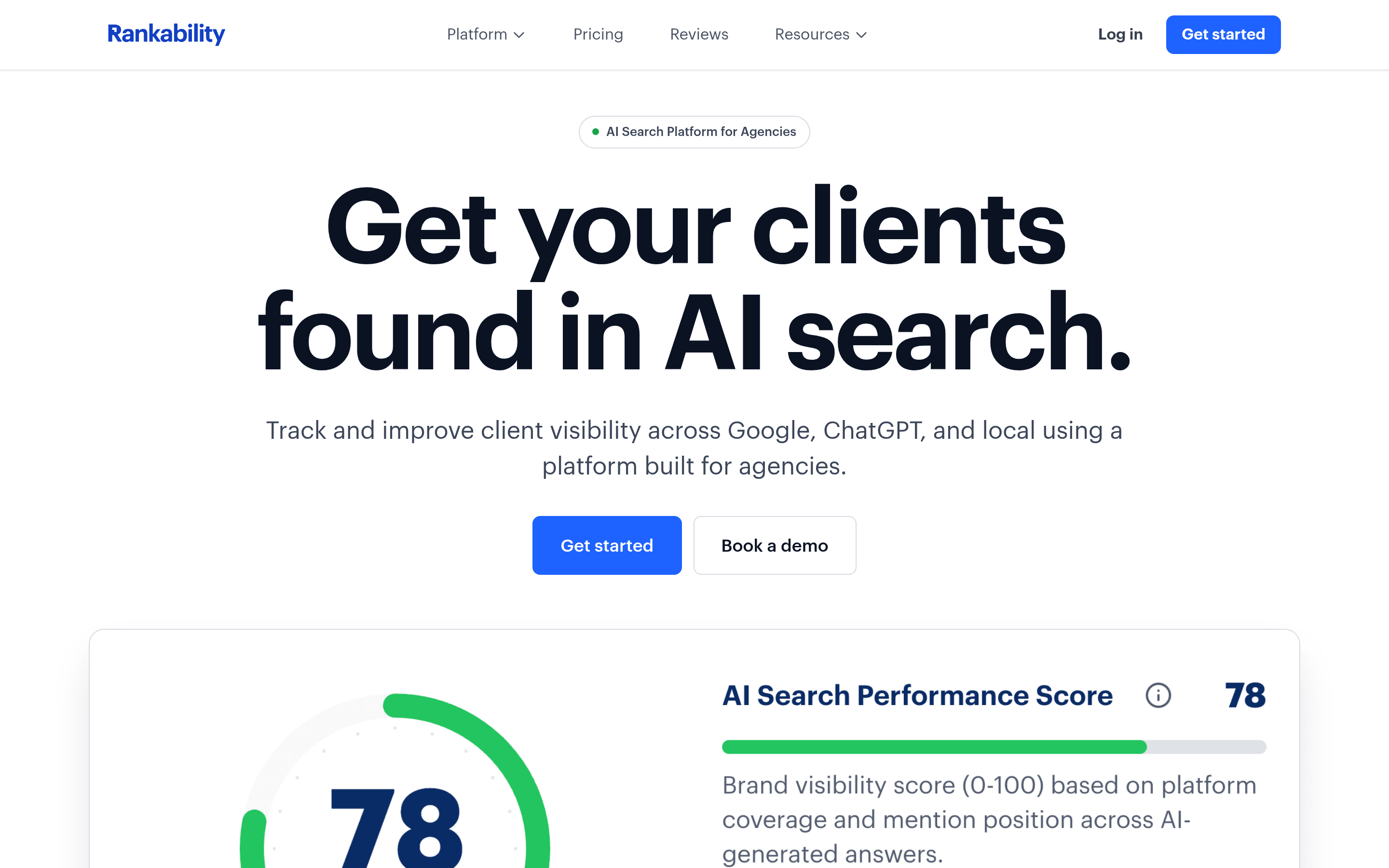
Rankability is the agency SEO workflow for Google and AI search, based in St. Louis, Missouri and trusted by 500+ agencies. It is designed for SEO agencies and marketing teams that need one connected system to research, write, optimize, and track rankings across traditional search and AI platforms like ChatGPT and Gemini.
Its differentiators are operational, not cosmetic: integrated Track, Research, Create, Audit, and Promote tools; Serena with client-specific weekly plans and recommendations; white label reporting; Integrations & API on every plan; and published pricing from $99/mo with unlimited clients and unlimited users. If your agency needs execution plus proof, not just visibility monitoring, Rankability is the clearest fit of the three.
Decision Framework: When to Choose Profound AI vs When to Choose Scrunch vs When to Choose Rankability
The right choice depends on whether your bottleneck is enterprise research depth, technical agent-readability, or multi-client delivery. Most agencies should decide based on the workflow they need to repeat every week, not the feature they find most interesting in a demo.
If you want to see how these three compare to the rest of the field, our roundup of the best AEO tools for agencies maps the broader market.
Choose Profound AI if:
- You are an enterprise or large agency and can support quote-based pricing (third-party estimates: $2,000–$5,000+/mo) and sales-led onboarding.
- You want the deepest AEO research across 10+ answer engines, proprietary datasets, and native automation via Profound Agents.
- You already have keyword research, content production, and traditional SEO reporting handled in other tools.
Choose Scrunch if:
- Your priority is technical agent-readability and serving AI-optimized content to crawlers via the AXP.
- You want daily AI mention/citation monitoring with GA4 agent-traffic attribution.
- You are comfortable with a tool now owned by and integrating into Sitecore’s DXP.
Choose Rankability if:
- You run an agency and need a repeatable workflow across many clients from research to reporting, with unlimited clients and users on every plan.
- You want to track Google rankings, local, video, and AI visibility in one system instead of splitting work across multiple tools.
- You need white label reporting, API access, and weekly Serena recommendations — starting at $99/mo with transparent, self-serve pricing.
Final Recommendation
If your agency needs one system to run research, content production, optimization, reporting, and AI visibility tracking together, Rankability is the strongest overall choice. It aligns with how agencies actually deliver work because it connects execution to proof instead of stopping at diagnostics — and it does so with published pricing from $99/mo, unlimited clients, and unlimited users.
Profound is the better option when you are an enterprise prioritizing AEO-first research depth across 10+ engines and you already have the rest of your SEO stack in place (and the budget for quote-based pricing). Scrunch is the better option when technical agent-readability via the AXP is your priority and a Sitecore-aligned roadmap suits your stack.
The practical next step is to run a short pilot on one client. Use 20 to 30 prompts across three categories, compare setup time, report quality, clarity of next actions, and whether the platform supports weekly execution without extra tool stitching.
FAQs
Is Profound AI better than Scrunch for AEO?
Profound offers broader, enterprise-grade AEO research — 10+ answer engines, proprietary prompt-volume data, and native Agents — and is backed by $155M in funding. Scrunch tracks nine engines and specializes in technical agent-readability through its AXP, and is now owned by Sitecore.
Profound generally wins on measurement depth; Scrunch wins on serving AI-optimized content to crawlers.
Which tool is best for agencies: Profound AI, Scrunch, or Rankability?
Rankability is typically the best fit for agencies because it combines research, writing, optimization, AI visibility tracking, and white label reporting in one workflow, with unlimited clients and users on every plan from $99/mo. Profound suits enterprise teams that already have a production stack; Scrunch suits brands focused on technical agent-readability.
Do I still need an SEO suite if I use an AI visibility tool?
Usually, yes. Pure AI visibility tools like Profound and Scrunch diagnose presence in answer engines, but you still need keyword research, content production, on-page SEO, and reporting — unless your platform combines those functions, as Rankability does.
How do these tools track visibility in ChatGPT and Google AI Overviews?
Each monitors a prompt library over time, compares outputs, and records brand mentions or citations. Profound tracks 10+ engines with proprietary datasets, Scrunch tracks nine engines with GA4 agent-traffic attribution, and Rankability tracks AI platforms alongside Google SERPs, local, and video.
The main difference is methodology depth and how findings are turned into actions.
Was Scrunch acquired?
Yes. Sitecore acquired Scrunch on June 3, 2026 for a reported ~$225 million, integrating Scrunch’s Agent Experience Platform into Sitecore’s digital experience platform.
If you are evaluating Scrunch as a standalone agency tool, factor in that its roadmap is now part of Sitecore.
How hard is it to switch from one AEO platform to another?
Switching is easiest when you standardize prompts, competitors, and KPIs before migrating. A two-week pilot on one client usually shows whether the new platform improves reporting quality and weekly execution enough to justify the move.