

If your agency produces content for a roster of clients, the question about Ahrefs AI Content Helper isn’t “does it optimize content well?” It does. The question is whether folding content optimization into the Ahrefs ecosystem — with its per-seat plans and paid add-ons — makes sense once your writers, account managers, and editors all need access across many client accounts.
This review focuses only on the content-related features — research, topic gaps, content score, AI writing tools, and refresh workflows — and looks at them through an agency lens: does AI Content Helper help a content team produce and refresh client work at scale, or is it a research add-on that stops short of an agency workflow?
This is an AI Content Helper review written for agency buyers. We’ll give Ahrefs honest credit — the optimization engine is genuinely good — and be direct about where the cost model and platform dependency strain an agency workflow.
The agency verdict: AI Content Helper is a strong, well-built content optimizer if Ahrefs is already the center of your agency’s SEO work and your team can share the seats. It turns SERP and keyword data into a guided writing workflow that’s excellent for content refreshes. But it’s an add-on layered on per-seat Ahrefs plans, it optimizes toward what competitors already cover, and it has no agency-specific reporting layer. If content optimization is your core deliverable and you don’t need the rest of Ahrefs, a specialist optimizer usually fits an agency better for less.
What AI Content Helper Does Well for Agencies
Let’s lead with the strengths, because the optimization engine is the reason to consider it at all.
AI Content Helper is an AI-powered writing assistant inside the Ahrefs platform. It uses Ahrefs’ SEO data and competitor content to show which topics and keywords appear on top-ranking pages, then scores your draft on how comprehensively it covers those themes. For an agency, the workflow value is real:
- Topic and coverage analysis grades content against top-ranking pages and highlights undercovered or missing sections.
- Color-coded topics tag sentences by subtopic so you can see distribution at a glance.
- Metadata helpers suggest title tags and meta descriptions based on what’s currently working in search.
- AI chat and feedback lets writers ask for ideas, structural feedback, or paragraph-level improvements.
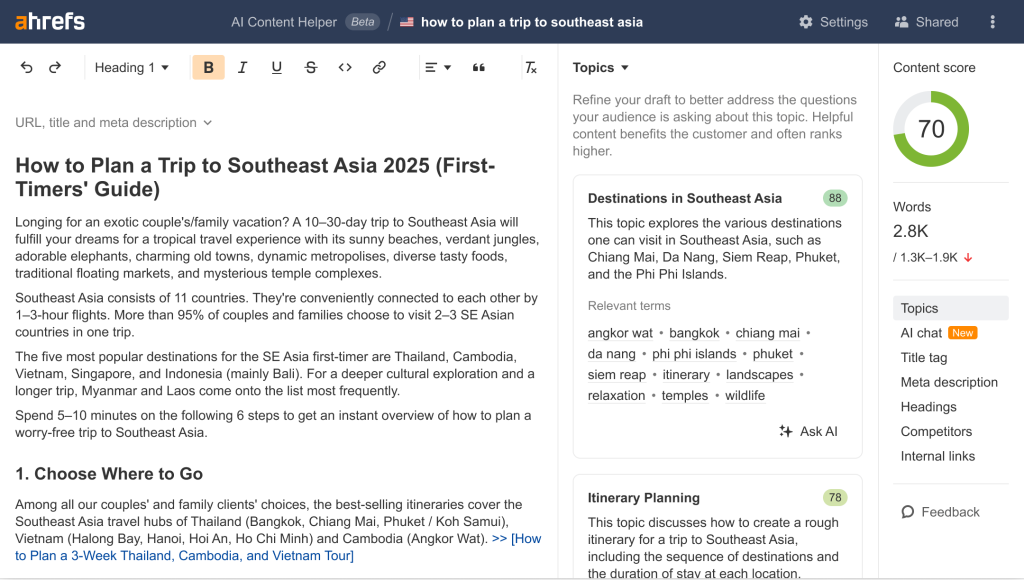
The result is a repeatable “research → outline → draft → optimize” loop. For content teams, the content score and topic lists work like a shared checklist — everyone sees what a page must cover to compete, without turning every brief into a manual audit. That consistency is genuinely useful when several writers handle different client accounts.
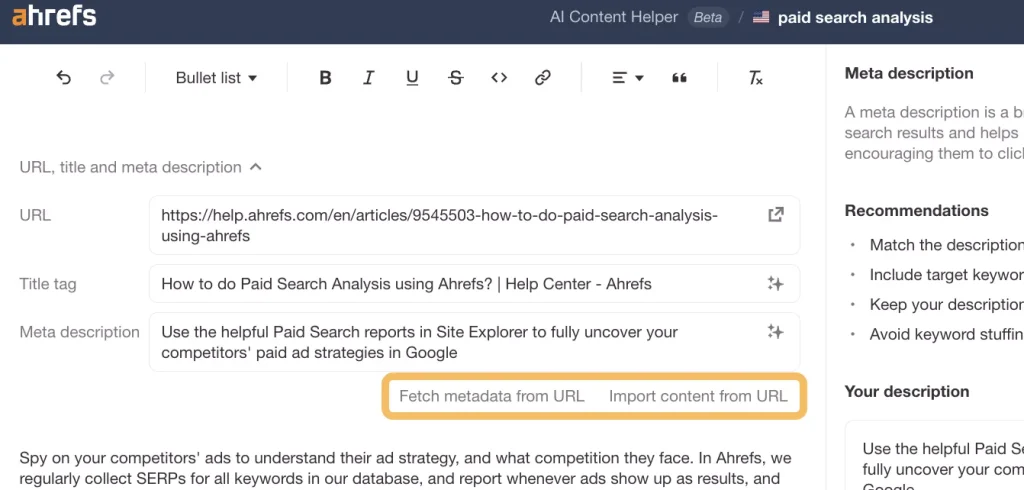
Where it shines most is content refreshes. Paste in an existing client URL, let it compare the page against current top-ranking pages, and use the content score, topic list, and color-coded gaps to outline specific updates. For agencies sitting on a backlog of older client articles that have authority but have slipped, that’s a fast way to recover lost organic traffic page by page.
Where It Strains the Agency Workflow
None of that means it fits the agency model cleanly. The friction shows up across a client roster.
It’s an add-on on top of per-seat plans
AI Content Helper is a paid add-on, not a feature tucked into the base platform. You pay for your core Ahrefs plan and the Content Kit add-on that includes it — and the core plans price by seat. For an agency, that compounds: the writers and editors who’d actually use the optimizer are exactly the people you’d have to buy seats for. The cost model is the same per-seat squeeze we cover in the main agency-buyer Ahrefs review.
It optimizes toward competitor consensus
The scoring is built around what top-ranking pages already cover. That keeps drafts aligned with search intent, but it also nudges teams toward “me too” content unless writers add genuine, unique insight. For an agency trying to differentiate a client in a crowded niche, leaning on coverage scores alone can flatten the very angle that wins.
It’s a content layer, not an agency platform
AI Content Helper optimizes on-page topic coverage. It doesn’t handle technical SEO audits, AI search visibility tracking, or — critically for agencies — client reporting. There’s no white-label output to hand a client. It’s one good layer in a stack, not an operating system for multi-client content delivery.
Pricing for Agencies
There are two cost layers to weigh: your core Ahrefs plan and the Content Kit add-on that includes AI Content Helper. Content Kit pricing starts from $99/month, on top of core plans that run:
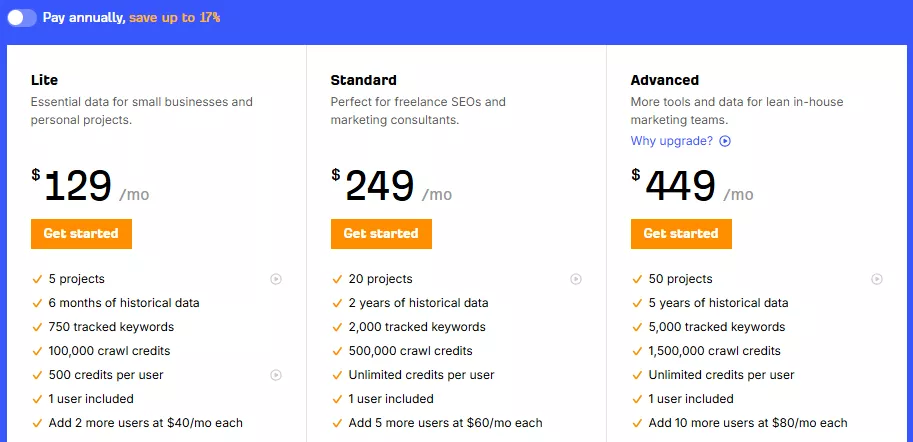
- Lite — $129/month
- Standard — $249/month
- Advanced — $449/month
- Enterprise — $1,499/month (annual commitment)
A useful detail: Content Kit can be purchased on its own without a full Ahrefs subscription, which softens the dependency somewhat. But for an agency the math still favors counting seats and clients first. If content optimization is the only job you need here, you’re paying ecosystem prices for one layer — and that’s the calculation that sends many agencies to a specialist.
Choose AI Content Helper If / Choose a Specialist If
Choose AI Content Helper if:
- Ahrefs is already the center of your agency’s SEO workflow and your team lives in Site Explorer and rank tracking daily.
- Content refreshes are a regular deliverable and you want optimization in the same tool as your research.
- Your team can work within shared seats without buying access for every writer.
Choose a specialist content optimizer if:
- Content optimization at scale is your core deliverable and you don’t need the rest of the Ahrefs platform.
- You want the deepest on-page engine rather than one layer of a broad SEO suite.
- Predictable per-client costs matter more than ecosystem convenience.
Rankability: A Specialist Optimizer Built for Agencies
If you like the idea of an AI-assisted content score and topic analysis but don’t need a full Ahrefs subscription, a dedicated optimizer is often the better agency fit. Rankability Copywriter focuses entirely on optimizing content for search.
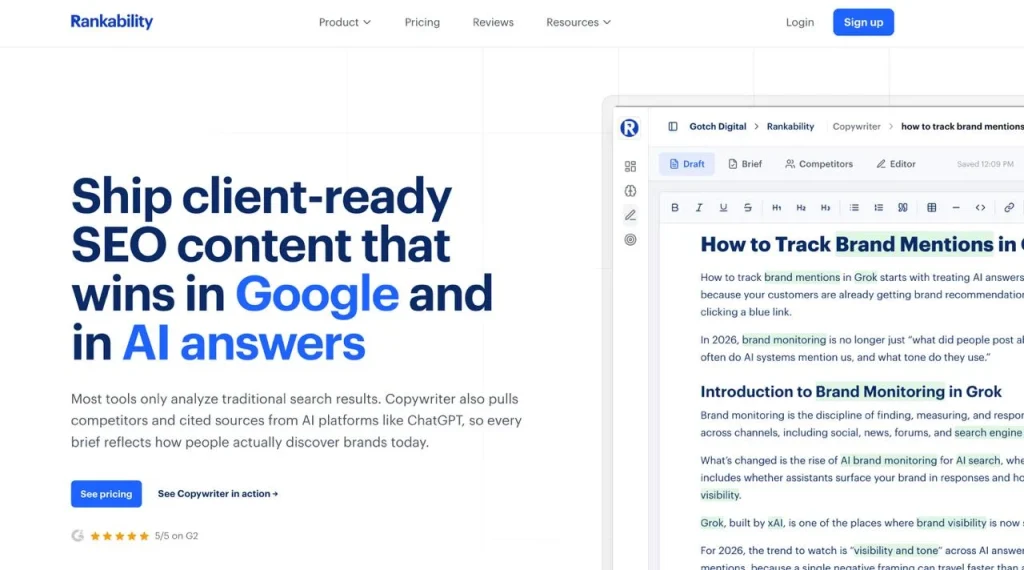
It combines IBM Watson and Google NLP to surface topic suggestions and keyword ideas, and is built from the ground up for agencies and SEO professionals who write and optimize at scale. Instead of one layer inside a broad platform, everything centers on the writing workflow: brief creation, optimization against live search results, ongoing coaching for the team members handling production, and the white-label reporting Ahrefs leaves out — with unlimited clients and users from $99/month. Rankability is featured in independent comparisons of the best SEO content optimization tools as a strong pick when you want the deepest content engine rather than a generalist suite. If you’re rethinking your whole stack, our guide to our Ahrefs review breaks down where it falls short.
Ahrefs AI Content Helper Alternatives
If you like the idea of a content score and topic analysis but don’t want to be tied to an all-in-one SEO suite — or you want a faster writer workflow, deeper briefs, better collaboration, or agency reporting — these are the strongest alternatives.
- Best overall for agencies: Rankability — content optimization for search and AI built around the agency writing-and-reporting workflow, with unlimited clients and users. See how it stacks up in our NeuronWriter vs Ahrefs vs Rankability comparison.
- Best score-as-you-write editor: Surfer SEO — a real-time content score, SERP analysis, and topical maps, now with AI-visibility tracking via Surfer AI Tracker.
- Best for editorial teams: Clearscope — a clean grading interface and high-quality term recommendations; lighter on broader SEO features.
- Best value pick: Frase — research, briefs, and an optimization editor at a lower price point, good for smaller teams.
- Best for big-site strategy: MarketMuse — topic modeling, content inventories, and authority planning across large sites.
- Best if you already use Semrush: Semrush SEO Writing Assistant — grades readability, tone, originality, and SEO inside Google Docs and WordPress.
- Best budget multilingual tool: NeuronWriter — NLP term suggestions and SERP analysis at an affordable price for solo creators and small teams.
Is AI Content Helper Worth It for Agencies in 2026?
Conditionally, yes. If Ahrefs is already your hub and your team can share seats, AI Content Helper is a logical extension that closes content gaps faster and gives writers clearer direction across client accounts. Credit where it’s due — the optimization engine is solid.
But “worth it” changes the moment content optimization becomes your core deliverable rather than a side benefit of owning Ahrefs. At that point you’re paying add-on-on-top-of-per-seat prices for one layer, while differentiation, AI visibility, and client reporting sit elsewhere. That’s the line where most content-led agencies reach for a specialist optimizer instead.
Explore the Ahrefs Cluster
If you’re evaluating Ahrefs across its products for agency use, these companion pieces go deeper:
- Ahrefs Brand Radar review — its AI brand-visibility product, reviewed for agency value.
- Best Ahrefs alternatives for agencies — the agency-framed shortlist if Ahrefs doesn’t fit.
- Ahrefs AI Content Helper alternatives — other content optimizers to compare.