

Which content management system is best for SEO, AI search, and agencies? Rankability pulled the top-ranking domains for 102 high-CPC commercial keywords and detected the platform behind each one.
Best CMS for SEO in 2026
Among the 524 domains we could fetch and classify, WordPress is the most common real CMS, powering 20.0% of top-ranking domains. The single largest group is sites with no detectable off-the-shelf CMS (28.4%)—custom builds, headless setups, and static frameworks.
WordPress share over time
| Year | Share |
|---|---|
| 2016 | 18.2% |
| 2024 | 49.9% |
| 2026 | 20.0% |
Earlier baselines used a different detection method, so cross-year movement is directional.
The top real CMSs in 2026
1. WordPress
20.0% of analyzed domains · 49.9% previously.
The most common real CMS among top-ranking domains. WordPress is highly extensible for SEO, widely supported, and gives teams full control over markup, content structure, and technical optimization. It remains the safest default for most agency clients.
2. Next.js
13.7% of analyzed domains · 2.4% previously.
Next.js is a React framework rather than a traditional CMS. It has climbed quickly among top-ranking domains because of its server-rendering flexibility and performance, and is a strong fit for performance-critical or custom builds.
3. Adobe Experience Manager
10.3% of analyzed domains · 1.3% previously.
Adobe Experience Manager is an enterprise digital-experience platform built for large organizations. Its governance, localization, and integration depth explain its presence among high-authority brands competing for commercial keywords.
4. Shopify
6.7% of analyzed domains · 0.3% previously.
Shopify is the dominant hosted commerce platform. Its strong showing reflects how many top commercial queries are e-commerce queries where Shopify storefronts rank well.
The full 2026 CMS ranking
| CMS | 2026 | Previous | Change | Domains |
|---|---|---|---|---|
| CMS Not Detected | 28.4% | 23.7% | 4.7 | 149 |
| WordPress | 20.0% | 49.9% | -29.9 | 105 |
| Next.js | 13.7% | 2.4% | 11.3 | 72 |
| Adobe Experience Manager | 10.3% | 1.3% | 9.0 | 54 |
| Shopify | 6.7% | 0.3% | 6.4 | 35 |
| Drupal | 5.7% | 2.4% | 3.3 | 30 |
| Sitecore | 4.0% | — | New | 21 |
| HubSpot CMS | 2.7% | — | New | 14 |
| Contentful | 2.1% | 0.3% | 1.8 | 11 |
| Webflow | 1.7% | 1.5% | 0.2 | 9 |
| BigCommerce | 1.1% | — | New | 6 |
| Gatsby | 0.8% | 1.1% | -0.3 | 4 |
| Squarespace | 0.6% | 0.6% | 0.0 | 3 |
| Magento | 0.6% | — | New | 3 |
| Wix | 0.4% | 1.3% | -0.9 | 2 |
| Craft CMS | 0.4% | 0.3% | 0.1 | 2 |
| Duda | 0.4% | 1.7% | -1.3 | 2 |
| Joomla | 0.2% | 0.4% | -0.2 | 1 |
| Framer | 0.2% | — | New | 1 |
107 domains could not be reached or scored and are excluded rather than guessed.
Best CMS for AI Search / AEO
The question agencies now ask is not only “which CMS ranks best in Google?” but “which CMS gives clients the best chance of being cited in AI search?” Answer Engine Optimization (AEO) and Generative Engine Optimization (GEO) reward sites that AI crawlers can read, parse, and trust. The platform matters less than the technical foundations it allows a team to control.
- Clean, crawlable HTML: Server-rendered semantic markup that AI crawlers can read without executing heavy client-side JavaScript. WordPress, Next.js with SSR or SSG, and Webflow can all do this well; SPA-heavy setups can hide content from answer engines.
- Structured data control: The ability to emit accurate Article, FAQ, Product, and Organization schema at scale helps AI engines understand entities and surface them as answers.
- Fast, stable delivery: Core Web Vitals and reliable uptime keep Google and AI crawlers indexing efficiently. Headless and framework stacks such as Next.js, Gatsby, and Astro often lead here.
- Crawler access and llms.txt: Teams need control over robots rules, sitemaps, and emerging standards such as llms.txt so they can explicitly invite or restrict AI crawlers.
The AEO takeaway: no CMS makes a site AI-visible on its own. Each platform creates a different ceiling for clean markup, structured data, and crawler access. The optimization work happens on top of that platform.
What AI-cited sites actually run on
To put data behind the AEO question, we looked at the sites AI platforms actually cite. Rankability analyzed 167,272 AI answers that included citations, collected over 90 days across nine platforms: ChatGPT, Google AI Overviews, Google AI Mode, Claude, Gemini, Perplexity, Brave AI, Grok, and Microsoft Copilot. We kept only sites with strong cross-platform visibility: cited on at least seven of the nine platforms by at least 10 different Rankability customer organizations. That produced 249 sites. After excluding social networks, app stores, map services, and Rankability itself, we detected the CMS behind the page AI cited most often on each remaining site.
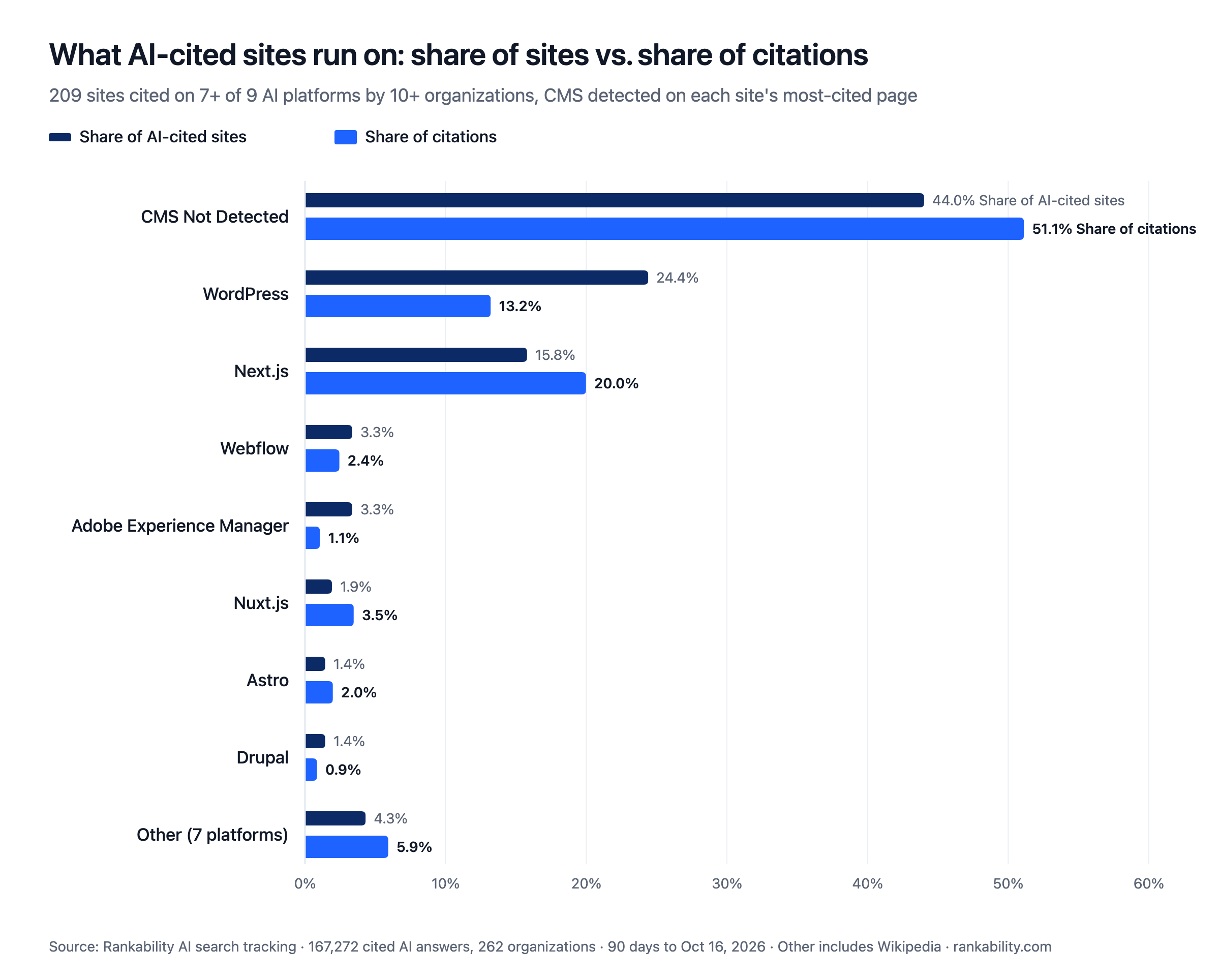
| CMS | Share of AI-cited sites | Share of citations | Sites |
|---|---|---|---|
| CMS Not Detected | 44.0% | 51.1% | 92 |
| WordPress | 24.4% | 13.2% | 51 |
| Next.js | 15.8% | 20.0% | 33 |
| Webflow | 3.3% | 2.4% | 7 |
| Adobe Experience Manager | 3.3% | 1.1% | 7 |
| Nuxt.js | 1.9% | 3.5% | 4 |
| Astro | 1.4% | 2.0% | 3 |
| Drupal | 1.4% | 0.9% | 3 |
| Contentful | 1.0% | 0.7% | 2 |
| HubSpot CMS | 1.0% | 0.4% | 2 |
| MediaWiki | 0.5% | 4.0% | 1 |
| Brightspot | 0.5% | 0.3% | 1 |
| Framer | 0.5% | 0.3% | 1 |
| Shopify | 0.5% | 0.1% | 1 |
| Wix | 0.5% | 0.1% | 1 |
Share of citations is the share of all citing answers in the sample that point to sites on that platform. 209 sites could be classified; 24 could not be reached and are excluded rather than guessed.
- Most AI-cited sites run no off-the-shelf CMS: 44.0% of AI-cited sites use custom builds or in-house stacks, including marketplaces, directories, publishers, and institutions such as Redfin, Amazon, GOV.UK, PubMed Central, and Time Out. That is well above the 28.4% among top-ranking Google domains.
- WordPress is the most common real CMS that AI cites: it powers 24.4% of AI-cited sites, close to its 20.0% share of top-ranking Google domains. The group spans agency and SEO-publisher sites as well as editorial publishers such as Healthline, NerdWallet, and This Old House.
- Next.js earns the largest share of citations: Next.js sites are 15.8% of AI-cited sites but receive 20.0% of citations, ahead of WordPress at 13.2%. Several of the most-cited directories and marketplaces in the sample, including Expertise.com, Sortlist, GoodFirms, Thumbtack, and Healthgrades, run on Next.js.
- Site type explains more than platform: AI answers lean heavily on directories, review sites, and publishers. Their platforms reflect their scale and engineering resources, which is why a CMS’s share of citations can differ sharply from its share of sites.
- Commerce platforms barely appear: Shopify accounts for 0.5% of AI-cited sites, likely because the tracked prompts lean toward services rather than shopping. It does not mean Shopify sites cannot be cited.
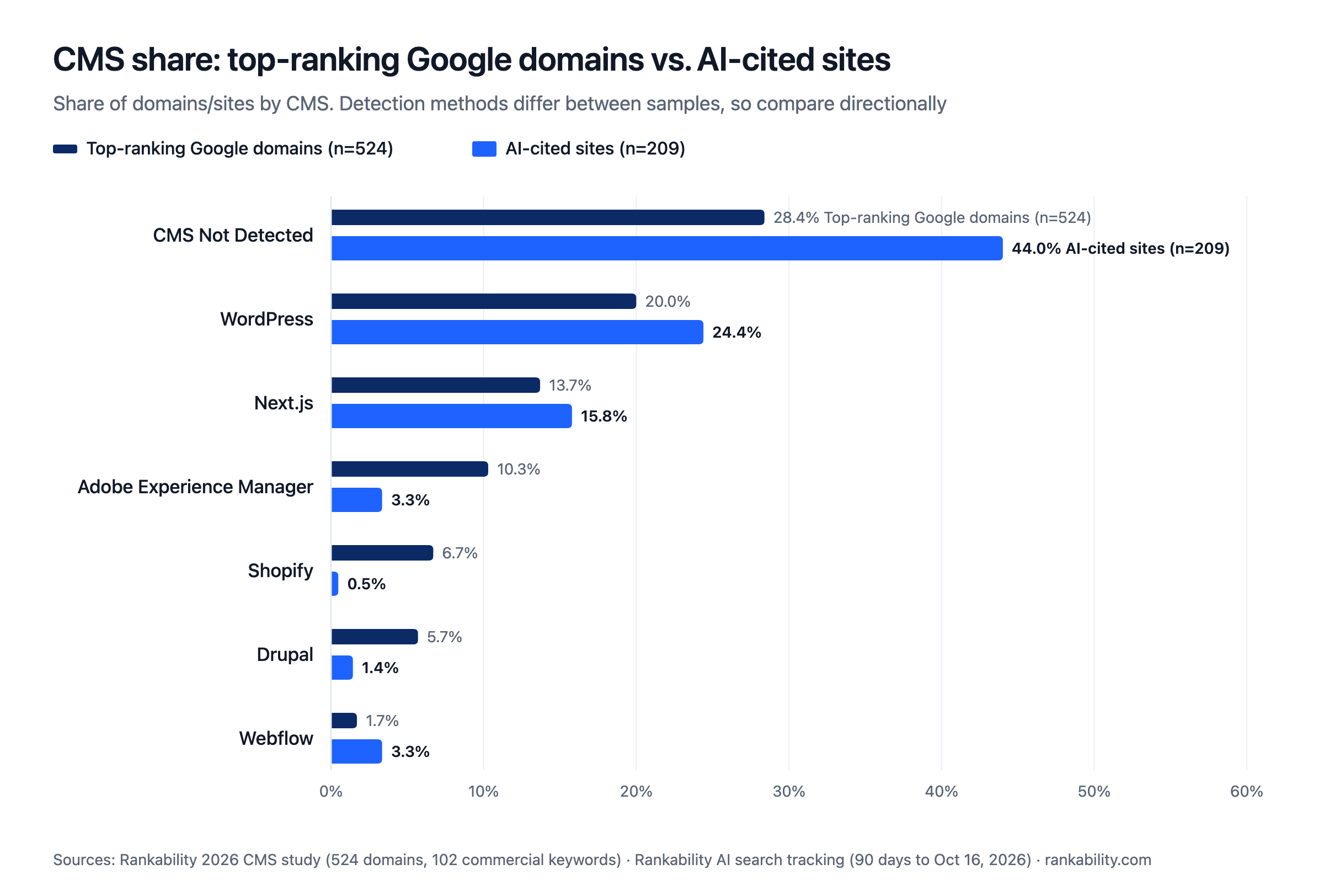
The citation data supports the AEO takeaway above. AI-cited sites run on every kind of platform, including no off-the-shelf CMS at all. Choose the CMS that gives your team control over clean HTML, structured data, and crawler access, then do the AEO work on top of it.
Best CMS for agencies
For an agency, “best CMS” is a different calculation than it is for a single brand. Agencies manage a portfolio of sites across many platforms, constraints, budgets, and in-house teams. The right CMS fits the client and lets the agency work efficiently across the book of business.
- WordPress — the safe default for most clients: Its deep SEO plugin ecosystem, easy handoff to nontechnical teams, and broad developer availability make it the lowest-risk choice for most small and midmarket sites.
- Next.js and headless — for performance-critical or custom builds: These stacks provide maximum performance, bespoke design systems, and headless content backends, at the cost of more developer involvement and a higher maintenance bar.
- Shopify — for commerce-led clients: Its meaningful and growing presence among top commercial results makes it the default for clients whose SEO goals center on an online store.
- Enterprise CMSs — for large clients: Adobe Experience Manager and Sitecore provide governance, localization, and integration depth for organizations with complex requirements and dedicated teams.
The constant across every platform is that the CMS sets the technical ceiling, while rankings and AI visibility come from the SEO and AEO work layered on top. Agencies win by remaining platform-agnostic.
How we conducted the study
Reproducible, version-locked CMS detection
Rankability runs its own CMS detector rather than relying on a third-party study. For the 2026 run, it pulled the top-ranking organic domains for 102 high-CPC commercial keywords, producing 631 unique domains. It fetched each live page and scored a version-locked set of fingerprint signals: HTML markup patterns, meta generator tags, response headers, cookies, and asset paths.
A domain only counts toward a CMS when the evidence clears a confidence threshold; otherwise it is recorded as CMS Not Detected. A commercial CMS API, WhatCMS, is used only to validate the detector and as a fallback for a small residual group of hard cases, never as the primary source.
Of the 631 domains, 107 could not be fetched or scored and were excluded rather than guessed. That left 524 analyzed domains as the denominator.
The detector achieved 96.7% accuracy on a hand-labeled sample of 30 domains whose platforms are publicly known. The study is version-locked with detector ruleset v2026.2 and keyword set v2026.1. Annual runs are stored as immutable snapshots, and no run is published until a human reviews and approves it.
The 2024 and 2016 baselines
The earlier points used the commercial WhatCMS API across top-ranking commercial domains in 2024 and a large Ahrefs keyword sample in 2016. They remain in the trend table, but because the methodology changed when Rankability moved to its own version-locked detector, cross-year comparisons should be treated as directional rather than exact.
The AI citation sample
The AEO data comes from Rankability’s AI search tracking rather than from the keyword study above. We used answers from the 90 days through October 16, 2026 that included at least one citation, across ChatGPT, Google AI Overviews, Google AI Mode, Claude, Gemini, Perplexity, Brave AI, Grok, and Microsoft Copilot. A site qualified when it was cited on at least seven of those nine platforms by at least 10 different customer organizations, so no single customer’s prompts could carry a site into the sample. Sites are counted by hostname, with subdomains kept separate.
For each qualifying site, we checked the page AI cited most often rather than only the homepage, because deep pages often run on a different stack. The page’s CMS came from the WhatCMS API, supplemented by a check for well-known platform asset paths, such as /wp-content/ or /_next/, when WhatCMS found nothing. When neither check could load the cited page, we used the homepage result; 24 sites were unreachable either way and are excluded. Because this method differs from the detector used in the keyword study, comparisons between the two samples are directional.
Limitations
- The study covers 524 analyzed domains from 102 commercial keywords; another keyword set would shift the percentages.
- Keyword selection: concentrating on one industry would change the CMS mix. An e-commerce sample would likely contain more Shopify and other commerce platforms.
- Detection uncertainty: 107 unreachable or unscorable domains were excluded, and fingerprint-based classification can miss bespoke or heavily modified installations.
- CMS choice is not itself a ranking factor: the data does not mean that simply selecting WordPress, Next.js, or another platform improves rankings. The platform is the car; the SEO and AEO work is the driver.
- AI citation sample: the AEO data reflects prompts Rankability customers chose to track, which lean toward agencies, legal, local, and home services, so it does not represent all AI search. It shows which platforms AI-cited sites use, not that a platform causes citations.
The bottom line
WordPress remains the most common real CMS among top-ranking domains, while frameworks such as Next.js are climbing and a growing portion of the top of Google uses no detectable off-the-shelf CMS. The CMS sets the ceiling; it does not perform the optimization.
AI search tells a similar story. WordPress is the most common real CMS among sites AI platforms cite, Next.js directories and marketplaces capture the largest share of citations, and the largest group, 44.0% of AI-cited sites, runs no detectable off-the-shelf CMS.
For agencies, the opportunity is to become the platform-agnostic team that can optimize search and AI-answer visibility on any client CMS.
Use Rankability as the SEO and AEO layer on any CMS
Rankability is not a CMS. It is the optimization layer agencies can run across WordPress, Next.js, Webflow, Shopify, and headless stacks:
- Integrations push optimized content into the tools clients already use.
- MCP connects Rankability to AI assistants and agentic workflows.
- The API supports optimization and reporting automation across a portfolio.
Get started with Rankability or learn more about GEO and AEO.