

If you run SEO for a business or an agency, 2026 changed more than your rankings. It changed where people get answers, which tools do the work, and how many people it takes to deliver a campaign.
Google now reports more than a billion monthly AI Mode users. Publishers are disclosing steep drops in Google referrals. And ChatGPT built an ad business with more than 100,000 advertisers by October 2026.
Below are my seven predictions for 2027, each backed by data, so you can see where search is heading and decide where to invest before your competitors do. Start with the list, then dig into the predictions that matter most to you.
The 7 AI SEO predictions for 2027
- Google AI Mode will become the default search experience
- Answer Engine Optimization (AEO) will become mainstream terminology
- Traditional SEO will remain essential, but its role will evolve
- ChatGPT will reveal more query intelligence to advertisers
- Advanced SEO work will increasingly happen inside AI agent harnesses
- More businesses will build internal AI SEO capabilities
- AI will enable significantly smaller agency execution teams
1. Google AI Mode will become the default search experience
The prediction
Google will keep moving toward an AI-native search experience, where conversational answers, follow-up questions, and agentic tasks sit at the center of the interface instead of in a separate tab.
To understand why, start with the money.
Google’s traditional search business is still enormously profitable
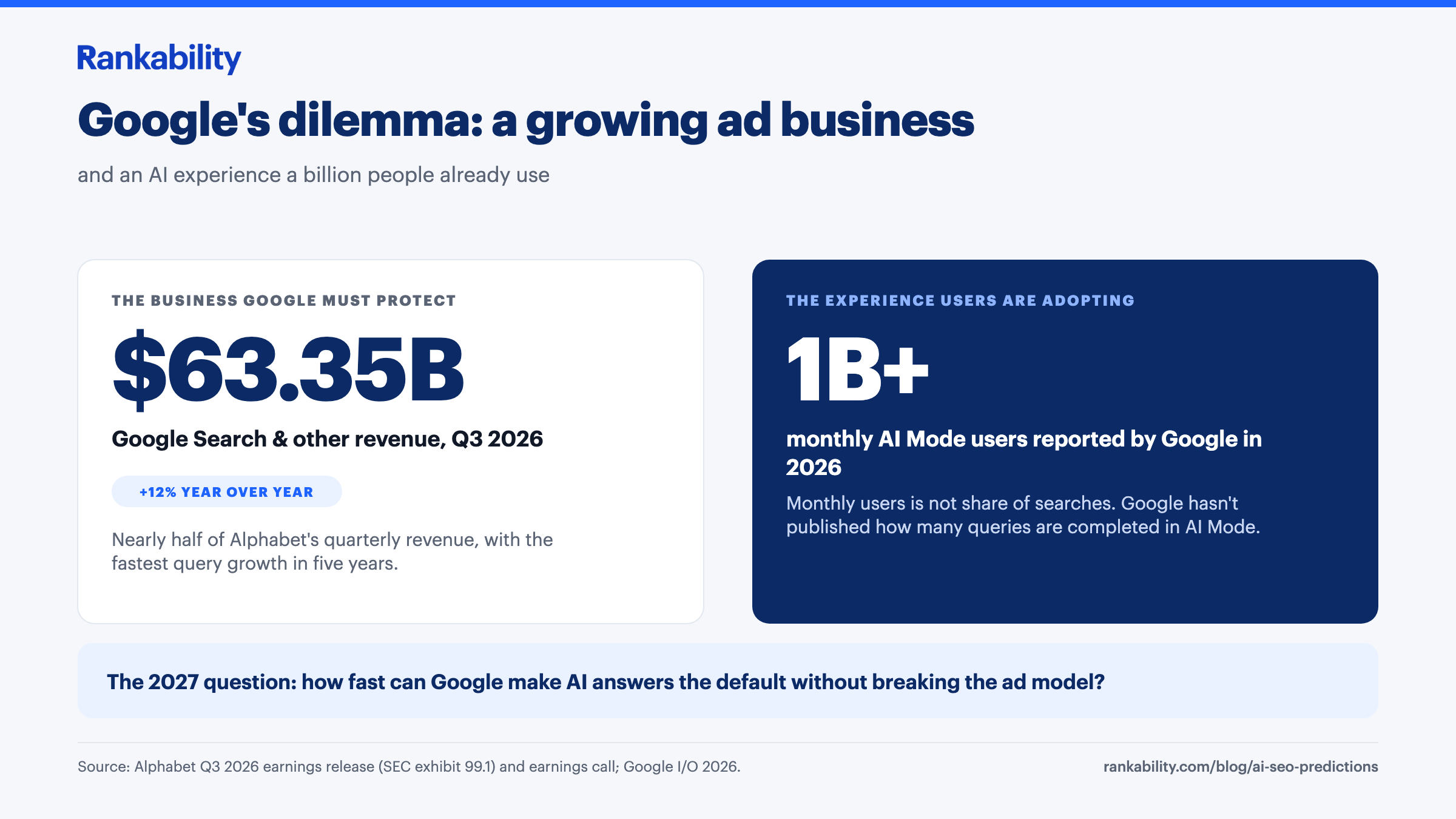
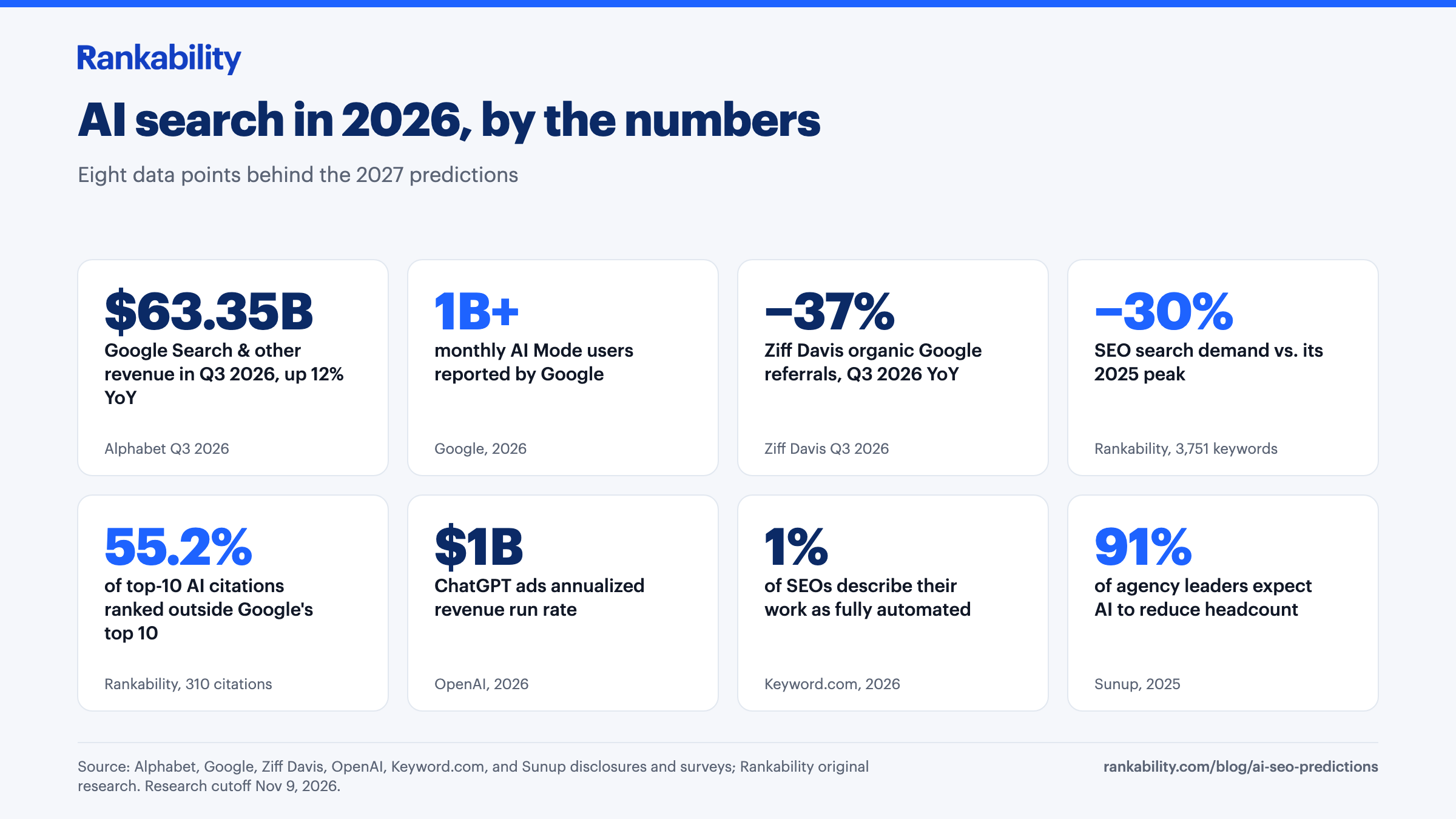
Alphabet’s Q3 2026 earnings release shows Google Search & other generated $63.35 billion in the quarter, up 12% year over year. That’s close to half of Alphabet’s total quarterly revenue.
On the Q3 earnings call, Google also said search queries grew at their fastest year-over-year rate in five years.
That’s the tension. Google has every reason to evolve Search before someone else does it for them. It also has every reason not to break a business that produces tens of billions of dollars a quarter.
Google still has to solve AI search monetization
A classic results page is an efficient ad unit: commercial query, ads, click. Conversational search is messier. One session can contain several follow-ups, and the best answer may need no click at all.
Google has been candid on its earnings calls that monetization in AI experiences is still developing.
The pieces it’s building suggest how it plans to close the gap: ads inside AI answers, sponsored product listings in shopping conversations, and ad formats that carry across multiple turns of a conversation.
Watch the tradeoff here. Every ad placement that makes AI Mode more profitable also risks making the answer less useful. How Google balances those two goals will shape what the “default” experience looks like.
AI search adoption is accelerating
Google reported more than one billion monthly AI Mode users in 2026 (Sundar Pichai, I/O 2026). AI Overviews reach an even larger audience, and Google has been adding conversational follow-ups directly into the main results page.
One caution. Monthly users is not the same as share of searches.
A person who tries AI Mode once a month counts as a monthly user. Google hasn’t published what percentage of total queries are completed inside AI Mode, so be careful with anyone who treats the user number as a measure of search share.
Publishers are already feeling the effects
The clearest signal comes from companies that report traffic to investors:
- Reddit disclosed substantial declines in Google search referrals in its Q3 2026 shareholder materials.
- Ziff Davis reported a 37% year-over-year decline in organic Google referrals in Q3 2026 (earnings call transcript).
- People Inc. described major long-term Google traffic losses on its Q3 2026 call.
Here’s the qualification that matters: these declines can’t all be pinned on AI Mode. AI Overviews, zero-click results, ranking changes, and shifts in how people use social platforms all contribute. Similarweb’s zero-click research is a useful companion read on that broader pattern.
The practical lesson is the gap between being cited and getting the visit. A brand can appear in an AI answer, even as a linked source, and still receive less traffic than it would have from a traditional blue link. Track both.
Why I believe AI Mode will become the default
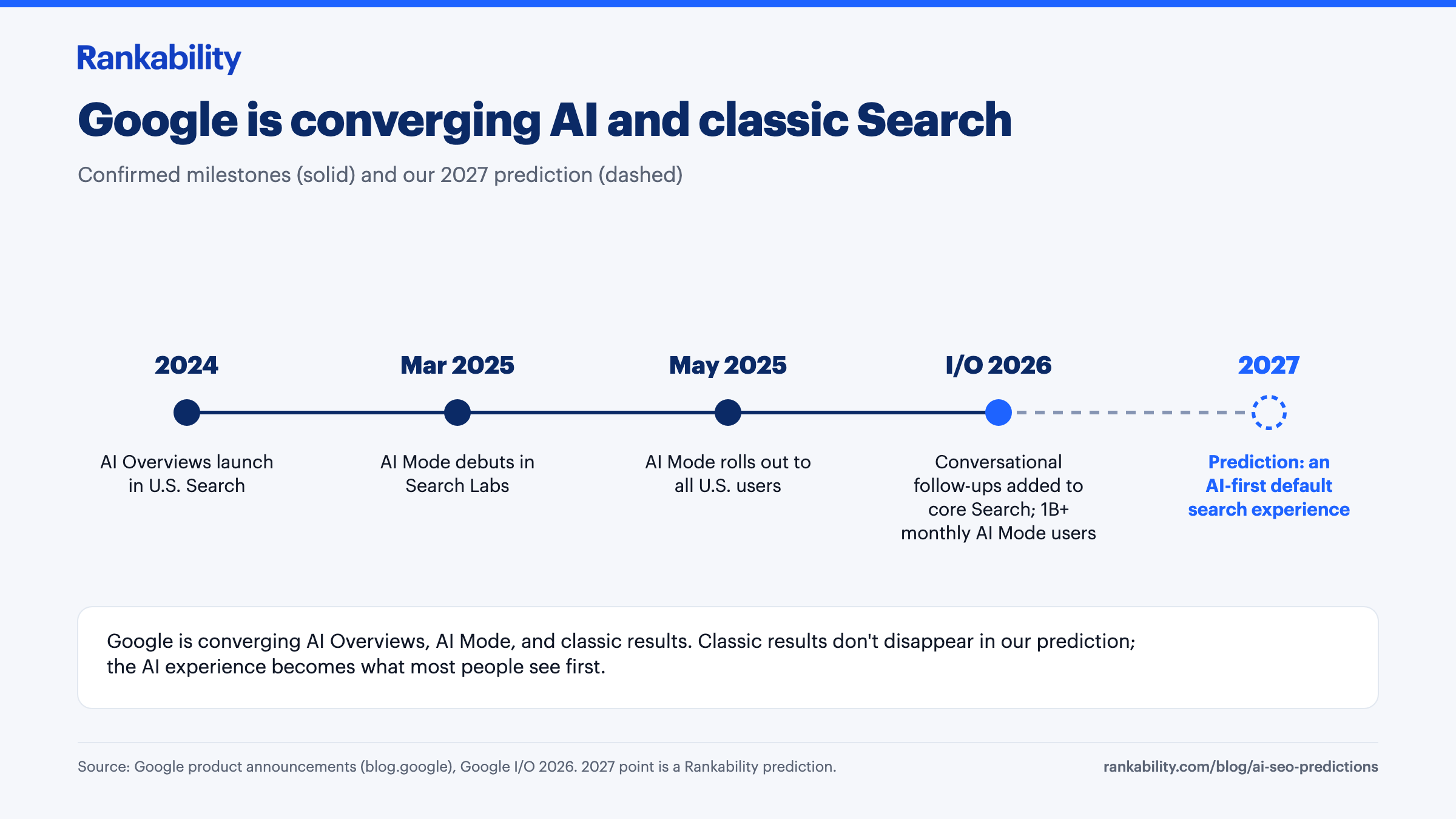
Google has already started blending AI Overviews, AI Mode, and the classic results page, and follow-up questions now live inside regular Search. The logical next step is one unified, AI-first interface, with conventional results still available underneath.
The counterargument: Traditional Search keeps growing financially, plenty of people still prefer scanning links, and Google may move slowly to protect revenue. That’s fair.
My prediction isn’t that classic results disappear. It’s that the AI experience becomes what most people see first.
What it means for 2027: Optimize for appearing in the answer, not just for the click. Rankings and clicks remain useful diagnostics. Mentions, citations, and the business outcomes behind them become just as important.
2. Answer Engine Optimization (AEO) will become mainstream
The prediction
"AEO" will be used far more widely by businesses, software vendors, marketers, and agencies in 2027. It could become the preferred term for optimizing visibility in AI-generated answers.
That doesn’t mean SEO or GEO goes away. It means AEO gets a seat at the budget table under its own name.
Search demand for AEO and GEO is growing
In our original AI search statistics study, we tracked a fixed panel of 3,751 AI and search-related keywords across 48 months of Google Keyword Planner data (June 2022 to May 2026). Three findings matter here:
- SEO-related search demand fell 30% from its 2025 peak within the panel. It was the first sustained decline in four years, not a seasonal dip.
- AEO and GEO both started from almost nothing in 2023, grew quickly through 2024 and 2025, and leveled off in early 2026.
- GEO drew roughly 2.2 times as much search demand as AEO over the measured period.
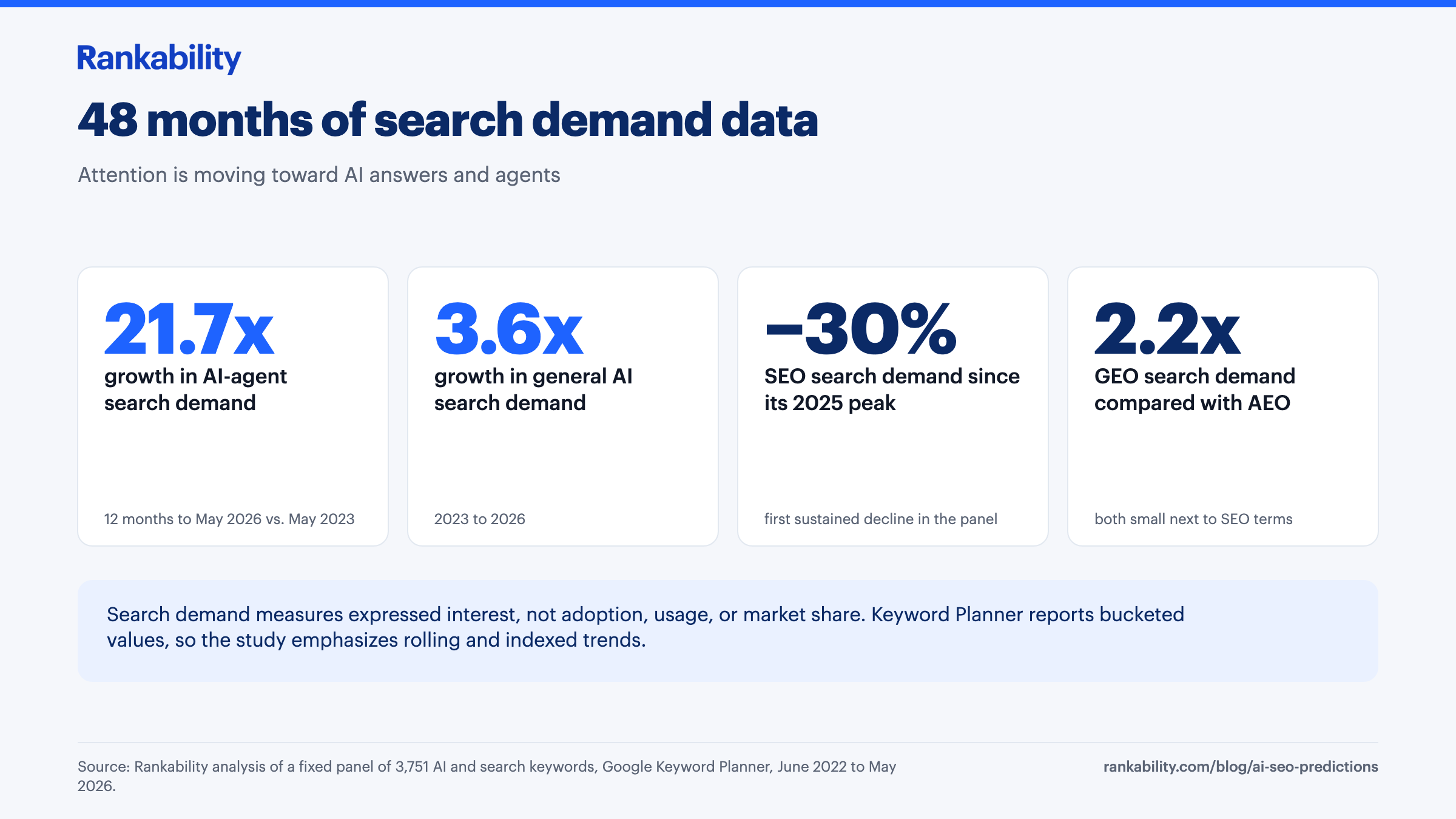
Two caveats. Keyword Planner reports bucketed values, so we focused on rolling and indexed trends.
And search demand measures expressed interest, not adoption or market share. Both AEO and GEO are still small next to established SEO terminology.
Exploding Topics shows the same pattern from a different dataset: searches for “answer engine optimization” were near zero until early 2025, then climbed to about 8,100 a month by August 2026.
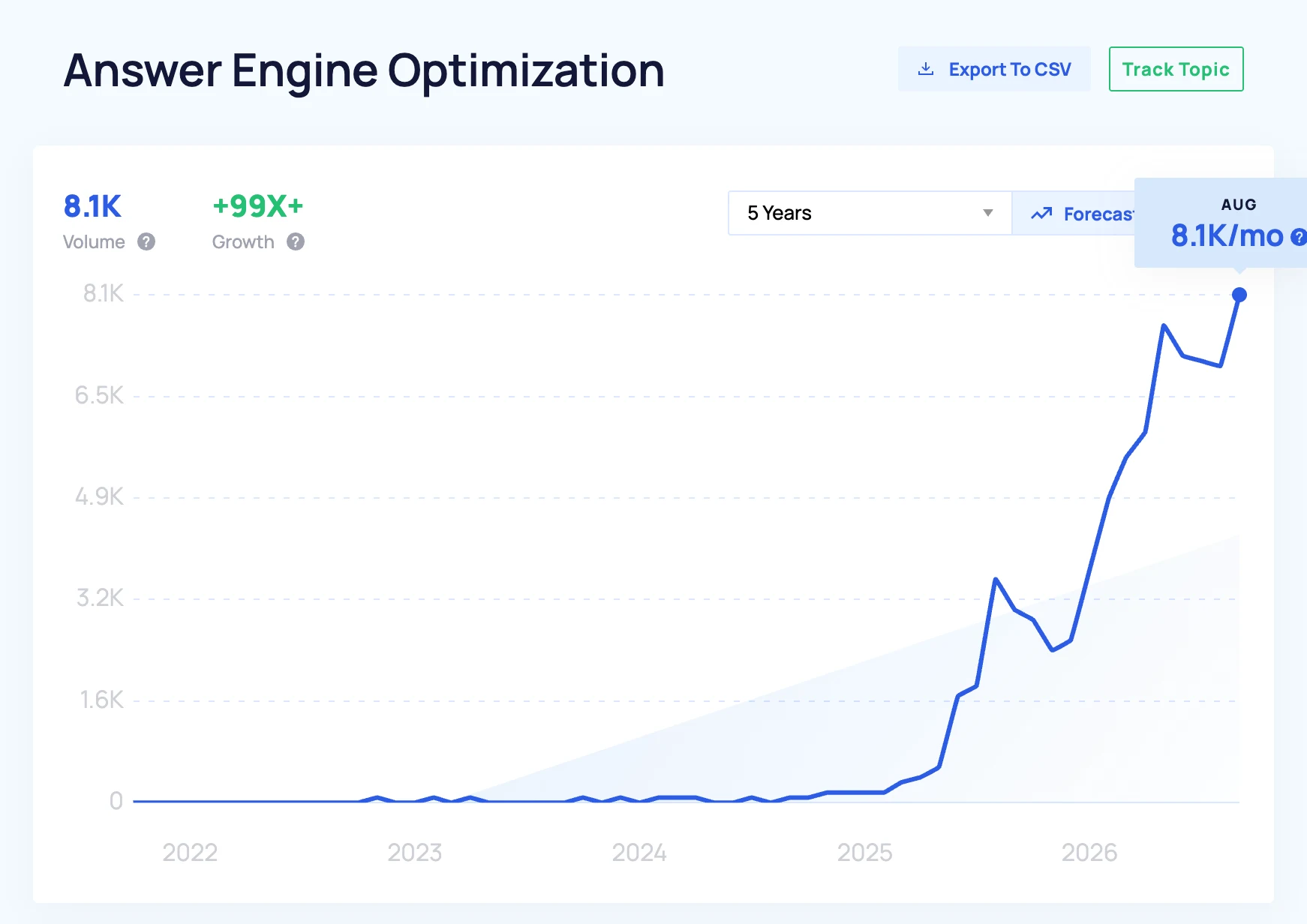
Image Credit: Exploding Topics
We’re seeing AEO demand directly in Google Search Console
Our own Search Console data tells a similar story. Over the 12 months before publication, Rankability’s pages earned more than 700,000 impressions on AEO-related queries.
To be clear about what that number is: GSC impressions count how often our pages appeared in Google results for those queries. It isn’t total market demand.
But it does show that people are searching AEO terms at a meaningful scale and that Google is matching those searches to AEO content.
Major software companies are adopting AEO terminology
Terminology goes mainstream when large companies put it in product names:
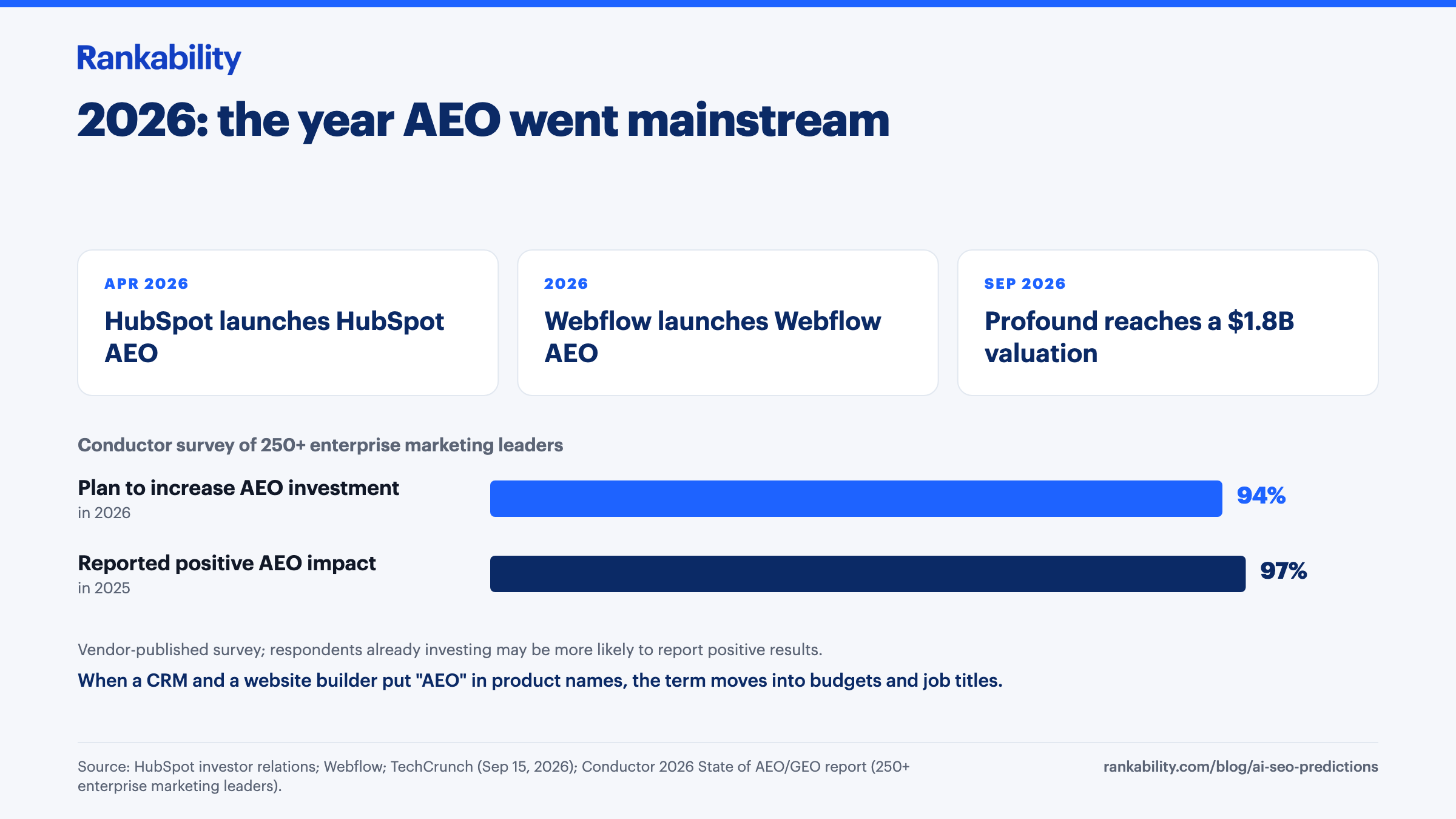
- HubSpot launched HubSpot AEO in April 2026.
- Webflow launched Webflow AEO.
- Profound, which positions itself in the AEO category, reached a $1.8 billion valuation in 2026.
When a CRM and a website builder used by millions of marketers both say “AEO,” the term stops being an insider debate.
Enterprise businesses are increasing AEO investment
Conductor’s 2026 State of AEO/GEO report surveyed more than 250 enterprise marketing leaders:
- 94% planned to increase AEO investment in 2026.
- 97% reported a positive impact from AEO in 2025.
Keep the source in mind. Conductor sells into this category, and survey respondents who already invest are more likely to report positive results.
Still, the direction is clear. Budgets are forming around the term.
AEO isn’t simply a new name for SEO
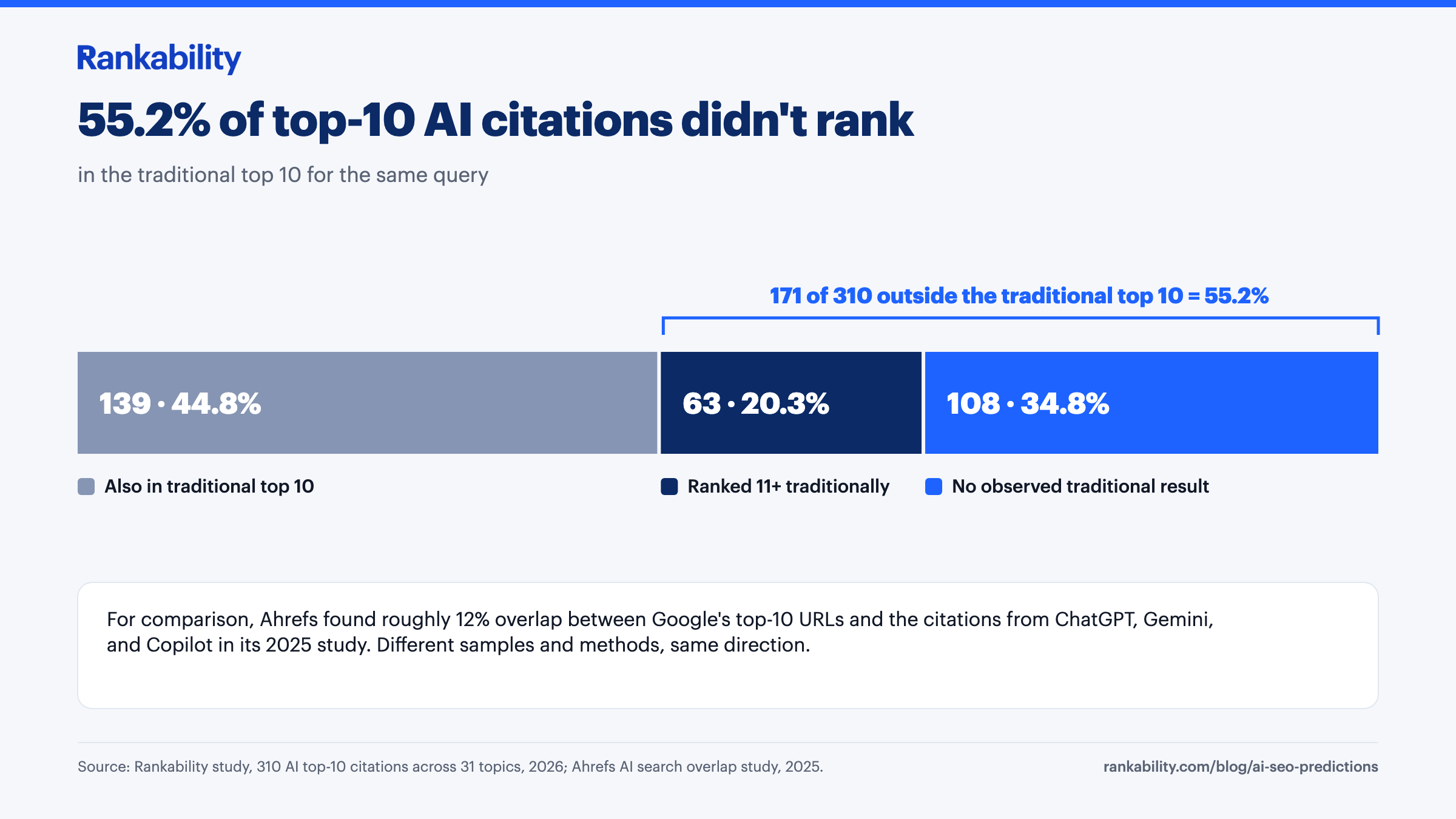
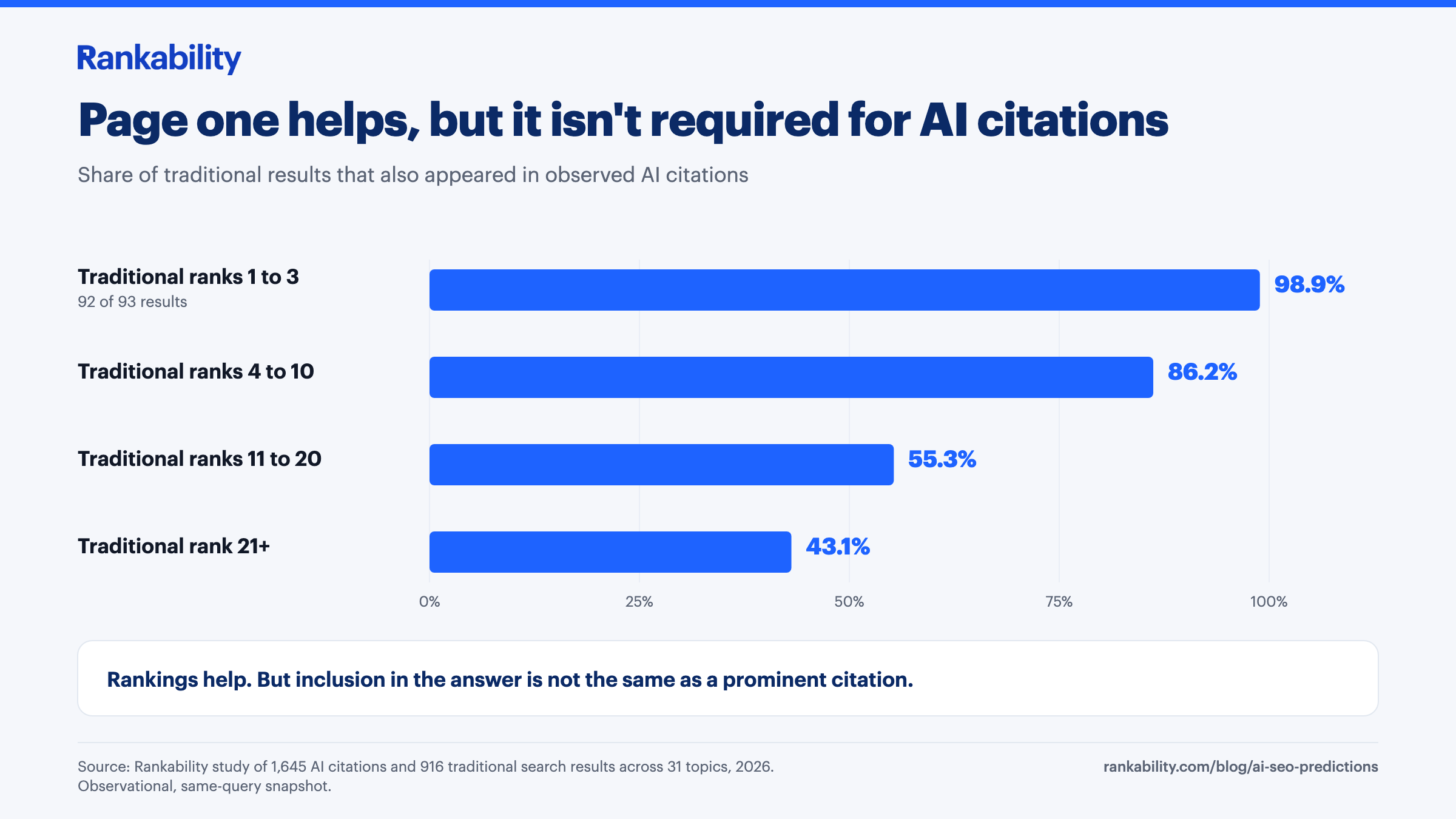
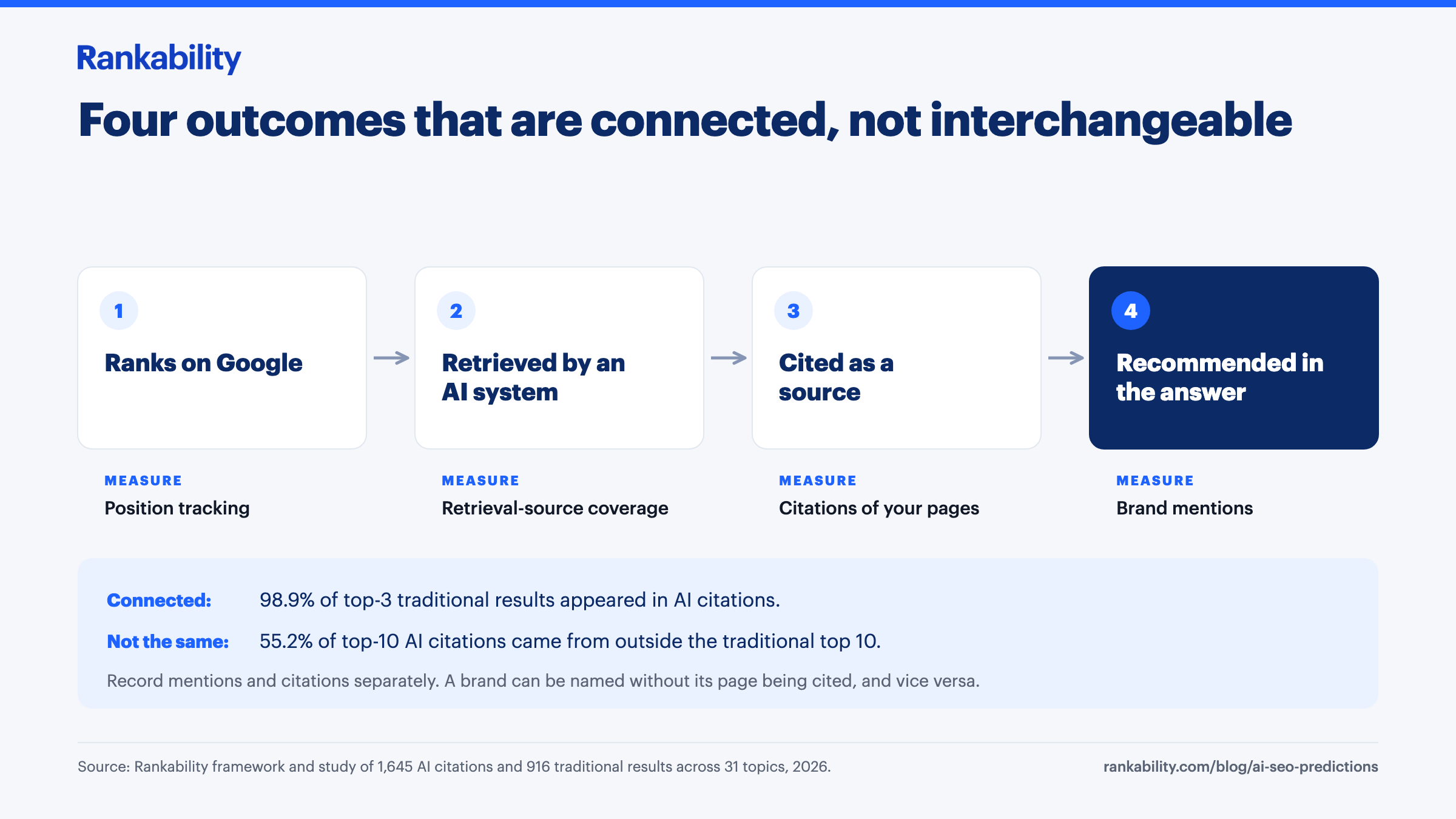
This is where the data gets interesting. In our citation study of 1,645 AI citations and 916 traditional search results, 55.2% of the top-10 AI citations we observed did not rank in the traditional top 10 for the same query (171 of 310).
Traditional rankings still mattered. Pages in positions 1 to 3 were included in AI citations 98.9% of the time (92 of 93).
But inclusion didn’t guarantee a prominent spot in the answer. A top organic ranking and a top AI citation are related outcomes, not the same outcome.
That’s why a separate discipline makes sense: the work overlaps, but the measurement doesn’t.
The counterargument: “SEO” is still the dominant term by a wide margin, and GEO currently has more search demand than AEO.
Google’s own guidance on AI features says SEO fundamentals still apply, and Search Engine Land has reported that many marketers simply call this work SEO.
Why I believe AEO will gain wider adoption
Businesses need a recognizable name for how they appear in AI answers, and “answer engine” describes what a CMO actually sees. As HubSpot, Webflow, and the agencies serving their customers use the term, it standardizes.
What it means for 2027: Expect AEO as its own budget category, service offering, job responsibility, and software category. If you sell SEO services, decide now how you’ll name, scope, and report this work.
3. Classic SEO will still matter, but the strategy will evolve
The prediction
Traditional search visibility will remain a foundation for AI search optimization. But winning will increasingly require coverage across many results and many independently controlled sources, not just one well-ranked page.
AI platforms still depend on search and retrieval systems
When an AI assistant answers a question that needs current information, it usually retrieves sources first and then writes the answer. Which sources it can retrieve depends on the search systems behind it, and those systems differ by platform:
- ChatGPT uses multiple search and retrieval providers. In September 2026, Peec AI’s research identified what appears to be OpenAI’s own in-house retrieval infrastructure, which it called Labrador. Search Engine Land’s breakdown covers how that stack indexes and caches pages.
- Microsoft offers Web IQ for AI grounding, and retrieval for AI can differ from what you see in consumer Bing results.
- Claude’s retrieval frequently aligns with Brave Search, according to Josh Blyskal’s State of AEO 2026 research.
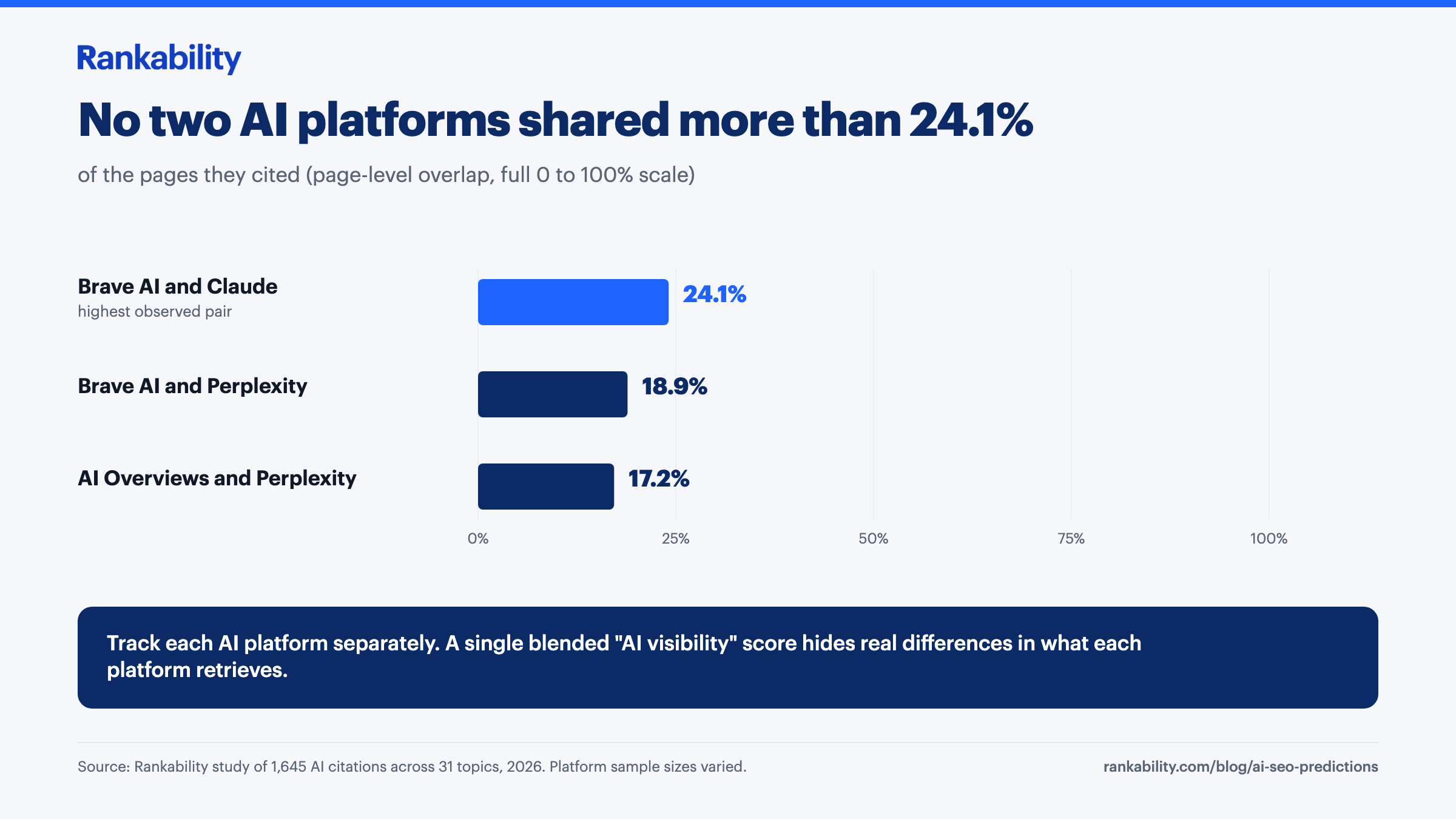
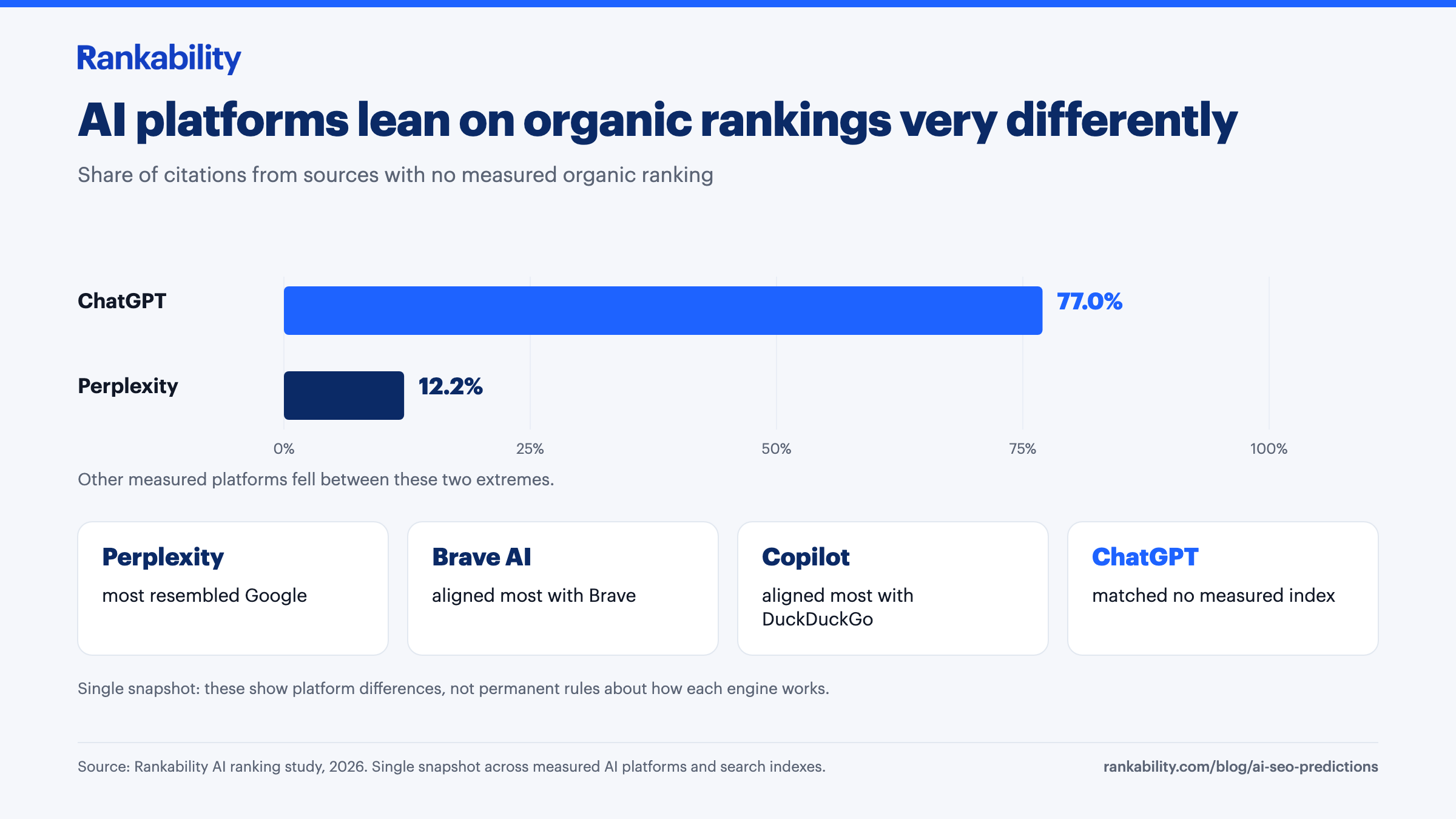
Our own data points the same way. Brave AI and Claude had the highest page overlap of any platform pair we measured, and even that was only 24.1%. Sources without a measured organic ranking accounted for 12.2% of Perplexity citations but 77.0% of ChatGPT citations.
These are outside observations of private systems, not confirmed architecture. But the pattern is consistent: there isn’t one index that feeds every AI answer.
Traditional rankings don’t guarantee AI citations
Ahrefs found roughly 12% overlap between Google’s top-10 URLs and the citations from ChatGPT, Gemini, and Copilot in its 2025 AI search overlap study.
Our study found the same kind of gap between ranking positions and prominent AI citations, plus substantial differences in which sources each AI platform cited.
So treat ranking on Google, being retrieved by an AI system, being cited as a source, and being recommended in the answer as four connected but different outcomes. Measure them separately.
Your website remains your primary owned asset
None of this makes your website less important. Keep investing in crawlability and indexation, technical SEO and site architecture, topical depth, internal linking and evidence, and clear brand and product information so any system summarizing you gets the facts right.
Classic SEO is what makes you discoverable in the first place, even when the final destination is an AI answer.
The new objective: maximum relevant search coverage
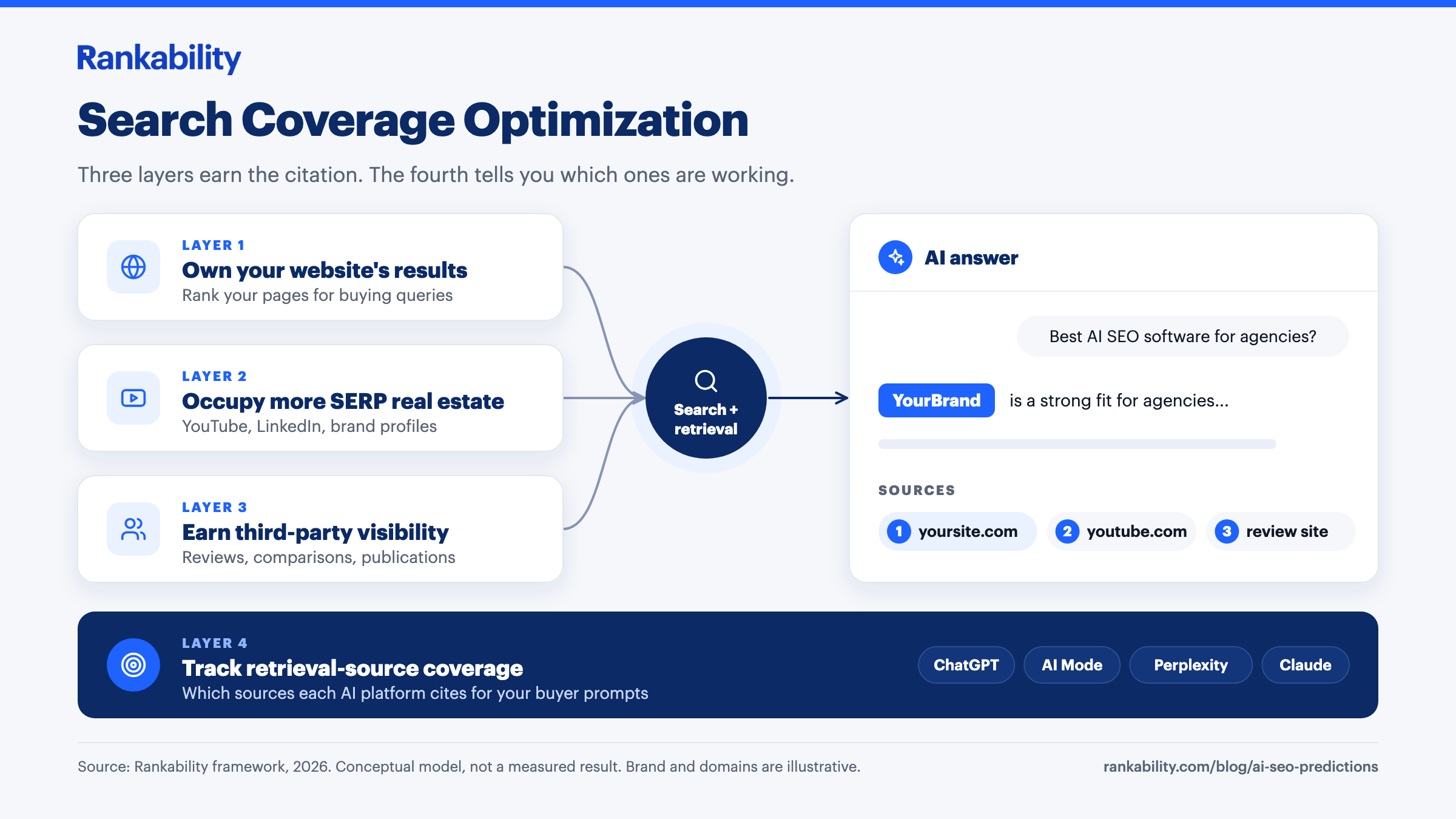
Here’s the framework we use to think about it. Call it Search Coverage Optimization: four layers, from what you fully control to what you can only measure.
Layer 1: Own your website’s results. Rank your most relevant pages for important topics and commercial queries. This is classic SEO, and it’s still the first move.
Layer 2: Occupy additional SERP real estate. Create and optimize assets you control on other platforms: YouTube videos, LinkedIn content, and other public brand properties.
Search Engine Land reported that YouTube description updates affected AI retrievals in one study, and Wix’s research shows which content types LLMs cite most.
Layer 3: Earn visibility on third-party pages. Pursue legitimate inclusion in relevant reviews, comparison articles, industry publications, and other sources you don’t control. When an AI answers “best X for Y,” it often leans on these pages.
Layer 4: Understand retrieval-source coverage. Track which websites and search providers show up in AI citations for your prompts on each platform. That tells you where Layers 1 to 3 are working and where the gaps are.
Brand mentions are part of AI search visibility
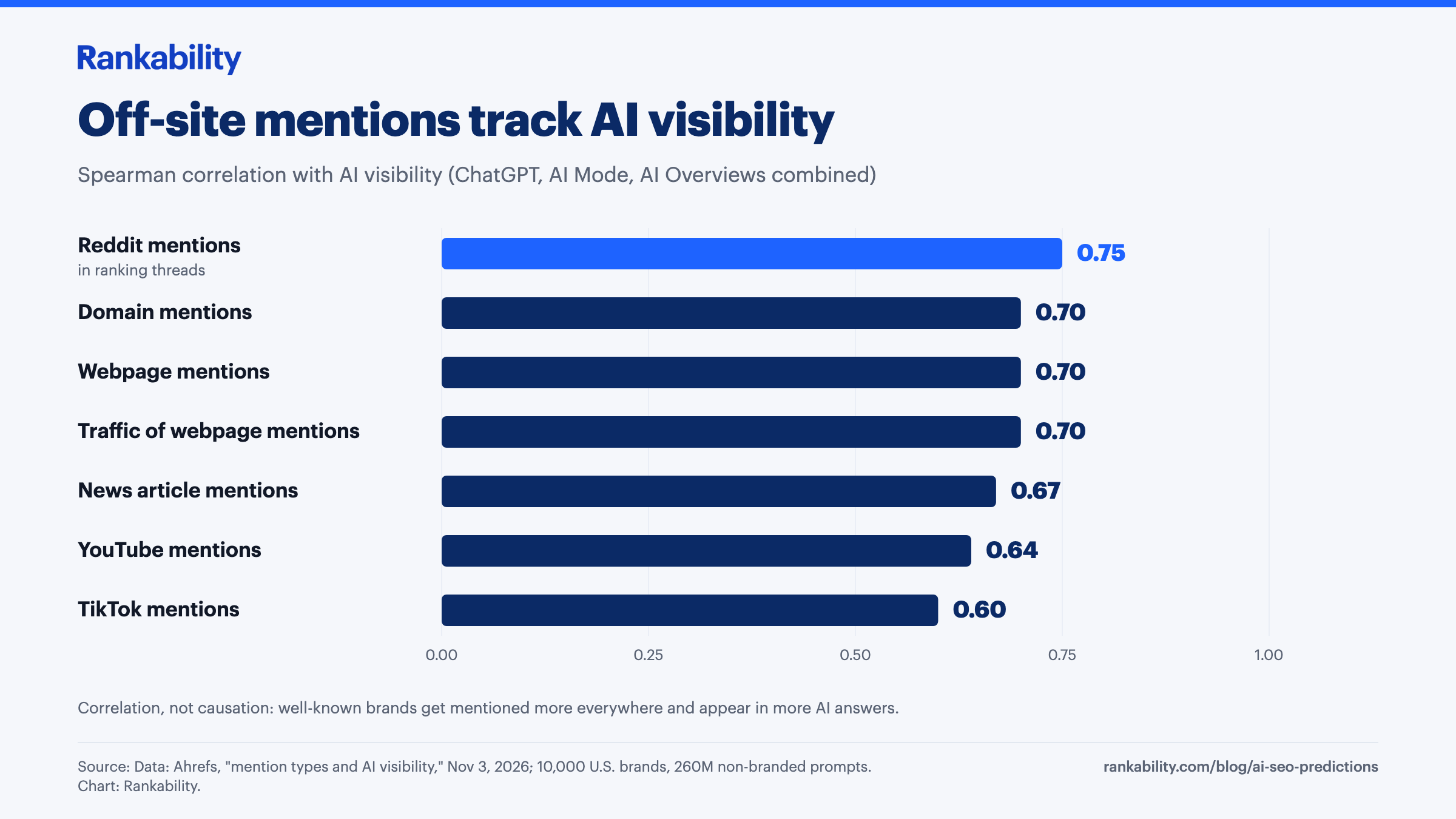
Ahrefs analyzed 10,000 brands across 260 million AI prompts (study) and found:
- Reddit mentions had a 0.75 correlation with AI visibility.
- Webpage mentions had a 0.70 correlation.
- News and YouTube mentions also correlated positively.
Correlation isn’t causation. Big, well-known brands get mentioned more everywhere and also appear in more AI answers. But the finding supports Layers 2 and 3: AI visibility is built partly off your own site.
Why classic SEO will remain essential in 2027
Traditional search is still a major discovery and retrieval layer. The goal is expanding from “rank my page” to “build credible coverage across the sources AI systems retrieve.”
What it means for 2027: SEO teams will combine technical SEO, content, earned media, brand building, and AI citation analysis into one plan. Start by checking which sources each AI platform cites for your most important buyer prompts.
That shows you which layer needs work first.
In Rankability, Tracker does this across Google and the AI platforms it monitors: you see where your brand is mentioned, which pages are cited, and which competitor and third-party sources appear instead.
4. ChatGPT will reveal more query intelligence to advertisers
The prediction
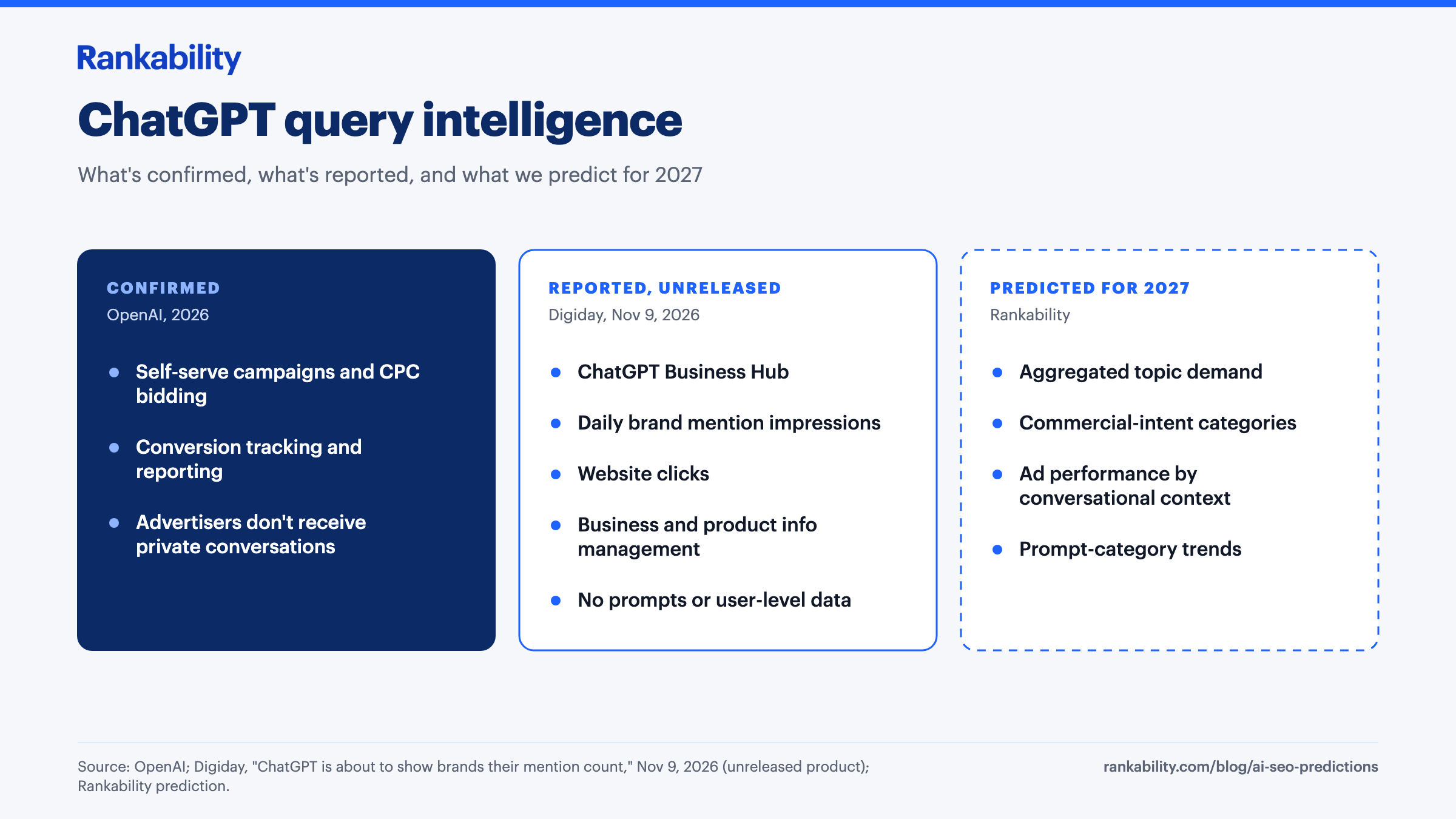
OpenAI will expand the aggregated commercial-intent and performance data available to advertisers and businesses.
Let me be precise about what I’m not predicting. I don’t expect individual user conversations to become available to advertisers. OpenAI has said explicitly that advertisers don’t receive private conversations.
ChatGPT advertising has become a significant business
OpenAI reported a $1 billion annualized advertising revenue run rate in 2026, and more than 100,000 advertisers had run campaigns by October 2026 (OpenAI).
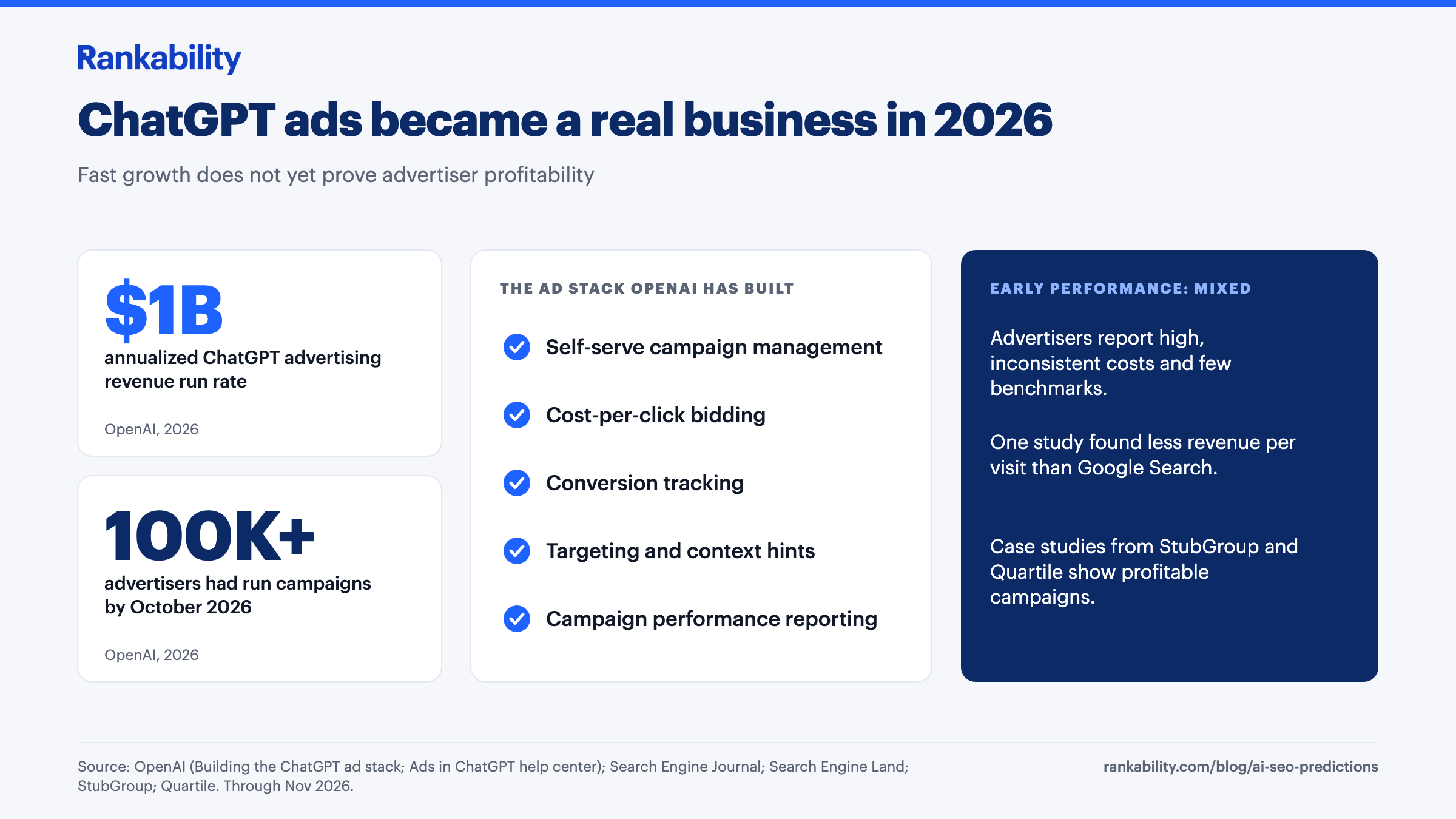
That’s fast growth for a new ad platform. It doesn’t prove advertisers are profitable on it. Early platforms often attract experimental budget before performance is proven.
Early ChatGPT advertising performance has been mixed
The early evidence cuts both ways:
- Advertisers have reported high and inconsistent costs, and Search Engine Journal found that six months in, many still don’t know what good performance looks like.
- One analysis reported by Search Engine Land found ChatGPT ads generated less revenue per visit than Google Search, and Ecommerce Research found weaker conversion performance in certain ecommerce samples.
- On the other side, case studies from StubGroup and Quartile with AFA Stores describe campaigns that worked.
The takeaway: to keep ad revenue growing, OpenAI has to help advertisers find the right audiences, target more precisely, and measure outcomes they trust. That requires giving advertisers more data.
OpenAI is already expanding advertiser capabilities
OpenAI has expanded access to ChatGPT ads and documented self-serve campaign management, cost-per-click bidding, conversion tracking, targeting and context hints, and performance reporting. Each of those features creates pressure for the next one.
Once advertisers can bid per click, they want to know which conversational contexts produce the clicks.
Evidence suggests a ChatGPT business analytics product is coming
On November 9, 2026, Digiday reported on an unreleased ChatGPT Business Hub with business profile verification, daily brand mention impressions, website clicks, and product information management.
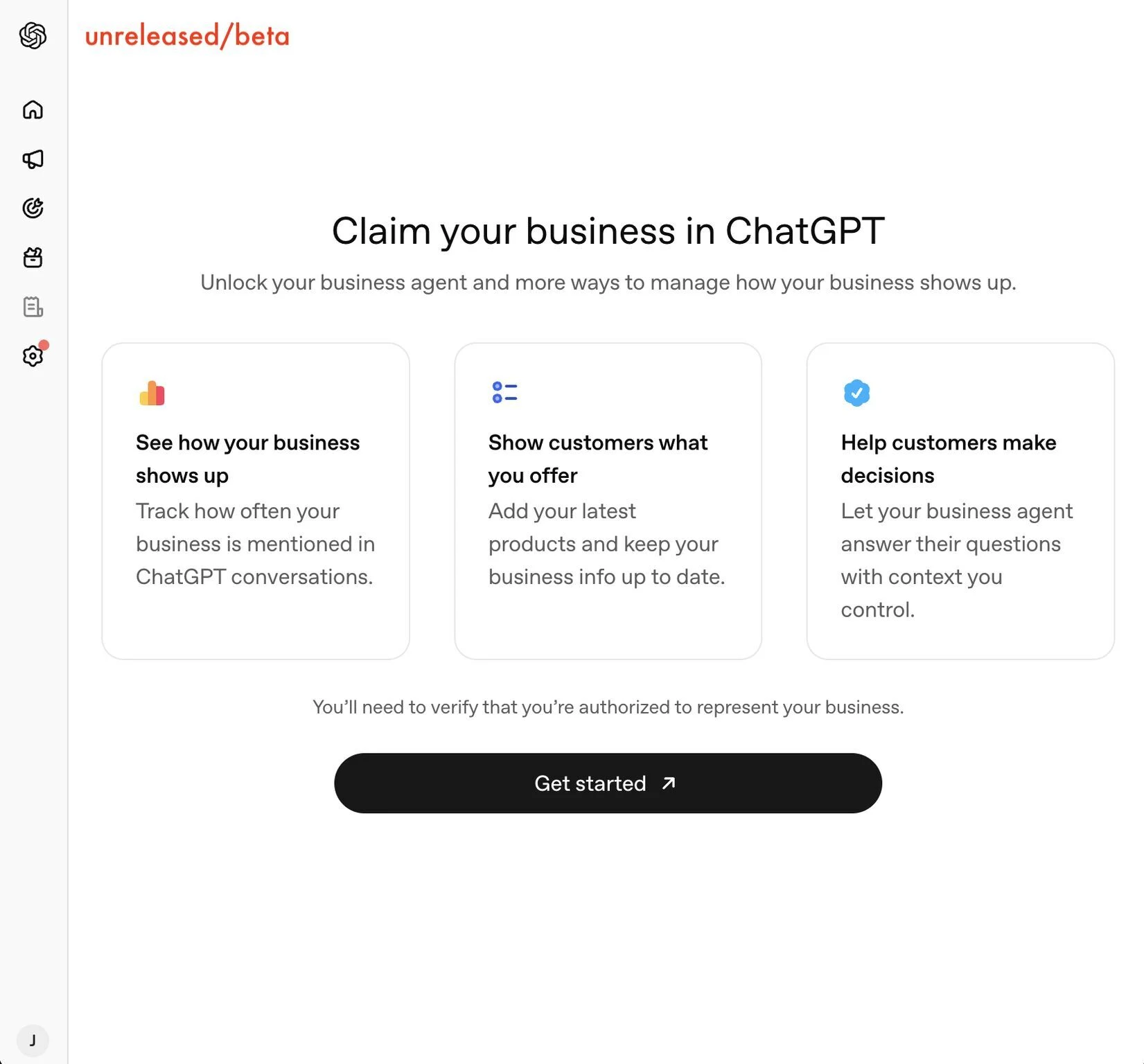
Unreleased beta screen; features may change before launch.
Two important qualifications. The reported dashboard doesn’t expose prompts or individual user data.
And it hasn’t launched. Treat everything about it as reported, not confirmed.
Microsoft has already moved in this direction: Clarity’s AI visibility citations dashboard shows site owners how they’re cited in AI experiences.
Why I believe better query reporting is likely
If OpenAI follows other ad platforms, expect aggregated topic demand, commercial-intent categories, ad performance by conversational context, and better organic attribution reporting. Better information helps advertisers optimize and makes inventory easier to value.
Aggregated reporting delivers that without exposing individual users, the same logic Google followed with Search Console and Keyword Planner.
The counterargument: The Business Hub is unannounced, and OpenAI hasn’t committed to query-level reporting of any kind. Privacy expectations around chat are higher than around search, and OpenAI may decide the trust cost isn’t worth it.
What it means for 2027: First-party ChatGPT visibility and ad data could become another important input for AEO measurement and commercial research. Until it exists, you’ll still need your own prompt tracking.
And when it arrives, keep in mind that traditional keyword volume and AI prompt volume are different things. Don’t treat one as a measurement of the other.
5. Advanced AI SEO work will move into agent harnesses
The prediction
Sophisticated SEO practitioners will increasingly do their work through general-purpose AI agents connected to specialized tools and proprietary data, instead of logging in to one dashboard after another.
AI adoption is widespread, but full automation is rare
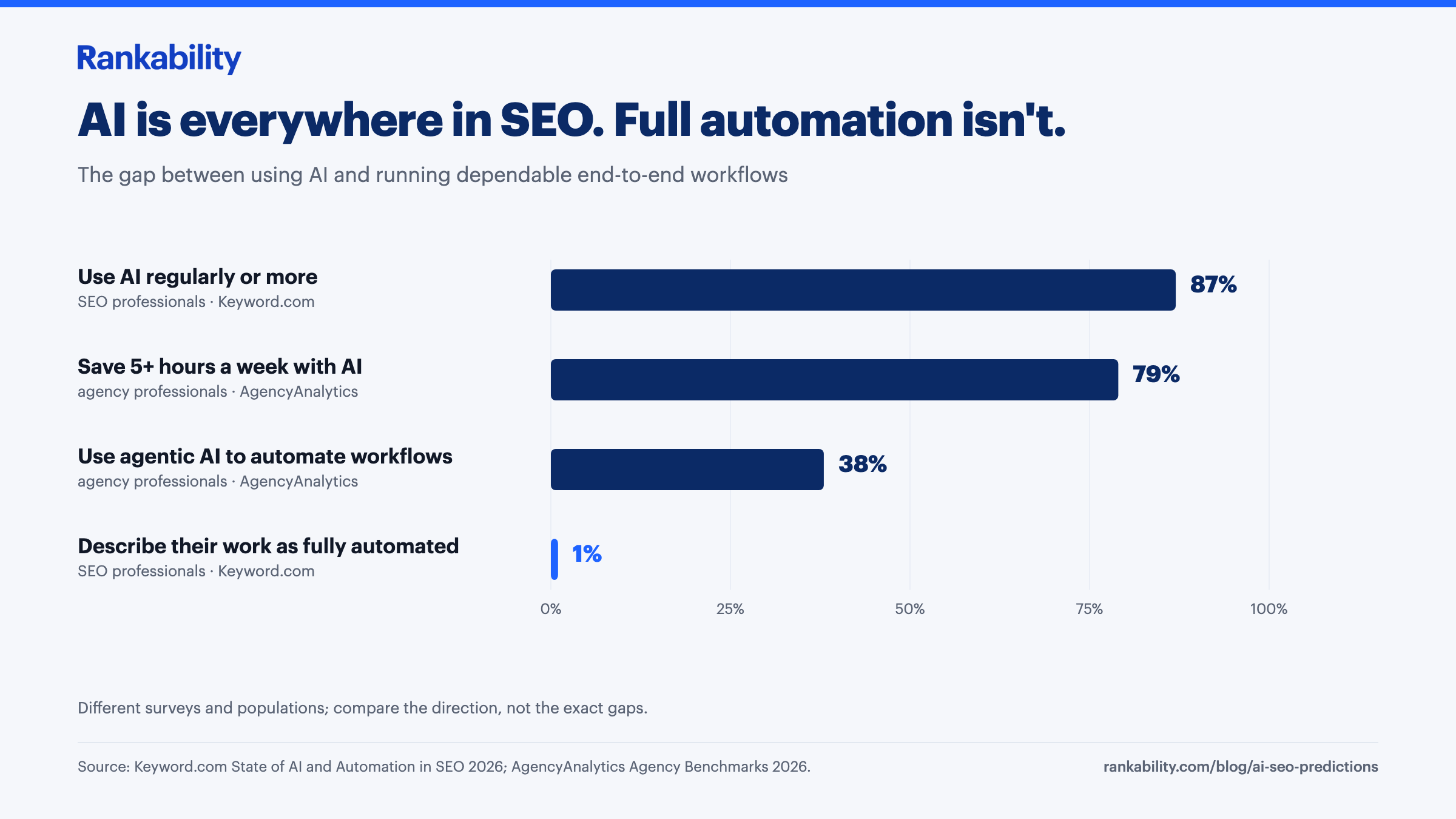
- Keyword.com’s 2026 SEO survey found 87% of respondents use AI regularly or more extensively. Only 1% described their work as fully automated.
- AgencyAnalytics’ 2026 benchmarks found 38% of surveyed agency professionals were already using agentic AI to automate workflows.
So AI is already in almost every SEO’s day. What’s changing is where the work happens.
SEO software is becoming accessible through AI agents
Quick definitions. An agent harness is where the agent works and acts (Claude, Claude Code, Codex).
MCP (Model Context Protocol) is a standard way to connect a tool or data source to that agent. An API is the programmatic access underneath, and MCP servers often sit on top of one.
Skills are reusable instructions that teach the agent how to do a specific job.
The SEO tool market has moved quickly here:
- Rankability hosts a remote MCP server and is listed in Claude’s connector directory. Codex and other MCP-compatible assistants can connect to the same endpoint.
- Ahrefs offers an MCP server.
- Semrush has published guidance on using Claude Code for SEO.
- Open-source projects like OpenSEO are building agent-compatible SEO infrastructure.
This mirrors what’s happened in software development, where JetBrains’ 2026 research documents rapid adoption of AI coding agents. SEO is following the same path a year or two behind.
The agent will become the primary workspace
Compare the two workflows.
Traditional workflow: Log in to several tools, export data, analyze it in a spreadsheet, and coordinate the deliverable by hand.
Agent-first workflow: Give the agent a goal, connect it to data and tools you trust, review what it proposes, and approve the actions.
The second still needs your judgment. It just removes most of the copying, pasting, and tab-switching.
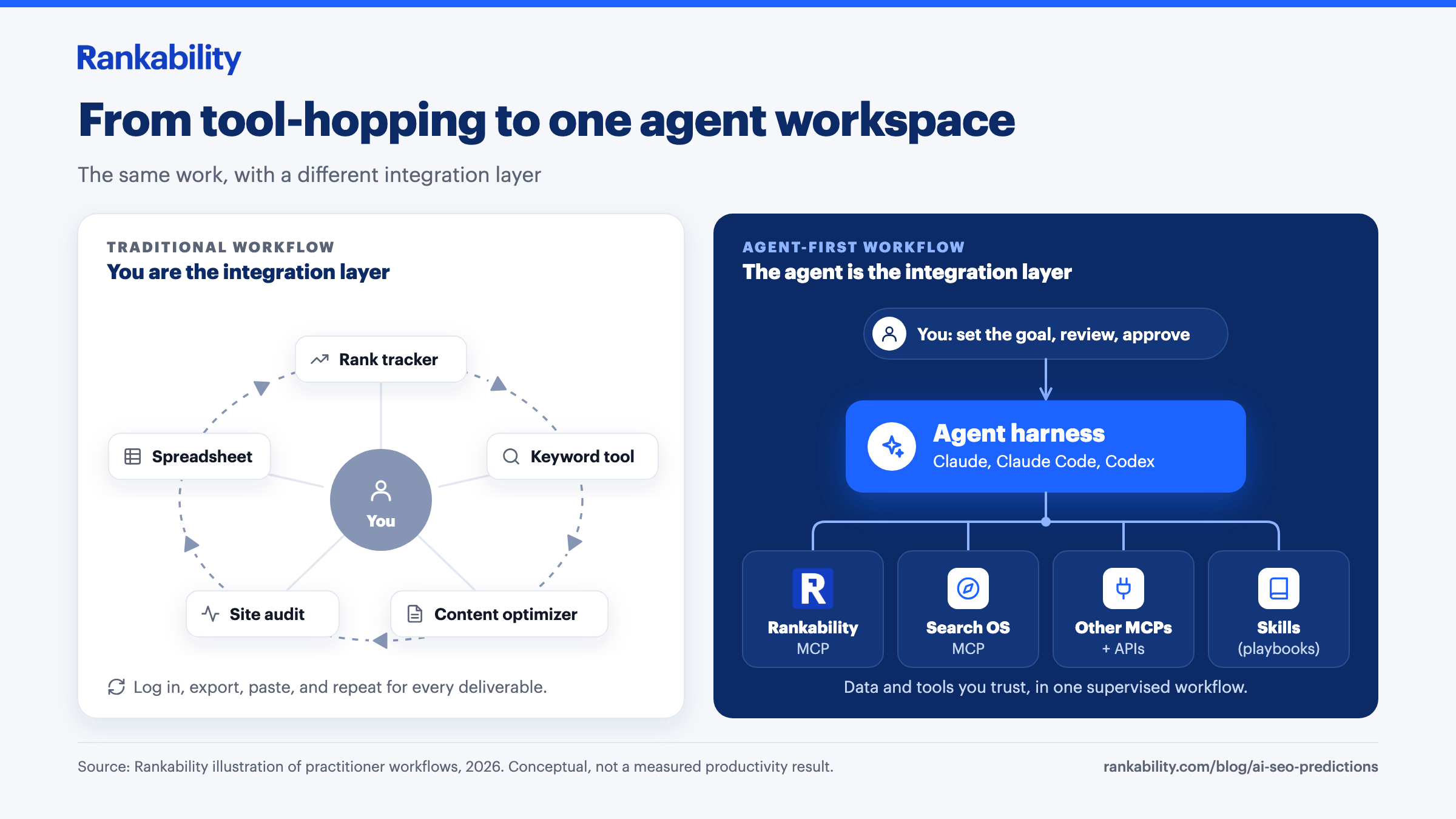
How I use Rankability MCP and Search OS MCP
Here’s what this looks like in my own work.
I connect Claude or Codex to two MCP servers. Search OS gives the agent curated research data and step-by-step playbooks, for example how to build a citation plan or a link plan for a specific business.
Rankability gives it SEO and AEO data plus execution tools: AI visibility from Tracker, Search Console performance, content research and optimization, and site audits.
In one conversation, I can ask the agent to pull where a client is missing from AI answers, check which third-party sources the AI platforms cite instead, compare that against the playbook for that type of business, and draft a prioritized plan.
I review the plan, change what my judgment says to change, and approve the next actions.
Before anything runs that uses credits, Rankability’s MCP shows the cost and asks for confirmation.
What used to be a chain of handoffs between tools and people becomes one workflow I can supervise. I’m not going to put a productivity number on that, because I haven’t measured it rigorously. But the difference in how the work feels is obvious.
Traditional software interfaces won’t disappear
Dashboards are still the right tool for client reporting, monitoring, and approvals. A client doesn’t want to read an agent transcript.
The counterargument: An AI-assisted task isn’t the same as a dependable end-to-end agent workflow. Agents make mistakes, permissions need care, and quality assurance still needs a human. McKinsey’s State of AI research consistently shows a wide gap between experimenting with AI and scaling it.
Why agent-first SEO will accelerate in 2027
As more platforms expose MCP servers and APIs, advanced practitioners can assemble powerful workflows without waiting for any one vendor to build the exact interface they need.
What it means for 2027: Proprietary data, execution capabilities, and reusable processes become bigger differentiators than the interface itself. If you’re a practitioner, pick one recurring task this quarter, like a monthly AI visibility review, and run it end to end through an agent.
You’ll learn quickly where it saves time and where it needs supervision.
6. More businesses will build internal AI SEO capabilities
The prediction
Businesses that already have marketing teams will increasingly use AI tools and outside advisory support to build internal SEO and AEO execution, instead of outsourcing everything to an agency.
Many businesses have been dissatisfied with SEO providers
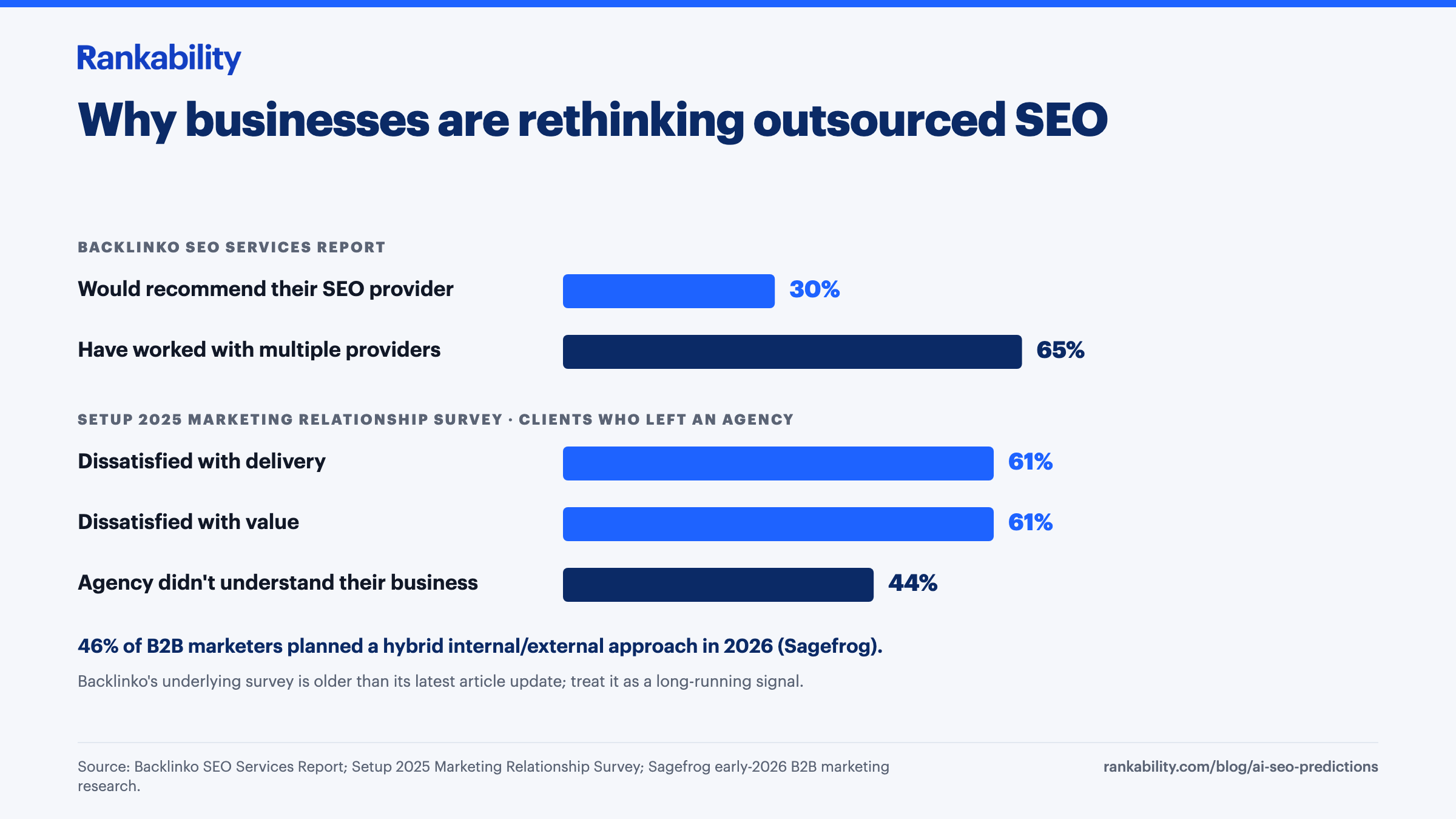
Backlinko’s SEO Services Report found:
- Only 30% would recommend their SEO provider.
- 65% had worked with multiple SEO providers.
- Many departing clients cited dissatisfaction with results and cost.
One note: the underlying survey is older, even though the article has been updated. Use it as a long-running signal, not a 2026 snapshot.
More recent agency research shows similar problems
Setup’s 2025 Marketing Relationship Survey found that among departing clients:
- 61% cited dissatisfaction with delivery.
- 61% cited dissatisfaction with value.
- 44% said their agency didn’t understand their business well enough.
Wpromote’s research on agency partnership challenges and First Page Sage’s agency retention data point to the same friction.
AI is lowering the execution barrier
A small internal team can now use AI-assisted tools for keyword research, content planning and optimization, competitive research, AI visibility monitoring, and reporting: work that used to need specialists.
That doesn’t make strategy, judgment, technical expertise, or verification optional. AI makes it easier to do the work.
It doesn’t make it easier to know which work matters. That’s the gap an experienced advisor fills.
The hybrid model could become the preferred alternative
Here’s the model I expect to grow:
Internal marketing team + AI software + fractional SEO advisor.
The business owns the strategy, the assets, and day-to-day execution. The outside advisor sets up workflows, trains the team, reviews quality, and gives strategic direction.
The data already leans this way. Sagefrog’s research found 46% of surveyed B2B marketers planned a hybrid internal/external approach in 2026. And Gartner reported that marketing leaders expect AI automation of marketing work to double to 36% by 2028.
How the economics could change
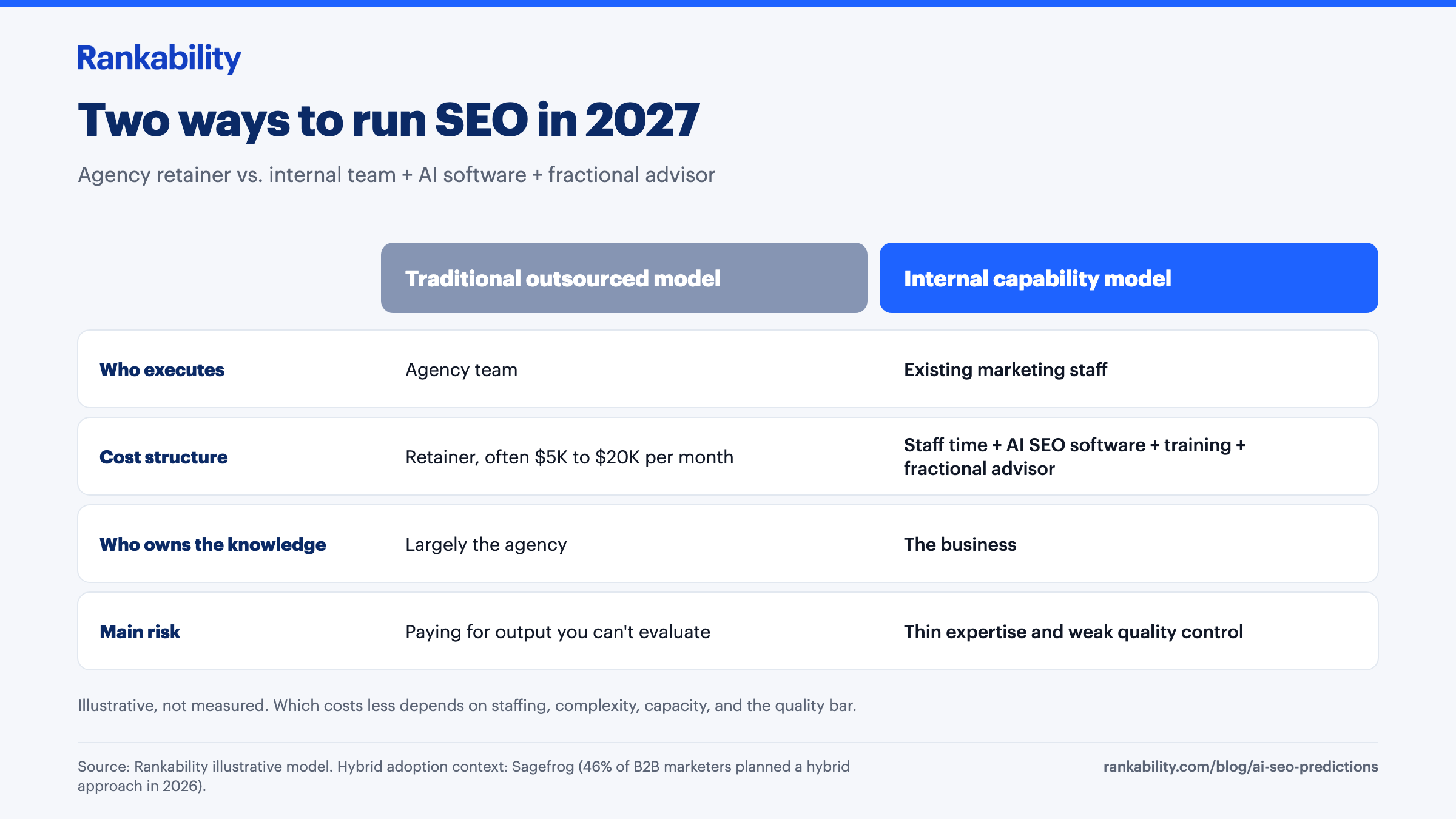
Compare two illustrative models (hypothetical, not measured results):
| Traditional outsourced model | Internal capability model | |
|---|---|---|
| Who executes | Agency team | Existing marketing staff |
| Typical cost structure | Agency retainer, often $5,000 to $20,000 per month | Staff time + AI SEO software + training + fractional expert oversight |
| Who owns the knowledge | Largely the agency | The business |
| Main risk | Paying for output you can’t evaluate | Thin expertise and weak quality control |
Which costs less depends on staffing costs, complexity, execution capacity, and the quality bar. An internal model is cheaper only when the team has capacity and the advisor keeps quality high.
Which businesses are best positioned to bring SEO in-house?
SaaS and technology companies, mid-market businesses with marketing teams, multi-location organizations where repeatable processes pay off, and businesses with strong subject-matter expertise, which is exactly what good content needs.
Smaller businesses without any marketing staff will often still get more value from outside implementation. If no one internally has time to execute, software alone won’t fix that.
The counterargument: Strong agencies provide real value: expertise, execution capacity, and an outside perspective that internal teams lack. Plenty of businesses that bring SEO in-house will bring it back out.
Why I believe more businesses will internalize SEO
AI makes the tools and processes more accessible, and agency dissatisfaction gives businesses a reason to look at alternatives. Together they push toward the hybrid model.
What it means for 2027: SEO consultants will increasingly sell strategy, training, systems, and quality assurance, not just execution hours. If you’re a business, list which SEO tasks are repeatable and which need deep expertise.
The first list is your internal opportunity. The second is where outside help earns its fee.
7. AI will enable much smaller agency execution teams
The prediction
Agencies will increasingly deliver the same or more output with fewer execution-focused employees. Relationship management, strategy, and quality assurance will stay human-led.
Agency leaders already expect AI to reduce staffing needs
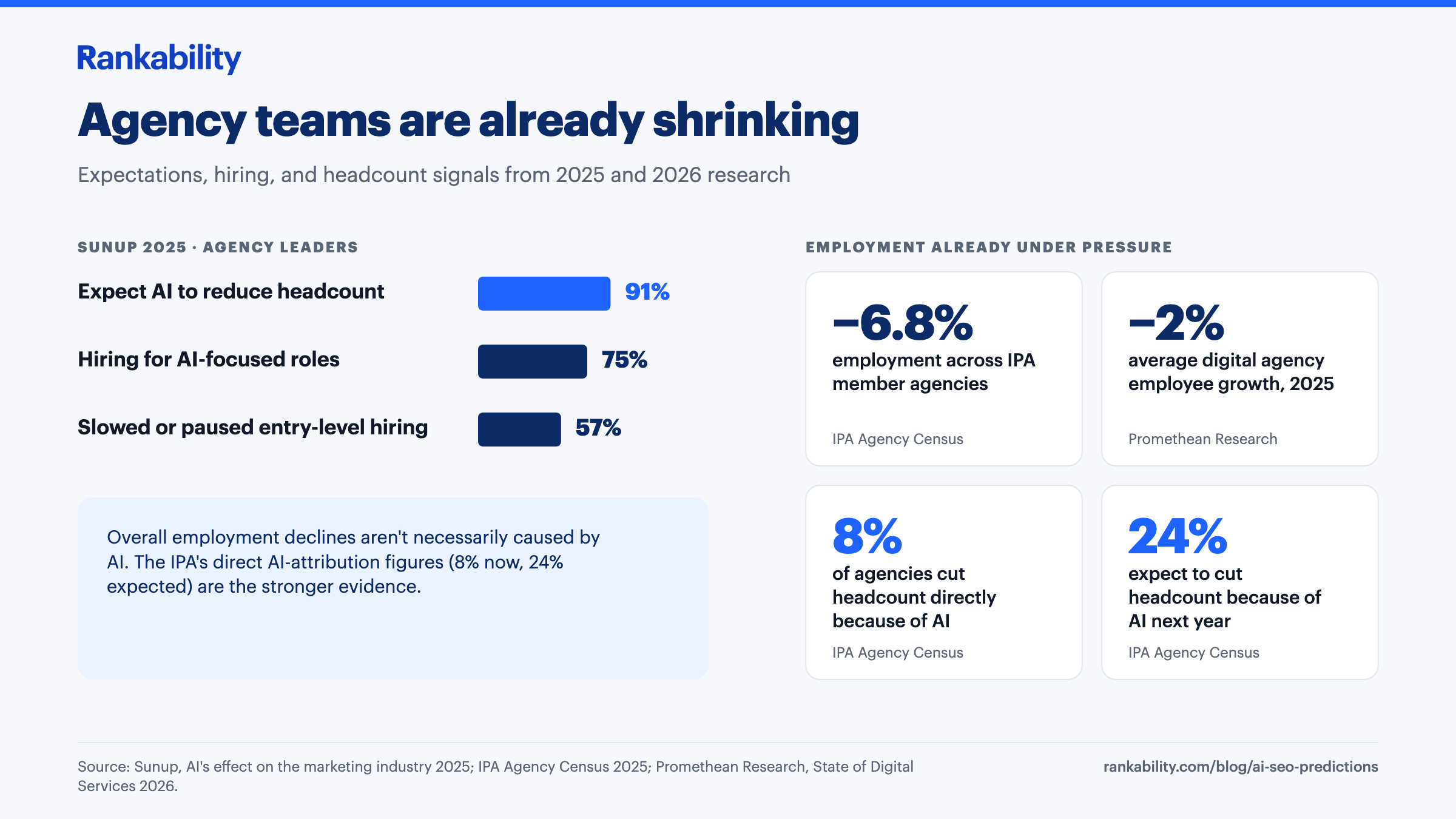
Sunup’s 2025 research on AI’s effect on the marketing industry found:
- 91% of surveyed agency leaders expected AI to reduce agency headcount.
- 57% had slowed or paused entry-level hiring.
- 75% were hiring for AI-focused roles.
Agency employment is already under pressure
- Promethean Research found average digital agency employee growth of negative 2% in 2025.
- The UK’s IPA Agency Census reported a 6.8% reduction in employment across member agencies.
- The IPA also found 8% of agencies had reduced headcount directly because of AI, and 24% expected to do so over the next year.
An important distinction: overall agency employment declines aren’t necessarily caused by AI. Client budgets, the economy, and consolidation all play a role. The IPA’s direct AI-attribution figure is the stronger evidence for the narrower claim that AI is already reducing headcount at some agencies.
AI is changing execution across disciplines
This isn’t limited to SEO. It reaches content production, web development and design, paid advertising, and analytics.
AgencyAnalytics found 79% of surveyed agency professionals saved five or more hours per week using AI (2026 benchmarks). eMarketer reports that automating repetitive tasks tops agencies’ AI playbook.
A real example: my AI SEO For Dummies book launch
Here’s where this got real for me.
For the launch of AI SEO For Dummies, I used AI agents and specialized tools to coordinate:
- SEO and AEO campaigns
- Facebook advertising
- Google Ads
- ChatGPT advertising
- Webinar presentation materials
- Overall campaign coordination
In the past, that scope would typically have meant several specialists or contractors plus someone coordinating them.
The lesson isn’t that AI replaced those people’s expertise. I brought 15 years of SEO experience to every decision. The lesson is that expertise, AI agents, reliable data, and repeatable processes together expand what one experienced operator can execute.
Client relationships will remain a core agency function
Agencies still need account managers, experienced strategists, stakeholder management, quality assurance, and accountability for commercial outcomes. AgencyAnalytics found 80% of surveyed agency leaders named strong client relationships as a major retention factor.
AI doesn’t build trust with a client’s CMO. People do.
The agency staffing model will change
Traditional agency: Larger teams divided into production roles, each owning one slice.
AI-native agency: Smaller, experienced, cross-functional teams supported by agent workflows, plus dedicated relationship management and strategy.
The WFA’s 2026 research shows global brands shifting toward paying for outputs rather than time, which pushes agencies toward exactly this model.
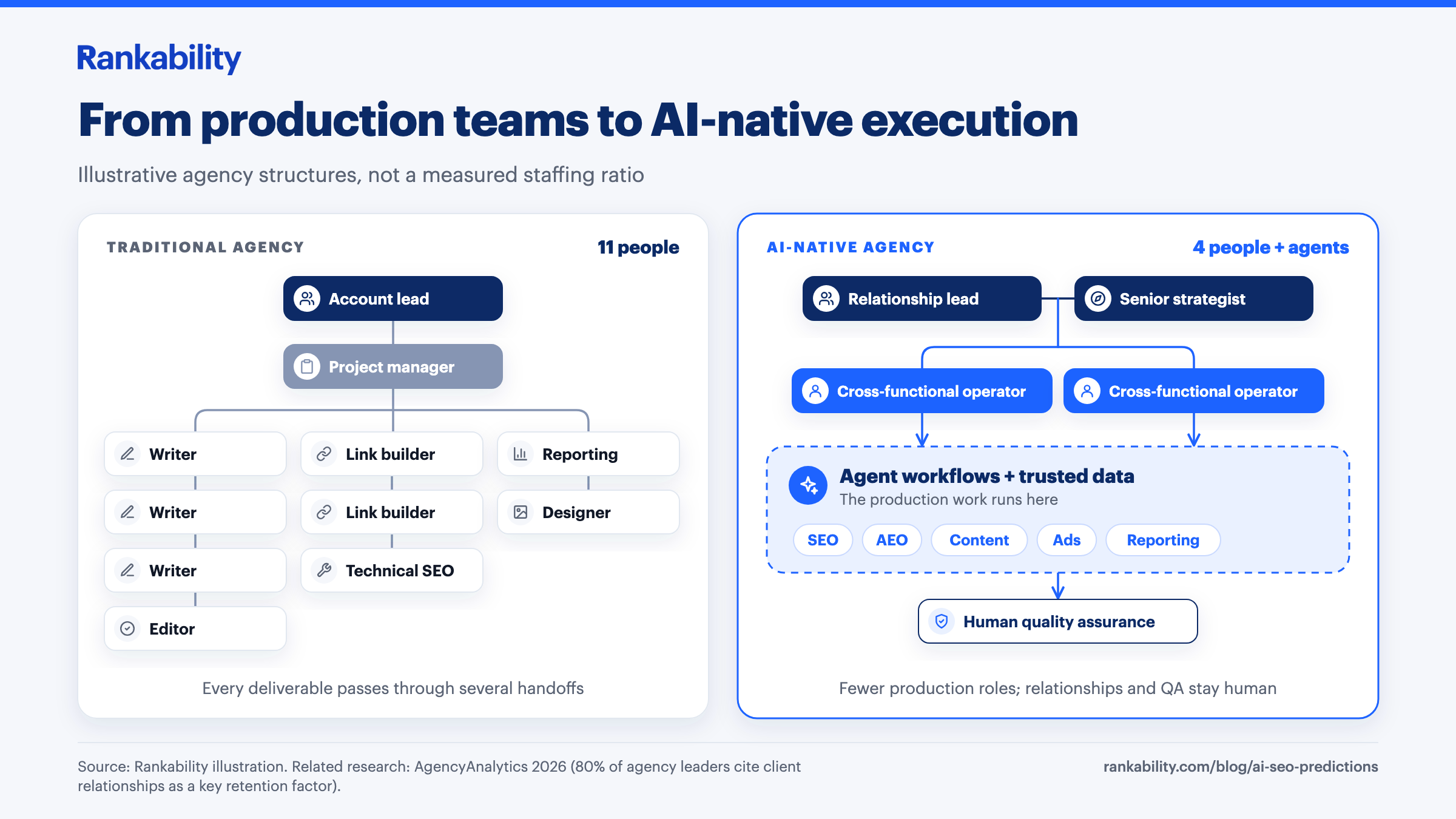
Smaller teams mean less labor on repeatable tasks, faster execution, lower overhead, and potentially stronger margins, as long as quality and demand hold up.
The counterargument: Some agencies will use productivity gains to grow, not to cut. Basis’ 2026 agency report and Promethean’s hiring trends show agencies are still hiring for many roles.
Complex, relationship-heavy work will still need experienced people, and research on AI and productivity (for example, this Management Science study) shows gains vary widely by task and by worker.
Why I believe agency teams will get smaller in 2027
The biggest staffing change will likely happen in production and execution, not across every function. Agencies will keep strategists and account leads. They’ll need fewer people doing repeatable production work.
What it means for 2027: Agency competitiveness will depend more on revenue, quality, and client outcomes per employee than on total headcount. If you own an agency, that’s the number to start tracking now.
What these 7 predictions mean for you
Here’s where we’d start, by audience.
For businesses
- Check your most important buyer prompts on the AI platforms your customers use.
- Invest in traditional search coverage and AI visibility. They’re connected, not interchangeable.
- Bring repeatable SEO work in-house where you have capacity.
- Use outside specialists for strategy, technical SEO, and quality review.
For SEO professionals
- Learn which search systems feed which AI platforms.
- Run one real workflow through an agent harness and MCP this quarter.
- Measure mentions, citations, and prompt coverage across platforms.
- Make your judgment visible. Strategy and QA earn the premium.
For agency owners
- Audit which execution work is genuinely repetitive. Start automating there.
- Invest in AI-assisted workflows and data you trust.
- Prioritize client relationships and outcomes. That’s what keeps clients.
- Revisit pricing. If you bill for hours, more efficiency can mean less revenue.
Frequently asked questions about AI SEO in 2027
Will AI replace traditional SEO?
No. AI systems still rely on search and retrieval, so crawlability, technical health, useful content, and search visibility still matter. The goal expands from ranking one page to earning coverage across the sources AI systems retrieve.
What’s the difference between SEO, AEO, and GEO?
SEO improves visibility in traditional search results. AEO (answer engine optimization) improves how a brand appears in AI-generated answers.
GEO (generative engine optimization) describes nearly the same goal. The three overlap heavily, and the terminology is still settling.
Will Google AI Mode replace traditional Google Search?
I expect an AI-first interface to become the default most people see. Classic results will likely remain available alongside or beneath the AI answer.
Does ranking on Google help a website get cited by ChatGPT?
It can, but it’s not a guarantee. In our study, 77.0% of ChatGPT citations had no measured organic ranking. ChatGPT uses its own mix of retrieval providers.
Will AI replace SEO agencies?
AI is replacing execution tasks, not the need for strategy, specialist expertise, or accountable client relationships. Expect smaller, more senior agencies.
Can businesses do SEO internally with AI?
Yes, with at least one marketer who has time to execute, reliable tools, and a quality-control process. A fractional advisor can set up the workflows and review the work.
How should businesses measure AI search visibility?
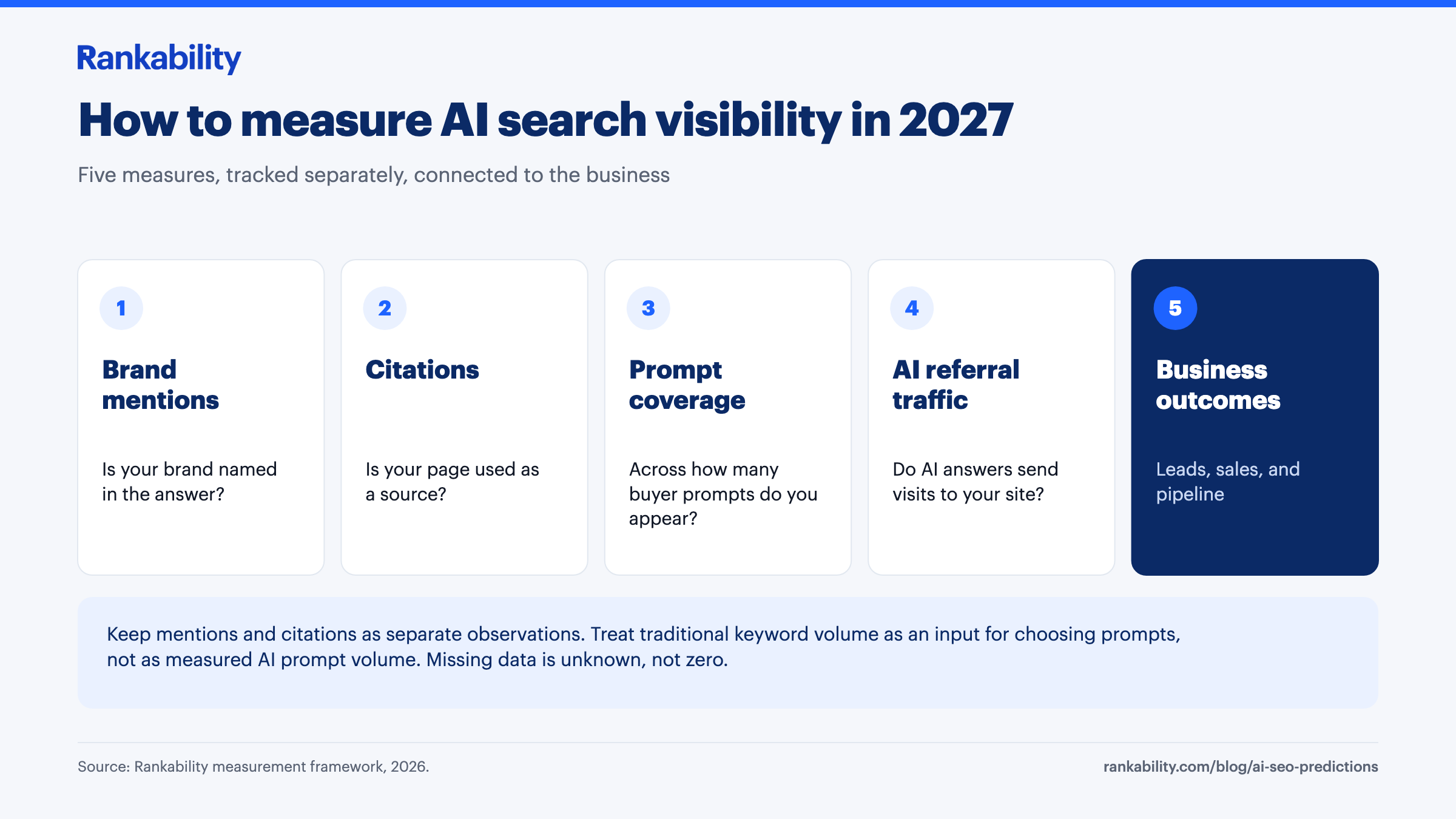
Track brand mentions, citations of your pages, prompt coverage, AI referral traffic, and the business outcomes behind them. Keep mentions and citations separate.
Conclusion: SEO is entering a new operating model
Three changes run through all seven predictions:
- Search is changing. AI answers are becoming central to how people discover information, products, and businesses.
- Execution is changing. Connected AI agents let practitioners get more done across more tools.
- Business models are changing. More organizations can build internal capabilities, and agencies can deliver with smaller execution teams.
My prediction isn’t that SEO will disappear in 2027. It’s that the way we practice SEO, deliver SEO services, and measure SEO success will look increasingly different from the industry we’ve known for the past two decades.
I’ll revisit these at the end of 2027 and grade myself.
Build your AI search capabilities with Rankability
Rankability helps businesses and agencies research, create, optimize, audit, and track SEO and AEO work in one place. Track your visibility on Google and AI platforms, see which brands and sources appear in AI answers, and use the gaps to plan your next move.
Connect Claude, Codex, or another MCP-compatible assistant to run those workflows from your agent.
Research methodology and sources
Original research: Rankability’s 48-month keyword demand analysis (3,751 terms), our citation study (1,645 AI citations and 916 traditional results across 31 topics), and first-party Search Console data. Full methodology is in our AI search statistics study.
Other sources: Public filings and earnings calls (Alphabet, Reddit, Ziff Davis, People Inc.), independent studies linked throughout, and Nathan Gotch’s firsthand work with agent-based workflows.
Limitations: Studies use different samples and time periods. Associations aren’t necessarily causal. Vendor research may reflect the vendor’s perspective. Search demand measures interest, not adoption. The predictions are informed opinions, not established outcomes.
Research cutoff: November 9, 2026.