

If you’re adding schema markup so ChatGPT, Gemini or Perplexity will cite your pages, you’re betting on a mechanism nobody outside those companies can see.
So we checked it against first-party data: 41,320 pages from Rankability site audits and 44,276 citations of those pages across ten AI engines over four weeks. Pages with schema were cited more often, 4.8% against 2.9%. Compare pages on the same site and of the same type, though, and page-specific schema made no measurable difference.
Below, you’ll see where the raw gap comes from, what lined up with citations far more strongly, and where we’d spend the time instead.
What the data showed
Across all pages, 4.8% of pages with schema markup were cited at least once in four weeks, against 2.9% of pages without it.
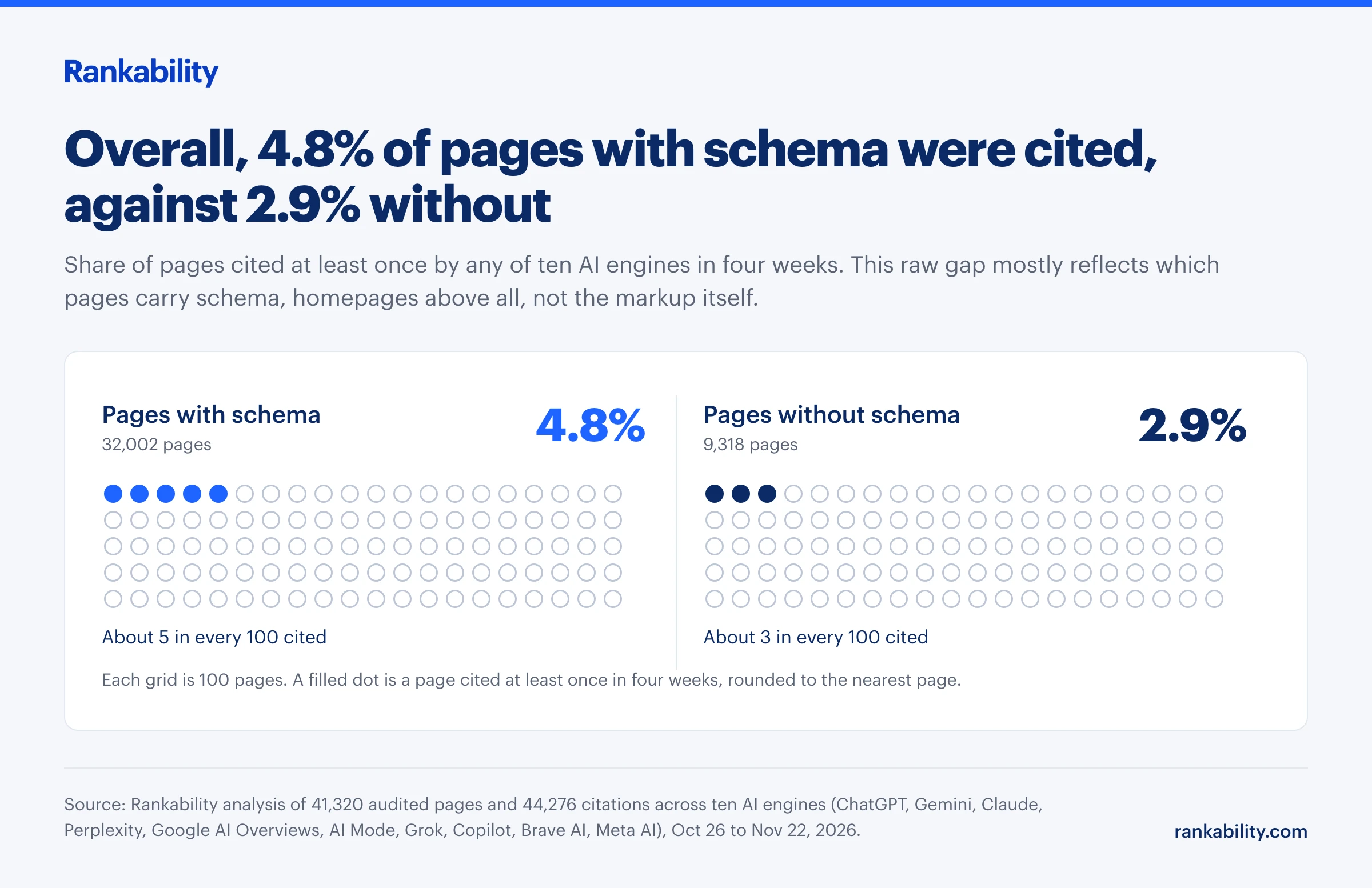
Each grid is 100 pages. A filled dot is a page cited at least once by any of ten AI engines between October 26 and November 22, 2026.
That gap is mostly about which pages carry schema. The pages that have it, homepages above all, tend to be the pages AI engines cite anyway. So we compared pages within the same site, then within the same site and page type.
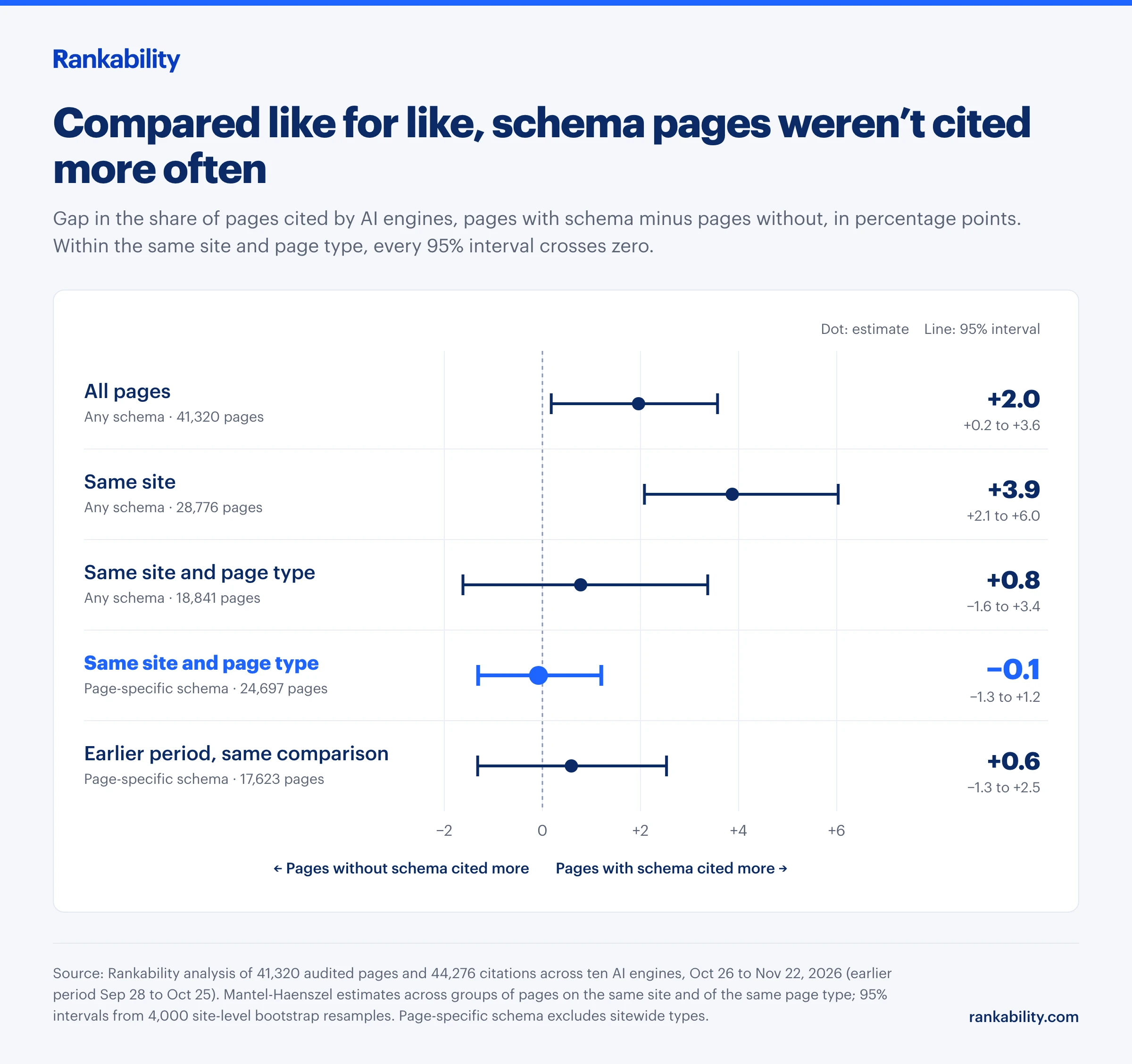
Each row shows the gap in percentage points and its 95% interval. Page-specific schema leaves out sitewide types such as Organization, WebSite and BreadcrumbList.
Within the same site, the gap grew to +3.9 points, largely because the page types that carry schema most are the ones AI engines cite most. Within the same site and page type, it fell to +0.8 for any schema (95% interval −1.6 to +3.4).
For page-specific schema such as Article, FAQPage, Product or LocalBusiness, the gap was −0.1 points (95% interval −1.3 to +1.2). In the four weeks before, it was +0.6 (95% interval −1.3 to +2.5). Both intervals include zero.
What predicts citations better
Page strength did. Pages with an authority score of 30 or more were cited about eight times as often as pages with none, with or without schema.
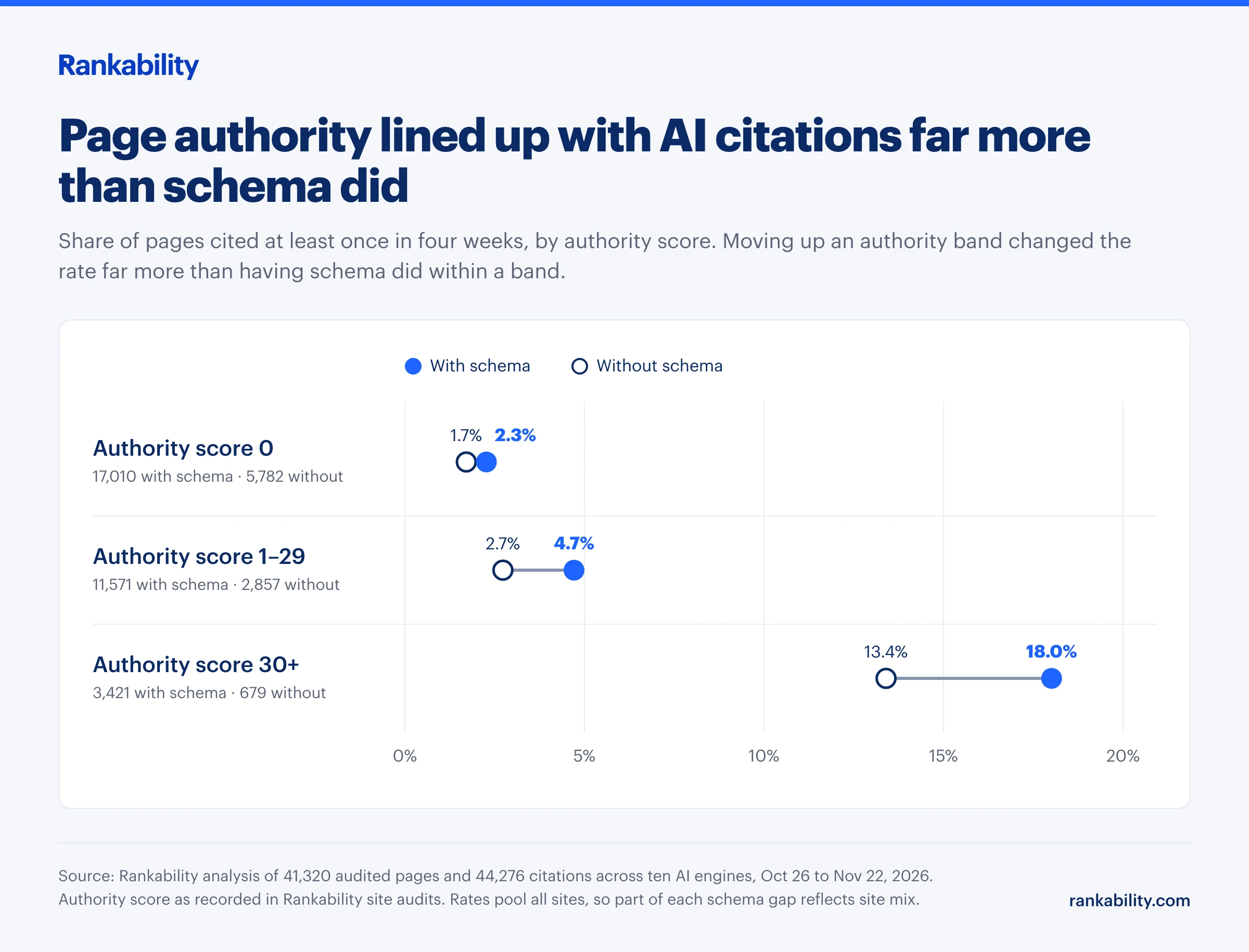
| Page group | With schema: pages, share cited | Without schema: pages, share cited |
|---|---|---|
| Authority score 0 | 17,010, 2.3% | 5,782, 1.7% |
| Authority score 1–29 | 11,571, 4.7% | 2,857, 2.7% |
| Authority score 30+ | 3,421, 18.0% | 679, 13.4% |
| Pages with search clicks | 2,238, 17.4% | 446, 14.1% |
October 26 to November 22, 2026. These rows pool all sites, so part of each schema gap is still site mix.
What to do with this
Don’t treat schema as an AI citation lever. Keep the markup you have where it serves another purpose; this study didn’t measure rich results or anything outside AI citations. But don’t expect new markup to get a page cited.
Here’s where we’d spend the next hour instead:
- Find out which of your pages already get cited. In Rankability’s Tracker, open the Sources tab and switch to URLs. Your own pages are labeled Your site, and Export CSV gives you the list. Start with the prompts closest to a buying decision. Here’s how to read the Tracker workspace.
- Compare the cited pages with the ones that aren’t. In Site Auditor, the Pages tab can show schema, word count, linking pages, crawl depth and Search Console data side by side. Look for what the cited pages have that the others lack. Here’s how to use Site Auditor.
- Strengthen the pages that matter. Authority and search clicks lined up with citations far more than schema did. That points the effort at what makes a page strong: internal links, earned links and genuinely useful content. This is our read of the pattern, not an effect we measured.
Site Auditor’s Statistics tab includes a schema markup card. Read it as a diagnostic, not a score to maximize. Not every page needs schema markup.
How this fits with Ahrefs’ study
Ahrefs tracked 1,885 pages that added schema and compared them with matched pages that didn’t. AI citations barely moved.
Their before-and-after design is the stronger test of cause. Ours is a snapshot, so it can’t prove cause either way. What it adds is a different angle on the same question: first-party data across ten AI engines, on the local-service-heavy queries our customers track, comparing pages within the same site.
Both point the same way for page-level schema: no measurable link to AI citations.
Methodology and limitations
- Sample. 41,320 indexable pages from Rankability site audits, on sites whose tracked AI answers included at least one citation between October 26 and November 22, 2026. 32,002 pages had schema markup; 9,318 had none. We used the latest crawl of each URL.
- Selection. Pages returned 200, were not noindexed, were not blocked by robots.txt and did not point their canonical elsewhere.
- Citations. A page counted as cited when its URL appeared as a source in at least one tracked AI answer for its own site, across ChatGPT, Gemini, Claude, Perplexity, Google AI Overviews, AI Mode, Grok, Copilot, Brave AI and Meta AI. DeepSeek was left out because its sources became unreadable in November.
- Schema. A page had schema when at least one JSON-LD block was found in its HTML. Page-specific schema leaves out sitewide types (Organization, WebSite, WebPage, BreadcrumbList, SiteNavigationElement, ImageObject) and pages crawled before a July 2026 crawler fix whose types were stored as “Unknown”.
- Analysis. Like-for-like comparisons use Mantel-Haenszel estimates across groups of pages on the same site and of the same page type. The 95% intervals come from 4,000 resamples of whole sites, so one large site can’t carry the result. We reran the results without the largest contributor, without Rankability’s own sites, without Google AI Overviews after November 19, and in the four weeks from September 28 to October 25.
- “Any schema” didn’t settle. Counting sitewide types as well, the gap within the same site and page type was small in the latest period (+0.8 points, −1.6 to +3.4) but clearer in the earlier one (+4.6 points, +1.8 to +8.3). The two periods covered a partly different mix of sites, and we can’t yet say why they differ.
- Schema the crawler can’t see. The audit crawler reads JSON-LD from the page’s HTML. Schema added by JavaScript, or written as microdata or RDFa, counts as none. That would hide a real gap rather than create a false one.
- Scope. This is an association at a point in time, not a test of cause. Each page’s schema comes from its latest crawl, up to six months before the citations. The queries are the ones Rankability customers chose to track, which lean toward local services, so this isn’t a sample of all searches or all sites.