

Scrunch AI addresses a specific agency problem: understanding how brands appear within AI-generated answers. When evaluating Scrunch AI alternatives, however, you may need deeper SEO execution, broader model coverage, more transparent client reporting, or stronger support for turning visibility data into publishable work.
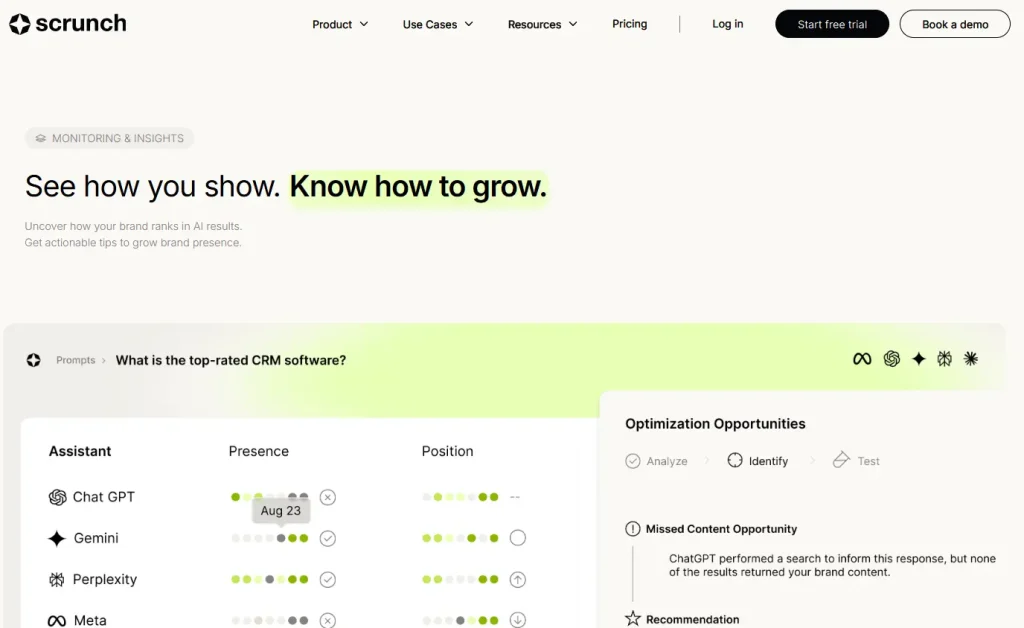
The eight platforms below differ substantially in scope, from focused citation monitors to integrated systems covering Google, ChatGPT, Gemini, Perplexity, and traditional search. This comparison examines tracking depth, content workflows, agency support, integrations, reporting, and pricing transparency.
How We Compared Alternatives to Scrunch AI
Scrunch AI is built for AI search visibility, but many agencies need more than prompt monitoring and citation tracking. A useful platform should connect AI citations to an actionable content strategy, conventional SEO workflow, rank tracking, and client reporting rather than merely documenting whether a brand appeared.
We evaluated each alternative against seven practical criteria:
-
AI platform coverage: Which answer engines and models the platform monitors, including ChatGPT, Gemini, Perplexity, and other supported systems.
-
Prompt and citation tracking: Whether users can inspect tracked prompts, generated answers, brand mentions, competitors, sources, and citations.
-
Traditional SEO capabilities: Whether the product includes keyword research, site auditing, content optimization, or conventional rank tracking.
-
Content workflow: Whether insights can become briefs, drafts, optimization assignments, and prioritized production tasks.
-
Client reporting: Whether agencies receive understandable dashboards, exports, recurring reports, and account-level separation.
-
Integrations: Whether API access or native connections can move data into an agency’s existing systems.
-
Pricing transparency: Whether the vendor publishes plans, defines usage limits, or requires a sales conversation.
AI answer data must be interpreted as a sampled observation rather than an absolute ranking. The strongest measurement systems expose the evidence behind a visibility score. Agencies should be able to inspect prompts, answers, citations, and competitors because an unexplained composite score provides weak support for strategic or client-facing decisions.
What Agency Teams Should Prioritize
Agencies should prioritize integrated tools for research, copywriting, optimization, reporting, and advising when those functions belong to the same production cycle. A connected system reduces manual handoffs and makes it easier to trace a recommendation from initial research through implementation and measured results.
Multiple client workspaces, white-label reporting, reusable templates, exports, and API access determine whether a platform can scale beyond one analyst. Products may add AI monitoring dashboards, but the relevant question is not how many features a platform lists — it’s how much client work your team can complete and substantiate without transferring data among disconnected applications.
Quick Comparison of the Best Scrunch AI Alternatives
Pricing changes often. Verify current terms directly on vendor pages before purchase.
| Platform | Best For | AI Search Tracking | Traditional SEO Workflow | Reporting and Agency Support | Pricing Approach | Key Trade-Off |
|---|---|---|---|---|---|---|
| Rankability | Multi-client agency execution | Tracks supported AI platforms, prompts, mentions, citations, and competitors | Research, AI copywriting, optimization, and rank tracking | Client knowledge bases, white-label reporting, Serena, and API access | Public plans from $99/mo | Broader workflow than monitoring-only tools |
| Ahrefs Brand Radar | Existing Ahrefs users | Brand and competitor visibility across supported AI results | Connects with the wider Ahrefs SEO ecosystem | Familiar Ahrefs reporting environment | From $199/mo per AI platform, or $699/mo for all six | Most compelling inside an Ahrefs stack |
| Profound | Enterprise AI search analytics | Answer, citation, brand, and prompt intelligence | Primarily complements an existing SEO stack | Enterprise-oriented analytics and data access | Self-serve from $99/mo (ChatGPT only); Growth $399/mo; enterprise custom | Less focused on integrated content execution |
| SEMrush AI Visibility Toolkit | Existing SEMrush customers | AI visibility and competitive measurement | Keyword research, site audit, content, and SEO tools | Established project and reporting functions | $99/mo per domain add-on (sold separately from core plans) | Plan complexity requires careful verification |
| AthenaHQ | Dedicated generative search analysis | Prompt, model, and citation monitoring where supported | Limited compared with broad SEO suites | Focused AI visibility reporting | Self-serve from $295/mo; enterprise custom | AI analytics take priority over conventional SEO |
| Peec AI | International visibility analysis | Prompt, competitor, and multilingual monitoring | Generally used beside another SEO platform | Market-level dashboards and reporting | From $95/mo (Starter); Pro around $199–$245/mo | Execution may require separate content tools |
| Otterly AI | Lean monitoring teams | Tracks prompts, mentions, citations, and competitors | Minimal traditional SEO workflow | Streamlined reports for focused monitoring | From $29/mo (Lite); Standard $189/mo; Premium $489/mo | Not a complete agency production system |
| LLM Pulse | Multi-model visibility comparison | Monitors supported LLM answers and prompts | Primarily an AI measurement layer | Visibility dashboards and competitive insights | From €49/mo (Starter); Scale €299/mo with API access | Dedicated monitoring rather than end-to-end SEO |
Rankability leads this comparison for agencies that need one operational workflow for Google SEO and AI search. The other platforms can be stronger choices when a buyer prioritizes enterprise prompt intelligence, international monitoring, an existing SEO ecosystem, or a lightweight visibility dashboard.
8 Best Scrunch AI Alternatives for Agencies
1. Rankability — Best Overall for Agency SEO and AI Search Workflows
Rankability is the strongest overall option for agencies and marketing teams that want to plan, create, optimize, track, report, and advise within one system. Its positioning as the agency SEO workflow for Google and AI search reflects a broader operational scope than an AI visibility dashboard alone.
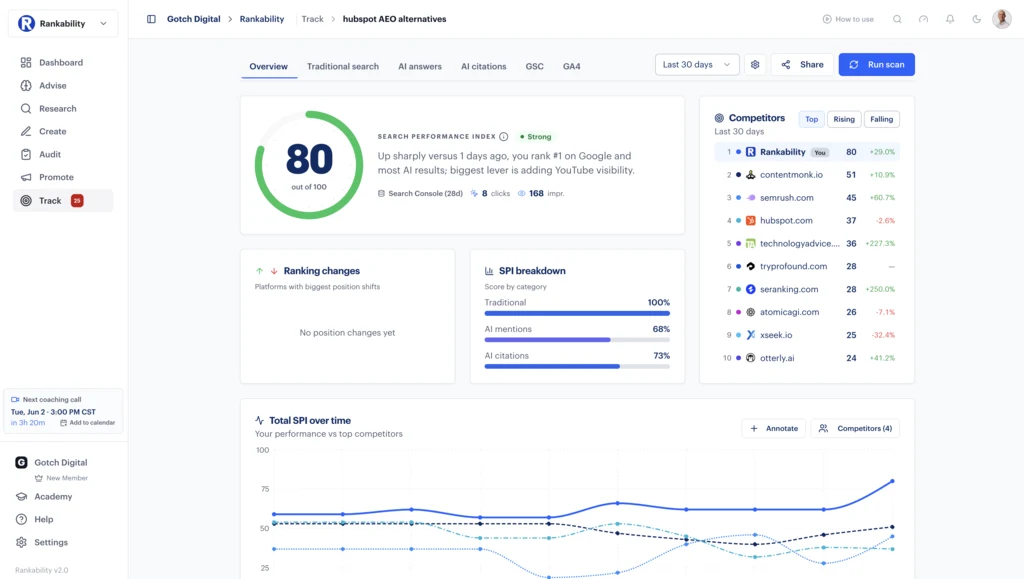
Overview: Rankability’s platform includes keyword research, AI-powered content creation and optimization, brand visibility tracking, technical auditing, backlink monitoring, and multi-client reporting.
Key features: Its Researcher supports keyword discovery and analysis, while Copywriter uses real-time topical-coverage scoring rather than keyword density. Tracker monitors Google and supported AI platforms.
Standout capability: A client knowledge base supplies account-specific context, while Serena offers client-specific weekly plans and recommendations.
Best for: Agencies that need repeatable workflows, unlimited-client account structures where included, white-label reporting, and API access.
Verdict: Choose Rankability when AI visibility must support ongoing SEO delivery rather than operate as a separate measurement project.
Visibility tracking across traditional search and AI platforms like ChatGPT and Gemini helps an agency discuss two related but distinct discovery channels. The Rankability AI Analyzer can identify mentions, citations, prompts, competitors, and share-of-voice patterns, while the wider platform helps teams act on those findings.
Its AI-assisted writing and optimization functions are designed to support natural topical coverage rather than reward keyword stuffing. That distinction matters because a higher content score is only useful when it corresponds with a more complete, readable page.
Track AI visibility and close the content gap — in one platform
Rankability Tracker monitors how your clients appear across ChatGPT, Gemini, Perplexity, Google AI Overviews, and more — then connects each gap directly to content work and white-label reporting.
Unlimited clients and users · White-label reporting included · From $99/mo
Where Rankability differs from Scrunch AI: Rankability’s principal difference is its repeatable, end-to-end SEO workflow from planning to proof. Your team can move from research and content planning into AI copywriting, optimization, Google and AI visibility tracking, reporting, and Serena-led next steps without rebuilding the project in separate tools.
Fewer handoffs also create stronger evidence for client conversations. An agency can connect an identified visibility gap to assigned work and subsequent reporting, which is more defensible than presenting an isolated AI visibility score without documenting the response.
2. Ahrefs Brand Radar
Ahrefs Brand Radar brings AI brand visibility into the broader Ahrefs research environment. It’s among the first tools to track brand mentions across AI platforms inside an established SEO suite, making it naturally appealing to teams already standardized on Ahrefs.
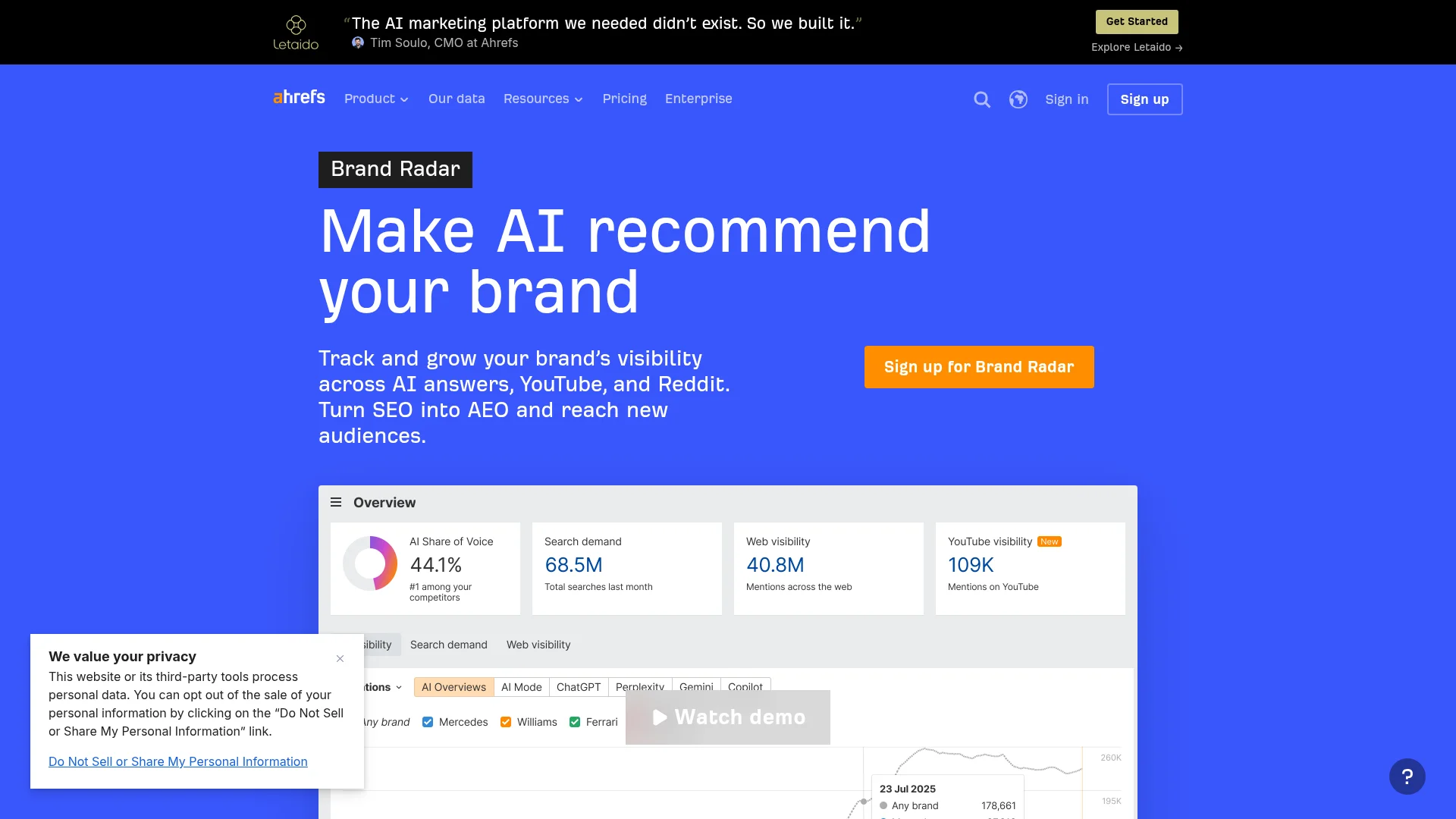
Overview: Ahrefs Brand Radar supports brand monitoring, AI mention analysis, and competitor analysis across currently supported indexes and surfaces.
Key features: It connects brand intelligence and AI visibility data with the wider Ahrefs research ecosystem, letting teams view AI citation data alongside traditional SEO metrics.
Best for: In-house teams and agencies already standardized on Ahrefs for conventional SEO research.
Verdict: Choose it when consolidating brand intelligence and established SEO data inside Ahrefs matters more than gaining a new content workflow. For a full agency-buyer breakdown, see the Ahrefs Brand Radar review linked in the comparison table above.
3. Profound
Profound is an enterprise-oriented platform for analyzing brand performance within AI-generated answers. It has positioned itself as a category leader in generative engine optimization, with substantial venture backing and a focus on Fortune 500 organizations.
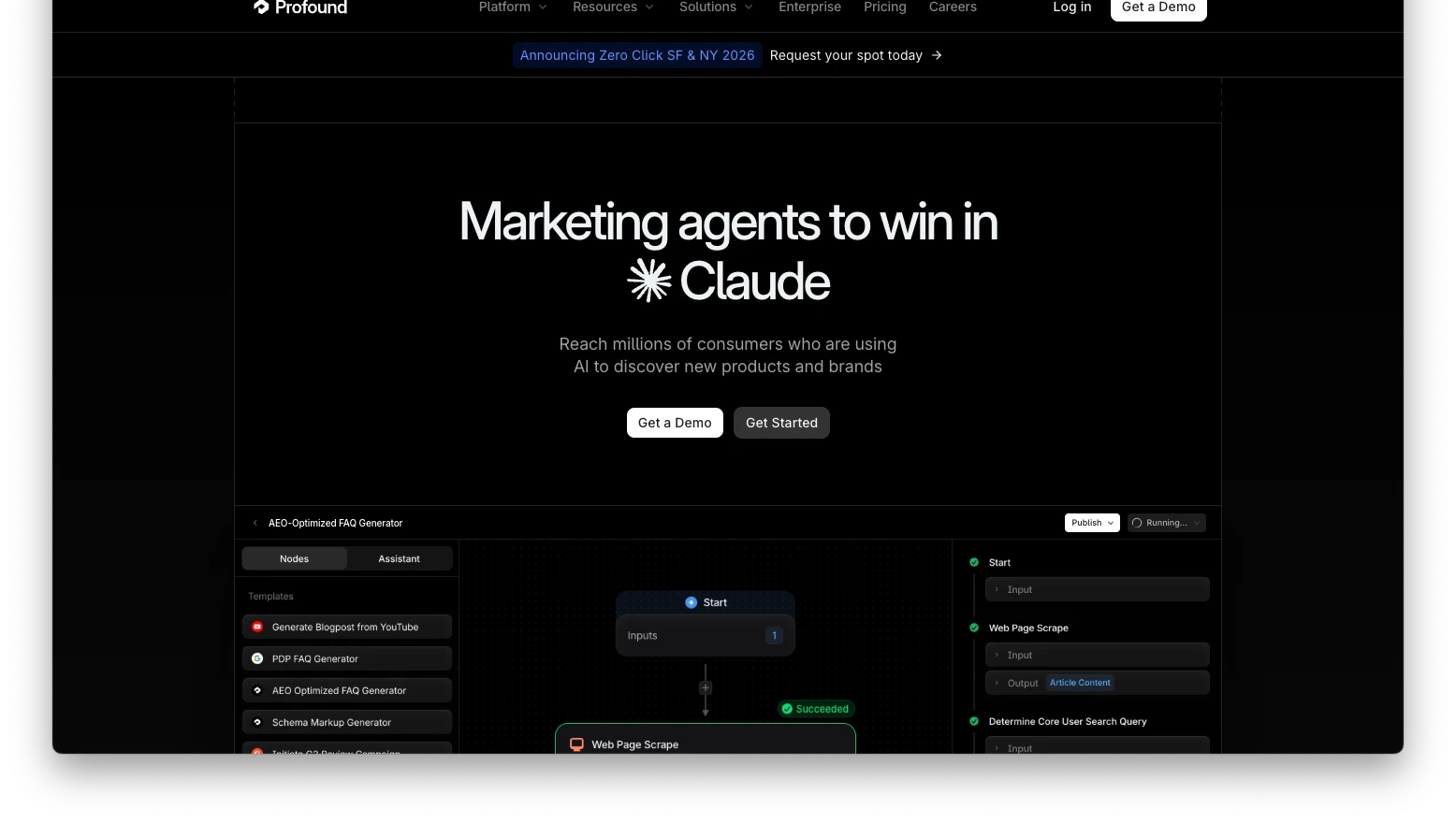
Overview: Documented capabilities include brand mentions, citations, answer monitoring, and competitive intelligence. Brand mentions and citations are distinct metrics: a mention names a brand, while a citation links to a source.
Key features: Profound offers Conversation Explorer, AI Visibility Dashboard, and Workflows that connect monitoring to content generation — along with deep integrations including Google Analytics and major cloud platforms.
Best for: Larger organizations with extensive measurement, governance, integration, or prompt-analysis requirements.
Verdict: Consider Profound when enterprise analytics and prompt intelligence outweigh the need for integrated writing and optimization. For an agency-focused breakdown of pricing and where it fits, see the Profound AI review linked in the comparison table above.
4. SEMrush AI Visibility Toolkit
SEMrush extends an established search marketing suite into AI visibility and competitive measurement. For teams already living in SEMrush, it offers a lower-friction path into AI monitoring without adopting a separate platform.
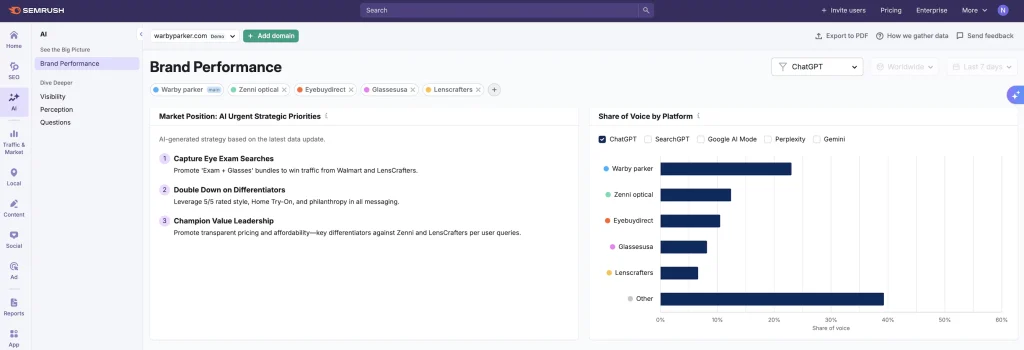
Overview: Depending on the plan, teams can combine AI visibility reporting with keyword research, site audit functions, content tools, and competitor analysis inside a familiar SEMrush interface.
Key features: Business Landscape reports, Brand Performance reports, Audience & Content query themes, and AI-generated recommendations give agencies a macro view of AI visibility.
Best for: Organizations that already manage SEO projects and reporting through SEMrush.
Verdict: SEMrush offers existing customers a lower-friction route into AI measurement, although subscription complexity deserves review before committing. The full agency breakdown — including pricing and data methodology concerns — is in the Semrush AI Toolkit review linked in the comparison table above.
5. AthenaHQ
AthenaHQ focuses on how brands, competitors, and sources appear within generative search answers. Founded by former Google Search and DeepMind engineers, it brings technical depth to AI visibility monitoring.
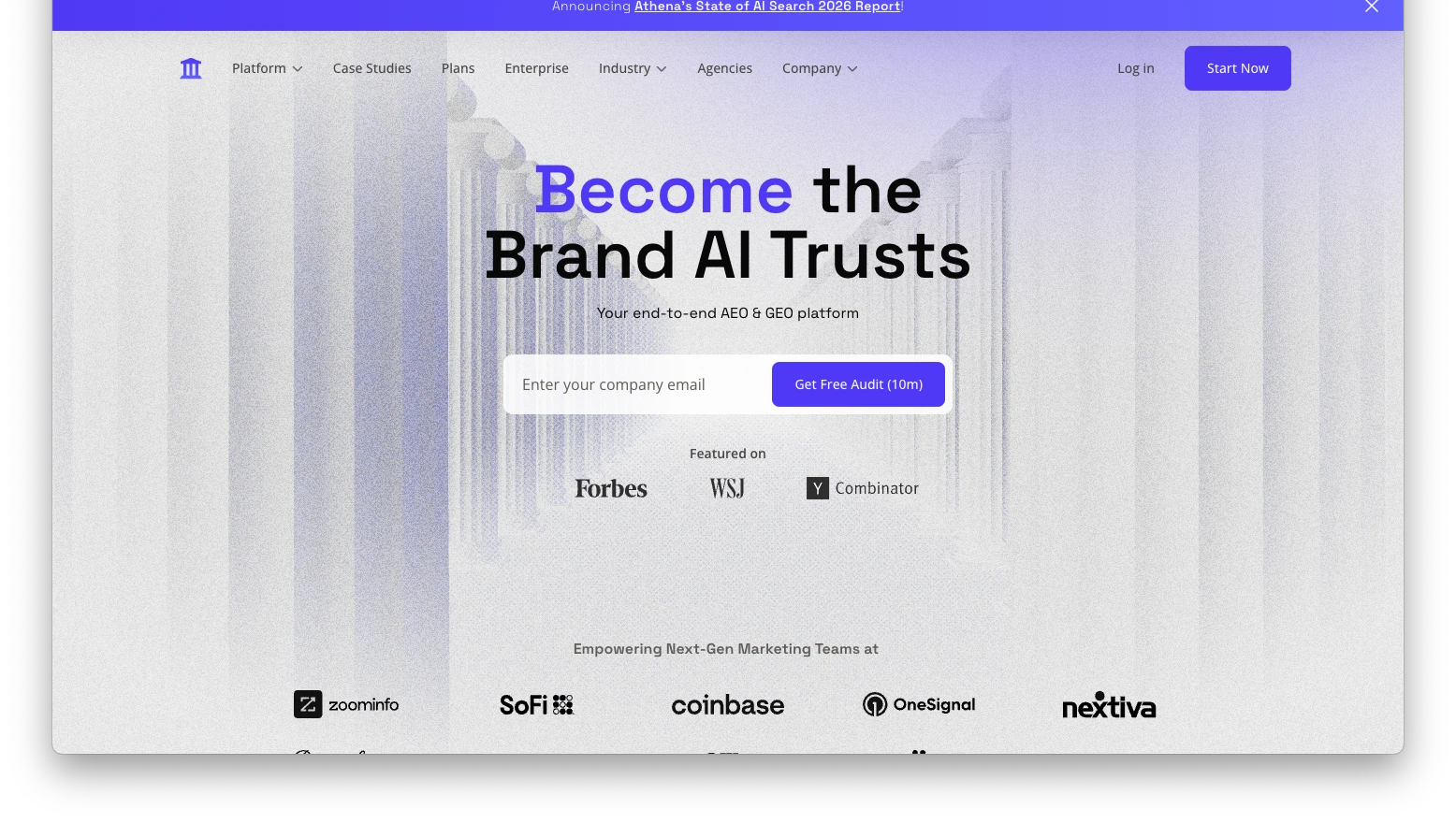
Overview: AthenaHQ’s current offering covers model monitoring, prompt tracking, citation analysis, and recommendations for improving brand visibility in AI search.
Key features: Source Intelligence, sentiment analysis, competitor benchmarking, and the Olympus dashboard provide a comprehensive picture of AI answer presence.
Best for: Teams seeking a dedicated generative engine optimization platform rather than a broad SEO production suite.
Verdict: AthenaHQ is a focused candidate when AI answer analytics take priority over integrated conventional SEO work. Pricing details and an agency-specific value verdict are in the AthenaHQ AI review linked in the comparison table above.
6. Peec AI
Peec AI provides AI search analytics with an emphasis on market, language, and competitor visibility. Its multilingual coverage makes it particularly relevant for agencies and brands operating across multiple countries.
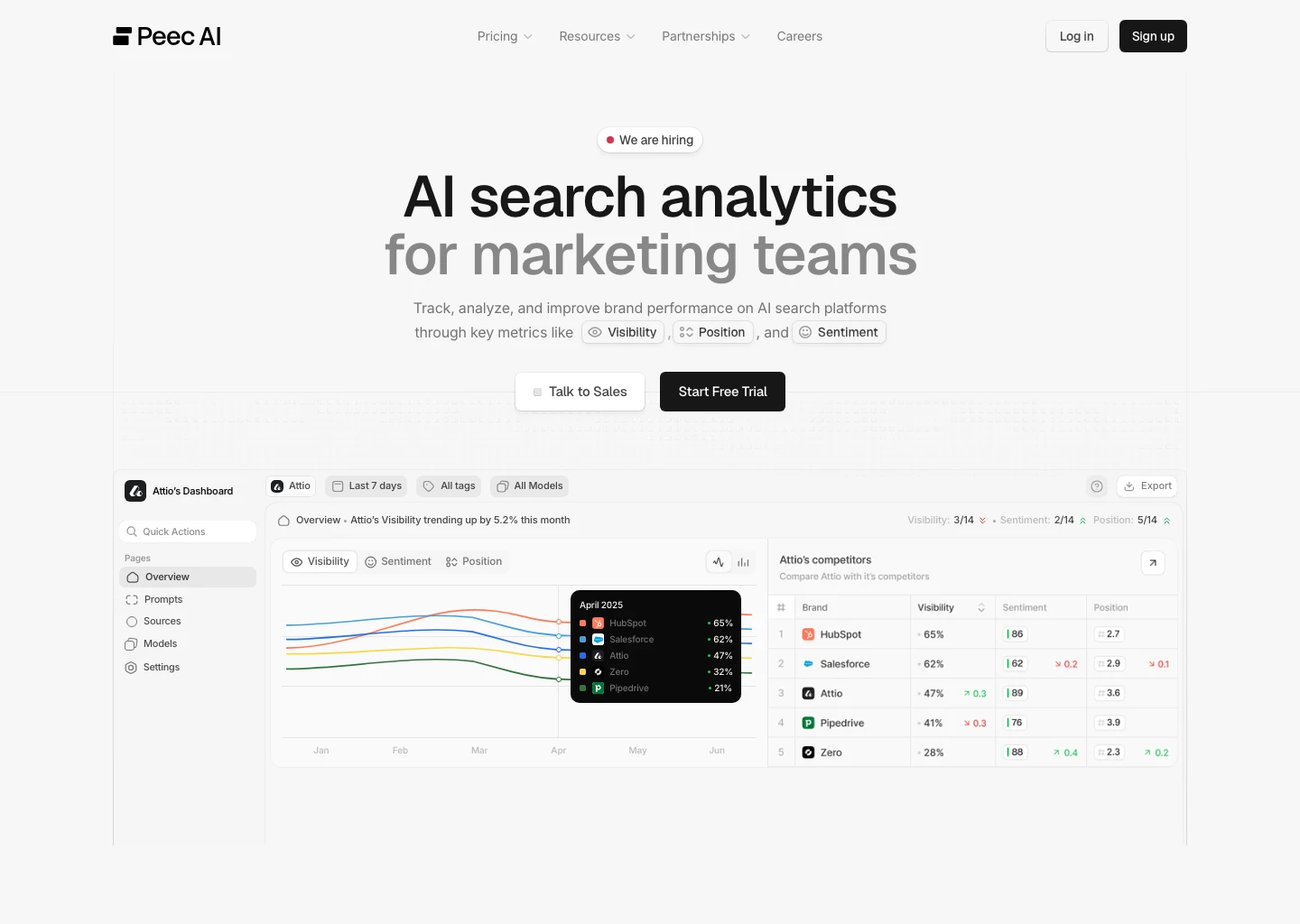
Overview: Peec AI tracks prompt-level performance, competitors, and visibility across AI engines including ChatGPT, Perplexity, Gemini, Claude, and Google AI Overviews. Its multilingual coverage spans more than 115 languages and 80+ regions.
Key features: Brand Visibility Tracking, Competitive Benchmarking, Prompt-Level Insights, Real-Time Analytics, and a Mentions Feed give agencies granular data on AI search presence.
Best for: Global brands and agencies evaluating AI search presence across multiple countries or languages.
Verdict: Peec AI deserves consideration when international coverage is a deciding requirement rather than a secondary feature. The agency-focused breakdown of pricing and workflow fit is in the Peec AI review linked in the comparison table above.
7. Otterly AI
Otterly AI offers a streamlined method for monitoring brand visibility in AI-generated search results. It’s purpose-built for AI search analytics, with strong early user reviews and a prompt-based pricing model that suits smaller teams.
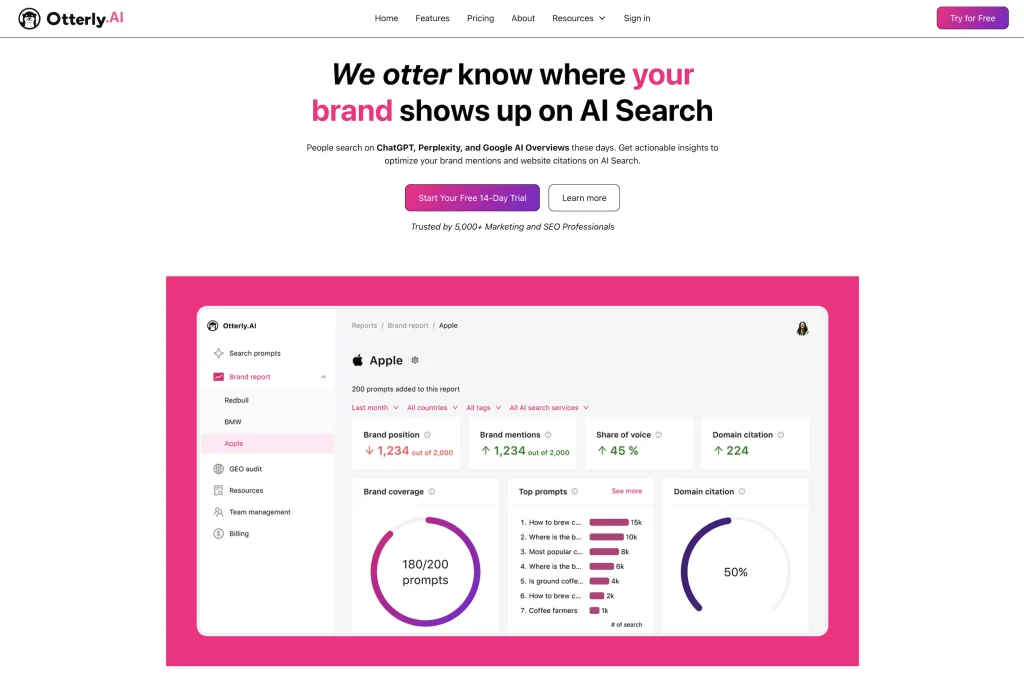
Overview: Otterly AI’s features include prompt-history tracking, brand mentions, citation sources, competitor benchmarking, and exportable reporting. It monitors ChatGPT, Perplexity, Google AI Overviews, Google AI Mode, Gemini, and Microsoft Copilot.
Key features: Search Prompt Monitoring, Brand Reports, Brand Visibility Index, Domain Ranking & Analytics, and GEO Audit tools cover the core monitoring use case efficiently.
Best for: Smaller teams that need direct AI search monitoring without a large implementation footprint.
Verdict: Otterly AI fits monitoring-focused buyers, but agencies may still need separate SEO production and reporting software. The full feature breakdown and pricing details are in the Otterly AI review linked in the comparison table above.
8. LLM Pulse
LLM Pulse is a dedicated platform for assessing brand visibility across supported large language models. It focuses specifically on multi-model comparison, letting teams see how their presence differs between ChatGPT, Gemini, Perplexity, and other AI platforms.
Overview: Buyers should evaluate model coverage, prompt monitoring, visibility dashboards, answer evidence, and competitive insights against the specific models relevant to their clients.
Key features: Multi-model visibility comparison and competitive monitoring are the core differentiators, particularly for teams whose priority is understanding cross-LLM patterns.
Best for: Teams whose primary objective is comparing visibility patterns among multiple LLMs.
Verdict: LLM Pulse is relevant when broad model monitoring matters more than integrated research, writing, and optimization.
Choose the Right Platform for Your Use Case
Your existing operating model should determine the right platform. A full-service agency has different requirements from an enterprise analytics team, even when both want to measure AI citations.
Full-service agencies: Rankability is the leading choice when you need client-specific planning, content creation, optimization, reporting, traditional rank tracking, and AI visibility in one place.
Enterprise brands: Profound may fit organizations requiring extensive prompt intelligence, custom analytics, governance, or sales-led support.
Global teams: Peec AI warrants attention when multilingual and international SEO monitoring requirements drive the purchase.
Existing SEO-suite customers: Ahrefs Brand Radar and SEMrush can reduce adoption friction when teams already rely on those ecosystems.
Lean monitoring teams: Otterly AI, LLM Pulse, or AthenaHQ may provide a narrower measurement layer without replacing the existing SEO stack.
A controlled trial is more informative than a vendor demo built around different assumptions. Test each platform with the same prompt set, competitors, models, markets, languages, refresh period, and reporting requirements so that coverage and usability can be compared on equivalent terms.
Decision Guide: When Rankability Is the Better Fit
Rankability is the better fit when you manage many client accounts and need consistent planning, writing, optimization, reporting, and advisory processes. Its integrated workflow helps prevent prompt findings, content tasks, and performance evidence from becoming separate operational records.
It is also appropriate when clients expect visibility across Google and AI platforms without receiving several disconnected reports. White-label reporting and API access can reduce manual assembly, while client knowledge bases and weekly Serena recommendations help teams maintain account-specific direction.
For a broader view of the best AI search visibility tracking tools, our roundup compares the full category across engine coverage, sampling cadence, citation transparency, and pricing.
When a Specialist AI Visibility Platform Is the Better Fit
A specialist platform makes more sense when you already have content, technical SEO, rank tracking, project management, and reporting systems that you intend to retain. In that situation, the new product only needs to add reliable prompt, mention, answer, competitor, and citation monitoring.
Enterprise buyers may also need a specific language, market, model set, data export, or integration that one specialist supports more deeply. Specialized coverage can justify another platform when the resulting data fits an established process rather than creating an isolated dashboard.
Questions to Ask Before Switching From Scrunch AI
A platform switch changes historical continuity, reporting, team processes, and possibly client expectations. Ask vendors to demonstrate your actual workflow rather than presenting generic visibility charts.
Which AI systems are measured? Confirm the supported models, interfaces, locales, languages, devices, and geographic settings because a model name alone does not define the test environment.
How frequently is data refreshed? Daily, weekly, and on-demand measurements can produce different operational value and substantially different usage requirements.
Can you inspect the underlying evidence? Every score should lead back to the prompt, generated answer, citation, competitor, model, location, and collection time.
How are prompts selected? Determine whether the platform uses customer-defined prompts, discovered topics, estimated demand, synthetic prompt sets, or a combination.
Can findings become production work? Ask whether the system turns gaps into content briefs, optimization assignments, writing tasks, and prioritized recommendations.
Does it support multiple clients cleanly? Review workspace separation, permissions, templates, account-specific knowledge, and bulk management before migrating.
What reporting functions are included? Test white-label reports, scheduled delivery, exports, annotations, date comparisons, and the clarity of client-facing explanations.
Is API access available on your plan? Confirm endpoints, rate limits, data retention, authentication, and additional fees rather than assuming an advertised API covers every dataset.
What are the real usage constraints? Prompt counts, model runs, competitors, markets, users, clients, and refresh frequency may matter more than the headline subscription price.
Can historical data be exported? Preserving Scrunch AI records gives your agency a baseline and prevents the migration from erasing useful evidence.
The final evaluation should include production staff and account managers, not only analysts. A technically detailed platform can still fail if writers cannot convert findings into work or client teams cannot explain the resulting reports.
Final Verdict: The Best Alternative for Most Agencies
Rankability is the top Scrunch AI alternative for most agencies because it combines traditional SEO, content execution, client reporting, and AI search visibility within a repeatable operating system. Its practical advantage is a repeatable, end-to-end workflow from planning to proof rather than a monitoring layer that leaves implementation elsewhere.
That recommendation is not universal. Profound can better suit enterprise analytics, Peec AI can serve international SEO requirements, Ahrefs Brand Radar and SEMrush can fit existing suite customers, and AthenaHQ, Otterly AI, or LLM Pulse may suit teams seeking focused AI measurement.
Choose according to the work your agency must perform after identifying a visibility gap. A single AI visibility metric has limited value unless your team can inspect its evidence, decide what should change, execute that work, and show clients whether performance moved.
For context on what to budget for any of these platforms, our guide on how much to pay for AI search visibility tracking tools benchmarks the full category against agency use cases.
FAQs
What’s the best Scrunch AI alternative for agencies?
For most agencies, the best fit is the tool that balances multi-client reporting, competitive benchmarking, and actionable workflow support. In this list, Rankability, Peec AI, and AthenaHQ are the strongest agency-oriented options.
What’s the best Scrunch AI alternative for startups?
Otterly AI and LLM Pulse are the most obvious startup-friendly options in this group if your priority is lower cost and less operational overhead.
Which Scrunch AI alternatives track Google AI Overviews?
Several tools in this list position around Google AI Overviews or broader AI visibility coverage. Rankability, AthenaHQ, Otterly AI, and Peec AI are the clearest current fits for teams evaluating Google plus AI-platform tracking together.
Are there lower-cost alternatives to Scrunch AI?
Yes. Otterly AI is the clearest lower-cost option in this comparison. Peec AI and AthenaHQ sit closer to the mid-market range depending on plan structure.
Do any Scrunch AI alternatives offer better API support or region-based reporting?
That depends on your exact workflow, but these are valid evaluation criteria. For teams that need region-based prompts, country coverage, or integration-heavy workflows, this should be part of the shortlisting process rather than an afterthought.
Is Scrunch AI still a good platform?
Yes. Scrunch AI is a strong fit for teams that want AI monitoring plus an agent-ready content layer. It becomes a weaker fit when you want a lighter-weight system, faster onboarding, or tighter integration with agency production workflows.
What makes a Scrunch alternative better for agencies?
The best agency fit usually comes down to repeatable reporting, operational simplicity, competitive insight, and a clean path from monitoring to action. Agencies care less about a flashy platform and more about whether the workflow helps them ship results across many accounts.
Methodology and Notes
This list prioritizes tools that address the core agency need for AI search visibility with actionable workflow support. Pricing and engine coverage change frequently, so treat dollar figures as directional and verify details before purchasing.
Free GEO Checklist – Download the complete 97-point checklist to optimize your brand for AI-powered search engines like ChatGPT, Gemini, and Perplexity.