
Need an SEOmonitor alternative? This is the agency hub for that decision. Below you get a ranked shortlist, an agency-intent capability matrix, honest head-to-head breakdowns of SEOmonitor versus the tools agencies actually compare it against, and a clear path to migrate—so you can answer “is this better than SEOmonitor for us?” without reading ten thin comparison posts.
This guide is for agency owners and in-house marketing leads who need a platform they can build a delivery system around. The quick answer is Rankability as the top pick, because its Search Performance Index (SPI) unifies traditional search, local pack, AI answers, AI citations, and video search into one reporting signal—exactly the kind of coverage agencies need when the SEOmonitor model no longer fits. But the honest answer depends on the one job you bought SEOmonitor to do, and this hub is built to match that job to the right replacement.
The tools below were evaluated on practical agency criteria: rank tracking accuracy and update cadence, white-label reporting capability, multi-client workflow support, content operations depth, and whether the platform reflects how search discovery actually works in 2026—including AI search visibility alongside classic SERP data. We also flag where SEOmonitor still beats the field, because pretending it has no strengths helps no one choosing a replacement.
| Tool | Best for | Starting Price | Key Strength |
|---|---|---|---|
| Rankability | Agencies wanting one connected SEO workflow | From $97/mo; plan limits | Unified workflow from research to reporting, with AI search visibility tracking |
| Semrush | Broad competitive research and all-in-one coverage | Pro: $139.95/month | Market-wide data across SEO, PPC, and competitor intelligence |
| Ahrefs | Backlink analysis and content research | Lite: $129/month | Best-in-class link index and clean organic performance data |
| SE Ranking | Value-conscious agencies managing multiple clients | Essential: $65/month | Strong reporting and rank tracking at a lower price point |
| Surfer SEO | Content-led optimization workflows | Essential: $89/month | Real-time content scoring tied to top-ranking competitor pages |
| Clearscope | Content quality and topic authority | Essentials: $170/month | Precise NLP-driven content recommendations for editorial teams |
| AccuRanker | Dedicated rank tracking accuracy | From $129/month | On-demand rank tracking with fast update cycles |
| Advanced Web Ranking | Flexible rank tracking and client reporting | Starter: $49/month | Strong white-label reports with broad SERP feature tracking |
The agency verdict: Pick Rankability if you want one connected workflow that reports on Google and AI search in a client-ready dashboard. Pick Semrush or Ahrefs if competitive research depth is the priority. Pick SE Ranking or Advanced Web Ranking if budget multi-client reporting is the job. Pick AccuRanker for pure rank-tracking accuracy, and Surfer SEO or Clearscope if your bottleneck is content rather than reporting. Be honest about why you’re leaving: if you came to SEOmonitor for its rank-forecasting and agency-grade SERP tracking, that is the one area where it still leads, and you should weigh a replacement on whether you actually used those features or just paid for them.
Agency capability matrix
This matrix scores each tool on the seven things agencies most often ask SEOmonitor to do. SEOmonitor is included as a reference row so you can see exactly what you’d be trading away or upgrading. “Limited” means the capability exists but is shallow, add-on-priced, or not built for multi-client delivery.
| Tool | White-label / branded exports | Multi-client + permissions | Rank tracking | Forecasting | AI / AEO visibility | GA4 / Looker Studio | Agency pricing / seats |
|---|---|---|---|---|---|---|---|
| SEOmonitor (reference) | Yes | Yes | Yes (agency-grade) | Yes (best-in-class) | Limited | GA4 | Custom agency tiers |
| Rankability | Agency and Agency Pro | Yes (plan limits) | Yes | Limited | Yes (9 platforms) | Looker Studio | Client limits by plan; unlimited team members |
| Semrush | Yes (client portal) | Yes | Yes | Limited | Yes (add-on) | GA4 | From $139.95/mo · per-seat |
| Ahrefs | Limited | Limited | Yes | No | Limited (Brand Radar) | GA4 | From $129/mo · limited seats |
| SE Ranking | Yes | Yes | Yes | Limited | Limited | GA4 | From $65/mo |
| Surfer SEO | No | No | No | No | No (content only) | No | From $89/mo |
| Clearscope | No | Team seats | No | No | No (content only) | No | From $170/mo · team seats |
| AccuRanker | Yes | Yes | Yes (fastest) | No | Limited (AI Overviews) | GA4 / GSC | From $129/mo |
| Advanced Web Ranking | Yes | Yes | Yes | No | Limited | GA4 | From $49/mo |
Capabilities verified June 2026; confirm current details on each vendor’s site.
1. Rankability — Best for agencies wanting a complete SEO workflow
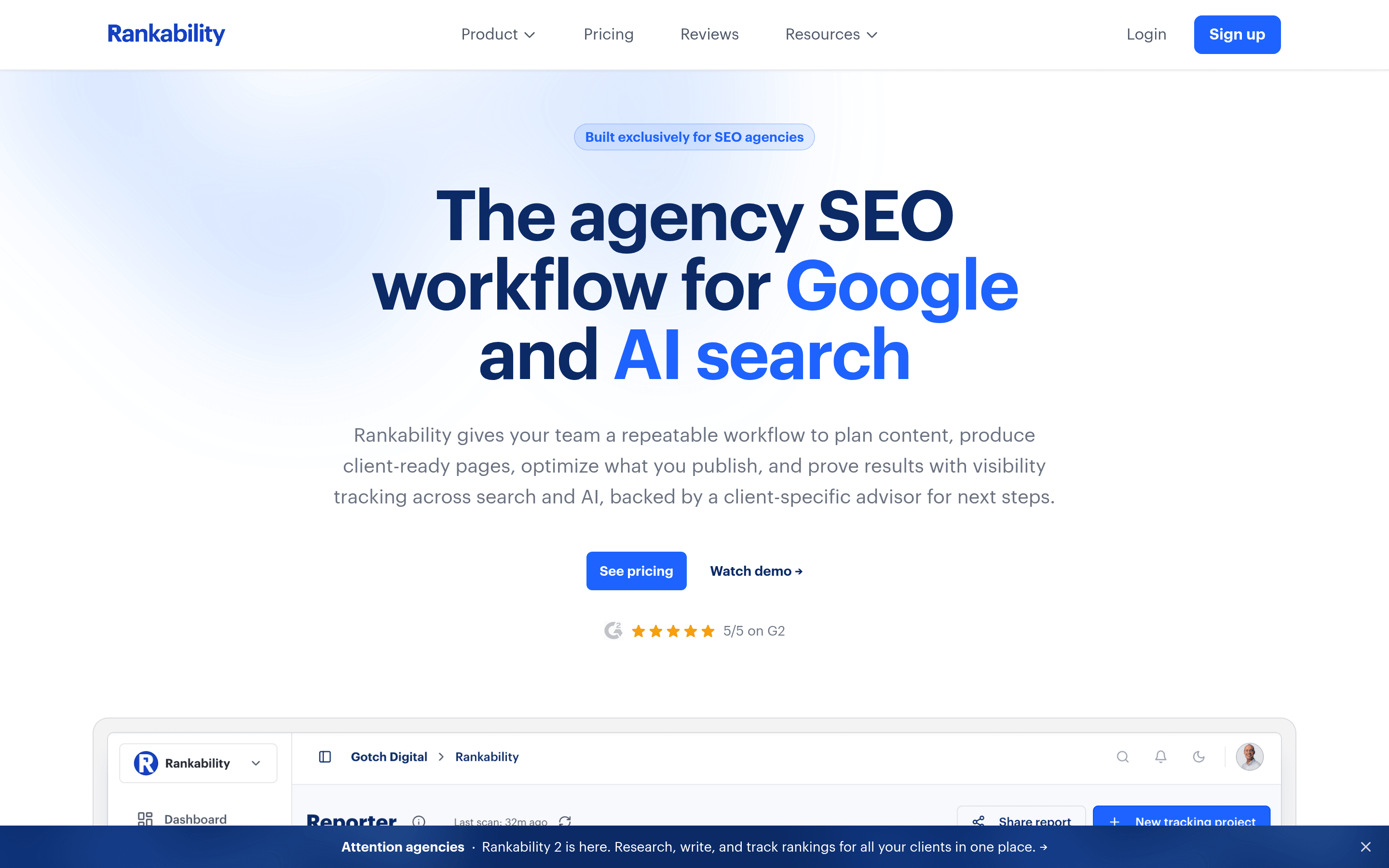
Rankability’s Search Performance Index (SPI)—the metric that unifies traditional search, local pack, AI answers, AI citations, and video search into one number—makes it the strongest fit for agencies that want one connected workflow from planning to proof. It replaces scattered tools with integrated keyword research, content brief generation, content optimization, reporting, and advising, while also tracking visibility in ChatGPT and Gemini. That combination is what separates it from rank trackers or content suites that only solve one part of the delivery problem.
The platform is built for agencies that manage multiple clients and want a unified workflow for Google and AI search. Unlike broad suites where modules don’t hand off cleanly to the next step, Rankability connects the full delivery sequence—from keyword research and keyword clustering through brief generation, AI content writer support, optimization, and client-ready reporting—inside one system. That sequence matters because agency workflow consistency often determines margin more than any single ranking metric.
Key features:
- Search Performance Index (SPI) combining traditional, local, AI answer, citation, and video visibility into one score
- AI search visibility tracking across ChatGPT and Gemini
- Content brief generation and AI content writer support
- White-label reporting and API access for scale
- Weekly SEO plan structure with client-specific recommendations
Pricing: Starter is $97/month, Agency $297/month, and Agency Pro $497/month. Annual totals are $970, $2,970, and $4,970. All paid plans include unlimited client workspaces, unlimited team members, branded reports, and API/MCP access. Content allowances are 20, 80, and 160 projects per month; tracked AI query allowances are 100, 300, and 500, respectively, across all 11 included AI platforms. Google keyword tracking and Local Pack scans have separate allowances. Gotch Inner Circle is included with Agency Pro annual plans. Get Started.
Ideal for: Agencies managing multiple clients that want a standardized workflow for research, content, reporting, and AI search visibility in one platform.
Bottom line: Rankability is the strongest fit if your biggest issue is inconsistent delivery across accounts—it solves process friction more directly than a broad suite.
2. Semrush — Best for broad competitive research and all-in-one coverage
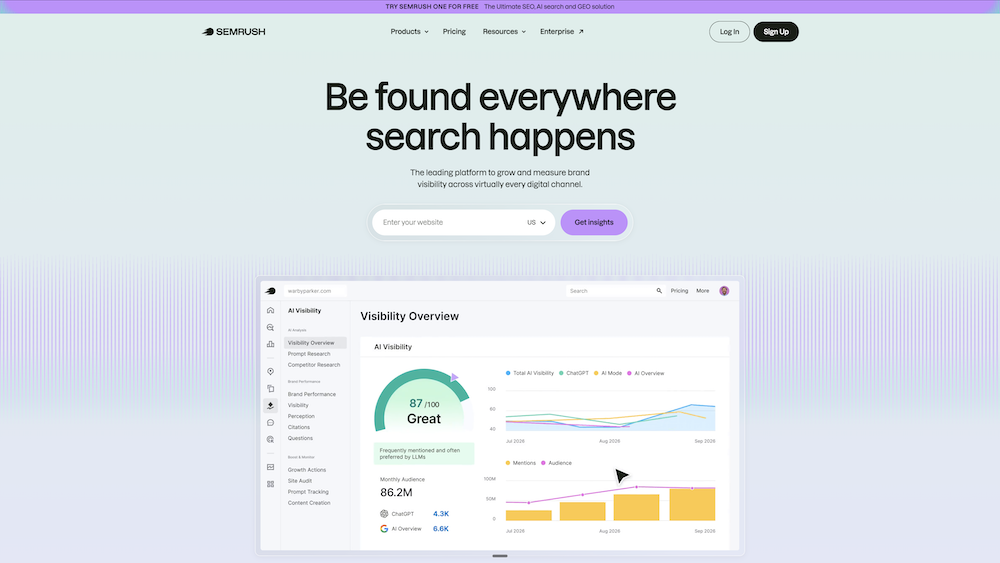
Semrush is a broad SEO suite with strong keyword research, competitor analysis, backlink analysis, and technical SEO audit features. It is a better fit than SEOmonitor when your team needs market-wide data for pitching, research, and cross-channel visibility. Its reporting strength is not just the volume of data but the number of ways you can package it—My Reports, integrations, and client-facing dashboard options make Semrush especially useful for agencies that need recurring, semi-automated reporting without rebuilding templates every month.
Semrush is often selected when research depth matters more than workflow standardization. Agencies that prioritize competitive datasets and broad SEO coverage will find it provides the raw intelligence needed for strategy decks and new-business pitches, though teams looking for a structured delivery workflow may still need additional tooling for content operations and brief generation.
Key features:
- Large keyword research database with competitor gap analysis
- Backlink analytics and technical SEO audit tooling
- My Reports builder for custom SEO and marketing reports
- Position Tracking with SERP feature and competitor comparison
- Client Portal option for stakeholder access
Pricing: Pro: $139.95/month; Guru: $249.95/month; Business: $499.95/month
Ideal for: Agencies that prioritize competitive datasets and broad SEO coverage across research, auditing, and reporting.
Our take: Semrush is the safest all-around choice when research depth matters more than workflow standardization—accept that you may still need extra tools for delivery consistency.
3. Ahrefs — Best for backlink analysis and content research
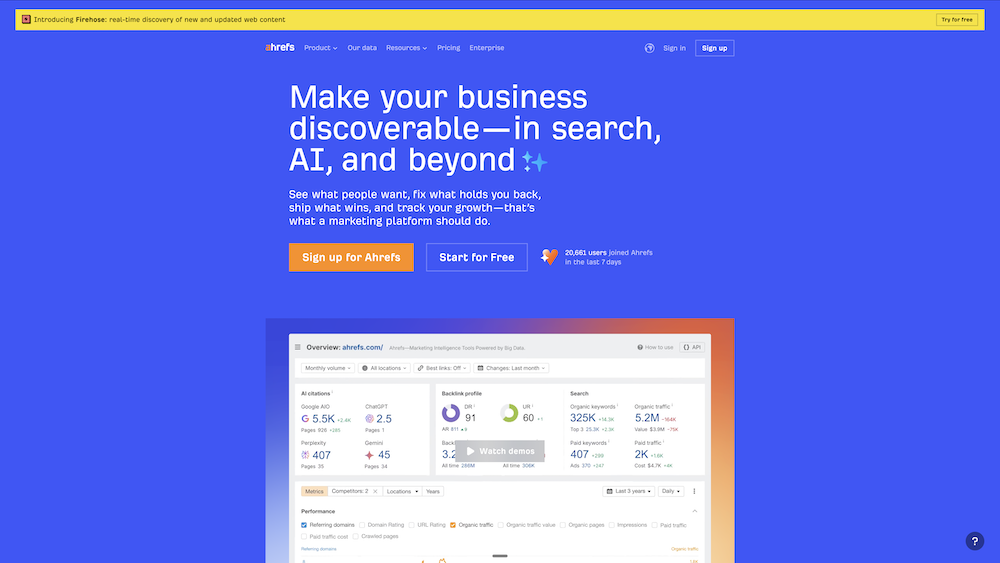
Ahrefs is especially strong in backlink analysis and content research, making it a reliable SEOmonitor alternative when your team needs accurate link data alongside organic performance reporting. Its backlink index remains one of the platform’s defining assets, and that gives reports more strategic weight when keyword changes are driven by off-page improvements rather than on-page edits alone. The interface is also cleaner than many enterprise-style platforms, which helps when clients need less noise and more signal.
Ahrefs works best for teams that already think in terms of pages, links, and search demand patterns, because its reports are strongest when interpreted through that lens. Agencies that center their strategy around link acquisition and content gap analysis will find Ahrefs more focused than a broader suite, though it does not include the content brief generation or optimization workflow that agencies running content-led retainers typically need.
Key features:
- Rank Tracker with scheduled visibility and SERP feature reporting
- Site Explorer for backlink and organic performance data
- Content Explorer for gap analysis and content opportunity research
- Competitive comparison across domains and pages
- Clear historical trend views for rankings and links
Pricing: Lite: $129/month; Standard: $249/month; Advanced: $449/month; Enterprise: $1,499/month
Ideal for: SEO teams that want reporting anchored in backlink intelligence and content performance data.
Why it stands out: Ahrefs gives reports stronger explanatory power when link equity and page-level competition are central to the client story.
4. SE Ranking — Best for value-conscious agencies managing multiple clients
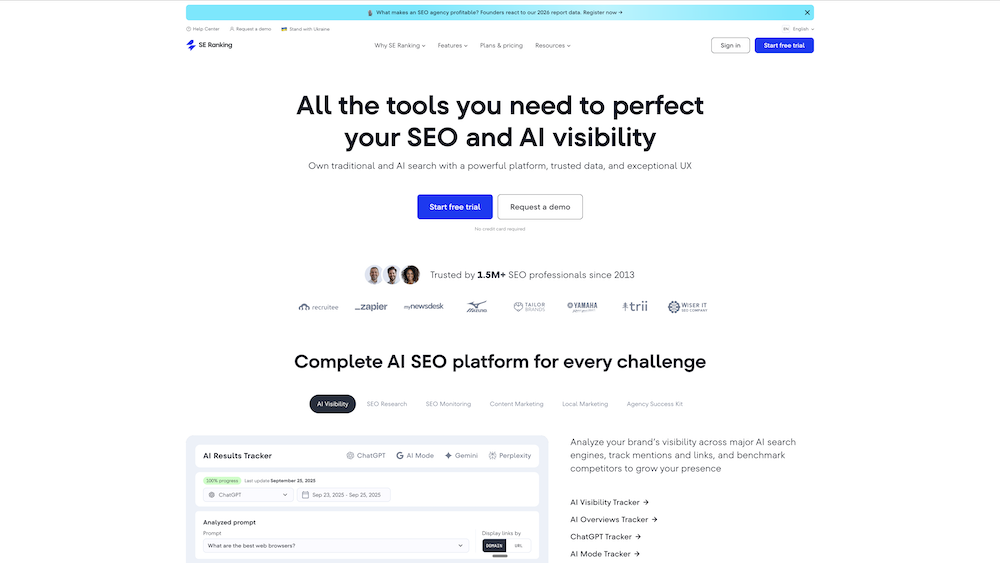
SE Ranking has improved steadily into a credible platform for agencies and smaller teams that need strong coverage without premium-suite pricing. Its mix of rank tracking, website audit data, competitor monitoring, and report automation gives you enough depth to build useful client narratives without paying enterprise-level rates. For teams managing many local or mid-market campaigns, SE Ranking often hits the balance point where reporting is detailed enough for professional use but simple enough to deploy quickly across accounts.
The value proposition is not just lower cost but lower compromise than many budget tools. SE Ranking includes white-label reporting, Google Analytics and Search Console integrations, and multi-location tracking—which covers the core agency requirements without forcing you into an expensive all-in-one suite when you only need a reliable tracker and clean reports.
Key features:
- Keyword rank tracking with local, mobile, and desktop support
- Automated white-label SEO reports
- Website audit and competitor research modules
- Google Analytics and Google Search Console integrations
- Multi-client project management with tags and permissions
Pricing: Essential: $65/month; Pro: $119/month; Business: $259/month
Ideal for: Small and mid-size agencies that want capable rank tracking and reporting at a moderate price point.
The verdict: SE Ranking is one of the strongest budget-to-capability options for teams that need scalable reporting without overbuying.
5. Surfer SEO — Best for content-led optimization workflows
Surfer SEO is a strong SEOmonitor alternative for agencies whose primary bottleneck is content—specifically, producing optimized drafts at scale and scoring existing pages against what’s ranking. Its Content Editor provides real-time feedback during writing, and its scoring system is tied directly to competitor page analysis rather than abstract guidelines. That makes it practical for agencies with writers and content managers who need a clear optimization target on every piece.
Where Surfer SEO falls short as a complete SEOmonitor replacement is on the reporting and rank tracking side—it is a content optimization tool first, not an agency delivery platform. Teams that need to replace SEOmonitor’s forecasting, share of voice, and client reporting will still need a dedicated rank tracker or reporting platform alongside Surfer. It fits best in a stack where the reporting layer is already covered.
Key features:
- Real-time content scoring tied to top-ranking competitor pages
- Content Editor with NLP-driven keyword recommendations
- SERP Analyzer for understanding what competitors do on-page
- Keyword research and content clustering tools
- Content audit for optimizing existing pages
Pricing: Essential: $89/month; Scale: $129/month; Scale AI: $219/month
Ideal for: Content-led agencies that need real-time optimization guidance during writing and already have reporting covered elsewhere.
Worth noting: Surfer SEO solves content quality problems, not reporting problems—make sure you pair it with a rank tracking platform if you’re replacing SEOmonitor’s tracking capabilities.
6. Clearscope — Best for content quality and topic authority
Clearscope is a precision content optimization tool that fits agencies and editorial teams that prioritize topic comprehensiveness and content quality over speed. Its NLP-driven recommendations are grounded in what top-ranking pages actually cover, and the interface is clean enough that editors and writers can use it without SEO expertise. For agencies that sell content quality as a differentiator, Clearscope provides a defensible scoring system that clients can see directly.
Like Surfer SEO, Clearscope is not a rank tracker or reporting platform—it does not replace SEOmonitor’s forecasting, share of voice, or client delivery features. Its value is upstream: improving content before it is published rather than measuring performance after the fact. Teams that need both content optimization and client reporting will need to combine it with a dedicated tracker and reporting tool.
Key features:
- NLP-driven content grade tied to top-ranking competitor pages
- Keyword and topic recommendations organized by relevance and importance
- Google Docs and WordPress integrations for in-workflow optimization
- Content inventory reports for auditing existing pages
- Team accounts with usage tracking across writers
Pricing: Essentials: $170/month; Business: Contact for pricing
Ideal for: Editorial teams and content-led agencies that want rigorous topic coverage standards and a clean optimization interface.
Our take: Clearscope is the right fit when content quality is the core differentiator—but plan to add a separate rank tracking and reporting platform to cover what SEOmonitor did.
7. AccuRanker — Best for dedicated rank tracking accuracy
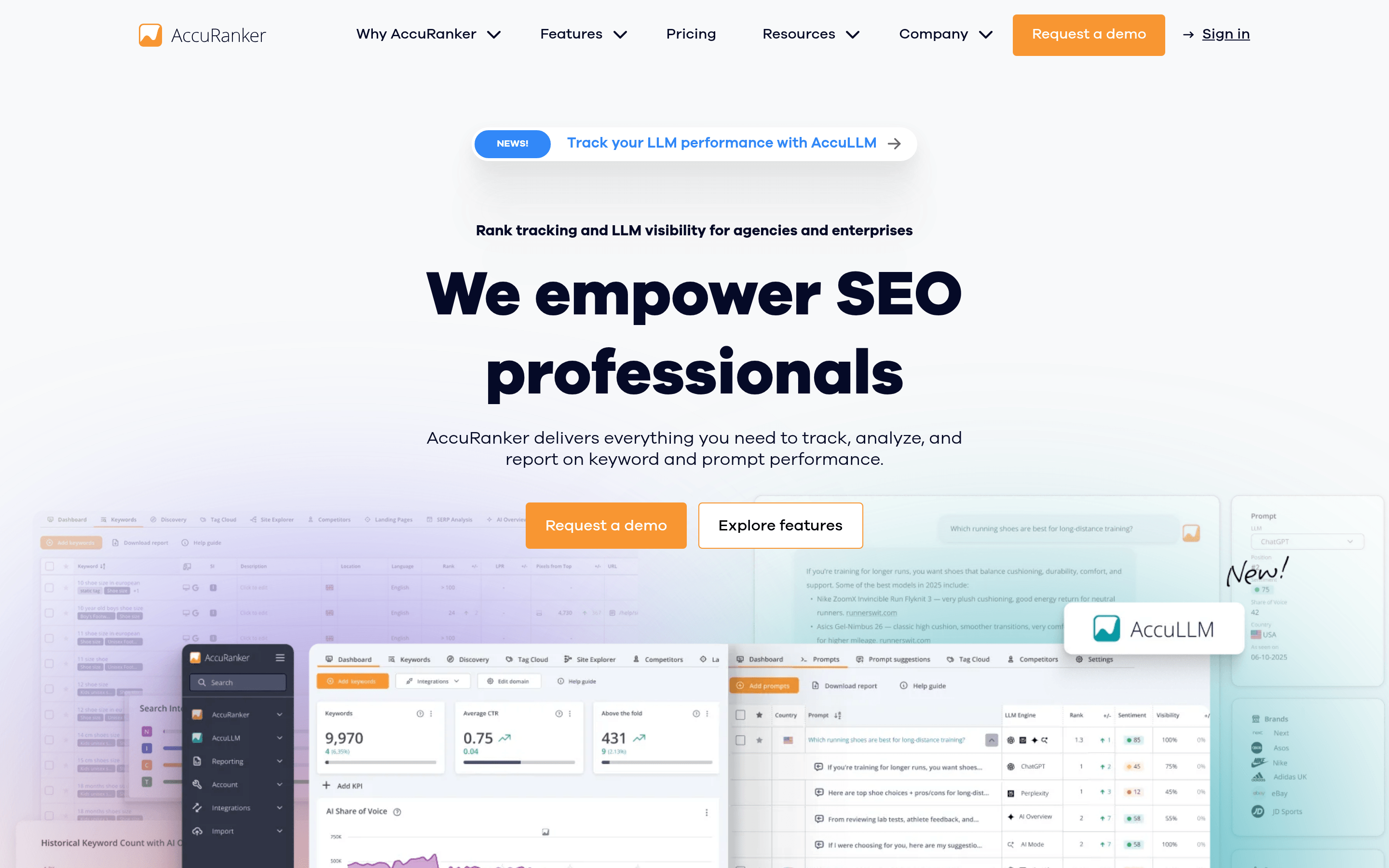
AccuRanker is one of the most accurate dedicated rank trackers on the market, and it is the clearest fit for agencies where rank tracking frequency and precision are the primary pain point. Its on-demand refresh feature lets teams pull updated rankings at any time rather than waiting for a scheduled crawl, which matters during site migrations, post-update monitoring, and active campaign periods. Update cadence and accuracy are AccuRanker’s core differentiators.
The trade-off is that AccuRanker is a specialist tool—it tracks rankings exceptionally well but does not include content brief generation, AI content writer support, optimization scoring, or the kind of workflow integration that replaces a full delivery platform. Teams replacing SEOmonitor primarily for its rank tracking features will find AccuRanker a strong upgrade on that specific dimension, with the understanding that reporting and content operations will need separate tooling.
Key features:
- On-demand rank tracking with fast refresh cycles
- SERP feature tracking including Featured Snippets, local pack, and AI Overviews
- Multi-location and multi-device tracking
- API access for integrating rank data into custom dashboards
- White-label reporting for client delivery
Pricing: From $129/month for 1,000 keywords (scales by keyword volume)
Ideal for: Agencies where rank tracking accuracy and update cadence are the primary pain point and content operations are handled by separate tooling.
Best if you need: AccuRanker is the strongest choice when daily or on-demand rank data accuracy is non-negotiable and you already have a reporting and content workflow in place.
8. Advanced Web Ranking — Best for flexible rank tracking and client reporting
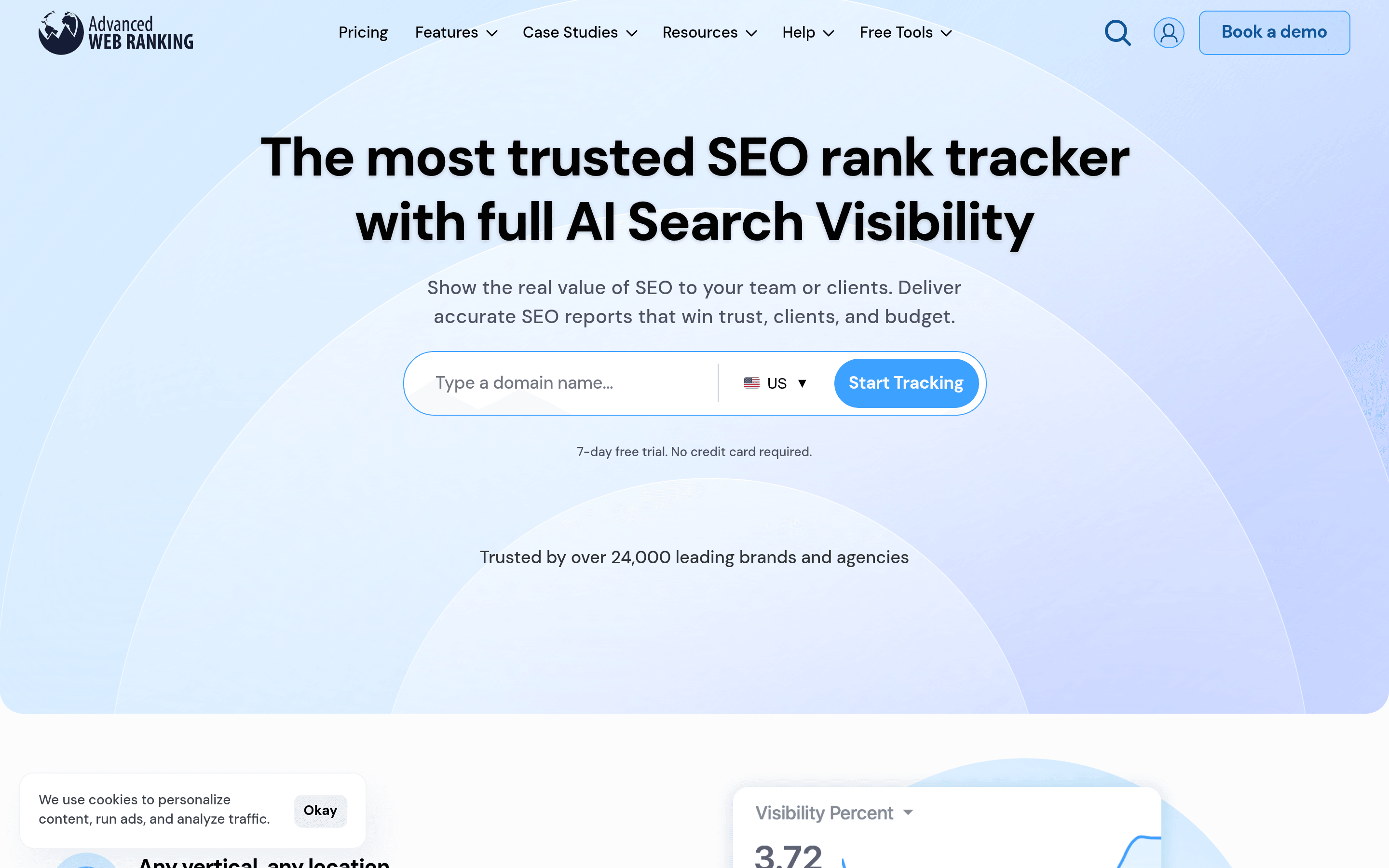
Advanced Web Ranking has been a rank tracking and reporting platform for agencies for over two decades, and its longevity reflects genuine utility rather than brand inertia. It tracks keywords across Google, Bing, Yahoo, and local search, supports white-label reporting with considerable template flexibility, and connects to Google Analytics and Google Search Console for blended performance data. For agencies replacing SEOmonitor’s reporting continuity, Advanced Web Ranking offers a mature alternative with a lower entry price than most suites.
Where it differs from a workflow platform is scope: Advanced Web Ranking tracks and reports, but it does not generate content briefs, score content, advise on weekly priorities, or track AI search visibility. Teams whose SEOmonitor dependency was primarily rank tracking and scheduled client reporting will find it a focused and cost-effective replacement; those who also relied on SEOmonitor’s forecasting or content workflow features will need to evaluate whether the gap can be filled elsewhere.
Key features:
- Keyword rank tracking across multiple search engines and locations
- White-label client report templates with flexible branding
- SERP feature tracking and visibility trend reporting
- Google Analytics and Google Search Console integrations
- Scheduled automated reports for recurring client delivery
Pricing: Starter: $49/month; Standard: $99/month; Premium: $199/month; Agency: $499/month
Ideal for: Agencies that need reliable rank tracking and polished white-label client reports at a mid-range price point.
The verdict: Advanced Web Ranking is a mature, cost-effective option when rank tracking and scheduled reporting are the core requirements—and when content operations and AI visibility are handled elsewhere.
How We Chose the Best SEOmonitor Alternatives
This list prioritized practical agency fit over feature breadth. A platform scored higher if it could reliably replace what agencies actually use SEOmonitor for: rank tracking accuracy and update cadence, white-label reporting at scale, multi-client workflow management, and some combination of content operations or AI search visibility tracking.
We evaluated each tool on six factors: rank tracking accuracy, reporting depth and white-label capability, content operations support (brief generation, optimization, and scoring), AI search visibility coverage, multi-client workflow design, and pricing transparency. That framework matters because a platform that excels at one dimension—say, backlink data or content scoring—does not automatically make a strong SEOmonitor replacement if it cannot also support the reporting cadence agencies depend on.
We also considered how each platform reflects the current shape of search. Classic SERP tracking still matters, but AI answer visibility, citation presence in tools like ChatGPT and Gemini, and local pack coverage now influence how agency clients measure discovery, so platforms that acknowledge those surfaces earned stronger placement in this evaluation.
SEOmonitor vs Surfer SEO
These two rarely overlap, which is exactly why agencies confuse them. SEOmonitor is a rank-tracking, forecasting, and reporting platform; Surfer SEO is a content optimization tool. If your reason for leaving SEOmonitor is “our content isn’t ranking,” Surfer is the better buy, because its Content Editor scores drafts against the pages currently ranking and gives writers a concrete target. But Surfer cannot replace SEOmonitor’s tracking, share of voice, or client reporting, so on its own it is a downgrade for an agency that reports to clients monthly. Be honest about the swap: SEOmonitor still wins on rank forecasting and SERP tracking depth, while Surfer wins only on the writing surface. The cleaner agency answer is a platform that does both—Rankability pairs content scoring with tracking and white-label reporting, and its on-page content optimization covers the job Surfer does without leaving a reporting gap. If you’re set on a pure content tool, weigh the field in our Surfer SEO alternatives breakdown first.
SEOmonitor vs SE Ranking
This is the most common “alternative to SEOmonitor” matchup because SE Ranking targets the same agency buyer at a lower price. SE Ranking gives you rank tracking, white-label reports, multi-client projects with permissions, and GA4/GSC integrations for a fraction of SEOmonitor’s cost, which makes it the obvious pick when budget is the constraint and you don’t lean on forecasting. Where SEOmonitor is still better than SE Ranking is forecasting precision and the polish of its agency reporting narrative—SE Ranking is capable but less opinionated about turning rankings into a client story. For agencies that want SE Ranking’s value but with AI search visibility and a single composite score built in, Rankability is the upgrade path. See the wider field in our SE Ranking alternatives roundup, or look at how the platforms line up directly in our Rankability vs SE Ranking comparison.
SEOmonitor vs Nightwatch
Agencies increasingly ask “is Nightwatch better than SEOmonitor?” because Nightwatch added LLM and AI-answer tracking on top of its rank tracker, and SEOmonitor has been slower to cover AI surfaces. If tracking visibility inside ChatGPT, Perplexity, and Google AI Overviews is the reason you’re shopping, Nightwatch is genuinely ahead of SEOmonitor on that axis. SEOmonitor still wins on forecasting and its agency-tuned reporting workflow, so this is a real trade rather than a clear upgrade. The deeper issue is that AI tracking alone doesn’t close the loop—you still need content execution to change what AI engines cite. For agencies that want AI visibility tied to action, a unified ChatGPT rank tracker inside the same workflow that briefs and optimizes the content is the stronger play. Compare the dedicated trackers in our Nightwatch LLM tracking alternatives guide.
SEOmonitor vs Clearscope
Like Surfer, Clearscope is a content optimization tool, not a tracking or reporting platform, so “SEOmonitor vs Clearscope” is really a question of which job matters more this quarter. Clearscope is the better choice if editorial quality and topic comprehensiveness are your differentiator—its content grade is clean enough for writers to use without SEO training. But it does nothing for rank tracking, forecasting, or client reporting, the core reasons agencies run SEOmonitor in the first place. SEOmonitor remains stronger on the measurement side; Clearscope is stronger purely on content rigor. Agencies that don’t want to run two subscriptions get content scoring and reporting in one place with Rankability. For a side-by-side on the content tools, start with our Clearscope alternatives breakdown or the focused Rankability vs Clearscope comparison.
SEOmonitor vs MarketMuse, Frase, and NeuronWriter
These three get grouped together because they answer the same intent: agencies wanting deeper content planning and optimization than SEOmonitor offers. MarketMuse leans into topic modeling and content strategy, Frase into research-to-brief speed, and NeuronWriter into affordable NLP optimization. None of them track rankings, forecast, or produce client reports, so none is a true SEOmonitor replacement on its own—each would sit alongside a tracker, which is exactly the fragmented stack agencies are usually trying to escape. SEOmonitor still owns the measurement and forecasting layer in every one of these matchups. If the goal is to consolidate rather than add another point tool, Rankability folds content briefing and optimization into the same platform as tracking and reporting. Compare the content options directly in our MarketMuse alternatives, Frase alternatives, and NeuronWriter alternatives breakdowns.
Migrating off SEOmonitor without losing client trust
The risk in any switch isn’t the tool—it’s the reporting gap clients notice mid-contract. Move in this order. First, export your keyword sets, tags, landing pages, and KPI definitions so share of voice, clicks, and ranking trends stay consistent across the cutover. Second, choose a platform that matches the job you actually used SEOmonitor for most weeks, using the matrix above. Third, rebuild your client deliverable before you cancel, not after.
If you’re consolidating toward an agency workflow, Rankability is built for this handoff: white-label reporting keeps deliverables on your brand, Looker Studio reporting covers stakeholders who want custom dashboards, and plan-based client capacity and unlimited team members mean the per-client math doesn’t punish growth. Agencies that want help moving over can use the free platform migration service, and teams productizing AI search can layer in the certified agency program. When you’re ready to compare plans, review Rankability pricing against what SEOmonitor was costing you per seat.
FAQs
What is the best alternative to SEOmonitor for agencies?
Rankability is the best fit if you want a unified agency workflow that reports on Google and AI search in one client-ready dashboard. Semrush and Ahrefs are stronger for competitive research, Surfer SEO and Clearscope for content optimization, and AccuRanker or Advanced Web Ranking for specialist rank tracking. Match the tool to the single job you used SEOmonitor for most often.
Is Rankability better than SEOmonitor?
For agencies, Rankability is better if your priority is a connected workflow—research, content, optimization, reporting, and AI search visibility in one place—rather than standalone rank forecasting. SEOmonitor is still better if rank forecasting and agency-grade SERP tracking are the specific features you rely on every week. The honest answer depends on which of those two jobs drives your renewal.
SEOmonitor vs SE Ranking: which should an agency choose?
Choose SE Ranking when budget multi-client reporting is the job and you don’t lean on forecasting—it covers rank tracking, white-label reports, and permissions for far less. Choose SEOmonitor when forecasting precision and a polished reporting narrative matter more than price. If you want SE Ranking’s value plus AI search visibility and one composite score, Rankability is the upgrade path.
Is Nightwatch better than SEOmonitor for AI search tracking?
On AI and LLM answer tracking specifically, Nightwatch is ahead of SEOmonitor, which has been slower to cover ChatGPT, Perplexity, and Google AI Overviews. SEOmonitor still wins on forecasting and agency reporting polish, so it’s a trade, not a clean upgrade. The catch is that tracking AI visibility alone doesn’t change it—you also need content execution, which is why a tool that pairs AI tracking with briefing and optimization tends to serve agencies better.
Can Surfer SEO or Clearscope replace SEOmonitor?
Not on their own. Both are content optimization tools with no rank tracking, forecasting, or client reporting, so using either to replace SEOmonitor leaves the measurement gap that agencies depend on. They make sense as a content layer next to a tracker, or you can avoid running two subscriptions by choosing a platform that combines content scoring and reporting.
How do I switch from SEOmonitor without losing client trust?
Export your keyword sets, tags, landing pages, and KPI definitions first, keep metrics like share of voice, clicks, and ranking trends consistent, and rebuild your client deliverable before you cancel rather than after. Keep Google Search Console and Google Analytics connected so conversion reporting stays grounded in first-party data through the transition.
Conclusion
The best SEOmonitor alternative depends on the job you need the platform to do every week, not the category it claims to own. Rankability leads for agencies because it combines research, writing, optimization, reporting, advising, and AI search visibility tracking into one repeatable workflow—which is the clearest replacement for a tool that was supposed to connect rankings to delivery.
For teams where competitive research and data breadth are the priority, Semrush and Ahrefs remain strong choices. If rank tracking accuracy is the specific pain point, AccuRanker and Advanced Web Ranking solve that problem well at a lower price point, while Surfer SEO and Clearscope make the most sense for agencies whose bottleneck is content quality rather than reporting or tracking.
Start by identifying the job you actually used SEOmonitor for most often. If it was reporting and client delivery, choose a platform built around agency workflow first. If it was rank data, choose a specialist tracker and pair it with your existing reporting setup. The right tool is the one that makes your next client recommendation easier to deliver—not the one with the longest feature list.