
Semrush remains a broad platform for keyword research, competitor tracking, site audits, and PPC analysis, which is why many agencies still start there. But the real question is not feature count — it is whether a platform fits the way your team actually delivers work and proves results.
For most agencies, the pressure point is operational, not theoretical. You need rank tracking that reflects modern search behavior, reporting clients can understand, and workflows your team will use consistently.
This guide covers nine platforms that can replace Semrush fully or partially. Rankability Tracker is our top pick because it unifies Google rankings, local pack, AI answers, AI citations, and video visibility into one client-ready score.
Every tool below was evaluated on agency workflow fit, rank tracking quality, research depth, technical SEO coverage, reporting, and AI search visibility.
| Tool | Best for | Starting Price | Key Strength |
|---|---|---|---|
| Rankability Tracker | Agencies tracking Google and AI search visibility | From $97/mo; plan limits | SPI score unifies traditional, local, AI answer, AI citation, and video visibility |
| Ahrefs | Research-heavy agencies focused on links | $29/month | Deep backlink index and referring domains analysis |
| SE Ranking | Smaller agencies wanting an all-in-one suite | $103.20/month | Broad SEO coverage with agency add-ons at approachable pricing |
| Moz Pro | Teams that want familiar metrics and easy onboarding | $39/month | Domain Authority and intent-grouped keyword research |
| SpyFu | Agencies blending SEO and PPC intelligence | $39/month | Historical ad and keyword data for competitor teardowns |
| Similarweb | Market research and channel benchmarking | Contact for pricing | Top-down traffic estimates and channel mix insights |
| Ubersuggest | Solo consultants and small agencies | $12/month | Core keyword research and audits at the lowest cost |
| Surfer SEO | High-volume content teams | $99/month | Editorial optimization workflow tied to SERP data |
| SEOTesting | Agencies that must prove change impact | $40/month | First-party SEO testing built on Search Console and GA4 |
Pricing can change — verify current plans, limits, and seat rules on each vendor’s site before buying.
1. Rankability Tracker — Best for unified Google, local, and AI visibility tracking
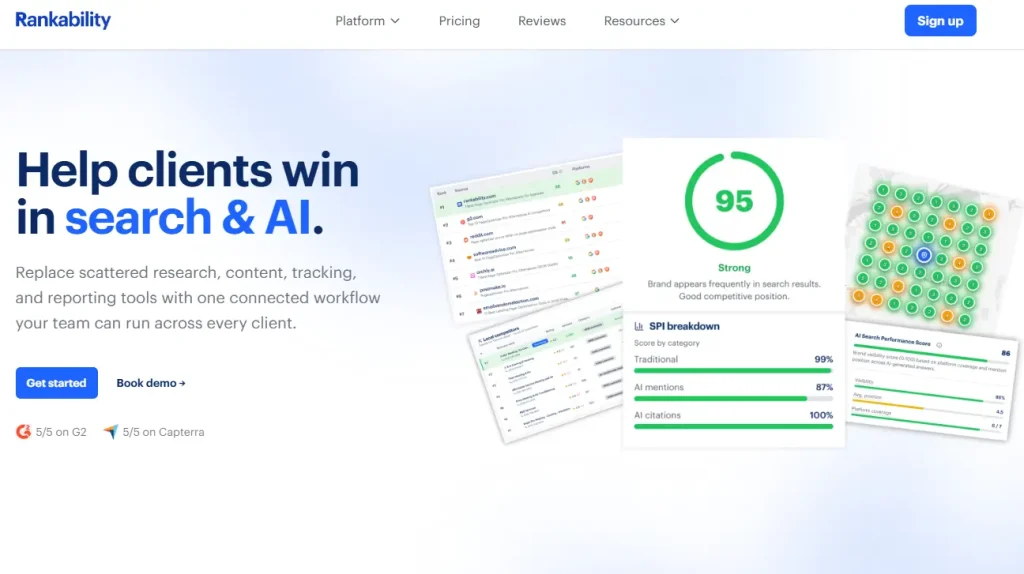
Rankability Tracker leads this list because of its SPI (Search Performance Index) — the metric that unifies traditional search, local pack, AI answers, AI citations, and video search into one number. That single KPI is far easier to defend in client conversations than five disconnected ranking charts.
Most client reporting breaks when agencies try to explain multiple visibility systems at once. The broader Rankability platform pairs Tracker with integrated research, copywriting, optimization, and reporting tools, so the workflow runs from planning to proof in one system.
Key features:
- Search Performance Index unifying Google, local pack, AI answer, AI citation, and video visibility
- Visibility tracking across traditional search and AI platforms like ChatGPT and Gemini
- Client-specific weekly plans and recommendations through Serena AI
- White-label reporting and API access for scalable agency use
- Integrated content briefs, optimization scoring, and rank tracking in one workflow
Pricing: Starter is $97/month, Agency $297/month, and Agency Pro $497/month. Annual totals are $970, $2,970, and $4,970. All paid plans include unlimited client workspaces, unlimited team members, branded reports, and API/MCP access. Content allowances are 20, 80, and 160 projects per month; tracked AI query allowances are 100, 300, and 500, respectively, across all 11 included AI platforms. Google keyword tracking and Local Pack scans have separate allowances. Gotch Inner Circle is included with Agency Pro annual plans. Get Started.
Ideal for: Agencies that want client-ready visibility reporting across Google, local, and AI search in one system.
Bottom line: If Semrush felt broad but fragmented, Rankability Tracker gives you a single KPI and an agency-first workflow — get started to see it against your own client roster.
2. Ahrefs — Best for backlink research and competitive analysis
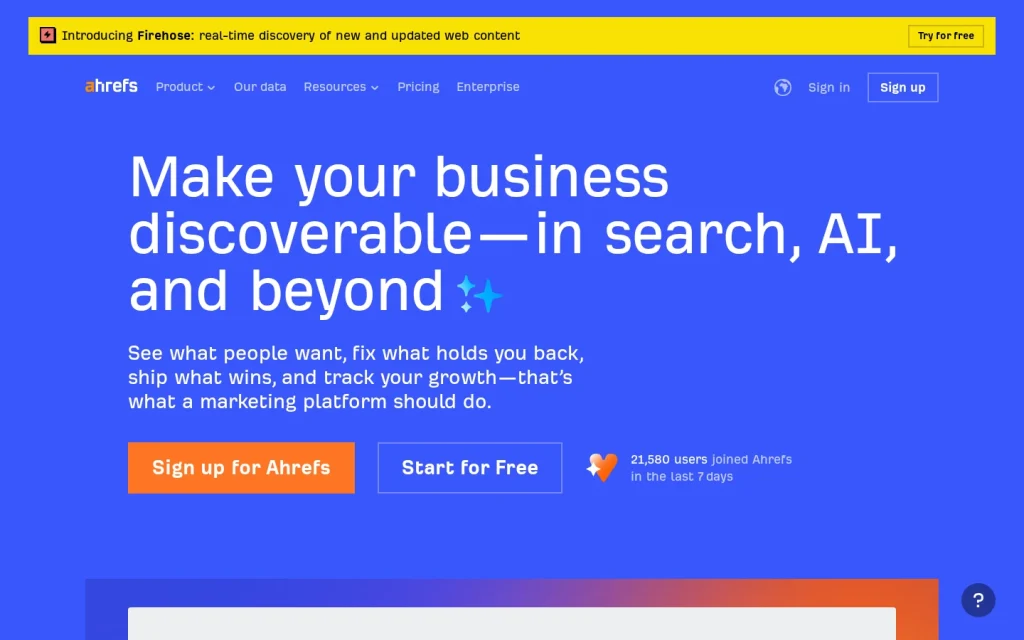
Ahrefs is the strongest replacement when your agency’s edge comes from competitive analysis, link acquisition, and content opportunity discovery. Its research environment is especially good at explaining why a rival page wins, not just that it does.
It remains one of the clearest tools for working with referring domains, keyword difficulty, SERP features, and competitor overlap at scale. Many agencies keep Ahrefs even after replacing Semrush — our Ahrefs review breaks down where it earns that spot.
Key features:
- Large web index for backlink research and referring domains analysis
- Keywords Explorer for competitive analysis and keyword difficulty checks
- SERP features and top-page research for content planning
- Site Audit with AI-assisted technical SEO capabilities
- Content Explorer for finding linkable assets and content gaps
Pricing: Starter: $29/month; Lite: $129/month
Ideal for: Agencies that prioritize backlink analysis and competitor research over all-in-one client reporting.
Why it stands out: Research depth and link intelligence remain central to strategy work, and no Semrush alternative matches Ahrefs there.
3. SE Ranking — Best all-in-one value for smaller agencies
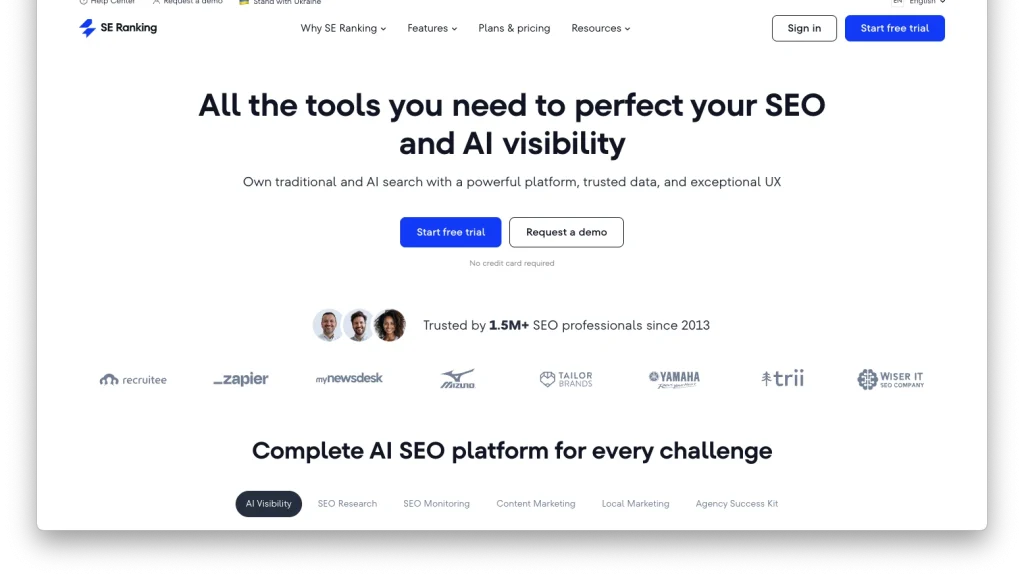
SE Ranking is the closest practical suite replacement for smaller and mid-size agencies that want broad SEO coverage without an enterprise bill. It combines rank tracking, audits, keyword research, competitor analysis, and agency management features in one predictable package.
Its newer AI visibility positioning also extends beyond standard SEO into AI search engines. If you are weighing it against other suites, our guide to the best SE Ranking alternatives shows where each one pulls ahead.
Key features:
- Configurable rank tracking across locations, devices, and schedules
- Keyword, competitor, and backlink research in one suite
- Agency Pack for client management and lead generation
- API and automation support, plus AI visibility tracking add-ons
- Report builder for client-ready deliverables
Pricing: Pro: $129/month, or $103.20/month billed annually
Ideal for: Smaller to mid-size agencies that want an all-in-one SEO suite with flexible tracking and agency add-ons.
Budget note: SE Ranking often delivers the best coverage per dollar when your agency needs breadth more than category-leading depth.
4. Moz Pro — Best for accessible reporting and trusted metrics
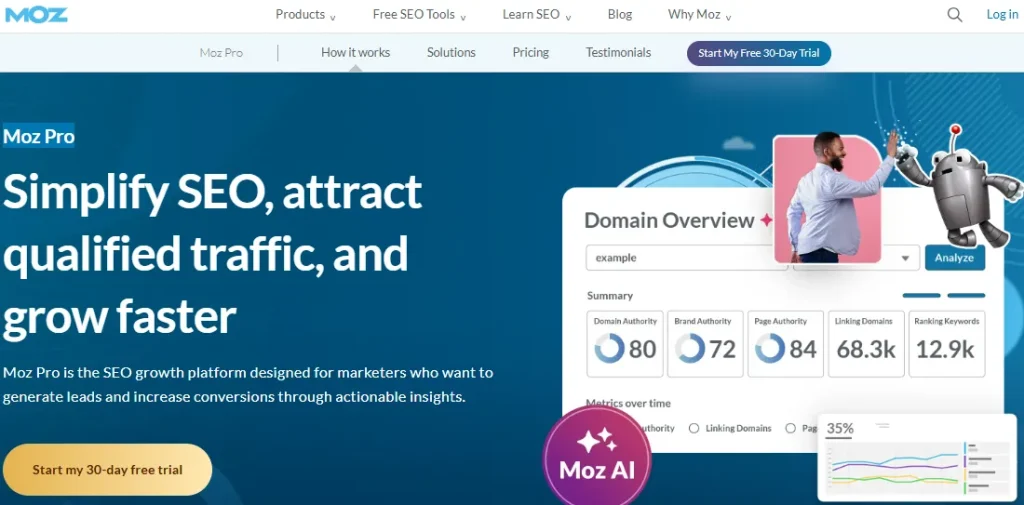
Moz Pro is a solid fit for agencies that value clarity, familiar authority metrics, and smoother onboarding for mixed-skill teams. Domain Authority still gives non-specialists a useful shorthand for relative link strength in client conversations.
Moz Pro also adds search intent analysis, keyword grouping, on-page grading, and site crawl validation. That combination lets account managers and junior SEOs turn data into recommendations without a steep learning curve.
Key features:
- Domain Authority and Page Authority link analysis workflows
- Keyword Explorer with suggestions grouped by search intent
- Site Crawl with on-demand re-crawls to validate fixes
- Rank tracking and competitive SERP analysis
- Page optimization recommendations
Pricing: Starter: $39/month billed annually
Ideal for: Agencies that want accessible SEO reporting and metrics clients already recognize.
Our take: Moz Pro works best for teams that need consistency across junior and senior users, not maximum feature depth.
5. SpyFu — Best for competitive PPC and SEO history
SpyFu is strongest when your agency sells strategy through competitor intelligence across PPC and SEO together. Historical ad data and keyword overlap views reveal how rivals have invested over time, not just what they rank for today.
That historical lens turns search data into market narrative. Agencies pitching against incumbent competitors get evidence of paid search patterns, messaging persistence, and keyword economics.
Key features:
- Competitor keyword and Google Ads research with historical ad testing data
- SEO overlap analysis and side-by-side competitive comparisons
- SpyFu GPT for actionable recommendations from platform data
- API access and exports for internal research or sales enablement
Pricing: Basic: $39/month
Ideal for: Agencies that blend SEO and PPC and need competitive ad and keyword history for pitches.
Worth noting: SpyFu is best used as an internal intelligence layer rather than your primary client reporting platform.
6. Similarweb — Best for market research and traffic intelligence
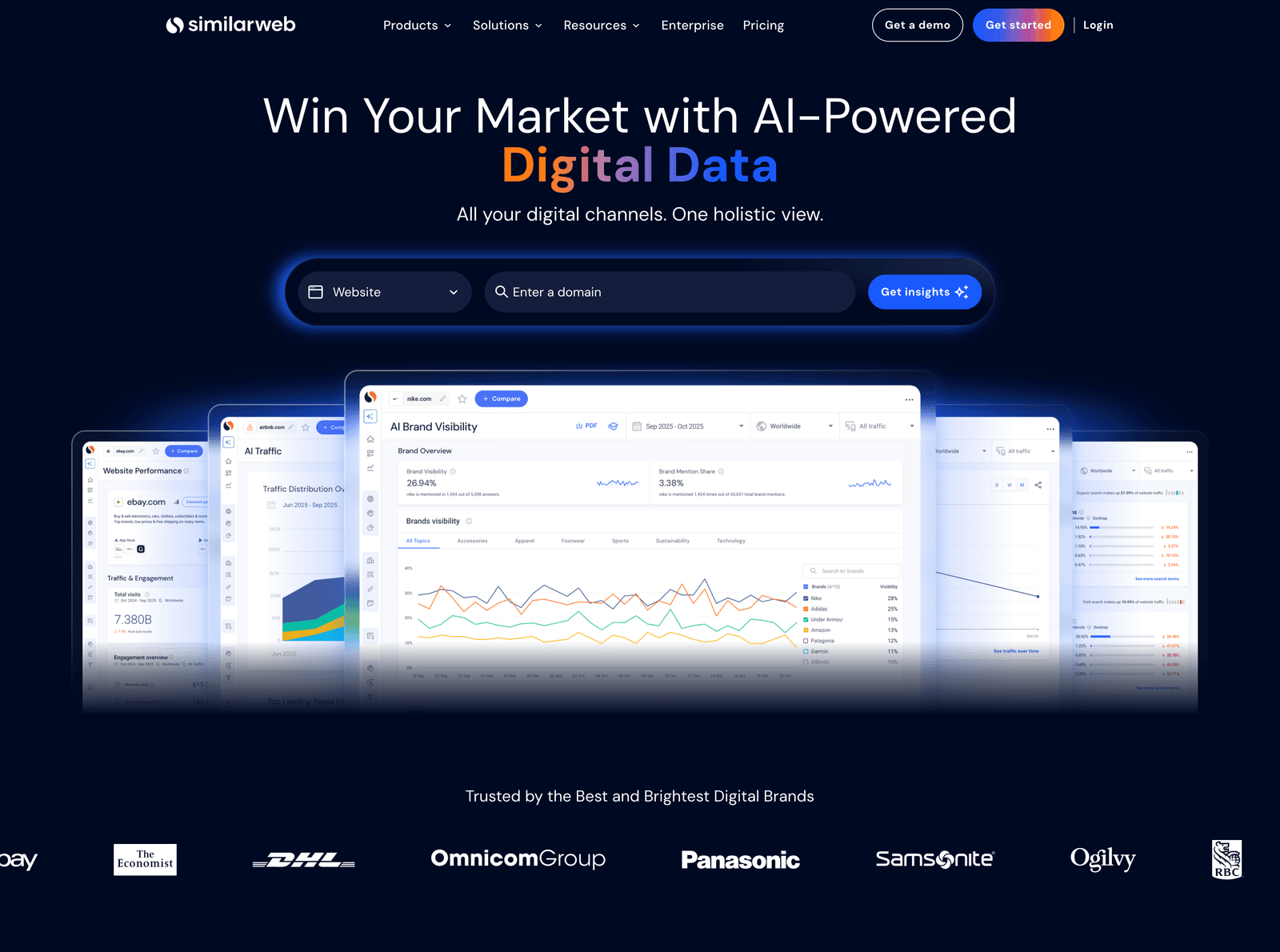
Similarweb solves a different problem than most Semrush alternatives: market research, channel benchmarking, and top-down traffic intelligence. Agencies that need to justify strategy shifts often require category context that pure SEO tools cannot provide.
Its value is highest when you need to estimate market share, compare channel mix, or benchmark audience behavior across competitors. That makes it especially useful for larger account planning and executive strategy work.
Key features:
- Traffic and engagement estimates across a large digital dataset
- Channel mix insights for search, social, referrals, and display
- Industry and audience benchmarking for market research
- SEO, AEO, and advisory data services for broader planning
Pricing: Contact for pricing
Ideal for: Agencies doing market research, competitor benchmarking, and channel strategy for bigger accounts.
Consider if you value: Market context to support SEO recommendations, not page-level diagnostics.
7. Ubersuggest — Best budget option for lean teams
Ubersuggest is a budget-focused option for lean agencies that need keyword research, audits, and quick competitive snapshots without a complex interface. Simplicity is the advantage when your team needs fast answers instead of deep segmentation.
Its content gap analysis, intent-aware keyword data, and lightweight reporting make it more useful than many entry-level tools. For small agencies, a simpler platform is more likely to be used consistently.
Key features:
- Keyword suggestions with search volume, intent, and difficulty data
- Content gap analysis for opportunity discovery
- Site audit for technical and on-page issues
- Domain overviews and basic rank tracking
Pricing: Individual: $12/month; lifetime plans available
Ideal for: Solo consultants and small agencies that need core SEO functions at the lowest cost.
What to expect: The essentials are covered efficiently, but advanced filtering and deep competitive datasets are limited.
8. Surfer SEO — Best for on-page content optimization
Surfer SEO is not a full Semrush replacement, but it can be the better answer if Semrush was mainly your content optimization layer. Its strength is production discipline: briefs, drafts, refreshes, and on-page recommendations sit close to the editorial workflow.
Content teams often fail from process fragmentation, not lack of data, and Surfer standardizes optimization decisions across writers and editors. If you are comparing this category directly, see our roundup of the best Surfer SEO alternatives.
Key features:
- Content Editor for briefs, writing, and optimization scoring
- SERP analysis tied to top-ranking pages
- Google Docs integration for editorial collaboration
- Content audit and freshness workflows
Pricing: Essential: $99/month
Ideal for: Agencies with high content volume that need consistent on-page QA and editorial workflow support.
Integration note: Surfer works best paired with a tracker you trust, so optimization activity maps cleanly to performance outcomes.
9. SEOTesting — Best for proving SEO change impact
SEOTesting is valuable when your agency needs to prove whether changes actually worked, using Google Search Console and GA4 data rather than platform-estimated scores. That evidence-first model matters because many SEO reports still confuse activity with impact.
Its testing framework evaluates before-and-after changes, detects content decay, groups pages, and annotates updates in a way stakeholders can follow. For agencies under pressure to show causality, reporting becomes a validation discipline instead of a dashboard habit.
Key features:
- Before-and-after and split-test workflows for SEO changes
- Google Search Console and GA4-based measurement
- Reports with annotations, changelogs, and grouped analysis
- AI traffic visibility analysis tied to first-party data
Pricing: Single site: $40/month
Ideal for: Agencies that want a disciplined way to test, measure, and report SEO changes.
Best if you need: Proof that a title change, content update, or internal linking project produced measurable results.
How We Chose the Best Semrush Alternatives
This evaluation prioritized execution over marketing claims, because a platform that looks complete in a feature grid can still fail if your team cannot turn it into repeatable client delivery. The goal was matching each tool to a specific agency lane rather than crowning one all-purpose winner.
We scored each platform on six factors: agency workflow fit, rank tracking quality, keyword and competitor research depth, technical SEO coverage, client reporting, and AI search visibility. Search now extends well beyond ten blue links, so tools that only track standard organic positions ranked lower.
AI coverage varies widely across this list, and “AI support” is now an overloaded claim. We verified whether each platform measures actual visibility in AI answers, citations, and Google AI Overviews or simply adds AI writing features.
How to Choose the Right Semrush Alternative
The right replacement depends on what your agency actually sells — software should reinforce your delivery model, not reshape it. If you want a single visibility KPI across Google, AI answers, local pack, and video, start with Rankability Tracker.
If backlinks, competitor research, and content gap analysis are your differentiators, Ahrefs deserves a place on the shortlist even if you report elsewhere. If you want broad coverage with agency-friendly pricing, SE Ranking is the closest suite-style substitute.
If your pitches depend on paid search history, SpyFu adds strategic depth general suites underdeliver. Similarweb is the better choice when executives care about market share and channel mix as much as rankings.
For content-heavy shops, pair Surfer SEO with a tracker you trust, and add SEOTesting when clients demand proof of impact. Our roundup of the best SEO tools for agency owners is a useful companion for building the rest of the stack.
The key is to avoid comparing tools by feature count alone. The best pick is the one that matches the work your team repeats every week.
What If You Used Semrush for Specific Workflows?
If you used Semrush for keyword research
Look at Rankability, Ahrefs, SE Ranking, Moz Pro, or Ubersuggest. For a full side-by-side, see our roundup of the best SEO keyword research tools.
Ahrefs is strongest for deep keyword data and competitive keyword research, while Ubersuggest is the budget pick. Rankability is the best fit if you want keyword research to connect directly into briefs, optimization, tracking, and client reporting.
If you used Semrush for rank tracking
Look at Rankability Tracker, SE Ranking, Ahrefs, or Moz Pro. Rankability is the strongest fit if you need rankings tracked alongside AI answers, AI citations, local pack, and video visibility in one score.
If you used Semrush for content optimization
Look at Rankability or Surfer SEO for on-page optimization without the full Semrush suite. Our comparison of SEO content optimization tools covers the wider category.
The SEO Writing Assistant is an add-on rather than a standalone editor, so most agencies replace it with a dedicated optimizer. For a closer look at the add-on itself, see our Semrush SEO Writing Assistant review.
If you used Semrush for Google Ads research
This is where you need to be honest. Most SEO-focused alternatives do not fully replace Semrush’s advertising research, so look at SpyFu or keep a dedicated PPC tool.
If you used Semrush for AI search visibility
Ranking alone no longer captures whether a client is cited, recommended, or summarized in AI answers. If your priority is visibility inside ChatGPT, Gemini, Perplexity, and Google AI Overviews, see the best alternatives to Semrush for AI search visibility tracking.
Agencies that ignore AI citations risk underreporting visibility in categories where buyers compare options through AI assistants before they ever click a result.
FAQs
What is the best Semrush alternative for agencies?
Rankability Tracker is the best overall Semrush alternative for agencies, unifying Google, local, AI answer, AI citation, and video visibility into one SPI score. Ahrefs, SE Ranking, and Moz Pro are strong options depending on your workflow.
What is the best Semrush alternative for rank tracking?
If you need rank tracking that also reflects AI answers, AI citations, local pack, and video visibility, Rankability Tracker stands out through its Search Performance Index. That makes it more useful for client reporting than tools limited to standard organic positions.
Is Ahrefs better than Semrush?
Ahrefs is often stronger for backlink analysis, SERP research, and competitor diagnosis. Semrush is broader as a suite, so the better choice depends on whether your workflow is research-heavy or all-in-one — our Semrush review covers where the suite still wins.
What is the cheapest Semrush alternative that still works for client SEO?
SE Ranking and Ubersuggest are common budget-conscious options for smaller agencies. Confirm data limits, reporting needs, and tracking quality before standardizing on either one.
Do Semrush alternatives cover AI search visibility?
Some do, but many still focus mainly on Google rankings. Rankability Tracker measures AI answer and citation presence directly, while SE Ranking offers AI visibility add-ons and SEOTesting analyzes AI traffic from first-party data.
Conclusion
Rankability Tracker is the strongest Semrush alternative for agencies because it turns Google, local, AI, and video visibility into one client-ready SPI score. That unified reporting model is the difference between showing activity and proving impact.
Ahrefs is the best pick for research-heavy shops built on links and competitive analysis, SE Ranking is the best value all-in-one suite, and SEOTesting is the right add-on when clients demand proof of causality.
Before comparing feature lists, decide who reads your reports and what they need to believe. The platform that helps you move from planning to proof with the least friction is the right replacement.