

Zero-click search is no longer a side effect of Google featured snippets; it now includes AI answer engines like ChatGPT, Gemini, and Perplexity that often resolve discovery before a click happens. When teams compare the best aeo tracking tools, they are really trying to answer a harder question: how do you measure visibility when the user may never visit your site?
This roundup is for agencies, in-house marketers, and SEO teams that need evidence, not guesswork. The quick answer is Rankability, because its SPI score gives agencies one way to measure combined visibility across traditional search, AI search, and video search, which matters when client reporting has to reflect how discovery actually works in 2026.
We prioritized tools that track AI answer presence, distinguish citations from mentions, support reporting, and fit real workflows. We also included adjacent platforms that strengthen entity visibility, because AI systems often rely on repeated web-wide signals tied to Schema.org, the Knowledge Graph, and E-E-A-T rather than one ranking position alone.
Quick Picks: Best AEO Tracking Tools at a Glance
If you need a fast shortlist, start here. The table below focuses on tools that help you measure AI visibility directly or support answer engine optimization through stronger reporting, entity monitoring, or multi-client workflow control.
| Tool | Best for | Starting Price | Key Strength |
|---|---|---|---|
| Rankability | Agencies needing unified SEO + AI + video visibility | Starts at $99/mo (annual billing) | Cross-channel Search Performance Index (SPI) |
| Profound | Enterprise AI search insights | Free tier available | LLM visibility + brand presence reporting |
| Peec AI | Small teams tracking AI search visibility | Contact for pricing | Simple setup + flexible tracking views |
| AIclicks | Practical AEO tracking workflows | Starts at $59/mo | AEO tracking focus + reporting |
| Ahrefs Brand Radar | Brand mention discovery | Contact for pricing | Brand monitoring signals tied to search ecosystem |
| SE Ranking (SE Visible) | SEO teams adding AEO context | Contact for pricing | Rank tracking + AI visibility context |
| Nightwatch | Agencies managing many clients | Contact for pricing | Portfolio rank tracking + segmentation |
A few names deserve context even if they are not in the table. Surfer SEO and Adobe LLM Optimizer appear in many AI visibility discussions, but this list favors tools with clearer tracking or reporting roles rather than broader optimization positioning.
That distinction matters because a useful AEO stack must show evidence, not just suggestions. If a platform cannot tell you whether your brand appeared, was cited, or was associated with a topic in an answer engine, it is harder to use for accountable reporting tied to the SPI score, Knowledge Graph presence, and practical E-E-A-T improvement.
1. Rankability — Best for Agencies That Need One Visibility Score Across SEO, AI, and Video
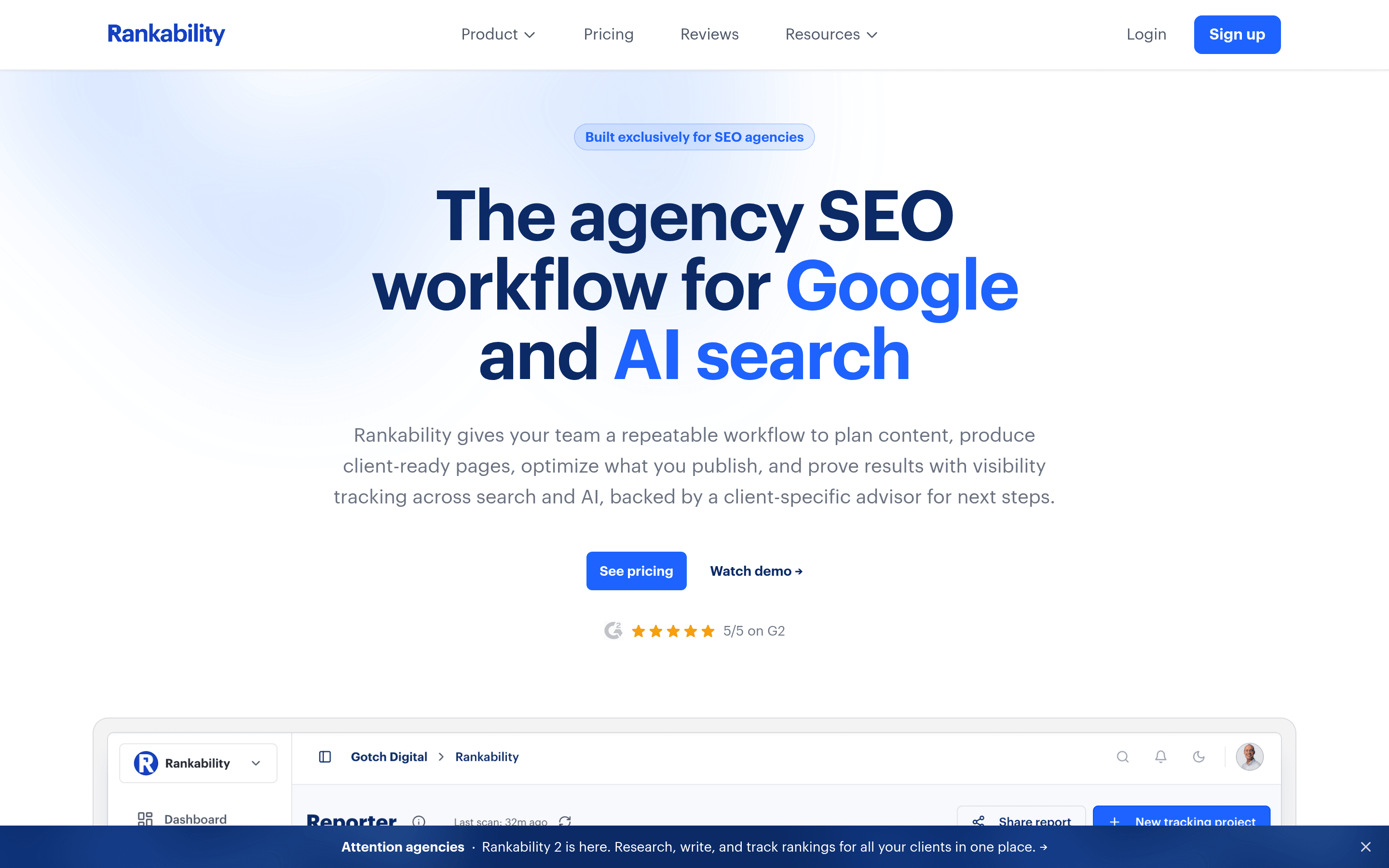
Rankability is the strongest pick for agencies because it treats modern discovery as one measurement problem instead of three separate dashboards. Its core differentiator is the SPI score, a Search Performance Index that summarizes visibility across traditional search, AI search platforms, and video search, which gives agencies a more defensible KPI in a zero-click search environment.
That matters in multi-client management because clients do not care which interface produced the impression; they care whether their brand is being found. Rankability’s agency workflow is built around a repeatable, end-to-end SEO workflow from planning to proof, and its AI Analyzer supports tracking across answer engines in a way that helps teams explain performance shifts without hand-waving.
Key features:
- SPI score to measure combined visibility across traditional search, AI answers, and video search
- AI visibility tracking across answer engine environments and major AI search platforms such as ChatGPT and Gemini
- Integrated workflow for keyword research, content optimization, reporting, and advising
- White-label reporting and API access for scalable agency reporting
- Client-specific weekly recommendations that support answer engine optimization and generative engine optimization workflows
Pricing: Starter starts at $99/month, Growth at $199/month, and Scale at $399/month when billed annually.
Ideal for: SEO agencies and in-house marketing teams that need one client-friendly visibility framework across Google and AI systems.
Bottom line: If you need one KPI that reflects how people now discover brands, Rankability’s SPI approach is unusually clear. That makes it easier to report progress, prioritize work, and compare SEO, AI, and video performance in one view.
2. Profound — Best for Enterprise AI Search Insights and Reporting
Profound is an enterprise-leaning platform built to measure brand visibility inside AI answer engines rather than just monitor classic rankings. Its positioning is clear: marketers can analyze, build, and measure how their brand appears in LLM-driven experiences, which is why it fits organizations that need AI visibility treated like a formal reporting discipline.
The platform stands out because it goes beyond one dashboard for mentions. Profound combines Answer Engine Insights, Prompt Volumes, Profound Agents, Agent Analytics, and integrations with systems such as Google Analytics, AWS, and Cloudflare, which makes it closer to an operating layer for AI visibility than a lightweight tracker, though that also implies heavier implementation than simpler tools.
Key features:
- AI search visibility monitoring for brand and competitor presence across answer engines
- Prompt Volumes data to align content strategy with actual AI demand signals
- Competitive analysis and reporting views suited to stakeholder updates
- Agent Analytics for tracking AI-sourced traffic and attribution
- Coverage analysis that can inform topical authority work
Pricing: Starter: $0/month annually for ChatGPT tracking only, 50 prompts tracked, and email support. Growth: custom pricing annually for 3 answer engines, 100 prompts tracked, 6 optimized articles per month, and email support.
Enterprise: custom pricing for up to 10 answer engines, multiple companies, tailored prompt tracking, dedicated Slack support, and SSO/SAML + SOC2 compliance.
Ideal for: Enterprise SEO and brand teams that need structured reporting across products, regions, or business units.
Our take: Profound is a strong fit when AI visibility has to be measured with the same seriousness as organic traffic or brand lift, adding the reporting layer that shows whether your authority actually surfaces in AI answers.
3. Peec AI — Best for Small Teams That Want Simple AI Visibility Tracking
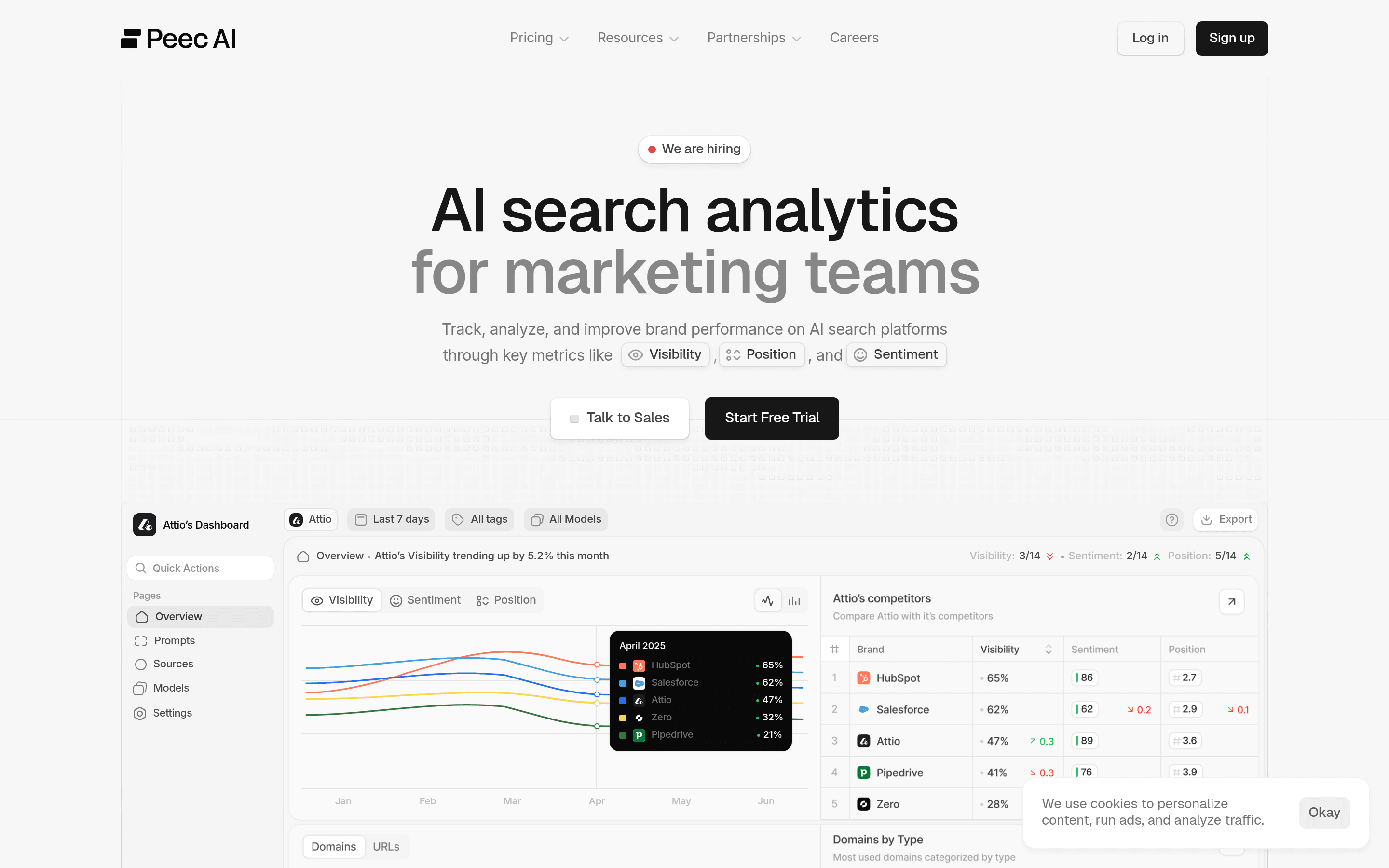
Peec AI earns its place because not every team needs an enterprise platform to learn how AI discovery is changing demand. Small teams often need a tool that answers practical questions fast, such as whether the brand appears in ChatGPT or Gemini answers, whether visibility is improving, and whether exports are easy enough to share in a weekly meeting.
That simplicity matters because operational overhead can kill adoption. Peec AI appears to focus on straightforward setup and flexible tracking views, which makes it useful for learning and monitoring, not as a replacement for a full SEO suite or a dedicated content platform.
Key features:
- AI search visibility tracking through a straightforward interface
- Flexible views for teams that want quick monitoring without heavy configuration
- Trend tracking for brand presence in AI answers over time
- Reporting dashboard options and exports, which should be validated during evaluation
- Support for monitoring answer-engine performance, with platform coverage worth confirming
Pricing: Contact for pricing. No public pricing data was available, so it is better to verify current tiers and whether visibility tracking across traditional search and AI platforms like ChatGPT and Gemini is packaged separately.
Ideal for: Small marketing teams that want a lightweight tracker and can benefit from advisor-style weekly plans and recommendations without building a heavy process around them.
Why it stands out: Peec AI is appealing because it reduces setup friction. If your team needs to learn quickly, a clear interface and shareable reporting dashboard often matter more than a long feature list.
4. AIclicks — Best for Practical AEO Tracking Workflows
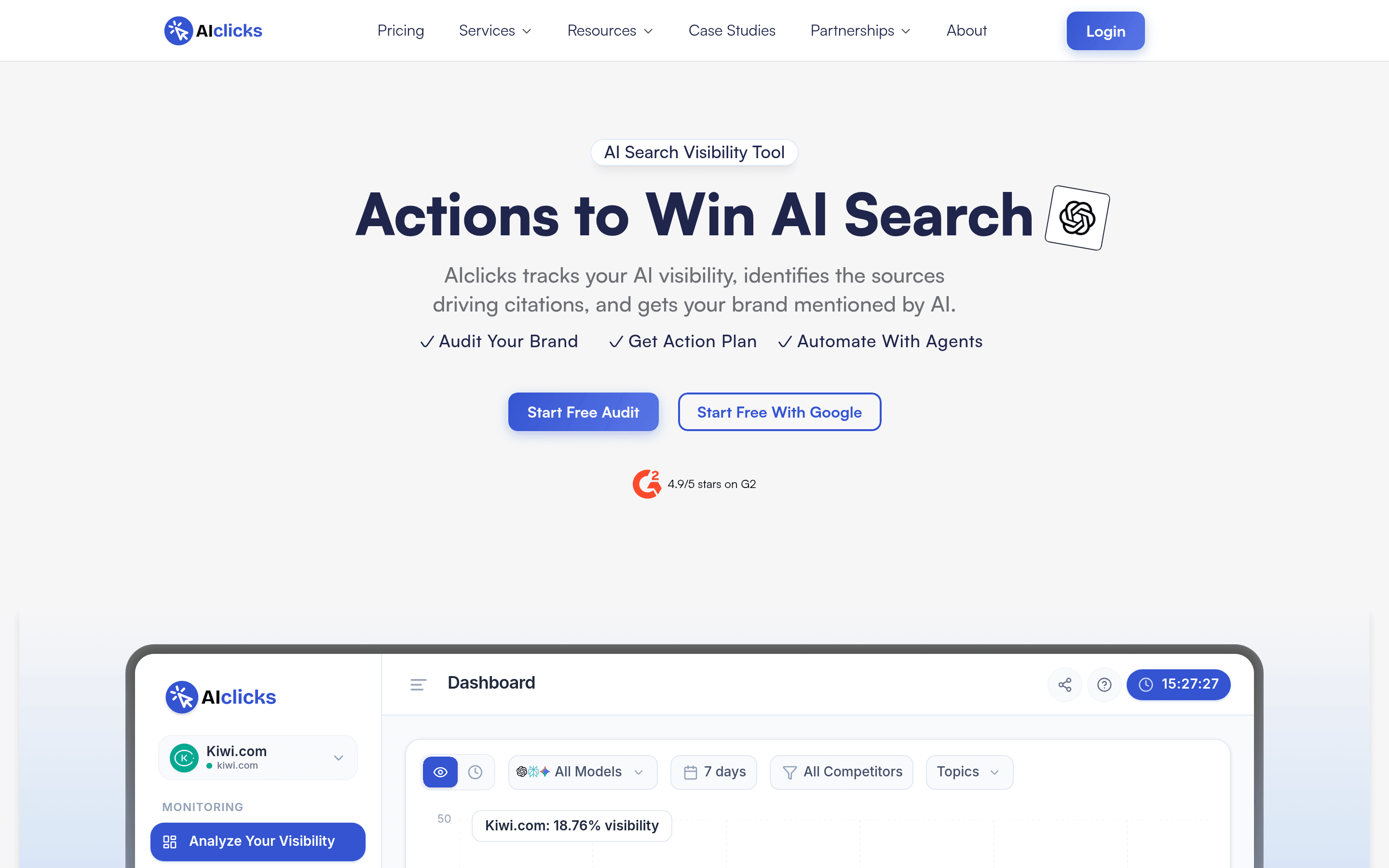
AIclicks is one of the few tools in this category that is explicitly positioned around AI search visibility and citation tracking rather than retrofitting old rank-tracking language. Its research-backed positioning centers on monitoring brand mentions, tracking citation sources, benchmarking visibility, and identifying what drives presence across more than 10 AI platforms.
That focus is useful because AEO tracking is not the same as SEO rank tracking. A practical buyer should verify whether AIclicks captures citations, mentions, visibility scores, and prompt-level changes separately, since those are different signals and each one supports a different response, from content updates to digital PR to source acquisition.
Key features:
- Tracks AI visibility and identifies sources driving citations
- Real-time prompt monitoring, visibility scoring, and industry benchmarking
- Monitors brand mentions across 10+ AI platforms
- Action plans to improve AI search rankings and presence
- Workflow-friendly dashboards plus automation through agents
Pricing: Starter: $59/month with a choice of 3 daily monitoring options.
Ideal for: Individuals and small teams that want an AEO-first tool rather than adapting a traditional SEO suite.
Worth noting: AIclicks is attractive because it is focused. Before you commit, confirm whether the reporting emphasizes citations with source URLs, simple brand mentions, or comparative rankings, because the evidence standard determines how useful the platform will be in client or stakeholder reporting.
5. Nightwatch — Best for Agencies Managing Multiple Client Portfolios
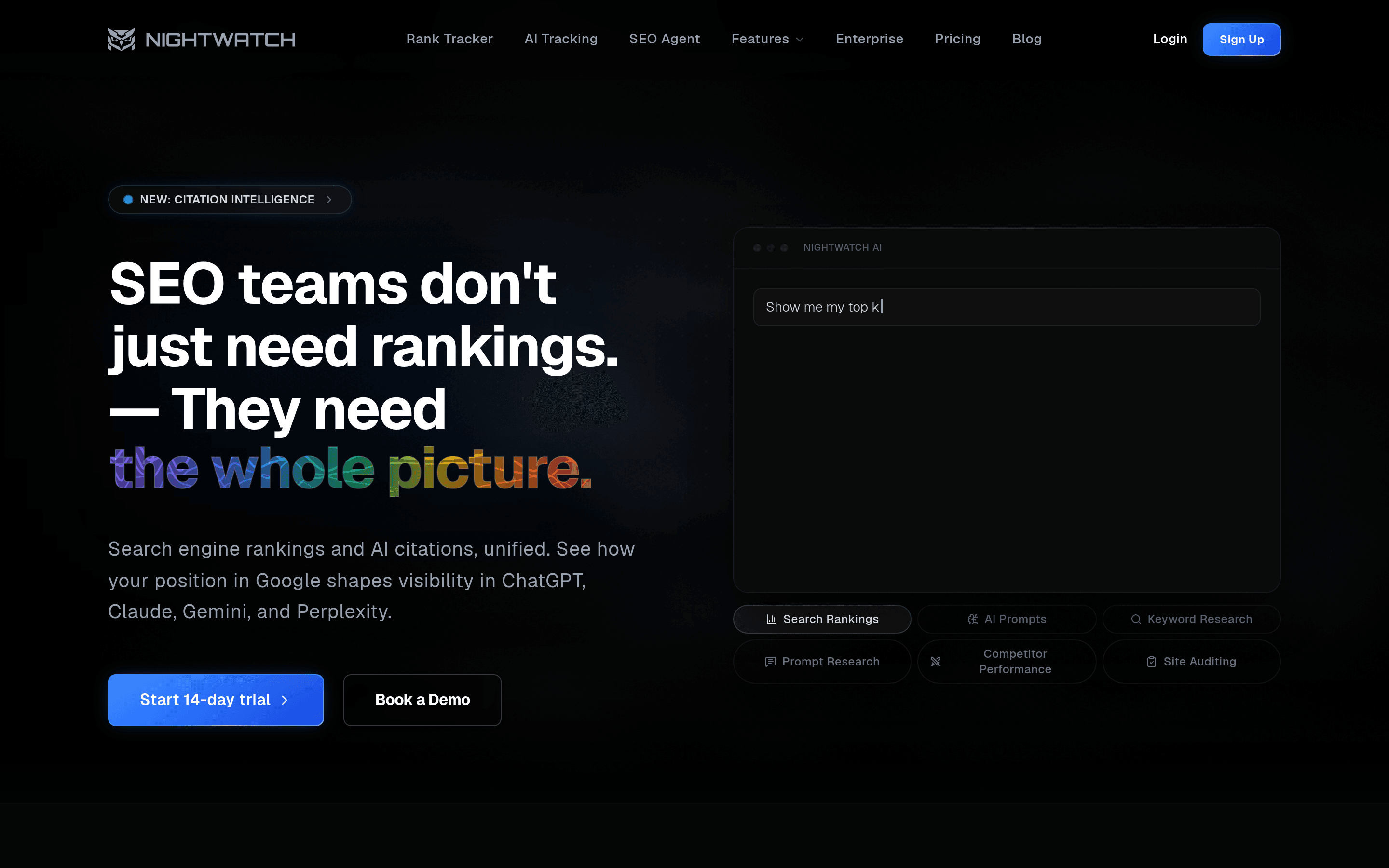
Nightwatch belongs on this list because many agencies still need a strong reporting backbone even if AI visibility is tracked elsewhere. In practice, AEO measurement often sits next to classic rank tracking, local segmentation, and device-based reporting, so a portfolio-oriented tool can still play an important role in an agency stack.
Its value is less about direct answer-engine coverage and more about operational control. If Nightwatch remains primarily a traditional rank tracker, it is still useful for showing how AI-driven visibility shifts relate to organic SERP movement, and that comparison becomes more credible when paired with citation monitoring from a dedicated AEO tool.
Key features:
- Portfolio-based rank tracking across locations, devices, and tags
- Client reporting workflows suited to agencies with many accounts
- Competitive tracking for traditional SERP movement
- Exports and segmentation that can support combined SEO and AEO reporting
- Structured data-aware optimization context should be validated during demos
Pricing: Contact for pricing. No verified public starting price was available in the research.
Ideal for: Agencies that need scalable rank tracking and reporting across many clients, even if direct AI answer tracking is handled by another platform.
The verdict: Nightwatch is a solid reporting backbone for agency portfolios. Just separate what it measures well, such as classic rankings and segmentation, from what requires a dedicated AEO layer, such as citations, answer presence, and answer-engine-specific evidence.
6. Ahrefs Brand Radar — Best for Brand Mention Discovery That Supports AEO
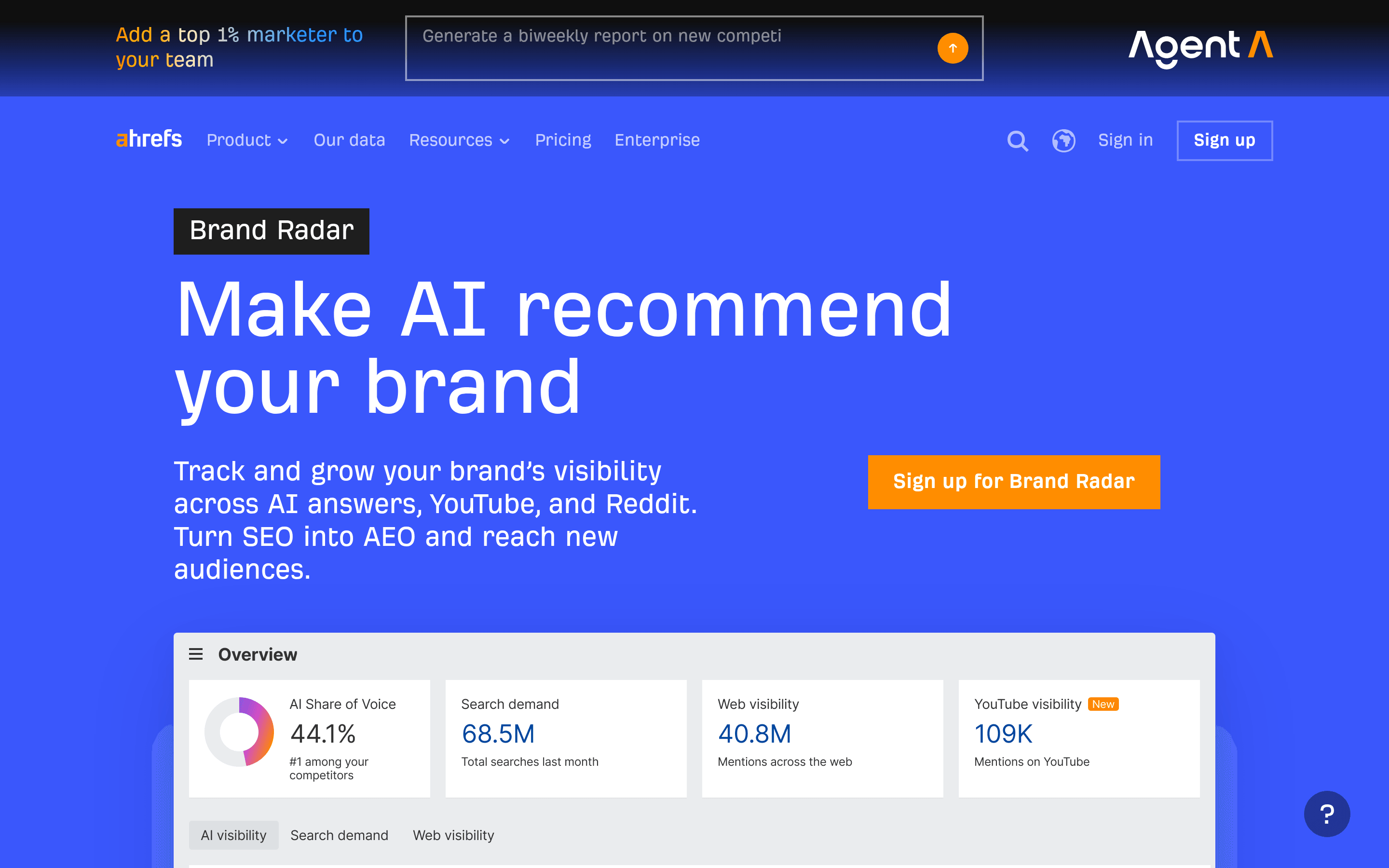
Ahrefs Brand Radar is not a pure AEO tracker, but it solves a problem that many AI visibility tools do not: discovering where your brand and related entities are being discussed across the web. That matters because AI answers often reflect repeated associations between brands, products, people, and topics, which are the raw materials of entity understanding in the Knowledge Graph.
The limitation is important to state clearly. Mention discovery is not the same as ranking in ChatGPT, but it is highly useful for diagnosing why your brand may be absent from AI answers, especially when entity coverage, citations, and authority signals are weak or uneven across product lines.
Key features:
- Brand and entity monitoring to surface where your company is being discussed
- Competitive mention discovery to identify share-of-voice gaps
- Filtering and alerting capabilities that should be confirmed for your use case
- Useful companion to AEO tools that track direct answer presence
- Supports analysis of products, executives, and topic associations that influence content strategy
Pricing: Contact for pricing. Current packaging should be verified, since inclusion within Ahrefs plans can change over time.
Ideal for: Teams that want to strengthen the authority and entity signals that influence AI-generated answers.
Best if you need: A practical way to see where your brand is and is not being referenced online. That insight helps you prioritize digital PR, partnership pages, expert bios, and content updates that improve the web-wide evidence AI systems use to form associations.
7. SE Ranking (SE Visible) — Best for Teams Adding AEO Context to an SEO Reporting Base
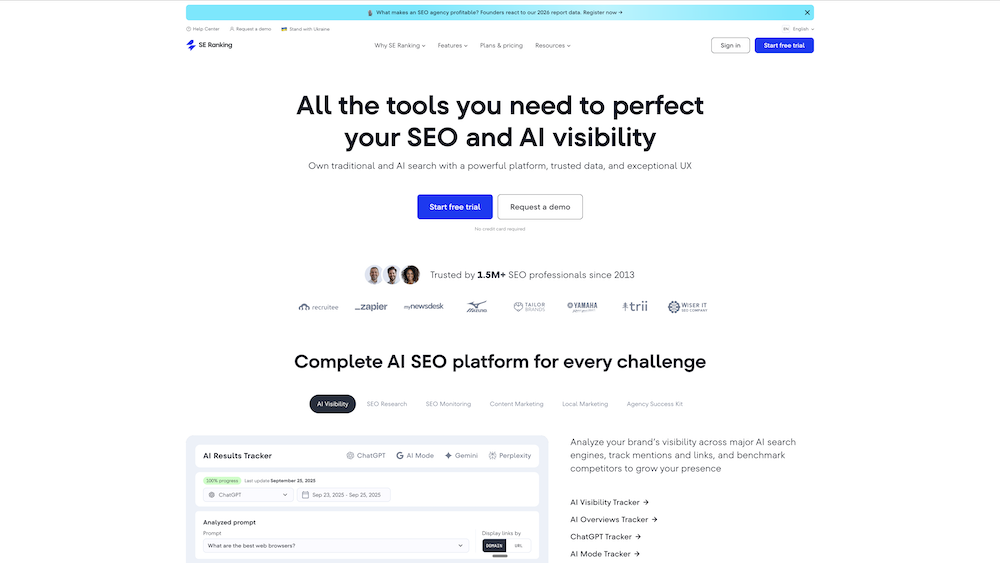
SE Ranking makes sense for teams that already operate from an SEO reporting foundation and want to add AI visibility without rebuilding their workflow. Its SE Visible product is positioned as an AI visibility platform for monitoring brands, sentiment, competitors, and source patterns across AI platforms, which is useful for agencies and digital marketers that need one familiar hub.
The tradeoff is depth versus convenience. If your team needs detailed citation capture, prompt-level evidence, or answer-by-answer diagnostics, you may still need a dedicated AEO platform, but SE Ranking can be a sensible bridge for teams moving from rank tracking into entity- and answer-aware reporting.
Key features:
- Track visibility trends, brand sentiment, and competitor performance across AI platforms
- Monitor AI-generated answers and analyze the sources shaping them by category
- Manage multiple brands with unlimited user collaboration
- Client-ready dashboards and exports for SEO reporting workflows
- Traditional SERP monitoring that complements AI visibility context
Pricing: Contact for pricing. SE Visible uses contact-based pricing according to the product research.
Ideal for: SEO teams, agencies, CMOs, and digital marketers that want one reporting base while gradually expanding into AI visibility measurement.
Worth a look: SE Ranking is useful when your reporting is already SEO-centric and you want to layer AEO context on top. Confirm the exact depth of its AI visibility features before you rely on it as your only source of answer-engine reporting.
SE Visible head-to-heads: Weighing SE Visible against a dedicated tracker? Compare it directly — SE Visible vs Peec AI, SE Visible vs LLMrefs, SE Visible vs Scrunch AI, SE Visible vs Rankscale AI, and SE Visible vs AthenaHQ.
How We Chose the Best AEO Tracking Tools
We reviewed this category through the lens of measurement quality, not feature volume. The shortlist prioritized AI answer visibility coverage, clarity between citations and mentions, reporting quality, setup time, multi-client support, and whether exports or APIs make the data usable in real stakeholder workflows.
That approach matters because entity SEO is increasingly about evidence. A tool that shows captured answers, citation URLs, competitive comparisons, and repeatable query sets is more useful than one that only claims “AI optimization” without proving where your brand appeared or disappeared.
What “AEO Tracking” Means in This Roundup
In this roundup, AEO tracking means measuring presence inside AI-generated answers across systems such as ChatGPT, Gemini, and Perplexity. It also means separating citations, which are linked or referenced sources, from mentions, which are unlinked references, and from entity associations, which show whether your brand is repeatedly connected to a topic.
No pair of AI platforms shared more than 24.1% of the pages they cited, which is why credible AEO tracking needs coverage across multiple answer engines.
That distinction matters because each signal supports a different action. Citations help you improve source eligibility, mentions reveal brand awareness gaps, and entity associations show whether your content and off-site footprint are teaching answer engines the right relationships.
Evaluation Checklist You Can Reuse
- Supported answer engines and how many prompts or query sets you can track
- Refresh cadence, because stale data is less useful in fast-changing answer environments
- Evidence level, including screenshots, captured answers, and citation URLs
- Exportability, API access, and reporting quality for agencies or stakeholders
- Coverage beyond rankings, including mentions, citations, sentiment, and competitor comparisons
We excluded tools focused only on content generation, generic chatbots, and SEO platforms with no credible AI visibility measurement. If you want adjacent categories, these guides on best AI search visibility tracking tools, the best AEO tools for agencies, best AI SEO tools, and best SEO content optimization tools are useful next reads. And if you want software that acts on what the tracking finds instead of only reporting it, our roundup of the best AI SEO agents covers the monitoring, content, and execution agents on the market.
Conclusion: Which AEO Tracking Tool Should You Start With?
Your best choice depends on what you need to measure and who needs to trust the report. Agencies should start with Rankability because the SPI score creates one shared language for SEO, AI, and video visibility, while enterprise teams that need governance and stakeholder-ready reporting should look closely at Profound.
Small teams that want fast learning with low overhead should consider Peec AI, and teams that want an AEO-first workflow should evaluate AIclicks. If your current reporting is built around classic SEO operations, Nightwatch and SE Ranking can serve as strong foundations, while Ahrefs Brand Radar helps diagnose whether weak entity coverage and brand mentions are limiting AI visibility upstream.
A practical starting stack is simple. Agencies can begin with Rankability and add Ahrefs Brand Radar if they need deeper authority and mention diagnostics, lean teams can pair Peec AI with an existing SEO suite, and enterprise organizations can layer Profound into their analytics pipeline; just validate pricing, platform coverage, and evidence quality during demos before you commit.
FAQs About AEO Tracking Tools
What is an AEO tracking tool?
An AEO tracking tool measures how often and how well your brand appears in AI-generated answers, not just in traditional rankings. In GEO, or generative engine optimization, that usually includes citations, mentions, and entity associations across answer engines.
How do AEO tools track visibility in ChatGPT, Gemini, or Perplexity?
Most tools run repeatable prompt sets and capture the returned answers over time. They then extract signals such as brand mentions, cited URLs, competitor presence, and sometimes sentiment or share of visibility.
What’s the difference between citations and mentions in AI answers?
A citation usually includes a linked or explicitly referenced source URL, which makes it easier to verify and act on. A mention is an unlinked reference to your brand or entity, and it still matters because repeated mentions can shape AI understanding.
Are AEO tracking tools worth it for small teams?
Yes, if AI answers affect discovery in your category. Start with a lightweight platform that is easy to maintain, then upgrade only if you need deeper reporting, governance, or multi-brand coverage.
Do I need a separate AEO tool if I already use Semrush or Ahrefs?
Often, yes. Traditional SEO platforms are strong for rankings, backlinks, and site audits, but dedicated AEO tools are usually better at capturing AI answer presence, citations, and representation inside LLM outputs.
If LLM answer tracking is your main need, see our roundup of the best LLM SEO rank trackers.
Why are so many AEO tools “Contact for pricing”?
Many vendors price by prompt volume, number of answer engines, tracked brands, or team seats, so fixed public pricing is less common. Pay first for stronger evidence, such as captured answers and citation URLs, and second for reporting quality, because those are the features that make the data usable.